RSS Feed

Author Archives: Wendy Lyon

Thoughts on the High Court case

As the three High Court judges retire to consider their decision in the latest Irish abortion law tragedy/farce, I’ve been thinking about the options open to them and their implications for the future. As I see it, there are four possibilities:

1. They could uphold the right to life of the “unborn”, thus compelling the woman to be kept on life support until the foetus can either be induced or dies itself. This is the family’s nightmare scenario. Probability of appeal: certain.

2. They could find the 8th amendment applicable to situations of this type generally, but exclude its applicability to this case on the basis of the overwhelming medical evidence that the foetus will not survive anyway. This would have implications for future fatal foetal abnormality cases; essentially it would vindicate the argument that no referendum is needed to allow for abortions in cases where the foetus’s condition is “incompatible with life”. However, the question would then arise of exactly how incompatible it must be, and who gets to decide and how. We would likely be looking at the FFA version of the Protection of Life During Pregnancy Act, for which there is likely to be just as much enthusiasm. Probably of appeal: fairly low, I would think.

3. They could find that the 8th amendment doesn’t apply at all, as it was strictly intended to prevent abortion. This argument was used in court by John Rogers SC, counsel for the women’s family, and is consistent with previous judgments such as Roche v Roche and O v Minister for Justice. Such a ruling would have implications for maternity care in Ireland, in particular the noxious National Consent Policy’s exclusion of pregnant women from the right of all other adults to autonomy in health care decisions, and the threatened use of court-ordered Caesarean sections. For this reason I would imagine the probability of an appeal would be fairly high.

4. Lastly, they could sidestep all the difficult issues above and simply rule that in all the circumstances of this particular case, it would create an injustice to force the woman to continue on life support. This is probably the best option for the family; there is virtually no chance of an appeal, and it would allow the Court to have regard to the woman’s own right to dignity rather than making that conditional on the prospects for foetal survival. Unfortunately, it would also mean that the underlying issues remain unsettled. And if there’s one thing that’s become increasingly apparent, from Savita to Ms Y to now, it’s that there really is no such thing as a “uniquely difficult” case. We are far from seeing the last “tragedy” of a woman whose pregnancy tests the 8th amendment in ways its supporters would have deemed too fanciful to rate as valid arguments against it.

The cowardice of most of our political parties to deal with this issue is something that simply can no longer be tolerated. And it is not simply the politicians who I am addressing that to. It’s time for us as voters to make this a red-line issue, to let our elected reps and candidates know that a preference from us depends on their support for repeal, and to stick to that pledge regardless of partisan or personal loyalty. Because if we vote back in another government that refuses to be the one to hold a referendum, every one who does so will be complicit in what’s been happening in that hospital since December 3rd.

Note: This post was written on an iPad Mini thousands of miles away from Ireland; please excuse lack of links and possible missed details.

On Frances Fitzgerald’s bill to criminalise clients

If you read this blog, you’re probably aware that Irish Justice Minister Frances Fitzgerald recently published the General Scheme of the Criminal Law (Sexual Offences) Bill 2014. And you’re probably also aware that the bill creates a new offence of purchasing sexual services.

But what does the bill not contain? Here are a few notable omissions:

  • No decriminalisation of sex workers. The Minister’s press statement says that “the persons selling the sexual service will not be subject to an offence”, but this is extremely disingenuous. It’s true that the bill does not create an offence of selling sexual services, but neither does it repeal the existing laws that criminalise sex workers. For the street-based minority, these are the laws against soliciting for the purposes of prostitution and loitering for the purposes of prostitution; for the indoor majority it’s the law against brothel keeping, which is often used against sex workers who share premises for their own safety. There is no reason to believe these laws will be used less frequently after the bill is passed; the experience in Sweden and Norway has been that the police target sex workers with whatever means they have at their disposal. If the TORL groups really had sex workers’ interests at heart, they would be shouting as loudly about this as they are about the plan to criminalise clients. They’re not.
  • No alternative income supports for sex workers. The bill aims to take away their sex work income but offers them nothing to replace it. There is no reversal of the cuts to social welfare and child benefit which have undoubtedly pushed more women into prostitution; no increase in the €19 per week given to women in the asylum system; no additional funds for education, training or drug treatment programmes that might open up other options. One might argue that most of these things aren’t within the remit of the Minister for Justice; but equally, one might argue that she should have insisted her Cabinet colleagues address those things before she introduced this bill – which, if it works as intended, will simply take away the option that they had decided was preferable to any others open to them. (Quick quiz: if I have one apple and no oranges, and you take away my apple without giving me any oranges, how many oranges do I have?)
  • No changes to laws that bar employment of asylum seekers and undocumented migrants and that limit the work options open to many of the documented. This one is within Frances Fitzgerald’s remit, and after all the hoopla recently about prostitution in direct provision centres she can hardly plead ignorance on it. Her plan to “address” this issue is to streamline the asylum system so that people spend less time in direct provision; again, if she really believed this was the best solution to asylum seekers having to engage in survival sex, wouldn’t you think she’d do that first?
  • No changes to Garda surveillance powers. In their testimony before a Stormont committee dealing with the same proposal, the Police Service of Northern Ireland said they would be unable to use the wiretap methods that the Swedish police rely on to enforce the sex purchase ban. Well, guess what: the Gardaí can’t use them either. Under the Criminal Justice (Surveillance) Act 2009, they have to apply to a District Court Judge for authorisation to use a wiretap, and this authorisation can only be given in connection with an “arrestable offence” i.e. one carrying a possible five-year-or-more sentence. Which leads me to the next omission…
  • No custodial sentence for paying for sex. The maximum fine is €1,000, and that’s only for repeat offenders – which hardly seems appropriate for an act that groups like Ruhama consider to be a form of violence against women. It’s also worth noting that Sweden recently increased its penalties, while in Norway, some have proposed making selling sex illegal too (in fact, according to a Norwegian human rights activist I met recently, that’s actually the main debate over the law at present) – because merely fining men who are caught paying for sex hasn’t been enough of a deterrent.
  • No change to the hearsay rule. In Sweden, hearsay evidence can be introduced in court, where it is given by a “trustworthy” source such as a police officer. In Ireland, it generally can’t be (there are exceptions, but none relevant here). So if a Swedish sex worker refuses to give evidence that she was paid to have sex with an accused, a Swedish policeman can quote things she said to him at the time of the arrest that would tend to support a conviction. In Ireland, anything she said would be inadmissible unless she went to court and said it herself. I’d imagine the chances of any sex worker agreeing to do this are virtually nil – unless of course the State subpoenas her and forces her to testify in what would be, let’s remember, a public hearing. Tell me again how the groups supporting this law have sex workers’ interests at heart?
  • No provision for review. New Zealand’s Prostitution Reform Act 2003, which largely decriminalised sex work, included provision for a Prostitution Law Review Committee which must report on the effects of the law between three and five years after its commencement (the findings are here if you’re interested, which if you’ve read this far you should be). No such requirement in the Irish bill – underscoring the lack of concern for any evidential basis of this law change.
  • On the plus side, there is also no sign of the particularly draconian measures advocated by the Oireachtas Justice Committee. The Sinn Féin and Labour committee members ought to think seriously about what it says that they advocated laws too repressive even for a Fine Gael Justice Minister.

The General Scheme of a bill is just that – a general scheme – so it is always possible that some of these changes will be made before the text itself is finalised. It could be amended on its passage through the Oireachtas, too. But the odds are against it being amended in any substantial way. As the Minister herself more or less admitted during a recent meeting with sex workers and sex work researchers (I was one of them), the law’s real purpose is symbolic, and its actual effects are of secondary importance. It doesn’t really matter what the bill includes because, to Frances Fitzgerald, it doesn’t really matter what the law does – whether or not it “works”, whether or not it harms sex workers. Sex workers themselves do not matter. This is why their views have been so readily ignored throughout this process: because as far as Irish policy-makers are concerned, the law is not really about them anyway.

(Hoping that) Women Hurt: regret as a tool of advocacy

Two weeks ago, Irish parliamentarians were invited to a presentation on the subject of “abortion regret”. While the invitation didn’t explicitly advocate for the continued illegality of abortion, no one could fail to recognise its underlying agenda: firstly because it came from Senator Rónán Mullen, who’s barely known for anything else, and secondly because the featured speaker, Julia Holcomb, is a spokesperson for Silent No More, a self-described “project of Priests for Life and Anglicans for Life”. Holcomb was there not only to share her own unhappy story, but to convince Irish politicians of the need to maintain our near-absolute ban on abortion, in an attempt to prevent others from experiencing the same regret.

This campaign is one example of what Yale Law Professor Reva Siegel calls “woman-protective anti-abortion argument” – a strategic shift away from the foetus fetishism that has traditionally defined the right-to-life movement, to centring the pregnant woman in its message by portraying abortion as contrary to her best interests. We’ve seen this in Ireland before, with billboard campaigns by Youth Defence (“abortion tears her life apart”) and Women Hurt, a sort of home-grown version of Silent No More.

At the same time, we’re seeing the emergence of a new anti-sex work campaign led by women who describe themselves as “survivors of prostitution”. Like Julia Holcomb, they have the patronage of people whose stance is an ideological one, unrelated to any regret a woman who had that experience might feel. Her trauma is incidental to these people, and instrumentalised by them, but it’s no doubt very real to her and she has every entitlement to share it.

Regret can be a useful element in a cautionary tale, and there’s certainly nothing wrong with suggesting that a woman think carefully about how she might feel about a decision later on. But as an argument for prohibitory legislation, it’s extremely problematic. And I’m not just talking about the logical inconsistency of banning some things that women might regret but not others (marriage, tattoos, Tequila shots); or banning things that some women might regret but not others; or banning things that women do when they’re illegal anyway (the women of Women Hurt all evaded the prohibition by going to England; many self-described survivors of prostitution worked in a criminalised setting). The idea that regret is, in and of itself, a reason to legally constrain women’s actions is conceptually flawed, paternalistic and degrading. It’s grounded in age-old sexist nonsense about women needing choices to be made for us, as unreasonable, feeble-minded creatures who need protection from the dangers we pose to ourselves. If “to err is human”, what does that say about people who can’t be allowed to err?

There’s another thing that bothers me about it, and that’s how the traumatised-woman-as-poster-girl creates a need for more traumatised women. The women who don’t regret their abortion or sex work threaten to undermine the effectiveness, as an advocacy tool, of those who do; thus, they must be silenced, discredited, or worse still, recruited. I say “worse still” because recruiting them often involves persuading them that they were traumatised all along and didn’t know it. Real-life examples are the woman who speaks unapologetically about her abortion and is invited to receive “counselling” from an anti-abortion agency, the sex worker who takes advantage of “exiting” services when she decides it’s time to move on and finds herself subjected to re-education programmes that recast her experience as abusive when she didn’t see it that way.

Advocates of these methods insist that the woman has merely been in denial, that they’re helping her come to terms with her hidden trauma in order to heal her. But there’s something deeply troubling about taking a person who’s at ease with her past and turning her into a victim. It would be bad enough if this were done in the genuine albeit misguided belief that it would ultimately help her, but it isn’t. It’s done to advance an agenda, and that’s unconscionable.

The bottom line is this. When someone says they don’t regret their abortion or their sex work, or anything else that some people find traumatising, then, absent real (and individualised) evidence to the contrary, there’s really only one acceptable response. It’s along the lines of “That’s great, I’m glad that you’re OK with your experience.” Anything else amounts to wishing trauma on someone – and it’s a short hop from there to thinking they deserve trauma for making a choice you disapprove of. It’s a hateful, nasty, punitive approach, and it’s incompatible with any genuine concern for the welfare of the women in question.


Who is most at risk due to ‘Care’ in our Maternity services?

Posted on

Sex workers are still targeted under the racist Swedish model

Posted on

Last week, an appeals court in Sweden upheld a decision in favour of a tavern owner and security staff who had denied entry on three separate occasions to Asian-looking women. The tavern admitted judging these women by their appearance, but said they had barred them in order to prevent prostitution from taking place on their premises. Police had told the tavern owner that this was going on, and that Asian women were involved. These particular Asian women weren’t though, and they brought a discrimination claim.

The women lost in the lower court, and then lost again on appeal. According to my best Google Translate, the appellate court found that preventing prostitution is an “inherently legitimate reason” which justifies the means that was taken by the tavern, even though the effect was to bar women from their premises who had done nothing more than appear to be Asian. That’s not unlawful discrimination, according to the Swedish courts.

There are a couple things going on here. First, of course, there’s the blatantly racist nature of the policy, now formally endorsed and legitimated by a Swedish judiciary which sees nothing wrong with singling out women of colour for whore stigma. It’s not particularly surprising that racialised women would bear the brunt of a policy aimed at a migrant-dominated industry, but the court’s seal of approval institutionalises racism within Official Sweden’s zero tolerance approach. Of such a priority is the Swedish state’s war against sex work that all else can be thrown by the wayside, even principles ordinarily regarded as pretty fucking basic in a supposedly advanced democracy.

The second thing is that this decision exposes the lie that the Swedish law is not about targeting sex workers. Of course it is. They may not be targeted for prosecution, but the Swedish authorities are more than happy to go after them with any other means at their disposal. They go after them with immigration laws, with the power to refuse them custody of their children; they stake out their homes. They have already involved non-state actors in their war, as when they train hotel staff to monitor the habits of female guests; now, it seems, other branches of the service sector are also being drafted into the Prohibitionist Army. Whose policy seems to be one of “shoot first, ask questions later”.

I don’t think there’s much risk of a similar court judgment in Ireland, even should the Swedish model be adopted here. Our Equal Status Act does allow for denial of services where it is believed that serving the person would give rise to a substantial risk of criminal activity, but “discriminatory grounds” are specifically excluded as a valid basis for that belief.  The reason for that exclusion is so that pubs and shops and hotels cannot cite criminality by some Irish Travellers as a reason to deny entry to all of them, so it’s rather unlikely that the courts would allow use of a similar justification to bar all women from ethnic backgrounds popularly associated with prostitution.

But what the Equal Status Act says and what actually happens in pubs and shops and hotels are two different things. And just as Travellers are, in fact, routinely denied entry on discriminatory grounds in spite of the law, women who are seen as being “high risk” for prostitution because of their racial appearance could well find themselves being subjected to a de facto discrimination door policy. This is particularly likely to happen if the law creates “an offence of recklessly permitting a premises to be used for the purposes of prostitution”, as recommended by the Oireachtas Justice Committee and supported by the Turn Off the Red Light campaign and its member organisations, several of which operate in the migrant advocacy sector. If this law is passed and migrant women become collateral damage in the Irish war against sex work, as they have in the Swedish and Norwegian wars, will these groups also shrug it off as an “inherently legitimate reason”?

We need to talk about Sweden’s problem with rape and consent

Posted on

Content/comments warning: This post is about the way Sweden’s justice system deals with rape and sexual assault cases. It will contain graphic descriptions of sexual violence and rape apologism. It is not about Sweden’s reported rape rate. Racist or MRAist comments will be deleted.

15th May 2013

Swedish court clears ‘bottle sex’ men of rape

Three 19-year-old men were cleared of the rape of an underage girl. They had pinned her down on a bed, pried her legs open and inserted a wine bottle into her vagina, causing bleeding. The court accepted the truthfulness of her account, but rejected the charge of rape. It said she may have tried to keep her legs together out of “modesty”. The verdict stated, “People involved in sexual activities do things naturally to each other’s body in a spontaneous way, without asking for consent”.

19th September 2013

‘No’ debate erupts after gang rape-acquittal

Six teenagers were cleared by a Swedish appeals court of gang-raping a 15-year-old girl. Although she had said no, as one of the judges told the media afterwards, “that doesn’t automatically mean it’s rape”. The absence of actual violence (apart from the rape) meant she had to show she was in an “incapacitated state”, and fear of being gang-raped by six people was deemed insufficient to meet that threshold.

4th November 2013

Activists protest foster home teen rape acquittal

A 17-year-old girl in foster care in central Sweden reported the foster father for rape. His sperm was found in her vagina and on the spot in her bedroom where she’d said the rape took place. His explanation that he had been “erection training” in the bathroom and left a sperm-covered piece of paper there, that just happened to find his way into the girl’s vagina, was deemed feasible by the court. He was acquitted.

14th January 2014

Swedish judge defends dominant-sex rape acquittal

A man was acquitted of raping a woman who had screamed to the point of losing her voice as he attacked her. The court said it could not be rape because “the thought had not occurred to him, that she did not want to have sex with him”.

27th January 2014

Man cleared of rape: was ‘unaware’ she was drunk

A man was acquitted of raping a woman in western Sweden. The court accepted that the woman was drunk – in fact, it said she had been so drunk that she “fell to the ground and lay there awhile”. But he claimed he didn’t realise she was drunk, and the court ruled there was no proof that he did.

31st March 2014

District Court: All participated in a game in the shed

A 16-year-old was acquitted by a court in Eastern Sweden after forcing an underage girl to perform oral sex on another boy. The Court accepted that the girl felt forced, but said there was no proof that the accused intended force. Even though the reason she felt forced was him shooting her with a BB gun.

***

There’s a common thread running through the majority of these cases: a definition of rape (or sexual assault) in which the defining factor is not the victim’s consent, but the perpetrator’s perception of that consent. And unlike in Irish or British law, it seems, once that perception is asserted, its reasonableness is irrelevant. The accused need only claim to not have known the victim wasn’t consenting – no matter how patently absurd that claim is. The prosecution will need to prove that the accused not only heard “no”, but recognised it as “no”; not only that the victim was passed out on the floor from drinking, but that the accused recognised them as drunk. The fact that anyone with a brain in their head would have recognised these things? Not enough.

Through its laws on rape and prostitution, Sweden has produced two seemingly contradictory policies: that paying a woman who agrees to take your money for sex is the worst thing ever, but ignoring a woman’s rejection of your sexual advances is ok as long as you say you didn’t mean it. For a country so determined to control some women’s right to say “yes”, why is there so little concern for the right to say “no”? The only conclusion I can draw from this is that the Swedish state really doesn’t trust women at all to dictate the terms of their own consent.

(I should point out that one change has been made to the laws discussed above: namely, a rape victim who submits without force no longer has to show that they were in an “incapacitated state”. They can now show that they were in a “particularly vulnerable situation”. But the woman in the 27th January case was able to demonstrate this, and her rapist still walked free. Because he claimed he didn’t see it, and that’s still what matters in Sweden.)

Of course, there are rapists who are convicted in Sweden, maybe some of whom tried and failed to get away with the “I didn’t know no meant no” defence. That doesn’t make the existence of the defence any more acceptable. There are also some rapists acquitted in Ireland and Britain despite exceptionally dodgy consent defences, and since all our rape trials are heard by juries, who don’t give reasons, we wouldn’t know if they were de facto applying the Swedish standard. But it’s still better that they’re instructed not to.

If you’re reading this and it surprises you, ask yourself why you haven’t heard of these cases before. Why are they only ever reported in Swedish media and never picked up abroad? Why is that mainstream feminists, when they do hear about these cases (usually because people like me have tweeted these links at them), still refuse to acknowledge Sweden’s rape problem the way they decry, say, India’s or the USA’s?

To me the answer seems obvious: because mainstream feminism is incredibly invested in the narrative of Sweden-as-feminist-utopia. This isn’t just because of its horrible sex work laws; Swedish-style governance feminism in general is what mainstream feminism aspires to, where its hopes are pinned. To admit that it’s actually a bit shit for women in some ways, and particularly in a way like this which goes to the heart of women’s rights, is to admit that their emperor has no clothes. So better to ignore it and hope it goes unnoticed.

As someone who cares more about the actual lives of women than about any state feminism project, this post is my small contribution to stopping it going unnoticed.


What the “sex buyers” survey found. And what it didn’t.

Posted on

There’s been much in the Irish media this week about a new report on sex workers’ clients, based on research conducted in five European countries (Ireland, Finland, Bulgaria, Cyprus and Lithuania). Unfortunately, if unsurprisingly, the media coverage has ranged from bad to abysmal. For a prime example of the latter, see this piece in the Irish Examiner, which starts off with the claim that “Ireland’s sex trafficking trade is worth an estimated €250m a year, a new study shows” – despite the fact that no such claim is made anywhere in the report. The journalist appears to have mistaken a made-up stat cited by a speaker at the report’s launch for an actual research finding, which I suppose is an easy enough error to make when you just repeat things NGOs tell you without ever cracking open a report yourself.

As for most of the other coverage, in general its worst sin is making the report out to be somehow shocking or revealing or breaking new ground, when it actually tells us very little – at least where Irish clients are concerned. By the time I finished reading it, my reaction was such a big fat “meh” I actually wondered if I should write this piece at all, and risk drawing more attention to something deserving so little.

Having decided (with some reservations) to proceed, I’ll start at the beginning. The report is an effort by the Immigrant Council of Ireland, the NGO behind the Turn Off the Red Light campaign, in partnership with like-minded groups from the other countries mentioned above. There is no attempt to hide the report’s agenda; Chapter 1.1 openly identifies it as part of an overall project that aims to

Reduce demand for the purchase of sexual services

and while this clearly gives the authors an incentive to find data that presents clients in the worst possible light, I don’t think they’ve actually achieved this – at least not when it comes to the Irish clients (whose responses I will limit this post to). The main reason for this is that their sample is so small as to be virtually meaningless: only 58 Irish clients took part in the survey, which was conducted entirely by means of an online questionnaire. (They actually did attempt to do face-to-face interviews but, as this excerpt relates, failed in almost comical fashion.) You’d need a pretty small population size for 58 to be remotely adequate enough to tell us anything about clients as a class – and the authors can hardly claim simultaneously that the population size is small enough, and that it spends €250m a year. After all, if the respondents amounted to even 10% of the sex-buying population of Ireland, that would still require them to pay an average of €431,034 per year for sex – something clearly impossible at the income levels reported (nearly three-quarters earn less than €40,000 per annum, and only 13% earn above €60,000). Add this to the finding that nearly half of respondents had paid for sex either “just once” or only “a few times”, and clearly the Irish sex industry is either a hell of a lot less lucrative than TORL advocates make it out to be, or those profits are coming from far too many clients to make this sample size sufficient. They can’t have it both ways.

While there are some disclaimers about the inferences that safely can be drawn from the report, they are both too little and too late. The “Research methodology” section (Chapter 1.2) explains that non-probability sampling was used, but suggests the only weakness of this approach is that it cannot

determine the percentage of the respective populations who had purchased sex

Nowhere does it explain that non-probability sampling cannot, by its nature, ensure a representative sample, and in fact at several points the report uses language that seems to assume the respondents are representative of Irish clients as a whole. Near the end, in Appendix 3, it concedes the risk of self-selection bias – where the sample is skewed by certain shared characteristics of those who choose to participate it – but then suggests this concern is unwarranted on the basis of

similarities between those who participated in this research and those who engaged in previous similar studies

Which previous similar studies they mean is unclear; looking through the report’s bibliography, I can’t find any previous research on clients in Ireland. This is a strange omission, in a report that everywhere else carefully references all the research it refers to.

To be clear, the report isn’t devalued by the use of non-probability sampling. Sometimes there isn’t any other way to study a particular group, and the information you get may still be useful even if it can’t be extrapolated to the group as a whole. For example, five Irish respondents said “a bar” was the location where they found the last person they paid for sex with; this is notable for indicating the need to study the poorly-researched phenomenon of bar-based prostitution, even if it can’t tell us what percentage of the industry that sector comprises. But in a report aimed at a non-academic audience, it’s important to make these limitations clear, and I don’t think this report adequately does this. Public pronouncements by the NGOs behind this report have certainly not done this – like this article from the Immigrant Council, which repeatedly equates “clients who completed this survey” with “men who pay for sex”.

The report also examines the meaning of “demand” in the relevant international law instruments, which require member states to reduce the demand that fuels human trafficking. The purpose of this chapter is to argue that “demand” in this context should be interpreted as demand for paid sex rather than demand for paid sex from a trafficked person. Obviously I disagree with them on this point: the current interpretation is in line with the requirement to reduce demand in non-sex sectors, and this is how it should be. Nobody suggests we need to reduce demand for agricultural workers just because some of them meet the indicators of trafficking.

Beyond that, though, I think there is much to criticise in the way the “demand” argument is made. Exploring the understanding of that term in academic research, the report relies heavily on the work of Bridget Anderson and Julia O’Connell Davidson, which is absolutely essential reading. Unfortunately, it elides one of their central arguments: that sex work and trafficking are not purely demand-led, and that supply itself may create the demand. Here’s a direct quote from the Anderson and O’Connell Davidson article setting out this position, which is entirely contrary to the impression of it given by the report:

“There is certainly demand for cheap and vulnerable sex workers, but it is by no means clear that this kind of demand acts as a stimulus for trafficking. It could equally be that a supply of cheap workers stimulates demand.”

There are a number of other, similar sleights-of-hand in this study. It cites a 2013 report by a Council of Europe anti-trafficking body, GRETA, in a manner that would lead the reader to believe – wrongly – that GRETA endorsed the Oireachtas Justice Committee’s anti-sex work proposals. It mentions that the Finnish Ministry for Justice recommended criminalising payment for sex, but fails to mention that the Finnish Government rejected that recommendation (though in fairness, that was a very recent decision). And it acknowledges that the failure to recruit more Irish clients may have had something to do with the

ongoing, very public discussion on the future of prostitution legislation in Ireland

but conveniently omits the fact that there is an ongoing, very aggressive campaign to make the research subjects into criminals, which campaign is being led by the authors of the study themselves. It seems to me that the interests of full disclosure should have required some mention of this.

But the study’s biggest flaw is the way it deals with the question of potentially trafficked or exploited sex workers. The online survey, which is reproduced in full in an Appendix, asks the question:

16. Have you ever changed your mind and walked away because the person seemed:

and a list of options follows, including “scared”, “controlled”, “unwilling”, “unhappy” and “too young”. “Trafficked” is not one of the options, but we are told in the Appendix that the options were chosen because they are

physical manifestations of exploitation [and] indicators of trafficking

In other words, a client who admits to walking away from an appointment because the escort seemed “unhappy” is assumed to have walked away because he believed she was trafficked! Quite plainly, this is absurd.

But it gets worse, because in the main body of the report, the question itself is completely rephrased to reach the finding the authors want to reach. Instead of reporting Question 16 as it’s actually worded, it reports it as if a significantly different question had been asked:

Around one-quarter of Irish buyers said they had encountered sellers they believed were being exploited.

This leaves no room for doubt: a client who might have ticked the box for “unhappy” because he’d walked out of an appointment with an independent escort who was in a bad mood would now be recorded as having encountered a sex worker who he believed was exploited or trafficked. This is not a conclusion that follows logically from the research question. It is a gigantic leap that undermines whatever credibility this survey might otherwise have had.

Next, the survey asks:

17. Have you ever considered reporting your suspicions that someone was being trafficked or controlled?

The only options given are “No” or “Yes”. There is no “Not applicable”. This is a classic “Have you stopped beating your wife?” type of question: there is no way to answer without allowing an unpleasant conclusion to be drawn. Though it was possible to skip the question entirely, and about a third did, it’s not clear whether respondents were explicitly told they could do so; thus the possibility can’t be ignored that some who would have selected “n/a” picked the next best option instead.

If the survey was designed so that Question 17 only popped up once Question 16 was answered affirmatively, this wouldn’t be a problem. But there’s no indication that it was. The sequential numbering (rather than as, say, Q.16 and Q.16a) suggests that it wasn’t. The text of the report also suggests that it wasn’t, and that Q.17 was asked of all respondents:

Buyers were also asked whether they had ever reported suspicions that someone was being exploited or controlled.

This is where it becomes really important to distinguish the actual findings from the spin. In the Immigrant Council article linked to above, their spokesperson writes:

“As well as profiling buyers the Immigrant Council of Ireland examined if the men ever came across women they believed were being controlled by pimps, were frightened or were trafficked. The results are startling, with over one in four admitting they had come across women and girls they believed were in such situations. A significantly lesser number considered to report this to the authorities, dispelling the myth that buyers are helpful is [sic] tackling human trafficking.”

“A significantly lesser number”? The report found that around a quarter of respondents had ticked one of those so-called trafficking indicator boxes. In a sample size of 58, that’s 14.5. The article above says “over one in four”, so we’ll round up to 15. It also found that 21% of respondents had considered reporting such a situation to the authorities. In the same sample size, that’s 12. The difference between 15 and 12 in a sample size of 58 may or may not be statistically significant (I’ll let someone else do the math), but it is hardly significant in layperson’s terms. The Immigrant Council’s use of that word in that article seems to be designed to mislead. And of course, when you consider the rephrasing of Q.16 (so that some of those 15 who walked away may not have done so because they thought the sex worker was being exploited), the difference could actually be even lower.

It is shameful how readily the Irish media allow themselves to be used as a vehicle for what can only be described as propaganda masquerading as research.

Another part of the survey that has drawn attention is a question asking clients what would deter them from paying for sex. Interestingly (though again bearing in mind the non-representative nature of the sample), “a bad experience or a disease” ranks first. Criminal penalties and the publication of their photo are also ranked highly. Predictably, this is treated as “evidence” that these measures would be successful in ending demand.

The problem with questions like this is that the answers are necessarily speculative, and human beings do not always behave as they expect themselves to. How people say they would react to the abstract hypothetical possibility of something happening, and how they actually do react when that something finally occurs, may not line up as neatly as the authors want us to think they will. The report fails to consider the phenomenon that criminologists call “initial deterrence decay”, whereby the effectiveness of a measure drops significantly after first appearing successful, as those who were originally deterred by it learn not to fear the penalties or find ways to get around them.

There are also some issues of concern with how the study was conducted. We are assured:

At all times, the research teams were aware of the ethical sensitivity of the issues being looked at.

However, there is no indication that any institutional ethical approval was sought or given. We are told that “training” and “guidelines” were given for the face-to-face interviews in two of the countries and for the handling of research data, but it is not clear whether full disclosure was made to any of the respondents about the nature and purpose of the study – a key ethical consideration when working with human research subjects.

A few other things struck me while reading the report, but I’ll leave it at this for now. One final comment: as the report’s real purpose is to advocate for the Swedish law of criminalising sex workers’ clients, it would be interesting to see a similar study carried out in Sweden. Presumably if the authors are going to accept these findings as authentic, they would have to do the same for an equivalent study on Swedish clients. I suspect the answers might surprise them.
One week on from telling my story @Ireland.

Last week, Janet Ní Shuilleabháin became the first Irish woman to draw world attention to Ireland’s draconian abortion laws without having to die or go to the High Court to do it. While her story has been picked up by Al Jazeera, the BBC, and media in France and Sweden, the Irish media are still pretending it never happened. Here she reflects on her unpremeditated decision to go public with her abortion story – one of over 150,000 since Ireland passed a referendum outlawing abortion in nearly all circumstances. We are very grateful to Janet for helping to break the silence.

Comparing “trafficking” statistics: why it’s a waste of time

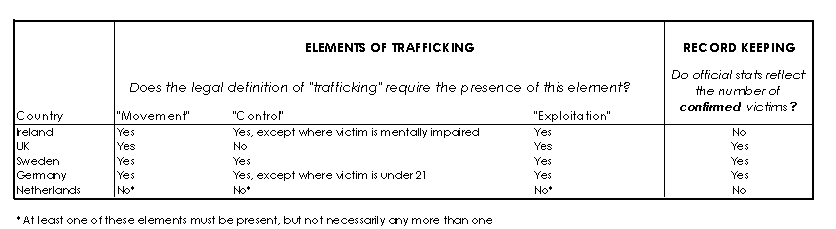
I thought it might be useful to make a simple chart to demonstrate why it’s meaningless to claim that one country has more trafficking than another, based on their official statistics. Seeing as this comes up all the time.

You can click on it to enlarge:

Trafficking definitions

There are a few explanations and disclaimers I need to get in:

  1. The chart is based on my own interpretation of each country’s laws. There is undoubtedly scope for disagreement in some of the details – but not, I believe, on the overall picture.
  2. The big centre column refers to adult trafficking only. I included an age qualifier for Germany because its law treats 18 to 21 year old adults as children.
  3. For “Elements of Trafficking”, I’ve used the three-part schema derived from Article 3(a) of the UN Trafficking Protocol. The headers are a common shorthand and are not to be interpreted literally (“control” doesn’t only mean actual control but can include deception, for example).
  4. Even within a single element, definitions can vary widely; eg, in the UK the “movement” element strictly requires travel, while the Irish definition adheres more closely to the broader Protocol criteria.
  5. Finally and most importantly, the chart reflects what the law actually says – not necessarily how it’s interpreted in practice. It’s theoretically possible that the reporting bodies in each country actually apply a more uniform definition in the process of collecting statistics. But that’s for the people who put faith in the official stats to demonstrate – and to my knowledge, not one of them has done so.

All that said, I think this chart makes one thing crystal clear: when countries tally up their “trafficking” figures, they aren’t necessarily counting the same thing. And unless these distinctions are controlled for in comparative studies, which they haven’t been so far, the evidential value of those studies is pretty close to nil.


Sources:

Ireland – Criminal Law (Human Trafficking Act) 2008

UK – Sexual Offences Act 2003

Sweden – Chapter 4 § 1 a of the Penal Code (2010:371) as translated in this Swedish police report

Germany – §232 StGB Criminal Code (original German here; translations courtesy of Ralph in this comment, Sonja Dolinsek of Menschenhandel Heute and Google Translate)

Netherlands – Article 273f of the Criminal Code

Sex trafficking in Sweden, according to the Swedish police

I’ve commented several times that what the Swedes say internally about their sex industry is often very different to the impression they give abroad, when trying to export the sex purchase ban. This is a good recent(ish) example, a press statement from their police service website – only issued in Swedish – which, run through Google Translate, reveals something interesting about police knowledge of the sex trade:

Most of the sex trade [is] currently conducted via the internet. None of the inspecting authorities have a complete picture of the scope as they are not engaged in continuous or structured reconnaissance.*

It’s an interesting contrast with the claims we normally hear from the Swedes, which exude absolute confidence and certainty that their sex industry has declined since clients were criminalised. Self-evidently, if you aren’t monitoring something in a consistent and coherent fashion, you can’t reach a definitive conclusion as to whether or not it has declined.

The police do monitor the sex industry to some degree, of course, and their findings are included every year in a document titled Trafficking in human beings for sexual and other purposes. The English version of the latest report was published last May, and covers the year 2011. While that makes it slightly out of date at this point, it’s still more than a decade after the sex purchase ban was introduced, and therefore useful in helping to determine whether the law’s objectives really have been met.

Section 3.1 covers “Trafficking in human beings for sexual purposes”, and it starts off by hedging the statistics with the following disclaimer:

 According to the Swedish National Police Board it is difficult to estimate how many people fell victim to human trafficking in Sweden during 2011. The number of victims of human trafficking identified in Sweden largely depends on the resources which the police put into detecting this crime and on the experience and competence that exists within the police organisation. The level of these initiatives varies between police authorities and can vary from one year to another. It is not possible to identify or even to locate all of the victims, mainly girls and women, mentioned in tapped telephone calls or observed during police surveillance.

There’d be nothing remarkable about this paragraph, were it not for the fact that it entirely contradicts one of the lines the Swedes often use when trying to sell the sex purchase ban abroad: “if the customers could find these persons, we could find them”. That line is intended to refute the suggestion that the sex industry has merely gone underground; but the text quoted above (and similar elsewhere in this report) is an open admission that some of it is underground and will probably remain there. And this, bear in mind, refers only to those believed to be victims of trafficking; if they admittedly can’t estimate those numbers, it’s hardly possible they could estimate the numbers of people selling sex through choice or circumstance, who (one hopes) they aren’t expending as much of their resources to find.

While the report quite rightly attributes some of the increase in numbers to better investigative work, it also indicates a belief that at least some of the increase represents more actual cases. For example, describing an apparent rise in the number of “women from Lithuania who are being exploited in prostitution in Sweden”, the report says:

Changes in the victims’ backgrounds and nationalities can be explained by a weakened national socio-economic climate which is hitting women and girls particularly badly. The economic crisis in southern Europe may also mean that human traffickers and pimps are directing their activities towards countries with more stable economies, such as Sweden.

These two statements may seem somewhat at odds with each other – the first suggests that the numbers are increasing because Sweden’s economy is getting worse [ETA – see comments below from Laura Agustín], while the second suggests that it’s because Sweden’s economy is relatively stable – but the important points are this: first, the tacit acknowledgment (made explicit later in the report) that there has been an increase at all; and second, the admission that Sweden remains attractive to “human traffickers and pimps”, which is totally contrary to the propaganda we hear about it all. the. time.

A genuine jaw-dropper follows a few paragraphs later:

In 2009, the National Bureau of Investigation estimated that there were about 90 Thai massage parlours in Stockholm and vicinity, most of which were judged to be offering sexual services for sale. At the turn of 2011/2012, the number of Thai massage parlours in the Stockholm area was estimated to be about 250 and throughout the country about 450.

Now, what kind of “successful ban” leads to an almost threefold increase in one type of provider of the banned thing in less than three years? If the estimate is accurate, this statistic alone ought to put paid to any claim that the law is an effective deterrent. An industry that has lost a lot of its customers couldn’t possibly expand at a rate like that.  (See previous post on this topic here.)

The report goes on to shed an interesting light on the Swedish view of sex workers who choose their occupation – in particular, those who aren’t from Sweden. It states:

In February 2011, the police authority in the county of Halland decided to deport a Romanian woman … . Police authorities said that the woman, who made her living through prostitution, constituted a threat to public order and security. The woman appealed to the Swedish Migration Board who made the same assessment as the police authority in Halland: namely that prostitution is indeed legal in Sweden, but the purchase of sexual services is a criminal offence. This means in practice that a crime has to be committed under Swedish law to enable a person engaged in prostitution to support themselves.

This decision was ultimately thrown out in court as a breach of EU freedom of movement, but subsequently the Justice Ombudsman, considering the case of another EU sex worker, upheld the Migration Board’s position:

“…prostitution is to be regarded as a dishonest means of support according to the law. Prostitution – which can not occur without a crime having been committed – may also be considered as a prohibited occurrence in one principal element. Unlike the judgement in a previous determination by the Ombudsman for Justice, which related to begging, deportation in this case is considered to be compatible with the Aliens Act.”

This demonstrates a point which is well-made by Norwegian criminologist May-Len Skilbrei here: just because it isn’t a crime to sell sex doesn’t mean a person can do so without facing the strong arm of the law. If the State makes it a policy that sex work is something that cannot be tolerated, its officers will fight it with whatever means they have at their disposal: immigration laws, housing laws (as in Norway’s notorious “Operation Homeless”), public order laws (same link; see also the French bill which explicitly allows such laws to be used against street workers); Anti-Social Behaviour Orders (the reversal of which was deemed “frustrating” by a Swedish model-supporting Irish parliamentarian), custody laws (with tragic consequences last year) and probably anything else you can think of, short of actually prohibiting the sale of sexual services. And these have a similar effect as prohibiting the sale of sexual services, namely, giving sex workers an incentive to avoid state officials or anyone they think might rat them out to state officials (including the police and health and social services). In this context, the distinction between the Swedish model and one which directly criminalises the sale of sex is a distinction without all that much of a difference.

Getting back to the report, it goes on to describe in some detail the awful conditions and abuse that many migrant sex workers endure.  I won’t quote it here, but suffice to say it’s on a par with any of the tragedy porn regularly cited in support of the Swedish model. It describes the significant involvement of organised crime in the sex industry, another of the things we in Ireland are frequently told we need the Swedish model to address. And it also goes on to describe a Swedish “review” site which could easily have been used as a source on that Invisible Men tumblr (which, of course, also propagandises for the Swedish model). These are other ways in which the sex purchase ban seems to have fallen short of the grandiose claims made for it.

The report then confirms something sex workers themselves have complained of:

In 2011, the police Prostitution Team in Stockholm established that the sex-purchasers seemed to prefer to use “out-calls” to a greater extent than before. One reason for this is believed to be that the sex-purchasers consider that the risk of detection will be less if they order a woman to come to their home instead of exploiting her in a hotel room.

Here, the report directly contradicts one of the findings of the 2010 official evaluation, namely, that sex workers are not at greater risk of violence under the law.

Section 3.1 concludes with a couple pages on “Payment for sexual services”. Here, the report briefly discusses the law against buying sex, the statistics on the offence and the (positive) conclusions of the official evaluation (which it quotes without comment). Notably absent is a claim that appeared in previous years’ reports that the law deters traffickers from setting up business in Sweden. Perhaps the Swedish police no longer believe they can stand over this claim. It’s not hard to see why.

**

Last month, I took part in a debate with Sarah Benson from Ruhama and Nusha Yunkova from the Immigrant Council of Ireland – the two NGOs leading the Turn Off the Red Light campaign. (Kathryn McGarry, a researcher from NUI Maynooth, made up the balance on the panel.) In response to my citing this report, Sarah Benson said that the Swedes “never said” they would eliminate prostitution entirely. I don’t think this is strictly true; the Swedish Women’s Lobby, for example, has described the law as “a model to end prostitution and trafficking for sexual exploitation”.

But it’s certainly the case that the law has been promoted outside of Sweden – not least in Ireland – as one that has been a hell of a lot more effective than this report shows it to be. In fact, when interviewed by the Irish community TV programme The Live Register, Nusha Yunkova made the amazing claim that “there is no prostitution in Sweden”.  While this would stretch credulity of even the most gullible Irish politician, I think it’s fair to say that most of those who’ve declared their support for the Swedish model would be surprised by the contents of this report. They’ve been sold a law that has been “proven” to reduce the size of the sex industry, not one that isn’t actually being measured in this respect. A law that “reduces” sex trafficking from other countries, not one under which the number of women from certain countries “who are being exploited in prostitution in Sweden” has increased. A law that “deters” men from purchasing sex, not one that is such a useless deterrent the number of massage parlours in the capital has almost trebled in recent years. And so on.

Of course, knowing the considerably less rosy reality of the Swedish model probably wouldn’t make a difference to the average politician or those leading the TORL campaign; facts and evidence aren’t really their main concern. But at least they couldn’t cloak their moral, ideological and populist stances under a veneer of empiricism. For those whose support for the law stems from a sincere belief that it’s actually had a significant effect on deterring clients and reducing the extent of sex work and trafficking, they’re entitled to hear the evidence that it hasn’t. And we’re all entitled to an honest debate – something that’s been sorely lacking in Ireland so far.

*ETA: The statement has now been removed from the Swedish police website. The original Swedish text was: “Merparten av sexhandeln bedrivs numera via internet. Ingen av de inspekterade myndigheterna har dock någon fullständig bild av omfattningen eftersom de inte bedriver någon kontinuerlig eller strukturerad spaning på nätet”.