RSS Feed

Category Archives: Abortion

Ungovernable Wombs – The Abortion Pill and the Erosion of the Eighth Amendment

Between 2010 and 2015 the rates of women travelling from Ireland to access abortion services in the UK fell from 4,402 per annum to 3,451 per annum. A total of 27,800 women travelled during this timeframe. Anti-choice groups congratulated themselves because of the drop in numbers, choosing to interpret the British Department of Health statistics as evidence of a drop in the rate of abortions taking place as a result of their work. Pro-choice groups were at pains to point out that this was incorrect; the British DOH stats simply show the decline in the numbers of women travelling from Ireland who access abortions in England in Wales, but they do not represent the total numbers of women from Ireland who are accessing abortions. The 27,800 figure was *never* accurate; it doesn’t include women who travelled from Ireland but gave UK addresses or in some cases used UK NHS numbers. It doesn’t include migrant women who travel to Eastern European states to access services there. It doesn’t include women who travel to other EU states that aren’t the UK to access abortion services there instead.

So the paper published today shows that during the period which *official* numbers travelling to the UK declined by 951, there were 5,680 women who requested the abortion pill to take at home within the island of Ireland from an organisation called Women on Web. The numbers willing to risk a criminal penalty to have an abortion at home are increasing year on year. That said, given that customs seize some of these packages, we don’t know how many made it through to the women who requested them or how many women actually took the medication once they managed to get them. But even if only 50% of women managed to get the abortion and actually take them, it pretty much cancels out the reduction of numbers women travelling to the UK for terminations. Fifty percent is actually a remarkably conservative estimate considering that Customs only managed to seize 68 of these tablets last year, and given that there are more websites than Women on Web who will provide the drug (including Women Help Women) and migrant communities who have their own word of mouth suppliers as well as less reputable black market suppliers online, it’s quite likely that there are a few thousand more who have requested and taken the abortion pill since 2010.

It’s good to see coverage of this issue, and specifically of Rebecca Gomperts’ research paper but it doesn’t tell the whole story about women who are willing to risk a prison sentence (such as the woman in the north who took pills and was subsequently reported to the police by her tout housemates). The pill was supplied by Women on Web to 1,642 women between 2010 and 2012 and they managed to conduct follow-up research on 1,181 of those women (72%).

What report does tell us is that the law that criminalises abortion north and south in Ireland, and allows the state to jail women if they breach it, is completely irrelevant to women who need to access terminations and can’t travel. They are going to take the risk and order the medication anyway. The women who accessed the abortion pill from Women on Web were generally between 20 and 30 years old and the majority of them were already mothers, and 97% of them reported that accessing and using the medication at home was the right thing for them with 98% saying that they’d recommend the experience to other women. The only negative thing for the women accessing abortions at home is doing it outside of the law.

While the Citizens Assembly pontificates on the rights of women in Ireland to bodily autonomy and control over their reproductive systems, women can and will break the law in order to end their pregnancies. The abortion pill is a safe drug, in fact, it’s safer than viagra, and while well-meaning obstetricians like to point out the risks of taking medicines without the supervision of a medical practitioner, it isn’t unreasonable to suggest that in an Irish context, those concerns are as much about women in Ireland challenging the State’s control over their bodies as they are about taking a safe dose of misoprostol following an online consultation with a medical professional overseas. Continuing the prohibition against abortion and forcing women to go to term with pregnancies they do not want to carry is a form of structural violence against women.

The fact that women ordering this medication clearly believe it is safe should tell the State and the Citizens Assembly something. More and more women are now taking the pill and recommending it to their friends who can’t or simply don’t want to travel. Furthermore, even if women don’t believe it’s safe, they are willing to take that risk as well as the risk of arrest and prosecution in order to end their pregnancies at home here in Ireland. At this stage, for women in Ireland whether they travel or order medication online, abortion is a pretty normal event. It isn’t certainly isn’t a rarity. No one is put off ordering drugs whether they are risking a 14 year prison sentence or life in penal servitude, or their own health or life when it comes to disreputable black market sellers. Women on Web and Women Help Women alongside the activists who are supplying them with information, contact details, assisting them in getting the medication and providing them with safe spaces in which to take their medication are changing women’s health care in Ireland. Of course, this medication is only available for early terminations, but the power of it becoming more normalised and giving women control over their own bodies should not be underestimated.

Recognising that taking abortion out of the constitution and criminal law and treating it as a public health issue, is absolutely essential. This is about women’s rights and self-determination There are clearly public health consequences as a result of this domestic criminalisation – not every seller is as ethical as WoW or WHW. Forcing women to a point where they order medication online, though potentially empowering from a bodily autonomy standpoint, is pretty demeaning and dangerous in the context of a potential jail sentence if they are caught; if you thought your home abortion wasn’t going quite according to plan and you were unsure whether you were bleeding a bit too much, would you ask a doctor knowing they might feel obliged to call the Gardaí?

The Eighth Amendment might still be in the Constitution looming over everyone with a womb in Ireland, but like the women of generations past who handed down details of Queen Anne’s Lace seeds and Pennyroyal tea; email addresses and website details and safe houses to have packages delivered to are handed down by the current generation. If there is no safe house for delivery there might be a drone delivery.  In all jurisdictions where abortion is illegal women will find a way around it regardless of criminal penalties. The existence of the internet makes a mockery of the 1995 Regulation of Information Act that tightly controls the circumstances under which you be given information about abortion; literally anyone with a smartphone could potentially tell you when, where and how much an abortion will cost. Whether you have the funds to access it is a different thing altogether. Even if you do have the funds, the ability to access it in a post-Brexit Britain is in question.

When the Eighth Amendment is repealed, it must not be replaced with a semi-liberalised system that allows for abortion in certain highly restricted circumstances that requires women to jump through bureaucratic hoops designed to degrade them by requiring the narration of their experiences for panels of doctors who decide whether their reason for wanting to end their pregnancy is good enough, or whether the risk to their health or life is risky enough. The treatment of Ms. Y during her engagement with the panel (that ordered the termination of her pregnancy by a c-section at 24 weeks rather than the abortion she requested at 9 weeks) has taught us that the State will not make owning your own body straightforward for women. The Eighth Amendment must be replaced by a system that allows for free, safe, and legal abortion where a woman decides it is best for her, in a venue that is convenient and accessible for her – whether that is in a clinic or in her home. Continued refusal to allow this to women will simply mean thousands more travelling every year and thousands more ordering abortion pills online.

The 1,642 women who received illegal abortion pills in Ireland between 2010 and 2012 are the tip of a very large iceberg that is not going away no matter what the Citizen’s Assembly decides.


The 8th

Posted on

Guest Post by Lauren Foley

It was maybe the third time you’d done it. It took easier than the first (you vomited), no worse than the last (DVDs in bed). You’d completely forgotten all three times (and the fourth, then the fifth), but just now there was this article on your Twitter feed.

You remember the rush of sexiness, that floaty semi-arousing pre-menstrual flood. Alarm of hormones. Then blood after saccharine tugging just below your navel. There’s a taste to a chemically-induced period like NutraSweet® in your bloodstream, epidermis, sweat glands; and you do kind of want to lick your forearm the way cats do lick theirs thinking your skin might taste of Diet Coke. The blood is lighter, clearer, brighter – a pop of red cherry. Like how we’re made to think it would look if it was red on TV, and not the brilliant blue it’s made be. The pain is synthetic, manufactured and claws as if from behind a curtain (wherein lies a great and powerful Oz).

You never think on them as abortions.

The third was only twenty-eight hours into seventy-two.

You’d normally ‘double dutch’ it. Condoms and the pill.

But, you’d gained ten pounds on the progesterone injections and your boyfriend had been around a good long while …

You still used condoms, insisted—the Catholic in you—except that one night after the 1920s party when you were both too drunk to fuck but somehow managed to come. He took that as a future freedom like the American guy in Catastrophe who impregnates Sharon Horgan. You agree with her it was a bit bad of them.

And just like this article linked now on Twitter, your abortion did you no harm, you’d completely forgotten about it (the fourth, the fifth).

The eighth.

#

Lauren Foley is Irish, and Australian (enough). Her short story, ‘Squiggly Arse Crack’, appeared in the 2014 Margaret River Press Anthology. She was shortlisted for the Overland Story Wine Prize, and Over the Edge New Writer of the Year Award, 2015. Lauren won the inaugural OverlandNeilma Sidney Short Story Prize 2016. She was also awarded a 2016 Varuna Residential Writer’s Fellowship for her short story cycle in progressPolluted Sex. She lives in Skerries. 

laurenfoleywriter.com

@AYearinSouthOz 

The political and personal landscape of choice in Ireland

This piece has been previously published in print by the Workers Solidarity Movement in the magazine Common Threads. Since its publication one of the pending prosecutions in the north referenced in the piece has resulted in a conviction for a young woman for having a safe though illegal abortion using the abortion pills.1383342_332492296896551_364124772_n.jpg


It is all but impossible, both in theory and in practice, to legally obtain an abortion on the island of Ireland, both north and south of the imaginary border that divides this island. It is completely impossible to safely and legally obtain an abortion anywhere in Ireland;  the legal framework in the south specifically requires that in order to obtain an abortion without being criminalised for so doing, the woman who needs it must be ill enough to die; thus it is rendered impossible for her to be safe in access to legal abortion.


In the north, the Offences Against the Person Act dating from 1861 – over a century and a half ago – is what renders women taking control of whether or not they give birth and remain pregnant illegal. It describes abortion as ‘procuring miscarriage’, a description which is very apt for what those who need abortions in the north of Ireland today are forced to do by this archaic piece of legislation; obtain the abortion pill illegally online via organisations like Women on Web, Women Help Women, or less reputable means. It states that anyone who does this “shall be guilty of felony, and being convicted thereof shall be liable [..] to be kept in penal servitude for life”. However there was an exception made to this under the Criminal Justices Act of 1945. This Act, while it created the offence of “child destruction”, defining it as “any wilful act [that] causes a child to die before it has an existence independent of its mother” allowed that such a “destruction” could be carried out without legal penalty if one is acting in good faith to preserve the life of the “mother”.


Unlike in the south, this has been interpreted by subsequent judgements to mean not only that the woman must be on the brink of death, but also that the woman’s health was important as well. (In the south, the Supreme Court ruling on X in 1992 specifically excludes the woman’s or girl’s health from being in any way relevant to whether she is permitted to access an abortion.) In 1994 a court in the north found that this “does not relate only to some life-threatening situation. Life in this context means that physical or mental health or well-being of the mother and the doctor’s act is lawful where the continuance of the pregnancy would adversely affect the mental or physical health of the mother. The adverse effect must however be a real and serious one and there will always be a question of fact and degree whether the perceived effect of non-termination is sufficiently grave to warrant terminating the unborn child.” However it is very difficult to establish clearly the criteria under which this is deemed to be the case; on the 26th of March of this year the Northern Ireland Executive finally agreed to publish guidelines for healthcare professionals on when it is legal for women to access abortion. This was following enormous pressure on the Executive owing to a ruling from Belfast High Court in November 2015 which found that to deny abortions to women carrying pregnancies that will not survive to term, or beyond birth, or pregnant as a result of “sexual crime” was a breach of their human rights. Again, as in the south, this legislative framework ensures that a woman cannot be safe if she is unwell and endangered enough to fit the criteria of being ‘permitted’ to access a legal abortion.

Despite the obvious outdatedness of the Offences Against the Person Act of 1861, there are nonetheless not one, but two pending prosecutions in Belfast at the moment under it. One is of a woman who procured the abortion pill for her teenage daughter; subsequent to its administration they presented at a hospital in search of medical treatment, worried for the daughter’s well-being. Though details of the case are as yet unclear, it seems that a (presumably anti-choice) medical professional they encountered there felt the need to report them to the police for something that would render them open to life imprisonment. The second pending prosecution is of a woman in her twenties who obtained the abortion pill for herself and apparently for others. Again, details of her situation are unclear, but given that there is no prosecution or pursuit of any of the over 200 women from the north who have openly and deliberately incriminated themselves under their full names in repeated open letters and publications in various media as people who have needed access to the abortion pill, it seems likely that this prosecution too came about under pressure from another party.


The legal structure in the south of Ireland is the 8th amendment to the Irish constitution. It states that “The State acknowledges the right to life of the unborn and, with due regard to the equal right to life of the mother, guarantees in its laws to respect, and, as far as practicable, by its laws to defend and vindicate that right.” The obvious afterthought of the right to life of the carrier of the foetus granted was only included in the wording after a vigorous campaign from feminist groups of the time. The referendum for its inclusion in the constitution of southern Ireland was passed in 1983 after a vitriolic debate in a referendum in which only 53% of the electorate voted. 67% of those who voted, voted for it. This means that a decision made by a mere 35% of the electorate of southern Ireland 32 years ago, none of whom are likely to be women of reproductive age today (the youngest a voter in that referendum would be now is 50), is deemed relevant and appropriate to force every person capable of becoming pregnant in the south of this island to remain that way regardless of that person’s own opinion on the matter.


The 8th amendment also strips from any pregnant woman or other person the right to consent or refuse any treatment a higher power than herself(!) may deem necessary for the foetus she carries in pregnancy. It also means that it is at the whim of a medical treating power to deny a pregnant woman potentially lifesaving medical treatment if they consider it may damage the foetus she carries, as was seen in the case of Michelle Harte. Michelle Harte was a cancer sufferer who was receiving treatment denied to her by Cork University Hospital’s “board of ethics” (what a misnomer) when she became accidentally pregnant. The same ethics board denied her, a dying woman, access to an abortion and forced her to travel to the UK while incredibly ill with cancer to obtain the healthcare she needed – an abortion. She subsequently died. A Catholic bishop sits on that ‘ethics’ board.


Since the context of choice and bodily autonomy in most public discussions, even most leftist public discussions, seems only to be understood as the choice to continue or to end a pregnancy, it is imperative to highlight that the 8th amendment is used also as a tool of coercion against women and others in continued pregnancy and during birth. The 8th amendment is regularly cited to pregnant women wishing to go against what their doctor deems to be the best for them; the phrase, “I could bring you to court if I have to, you know” is one used against pregnant and birthing women in Ireland far too often. This is explicitly stated in the HSE’s National Consent Policy, which cites the High Courts as the appropriate place to determine what can be perpetrated upon the body of a pregnant woman without her consent. Doctors, midwives and social workers are more often those doing the coercing in this scenario; it rarely goes as far as the courts, as most women when told by the social workers who arrive on their doorstep (as has happened in more than one instance) that their existing children will be taken from them into care if they continue to refuse to comply with their doctor’s vision of what is best for them, do not feel capable of struggling back when in all likelihood they will lose anyway. However there is one instance in which the High Court has been invoked, in Waterford in 2013 in the Mother A case.


The Mother A case involved Waterford Regional Hospital taking a woman, known as ‘Mother A’ by the court, to the High Court in an attempt to secure an order coercing her into a caesarean section. They took this action despite the fact that Mother A was not utterly refusing to consent to a c section; she specifically said that despite her desire to have a vaginal birth, should an emergency arise, she would consent to a section. It was not an emergency situation; the spur for the coerced c section was a foetal trace which was categorised by the person interpreting it as “non-reassuring” rather than emergency. She also wanted to delay the birth by at least 24 hours, because her partner was out of the country until then and she wanted him to not only be present at the birth but also to be able to be there to care for their older child during the period she was in hospital. Further, while the hospital insisted she was 41 weeks and 6 days pregnant, she deeply disagreed with their assessment. (It is worth highlighting at this point a similar case in Our Lady of Lourdes Hospital in Drogheda in 2003 where a woman, Therese Darcy-Lampf, was coerced into a section at 34 weeks owing to the hospital having wrongly noted her gestation after a scan, despite the fact that she pointed this out to them repeatedly. Her baby, Jessica, died shortly after being born far too early.) All very reasonable things to want; yet all things that were utterly denied her at the apparently capricious behest of an obstetrician and a hospital that stripped her of her voice and her autonomy. No judgement was handed down in this case as the woman “consented” to the caesarean section before one became necessary.


The nightmarish reality of forced caesarean sections has now been publicly enshrined not only in Irish practice by the Mother A case, but also in law and in practice by the passing of the Protection of Life During Pregnancy Act of 2013. The first draft of this bill was called the Protection of Maternal Life During Pregnancy Bill; but clearly this concept, that women should not die because we are pregnant, was deemed far too radical by the Labour-Fine Gael coalition government to pass into law and thus it was renamed to ensure that nobody reading it should become confused and think perhaps that women’s lives matter. Such confusion is however highly unlikely given the content of the Act, which requires that a suicidal woman must prove that she is suicidal to up to 6 doctors before eventually being granted a lifesaving abortion. This despite the fact that suicide is a leading cause of death during pregnancy in Ireland, and despite the fact that we are constantly being reassured through ad campaigns telling us to ‘please talk’ (talk to whom is never made clear) that mental health is in fact real health. It is only real health until it comes to pregnant women, as was made obvious by the atrocities perpetrated on Ms. Y by the medical establishment and the state in the south in 2014.
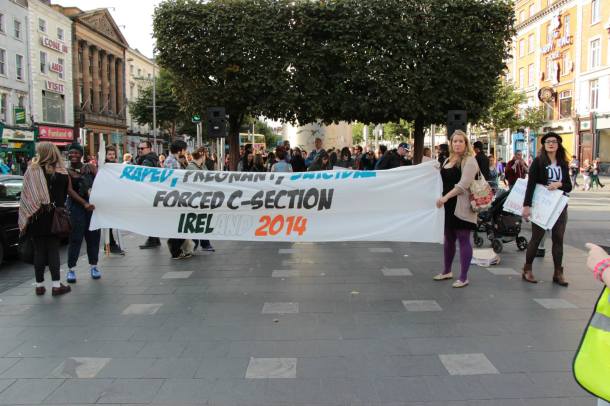
10626302_700414156674328_50113362901245159_o.jpg

Ms. Y arrived in the south of Ireland on March 28th, 2014 as a refugee. At what is described as a “health screening”, six days later she found out she was pregnant; she made known to those performing the screening on behalf of the state that she had been raped and that she could not possibly under any circumstances have a child. She was very distressed. A nurse made an appointment for her two days later with the IFPA who informed Ms. Y that abortion is not accessible in Ireland and that travel for her “may” be difficult – as an asylum seeker travel documents and visas into and out of Ireland are time consuming, costly and difficult to obtain. The IFPA made an appointment for Ms. Y to have a dating scan and referred her to the Immigrant Council of Ireland for advice and support on travelling as a migrant. Four days later, Ms. Y had a dating scan performed and it was discovered she was 8 weeks pregnant.


At this point it would have been possible to hand her three pills and for her to have ended her own pregnancy as she wished, with minimal impact on her, minimal further violation of her bodily autonomy and integrity, and minimal pain and suffering. Three pills.


Instead, she was handed about from pillar to post, having contact with three separate NGOs as well as the HSE staff she initially encountered, and her situation appears to have slipped between the cracks of these, unnoticed by anyone except herself as with the continuation of her pregnancy her despair and hopelessness deepened. A doctor from Spirasi, one of the NGOs she had contact with, wrote to the GP of the direct provision centre she was consigned to, describing her as “having a death wish”. The GP of this centre says that the letter was not received. A co-ordinator at the ICI formed the opinion that Ms. Y might change her mind about needing an abortion based on apparently nothing whatsoever. A counsellor at the IFPA suggested adoption to her. For a further 16 weeks she was handed around and around until eventually, on the 23rd of July (almost four months after her pregnancy was first discovered and she initially declared herself utterly unable to contemplate going through with it) she had an assessment with a consultant psychiatrist who told her it was too late to have an abortion and then coerced her into being detained in a maternity hospital under constant surveillance, where she refused all food and fluids for several days.


By that time she had met a consultant obstetrician who was of the opinion, despite the fact that Ms. Y was so despairing and suicidal that she was even refusing water,  “that Ms Y could be maintained on the ward for as long as possible and hopefully to 30 weeks so that the baby could be delivered appropriately.” This would have meant another 6 weeks of detention against her will; another 6 weeks of sedation against her will in order to forcibly feed and hydrate her against her will in order that her body and autonomy undergo repeated violations in order to host a pregnancy she loathed so much she would rather have died than have it in her body any longer. Instead however, as Ms. Y continued in her determination to refuse fluids, a caesarean section was carried out on her several days later; enforced major abdominal surgery also against her will.


This horrifying and traumatic ordeal inflicted upon Ms. Y was torture; state-sanctioned, state-inflicted torture, state-legalised torture. And were another Ms. Y to arrive in the south tomorrow, in the same harrowing circumstances, the state would more than likely torture her in precisely the same manner.


It is important to note here the degree to which the maternity hospitals in the south are complicit in, and even the driving forces behind the denial of basic bodily autonomy to pregnant women; both in abortion and in continued pregnancy. It is for these reasons that those of us who are involved in the pro-choice movement should be deeply wary of embracing the “masters” (the word alone should be warning) of the Dublin maternity hospitals such as Rhona Mahoney and Peter Boylan when they declare themselves to be opposed to the 8th amendment. At least one of those ‘masters’ has been known to invoke the courts in order to coerce pregnant women into interventions during their pregnancies, labour and births, and both of them are opposed to women’s choice of type of care (midwife-led or obstetrician-led) and the choice even of birth position in the case of Peter Boylan. Furthermore Peter Boylan in 2015 testified in the High Court in defence of the barbaric practice of symphysiotomies. Tempting though it is to reach for a “higher authority” in defence of our stance, these are not our allies in the struggle for women’s bodily autonomy.


However those who are our allies in this struggle are, in fact, the majority of the voting public in the south. An exit poll carried out at the general election in February of this year found that 64% of people support the repeal of the 8th amendment. This number is all the more invigorating for those of us in the trenches of this fight given the increasing vehemence of the well-funded anti-choicers over the last number of years. It’s also all the more inspiring because there’s a general misunderstanding of what the pro-choice position is in the public discourse around abortion in the south; the case is constructed as “Would you agree with and support her decision in this case?” rather than “Would you personally stop her?”, a much truer reflection of what the pro-choice stance is and means.


As the fight continues, it becomes more and more important to avoid the slippery slope of only publicly advocating and arguing for abortion access in terms of the “hard cases”, such as where the pregnancy will not survive outside the womb or in the case of survivors of rape. The majority of those who seek abortions do not fall into these categories and would be left by the wayside. Only allowing abortion access for pregnancies conceived by rape and incest would not only be impossible to legislate safely for but also makes clear that the enforcement of continuation of unwanted pregnancy because the woman chose to have sex is outright misogyny; either one believes that an embryo or foetus has rights overriding that of the person carrying it or one does not.


We own our own bodies. We are not property of any state. We can and will birth where, how, and if we choose.


A pro-choice voter’s guide to the Stormont elections

We are happy to share this communication sent to us yesterday:

Just wanted to let you know that some NI pro-choicers have compiled a spreadsheet of MLA candidates and their stance on abortion in the run up to #AE16.

We’re keeping our names anonymous in the public sphere but there’s an email [in guidelines] if people want to get in touch.

Here’s the spreadsheet. And the spreadsheet guidelines are here.

Quick note on the Belfast abortion rats

Posted on

Just when you thought the story couldn’t get worse about the 21-year-old Belfast woman who was given a suspended jail sentence for inducing her abortion, along come the people who shopped her to the police – her own housemates – to show the world how truly abhorrent it’s possible for humans to be. Here are some choice quotes from them in today’s Belfast Telegraph:

“This isn’t anything to do with the rights and wrongs of abortion. I’m not anti-abortion. I believe there are circumstances, like rape, where it should be a woman’s choice.

“This is about her attitude. It was as if she was getting rid of a piece of clothing,” she stated.

“There was absolutely no remorse. Even the way she was up and away out and doing her own thing a day after the abortion, while me and our other house-mate just walked around in shock.”

“It is just insane the way we are being portrayed as being the bad ones in this.”


So they didn’t report her out of some sense of civic duty, because she’d committed an offence. Abortion is illegal throughout Ireland in the case of rape, too, but apparently this housemate would have had no problem with that (even though the embryo would presumably look exactly like it did in this case). They reported her because she wasn’t sorry about her abortion. Because she had the absolute temerity to be able to get on with her own life after it. Because she didn’t feel the regret they think a woman should be obliged to feel after terminating an unwanted pregnancy. Because she didn’t hurt. So, they were going to make sure she did.

The housemates are clearly taking note of the reaction on social media, so allow me to add this one: Yes, you are the bad ones in this. You are awful. You are the worst people I have read or heard anything about today. I am disgusted to breathe the same air as you. I hope you step on a Lego for every remaining day of your terrible life.

The social media response is the one positive thing to come out of your despicable deed. For once, the people being shamed because of an abortion actually deserve it.


Taking the Boat: A Short Film by Lisa Keogh

Guest post by Lisa Keogh

I don’t find it difficult making decisions, which is probably a good thing considering that a lot of writing and directing is about making decisions. How long should we linger on close-up? Is there really another world or is it all in her head? How the hell are we going to shoot this if it keeps raining?

Most of the time when we claim to agonise over a decision what we’re looking for is the permission to make the choice we feel is instinctively right.

For me, there is no drama in the decision of whether or not to abort an unplanned pregnancy, because drama suggests conflict between right and wrong. Instead, when it comes to abortion, each woman makes the choice that is best for her life – she just needs to give herself the permission to accept it. And society needs to support her to make that choice. Every child, whether planned or unplanned, should be a wanted child.

Too many women are imprisoned by the cloak of shame around abortion. The dramatic arts have played their part in adding to that cloak and in attempting to lift it. It all comes down to how writers handle the issue. Making films about “the dilemma” implies there are only certain circumstances where abortion is acceptable. It makes people believe they have the right to examine a woman’s choice about her own body and to make her justify why she does or doesn’t want to proceed with a pregnancy.

Instead, I believe we need to trust women. Instead of focusing on the dilemma of whether or not to have an abortion, exploiting the suspense of a “will she/won’t she” plot, what needs to be examined is that Ireland is exporting its abortions. 12 women a day are leaving our island to access services that should be free, safe, and legal on their doorsteps. How many other women are ordering pills over the Internet and facing prosecution? How many others are forced to continue with a pregnancy because they don’t have the means, knowledge, or support to make that trip?

That’s where the drama is for me – that’s where the story lies. So I made a short film.

25,000 women have left Ireland in the last five years to access abortions. That’s a lot of stories about taking the boat – about finding the cash, arranging childcare or time off work, booking flights or ferries, about lies told and secrets kept.

Taking the Boat is the story of just two of those women.

After #ge16, where to now for #Repealthe8th?

pro choice002

The results from count centres across the state are slowly trickling in as I write this, and Labour activists and supporters are shouting that #Repealthe8th is dead as quickly as their candidates are dropping out of the race. They need to stop.

I presume they genuinely believe what they’re saying, just as they believe that we wouldn’t have marriage equality were it not for the Labour Party, but peddling that view damages the pro-choice movement.

Labour might have been confident that they could deliver a referendum on the eighth amendment, but pro-choice activists of all political stripes and none haven’t forgotten that they delivered legislation on X to allow for abortion where a woman would be a risk of dying that contained a 14 year jail sentence penalty for inducing a miscarriage, and the horrifying case of teenage refugee pregnant as a result of rape enduring what was ostensibly a forced c-section at 25 weeks, despite medical professionals acknowledging that she was suicidal. The #Repealthe8th campaign exists in spite of Labour, not because of it. Perhaps Labour in government after #ge16 would have delivered a referendum, but what would that have looked like?

Besides, Labour aren’t in government now, and unless there’s some kind of divine intervention over the next twelve hours it doesn’t look like they will be. They had five years to work to hold a referendum and didn’t. We can acknowledge that Labour were in government when the Marriage Equality referendum happened but it was won because people mobilised and worked their rocks off to get it passed; People who were never involved in politics before came out alongside grassroots groups and got Ireland to a place where it said yes to valuing people as equals. So instead of throwing the toys out of the pram and acting all hard done by, Labour activists would do better to channel their energies into the pro-choice campaign and work for a repeal of these laws. There is nothing to be gained by trying to undermine the positivity of pro-choice campaigners by getting in a huff, throwing hands in the air and saying we should all just forget it now.

That said, it is difficult to ascertain just how much of a deciding factor abortion was in this general election given the number of Fianna Fail TDs that have been returned and their unwillingness to commit to a referendum – but there have been huge returns for independents and political parties who are very much in favour of holding a referendum. The people of Dublin Bay South waved goodbye to Lucinda Creighton, one of the most staunch anti-abortion voices in the Dáil and while this is to be welcomed, this is not a time for pro-choice activists to rest on our laurels. Clare Daly has championed reproductive justice and been returned to the Dáil alongside Joan Collins. Ruth Coppinger, Paul Murphy, Richard Boyd Barrett and Gino Kenny are all pro-choice. Sinn Féin have a policy in favour of repeal the eighth. There is a recognition, even amongst conservatives such as Leo Varadkar and Frances Fitzgerald that a referendum is inevitable. It is easier now to be pro-choice than it ever has been before and thanks to the work of pro-choice activists and an increase in public support, the stigma surrounding the subject is ebbing away. Now is the time to send a clear message to the returned members of the new Dáil that a commitment to repeal the eighth amendment must form a part of any new Programme for Government. Women must no longer be blocked from accessing appropriate healthcare. Public opinion on the need to repeal the law and provide legal abortion for women is far more progressive than what is represented in the Dáil now, even with the addition of the large range of socialist, republican and left of centre voices. This public opinion needs to be converted into action on the ground.

We must make no mistake, the anti-choice groups that are happy to see women die for want of medical care, will consolidate their efforts in order to keep the eighth amendment in place. They will continue with their bitter newspaper columns full of demonisation and blame, and their shaming billboards and they will continue their misrepresentation and campaigns of outright lies against people who provide women’s healthcare in Ireland. Their attacks on the IFPA and others are not about women’s healthcare, they are about muddying the waters so that they can portray themselves as being something other than religious fundamentalists who want to keep women in the dark ages. They have no intention of stopping so we have an onus to build our movement, to keep up the pressure no TDs and tell them in their clinics, in the streets, in the courts, and in their media streams that they must fight to repeal the eighth. We can’t only depend only on TDs to argue these points in the confines of the Dáil chamber; there is an onus on us to keep speaking to our families and friends to reduce the stigma, to help women accessing abortion care, to publicise information and to counter the outrageous propaganda and lies bandied about by anti-choice activists. We must organise and march in the streets and stand shoulder to shoulder with others campaigning for free, safe and legal abortion.

Pro-choice groups are ready for this fight. Are you?

#Repealthe8th

@stephie08

Breda O’Brien, clickbait and being devoid of empathy

Breda O’Brien, clickbait and being devoid of empathy

Breda O’Brien has a regular, offensive clickbait column in the Irish Times where she gets paid actual money to peddle her narrow, bigoted view of the world that doesn’t tally in any way with actual evidence of what happens in real life. She goes to great lengths to portray women who’ve had abortions as being at best cold and indifferent about their experiences and at worst, callous, unless they are members of Women Hurt. For Breda, the only time it’s acceptable for a woman to talk about her experience of abortion, is if it is in the context of being a negative experience in your life. Ideally, the more torment connected to it, the better – because it will be the only time that your experience has any value at all. It doesn’t matter for her or even the Irish Times, that her stories are possibly not actually true, it just matters that some people will believe them. If you throw enough stones, eventually you’ll hit something.  Today’s offering is no different.

O’Brien opens today’s drivel by saying that Irish women talk about their abortions all the time with her. Maybe there are women who talk to O’Brien about their experiences but she is hardly the most likely of people you would confide in;

“Breda, you are a well known anti-abortion activist so I need to tell you, I was raped at 14 and had an abortion at 6 weeks.”

“That choice was morally wrong and is exactly the same as drowning a three year old child. ”

“Um, thanks Breda. I’m glad I got that off my chest by talking to you.”  

Given the exposure Tara Flynn and Roisin Ingle’s stories got in the Irish Times last week, it’s hard not to read O’Brien’s piece as a direct retaliation towards these courageous women. It’s basically an eight hundred word fuck-you to Roisin and Tara.

She also says that women have told her of going for post-abortion counselling in a pro-choice organisation only to be told, “you did what was right for you at the time. Put it behind you and move on.” But I find it a stretch that any pro-choice organisation would simply tell a woman “move on” after she said she found her experience difficult to deal with or that she had regrets. Because that is not how pro-choice people or organisations operate. That is a fiction. Unlike O’Brien, we recognise that women have different experiences while noting that the vast majority of women who have terminations do not regret them.

O’Brien says that these women feel dismissed and diminished, while not for a second noticing the irony that women who do *not* regret their decision are dismissed and diminished by O’Brien and her Iona cronies who are given a national media platform on which to do so. No person’s experience should be diminished, but the women who allegedly seek comfort from O’Brien should not be taken as representative of the sum total of women who have had terminations – just as the women who do not regret them are not the sum total, we merely note that they are the overwhelming majority. O’Brien goes to great lengths to couch her language in terms of pseudo comfort and “common humanity” and then denies to other women the capacity to make decisions for themselves believing that she knows better.

She  decries those of us who speak of cells and the right to choose and implies that we are the same as Roman men who left babies to die on the side of a hill as we dehumanise the “victim.” At no point does it register with her how she dehumanises women who make the decision to abort without regret; women who terminated because of the suffering that continuing the pregnancy might bring, or the risk to their health or wellbeing, or because they were in a violent relationship, or because they simply did not want to be pregnant.  If pro-choice feminists who advocate a woman’s right to choose are for O’Brien, like the Roman men who leave babies to die of exposure on the hillside then what does that make the women who actually choose to abort? This of course is the woman who is a spokesperson for the people that carry signs at their rallies saying “Abortion is Witchcraft” (forward to 2:52 of this video). Does that sound like empathy to you?  

Anti-choice ideology ignores that fact that legal and medical structures that deprive a woman of full control over her own reproductive system condemn women to being second class citizens. O’Brien attempts to portray herself as being understanding, attempting to make us believe she empathises with women in crisis pregnancies by saying if she had become pregnant as a teenager, she is “not sure what (she) would have done.” Perhaps that’s true. She wouldn’t be the first woman to be against abortion until faced with a crisis pregnancy and had she accessed a termination, she certainly wouldn’t even be the first anti-choice woman to terminate and subsequently stand outside that very same clinic and denounce the women who enter it.

But you are not empathising with a woman in a crisis pregnancy when you actively campaign in favour of laws that compel women to endure a forced pregnancy, a court ordered c-section, and then tell us that she should have been made to carry that pregnancy to term. Being empathetic does not mean heaping judgment on women who had abortions and telling them their decisions was morally wrong. Since when did empathy extend to stigmatising and criminalising women and advocating that they go to jail? You cannot attest to empathise with women in crisis pregnancies when you deny them a choice in their medical care that will literally result in their death.

O’Brien also carefully adds a sentence about Aylan Kurdi so that there is to be no misunderstanding as to where she stands –  comparing the drowned three year old to the terminated weeks old foetus. She could have written a column about how Europe should open its borders to the refugees, or about how Hungary is treating the thousands walking through their land, tired, cold, and hungry, searching for a better life. She could have even spoken about the reasons why women choose abortion and acknowledged that if you want less abortions, you need to make it easier for women to have children. That would be the logical thing, but this is not about logic, this is about curtailing women’s choices because Breda O’Brien views them as vessels and nothing more.

The majority of people in this state are pro-choice despite all of us of child-bearing age having never had our say on the Eighth Amendment. My own mother wasn’t even old enough to vote when the Eighth Amendment was passed. Prochoice activists acknowledge that abortion can often be a difficult decision for a woman. We also acknowledge that the decision to terminate can be a source of great relief to many. The difficulty for anti-choice activists is that they cannot contemplate, due to being completely devoid of empathy, why it would be a relief  for many women and why not every woman struggles with it, so in order for them to understand it they must portray these women as uncaring monsters like the Roman patriarchs or of course, witches.

Anti-choice activists do not understand, much less care, that when a woman is pregnant, she is more than a receptacle to carry a foetus to term, with thoughts, feelings, financial pressures and very often, other children to take care of. Just as it would be wrong for a woman to be compelled to terminate against her wishes, it is wrong to compel her to carry a pregnancy against her wishes. Women are more than the contents of their wombs and their existence has more reason than bearing children, and if we want to talk about moral value, then we must acknowledge that an embryo does not have the same moral value as a living, breathing woman who bears it, simply because it has the potential to become a human being. The inability to empathise at the very core of anti-choice beliefs is the reason why there is a woman on trial in Belfast for supplying her daughter with abortion pills, and it is the reason that a woman who has an illegal abortion in this state will get 14 years in prison. Reducing a woman’s humanity and placing it on a par with a week old embryo is not empathy, it is stomach-churning fanaticism. Perhaps had O’Brien actually been faced with a crisis teenage pregnancy, she may believe that had she taken certain decisions that she should have faced 14 years in prison, although at that time it would have been a life sentence (presumably for her own good), but that is not empathy.

Believing that because you never had an abortion that nobody else should have one either is about as far away from empathy as you can possibly get.

#Repealthe8th

@stephie08

Ireland: we need to drop the pretence of being a country that loves children

This post discusses intensely distressing topics, among them violence against women, violence against children, child abuse, and infant and child death.

Ireland, we all need to have a good talk. You know the way we all buy into this idea that there’s a massive overarching image of ourselves presented to the world and that somehow it matches up to the reality? That we’re the friendliest country to visit in the world, and other common or garden varieties of horseshit along these lines. We’re so invested in this portrayal that to question it is nearly tantamount to treason, and other tourism destinations found to ALSO be friendly in media polls is almost cause for the mass donning of sackcloth and ashes. Well, there’s one aspect of it in particular we really need to stop hawking and face up to it just Not Being True.

We need to stop pretending to ourselves and the rest of the world that we’re a country that loves children.

It’s a longstanding lie, and one we’ve told ourselves repeatedly throughout the years. It was even the primary basis for pushing through the horrendous 8th amendment, and all the toxic fallout of that that has been inflicted on women and children, of whom Miss X, aged 14, was one, in the 32 years since 1983. It should go without saying that if we loved children, we would allow those of them who needed and wanted to access abortions to do so, rather than force those children, some of whom have been abused and raped, as Miss X was, through the rigours, hardships, and dangers of unwanted pregnancy and unwanted birth.

If we truly loved children, we wouldn’t let the most vulnerable of them suffer as we do and as we have done consistently throughout the history of our nation. Look at the Mother and Baby homes and the Magdalen Laundries, the incarcerations and starvation and deaths and beatings and shame and forced adoptions and forced family breakups that went on in those institutions for decades, with the full support of the Irish state as well as the church.

If we truly loved children, we wouldn’t still refuse to investigate properly what went on in those homes, with local historian Catherine Corless having to bang the drum alone for the nearly 800 babies and children and 5 women the Sisters of Bon Secour, funded and supported by the Irish state, left lying in unmarked graves in Tuam as though they had never mattered at all. And of course to the church and to the Irish republic, they didn’t. After first attempting to paint Catherine Corless as an incompetent amateur attempting a gross exaggeration for some malevolent entertainment of her own, the government finally, grudgingly established a body to look into this. This body, The Commission of Investigation, is a year on still dragging its heels, not even bothering to reply to Catherine Corless when she provided them with her most recent research which indicates that there are 5 mothers buried on the grounds of the Tuam Mother and Baby home along with the hundreds of tiny children’s bodies also lying in the ground there. There have been no indicators of any progress being made in a paid and funded group of over a year’s work, despite having had another person’s extensive unpaid, unfunded research handed to them on a plate. No answers, no recognition of those children’s tiny lives and appalling deaths. No acknowledgement that those babies, those children, weren’t loved by us at all.

If we truly loved children, we wouldn’t ignore the truths of the stories that the Magdalen survivors tell us, many of whom were children when they were first incarcerated in those institutions, and many of whom had children stolen from them and sold with no regard to their best interests or their need for their mothers; how we patted ourselves smugly on the backs when the McAleese report came out, trumpeting that now justice had been done, they had been heard, never bothering to ask the women themselves how they felt about it. How they felt about it for very many was abandoned, betrayed, shamed and lied about all over again by the Irish state. The report spoke over, ignored and attempted to make liars out of the survivors of the laundries, the women whose needs it should have most urgently sought to meet and whose voices it should have been required to amplify. The women whose forgiveness the Irish state should be begging on bended knees every day for as long as they live. Justice for Magdalenes – co-founded by Claire McGettrick, who tweeted on this this week – published detailed research on the serious issues with the report. A key phrase from that research is “Most concerning was the Report’s contention that a very small level of physical abuse took place in the laundries” , a contention that is in direct contradiction of the evidence of the survivors of the laundries. It’s a key pointer to how little value and worth the authors of the report put on the testimony and accounts of survivors that their words weren’t considered ‘evidence’. The Irish state cares so little about these women, their stolen children, and their feelings and needs, and yet so much about its precious reputation abroad that it will even seek to prevent the media of other countries from broadcasting the truth of the McAleese Report.

If we truly loved children, we wouldn’t stand idly and quietly by as the Minister for Social Protection – what a heinous joke of a title – inflicted savage financial cuts on children living in lone parent families who are dependent on social welfare for their income, children who are already amongst the most marginalised and at risk of poverty in the country. Joan Burton had promised to only implement these cuts to the financial supports of children over 7 if a “Scandinavian style system of childcare” was implemented – which was also in her remit to do – thus proving she was more than well aware that depriving children of 7 and older of the care of their parents by rendering it financially impossible for their mother (87% of lone parent families are headed by women) to either stay at home with them or afford to access childcare is barbaric. Yet she implemented them anyway, with no support net for these children and no apparent interest in what happens to them. If we loved children, as a country, we would never allow this to happen. It is an outrage. It is beyond a disgrace.

If we truly loved children, as we love to claim, we would see instantly that Frances Fitzgerald telling the media that Ireland’s doing ‘more than its fair share’ in taking the absolutely paltry amount of refugees in that we are, and then forcing them into the horrors of direct provision indefinitely is nothing short of repugnant. Hundreds, thousands of people are drowning in the Mediterranean in an attempt to escape from suffering and misery while Labour and Fine Gael are intent on shoring up the walls of Fortress Europe. If we cared about children at all, we would be welcoming them and their families with open arms, cheering them on in their escape, not penning and corralling those who manage to survive against the odds like animals on the border points of Europe. Not forcing them to live for years with their family in one room of a run-down, miserable ‘hotel’ with no ability to cook their own food, or enough money to even buy it, or access public transport to go anywhere – if indeed public transport is accessible from the direct provision centre we’ve incarcerated them in.

There is no such thing as a ‘fair share’ of the work to be done when the drowned bodies of babies and toddlers continue to wash up on European beaches. The fact that anyone could speak of it so is something we should all find beyond comprehension.

If we truly loved children we would collectively remember when once it was the people living in Ireland who had to put their children on coffin ships in their hundreds of thousands, on water that was safer than the land on which they were starving, and cast themselves upon the cold mercy of an uncaring world. We would seek, urgently and desperately, to do everything within our power to prevent those horrors being inflicted on these other suffering and starving and drowning children of today. We would support this direct action group travelling with an aid convoy from Cork to the refugee camps in Calais, to alleviate the suffering and misery of those children and families and people who did survive but who are now trapped, without hope, in a Europe they hoped would be their promised land. We would campaign, furiously and energetically, arm in arm with the refugees living here to end direct provision in our own country and stop shutting our ears and eyes and mouths to the reality that incarceration of innocent suffering children is not a thing of yesteryear in today’s Ireland.

Until then, we have no right whatsoever to the claim.

Whose country is it anyway?

Posted on

I’ve been thinking about a couple of comments that Marcus Ranum made on my last post (thanks for the food for thought, by the way!). Here’s the exchange:

Screen Shot 2015-01-06 at 11.19.25Now, obviously (especially since he actually said it in as many words) the suggestion wasn’t a serious one. It’s just an expression of frustration, and a legitimate one at that. I threaten to move to the far side of the Moon on a regular basis, right? It got me thinking, though.

Yes, women and people with uteri are second-class citizens in Ireland. We have a constitution that tells us that we have a special place within the home, shouldn’t be bothering our pretty little heads with economic labour, and are legally equivalent to a fertilised egg. I mean, technically you could even say that a male foetus has a higher status than a grown woman, since at least the foetus is expected to go get a job at some point in the future.

It’s grim.

Of course, women and the uterus-enabled aren’t the only ones living with second-class citizenship in this lovely country of ours. Trans people still can’t have their genders recognised, queer people are barred from equal marriage and can be legally discriminated against if we work in education, and let’s not even start on direct provision and arbitrary deportations of asylum seekers, or the abysmal way that the Travelling community are routinely dehumanised, or people on years-long waiting lists for public healthcare, or non-Catholic families being shoved down school waiting lists or.. oh, I could go on. You know I could go on. We have no shortage of second-class citizenship (or residency, or humanity) in this country.

Does being second-class citizens mean this space is less our home, though?

My answers, as ever, over at Consider the Tea Cosy