RSS Feed

Category Archives: Politics

Media outraged over playground insult while Irish Water bullies roam free

Media outraged over playground insult while Irish Water bullies roam free

RTÉ’s outrage over protesters insulting the president illustrates the hypocrisy at the heart of the media establishment. Let’s be frank here; no one in RTÉ gives a toss about ableism. Of course it isn’t nice to see someone being called a “midget parasite”. It is ableist language and pretty nasty, and not a word that should be bandied about like that.

I’m not unfamiliar with pointing out when people use rubbish or offensive terminology, but I’m finding it really hard to jump on the condemnation here. It’s not that I think this is fine behaviour or in any way acceptable, or that I have some special regard for the office of President (although while I’m on the subject I don’t think protesting against the president because he signed a bill into law and refused to do an Article 26 referral is a good politics. It’s silly and lacks an understanding of what the implications of a finding of constitutionality under Article 26 actually are). It’s just that I literally do not care that a bunch of people did this in Finglas to register their dissent given what’s going on elsewhere.

The media are gleefully hawking this video around like snuff at a wake but their fury has nothing to do with ableism or even affording appropriate respect to the office of President. Labour Senator Lorraine Higgins called it “incitement to hatred” on twitter mere weeks after tweeting about the “free world” and the hashtag #jesuischarlie. RTE expressed outrage, and anyone who wants to say Paul Murphy is an apologist for hooliganism is given a platform to air their views. Michael D is a man that goes to League of Ireland football games, so I’m pretty sure he’s heard worse and much less cares, but to RTÉ, Finglas is rapidly taking Jobstown’s place as Ireland’s home for a feral community intent on destroying civilisation as we know it. Production staff on Morning Ireland would probably save themselves time if they just played Tony Harrison from the Mighty Boosh on a loop screaming “It’s an outrage!”

But as I said, I don’t really care about what happened in Finglas.

I really don’t care that a bunch of people said some mean things to the President when he is surrounded by a gaggle of Gardaí to protect him. Sure. They shouldn’t have said it, but I don’t care because I have watched too many videos of people being beaten with impunity by the guards and having excessive force used on them.

I don’t care because as I type this a private police force decked out in balaclavas is roaming through Stoneybatter and Broadstone assaulting people, abusing pregnant women, and filming  people coming  and going from their homes all at the behest of Irish Water. I don’t care because I have listened and watched as Irish Water staff screamed at my next door neighbour that he was a “cunt” at the top of his lungs. There are plenty of videos on youtube where the Gardaí stand by and watch as Irish Water staff abuse and assault people, and more where the guards assault people.

I don’t care because two people using the word “midget” to the president is a convenient mechanism for distraction for a lazy media (including the government mouthpiece RTÉ) who can wring their hands over this instead of airing stories about communities under siege and families in poverty looking at prospects of Irish water bills that will push them over.

That protest was last week so why is the video only coming out now? Oh that’s right. There’s a protest this weekend. It’s the equivalent of throwing a stick for dog to distract him from chewing your shoe. If there was half as much righteous indignation in the media over Garda brutality and Irish Water and GMC Sierra as there was about name-calling, it would be in much healthier shape.

The feigned shock and condemnation is hypocrisy at its worst and there really are bigger and more urgent things to worry about. People need to stop falling over themselves to try and be the most respectable game in town.

Get over it.

Get organised.

Get out on Saturday and show the zero fucks that you give about this.

Irish women are now incubators. Even in death.

Posted on

Consent is not for Irish women: once a person in Ireland becomes pregnant, their right to refuse or to choose medical treatment is null and void. Self-determination is not for Irish women: once a person in Ireland becomes pregnant, they may no longer choose the direction of their lives within our borders, and if they do not have the right to leave their borders their lives become the property of our state. And as of today, even the right to be laid to rest after our deaths is not for any pregnant person in this country.

At first glance, it doesn’t seem that way. December 26th marked a High Court ruling on the case of a brain-dead woman who has been kept on life somatic support since her death on December 3rd. She has been kept breathing, despite the unanimous wishes of her partner and family, because at the time of her death she was ~14 weeks pregnant, and Ireland’s constitution demands that the right to life of a foetus must be protected. Because of this constitutional provision- which I’ll go into in more detail in a moment, don’t you worry- none of her doctors would allow her life support to be turned off. Her family- including her two young children- have been forced to watch as the condition of her still-breathing corpse deteriorated grotesquely, waiting for the High Court to deliberate and make its decision.

It’s a hell of a way to spend Christmas.

On the morning after, though, the High Court ruled in favour of the woman being taken off somatic support. At face value this is a positive thing. It allows the woman to finally have some kind of dignity in her death, and for her family to begin to grieve her and move on. They’re not stuck with grotesque daily updates on the deteriorating condition of her body and the foetus inside it.

It looks positive- in as much as you can use a word like that in a situation like this- unless you actually read the High Court ruling. When I say “then it becomes terrifying”, I want you to understand that I am not exaggerating for effect. The implications of this ruling are terrifying, and they are macabre, because although it provides for somatic support for this woman to be switched off, it also creates precedent for the corpses of pregnant people to be sustained in future. And within this, there is no consideration whatsoever given to the wishes of the person being used this way.

I said that consent is not for Irish women. With this ruling, neither consent nor the right to a dignified and final death are for any pregnant person in this country.

I guess it’s time to explain.

Continued at Consider the Tea Cosy

Parental (and paternity) leave is a feminist issue

The Irish Times this week, followed en masse by other papers and mainstream media outlets, breathlessly rushed to report that 2 Irish MEPs were the MEPs with the worst record of attendance at voting sessions of the European Parliament in Strasbourg. What they didn’t manage to initially include in the story, and which transpired over the course of the day that the story broke, was that one of the MEPs (Brian Crowley) has been unable to attend at all as he’s ill, and that the other, Luke ‘Ming’ Flanagan, has needed to be at home with his wife, newborn baby, and other children. His wife has also been ill, in addition to having all the intensive, non-stop demands of a newborn to contend with. As at the time of writing, the Irish Times has run four separate follow-up pieces by Suzanne Lynch, all focusing on Ming’s ‘dismal voting record’, how he should suffer financially for it, and should Irish MEPs (and by obvious inference Ming) have even bothered to run at all if they were going to let down the electorate like that by non-attendance through having the nerve to have babies and families that need caring for? In one piece, Lynch attempted a mealy-mouthed pretence at recognising the fact that Ming was at home, caring for his unwell wife and their newborn baby as well as their other children, calling this ‘mitigating circumstances’, claiming that “[n]o one is suggesting [his need to take paternity leave] should elicit anything less than complete empathy” while immediately following this up by suggesting that his low attendance “while drawing full salaries raises the question as to whether Ireland’s MEP system is fit for purpose.

No, actually, that’s exactly how parental and paternity leave systems SHOULD work. Nobody should be financially penalised for having a baby. (This is not a conversation about whether people who are supposed to be representing the public should be paid as much more than the majority of that public than they are, though that’s a conversation worth having too.) Nobody should be forced to attend their workplace immediately after the birth of a child for fear of losing their job – or indeed, as in the Irish system and in this instance, depending on the time of the birth, DURING the birth of a child. (In Ireland, because there is no entitlement whatsoever to paternal leave, new fathers are reliant on their holiday leave and employer’s vagaries to be able to be present at the birth of their children should that birth be during working hours, as well as to be home with their partner and newborn in the time after the birth.) Nobody should have their absence from their job as the result of the birth of a child and needing to be at home to care for that child, their unwell partner, and their other children reported in the national media and the subject of this kind of intense and judgemental scrutiny. No man should be expected to abandon his sick partner for her to provide alone the kind of intensively demanding all-around-the-clock care that a newborn provides, in order to show up at a place of work. And certainly no sick woman should be left alone to care for a newborn without the support she has a right to expect from her partner in creating that newborn, as well as support in caring for herself and her other children. What kind of barbaric social system would demand that?

Only, of course, the one we live under; a horrible combination of capitalism and patriarchy, which holds ‘work’ (meaning, of course, paid work, done outside the home, not something as petty and gendered as simply bringing a child into the world, caring for its every need, raising it as a moral being and seeing to its needs around the clock) as supreme; as an unquestionable overlord to be served without regard to personal needs and circumstances. “Doing your job”, in this paradigm, is paramount, and excuses everything from the actual killing of another human being to being expected to abandon one’s partner, the person one is assumed to love and honour above all others, to the 24/7 backbreaking work of caring for a house full of children (one a newborn) alone. And sure if you’re paid enough can you not just pay someone else to do that caring nonsense for you?

At no point in any of this coverage has the fact been mentioned that no Irish political representative – whether at local government level, at national level, or European level – has ANY right to any parental leave, whether that be paternity or maternity leave. It took Nessa Childers on Twitter to do that first. Nor did any of the coverage point out that while it’s “only one session a month” (as many on Twitter appeared to enjoy very much repeating), that “one session a month” extends to four consecutive days, and there are no direct flights between Dublin and Strasbourg, meaning this “one session” could very well in fact have demanded a full week every month away from Ming’s wife, newborn baby and other children. Even if his wife weren’t unwell, this would be an utterly unreasonable burden of care to lay on a woman who has just become a mother all over again. The blanket and unquestioning expectation apparent in not only the mainstream media coverage, but also the majority of the Twitter commentary on this, that if she weren’t sick (and in some cases that even though she is; and in yet some more, even more deplorable ones, that somehow they have the right to know HOW sick she is, and why, and since when, and why didn’t they know earlier), that he should have abandoned her, their newborn, and their other children, to the almighty power that is Work, is frankly sickening. A father should have the right to be with his newborn, just as a mother should have the right to not be the enforced sole, isolated carer of her newborn simply because its father needs to worship at the altar of Work. One of the most telling things of the coverage of this whole (non) issue is that there hasn’t been a single piece which can point to any of the votes he missed and name it as a topical one, as one that’s relevant to Ireland’s interests, or indeed one of those missed votes of his as having had any possible impact on the outcome if he had attended. Why isn’t that what’s being questioned as being a broken political representation system, rather than his having needed to take time to be with his family?

It is not possible to expect to see, and argue for, women’s participation in politics and public life rising from its current dismally low level, while also creating a society which excoriates men for taking up their part of the caring responsibilities that having a family entails. Perpetuating the idea and the necessity that only women can have space to do that not only condemns women to unpaid work in the home but also does not allow for space to honour that work; which has the potential to be beautiful, rewarding, and thoroughly worth doing. The work of caring for and raising a child is every bit as important to society, if not more so, than paid attendance at a workplace.

Sometimes people with babies need to be with those babies. Sometimes people with sick partners need to be with those sick partners because that’s what a partnership looks like. (It’s definitely what my partnership with my husband looked like when I was having an absolutely hideous time after our daughter was born, suffering from intense and unexpected postnatal depression, and would absolutely fall apart when he needed to be out of the house for even an hour, let alone travelling to another country for a full week.) No society that is worth living in should seek to punish or castigate its members for so doing.

A duty to reproduce: Modern Ireland is a sci-fi dystopia for women

In an episode of Battlestar Galactica called “The Farm”, Starbuck gets shot during a raid on Caprica and loses consciousness. She wakes up in a hospital, where it turns out that the cylons have a lot of human women hooked up to “baby-machines”, because they can’t reproduce themselves, so they’re trying to reproduce with humans. The human women are used as incubators and the cylons are of the view that they have a duty to reproduce. The cylon doctor tells Starbuck how women of reproductive age are very “precious commodities.” The agency of the individual does not matter – they are merely vessels. Vessels do not need to consent. The women hooked up to machines for the sole purpose of reproduction are, in this case, science fiction, and it’s pretty grim.

As I type this, there is a woman who is clinically brain dead but being kept alive on life support against her family’s wishes solely due to the fact that she is pregnant. The trauma that her family is going through now does not bear thinking about. I have lost a close family member in terrible circumstances, but I cannot imagine what it must be like to endure the heart-breaking pain of deciding to switch off a life-support machine. The trauma of it is surely enormous.

A next of kin is generally legally entitled to make a decision regarding treatment where a person can no longer consent. This family has concluded that the best course of action for this woman would be to withdraw life support. The medical staff cannot grant this request due to the constitutional right to life of the unborn: the right of an early stage foetus to be gestated potentially supersedes a woman’s right to dignity in death.

The state and the law of Ireland views women as vessels. In Ireland, once we are pregnant, we are no longer agents of ourselves. We do not get to decide whether we should or should not remain pregnant. Our thoughts, our feelings, our mental health does not matter. Our ability to parent does not matter. Our poverty does not matter. Our right to die a natural death does not matter. Our dignity does not matter. Our physical health does not matter, because you must be at risk of death to have an abortion. This is the outworking of the 8th Amendment. The state is unapologetic in this. The only time in which a pregnancy may be ended lawfully through termination is when there is a risk to a pregnant person’s life. The life of the foetus is what matters: continuing the pregnancy at all costs is what matters. If a pregnant woman is deemed to be suicidal, and like Ms. Y, wants an abortion, the pregnancy will be ended not through termination, but by an early caesarean once it is viable. To the state, ultimately, we are simply wombs with irrelevant thoughts attached.

The woman on life support in Mullingar, due to being clinically brain dead after suffering brain trauma, is being treated as an incubator for her foetus. There are people arguing for her to be kept alive for months so that her foetus may be born, and then turn the life support off – for them, she serves no purpose beyond this pregnancy. Her family now intend going to court to ask, in the name of compassion and human dignity, that her life support machine be switched off. There is no predicting what the courts will decide.

Will Article 40.3.3’s requirement to vindicate “the right to life of the unborn” in so far as is practicable require doctors to keep a clinically dead woman alive artificially in order to incubate it until it can be delivered? It is the crux of the case. It isn’t clear what stage the pregnancy is at (Reports have varied from 16 weeks to 20 weeks, with Joan Burton stating during Leader’s Questions today that it is at a “relatively early” stage), but while the 8th Amendment remains on the books every single case that presents such as this one will mean a trip to the courts for a family, because there will never be a clarity on what is practicable and what isn’t. Is one week practicable or twenty? You cannot legislate for every potential case.

We do not need another inquiry and report to tell us that the 8th Amendment still leaves medical practitioners with a lack of clarity as to what to do in these situations, or to tell us there is lack of clarity on whether it’s the pregnant woman’s rights or that of the foetus that will prevail. Leaving a pregnant woman hooked up to a machine for the sole purpose of incubating a pregnancy for possibly twenty weeks, in the absence of her next of kin’s consent where she has no capacity, does not uphold her dignity. It does not uphold her right to die a natural death. It does not allow for her family to consent when she cannot. It is inhumane, but her womb is a “precious commodity.” They wouldn’t do it to a dog.

This is the constitutional law, and while the law is designed to treat women as vessels we will always have the hard cases that fall outside of the scope of legislation. We will have more women in desperate situations. More Savita’s, Ms. Y’s. More A’s, B’s and C’s. More Ms. D’s. More Ms. X’s, and more women hooked up to machines because the state does not afford them or their next of kin the capacity to consent for themselves because their wombs are too precious a commodity to risk allowing them control over. This isn’t science fiction, for women, modern Ireland is dystopia enough, and there is no need for machine overlords, while catholic conservative values dominate policy on this issue.

#Repealthe8th


Those who can, teach. Those who can’t, complain about teachers.

Those who can, teach. Those who can’t, complain about teachers.

The Irish media has been clamouring to give voice to beleaguered parents and concerned citizens condemning today’s teachers’ strike. Some of those commenting on the ASTI and TUI decision to picket seem to be under the impression that teachers are just obstreperous babysitters who live a cosseted existence, overpaid and underworked, doing an easy job that a monkey could do in their sleep – except these monkeys are particularly greedy. The reality of this couldn’t be further from the truth and there is far more to teaching than standing in front of a classroom from one end of the day to the next.

Teaching is a profession that’s viewed with an almost unique level of disdain in some quarters. The phrase “those who can’t do, teach” might be used in a self-deprecating manner by some teachers but it’s something that genuinely appears be the core mind-set underpinning the criticisms of the strike. Texts are being read out on Newstalk from critics saying “these teachers are only afraid of doing more work with no extra pay,” as if teachers should be martyring themselves and teaching for free, for the pure love of imparting their knowledge to students, as if instilling a love of learning in pupils should be reward enough in itself. It’s probably only teachers and nurses that are consistently faced with the attitude that serving others should be compensation enough and it’s no coincidence that it’s a female-dominated professions that bring out comments such as that. The Minister herself isn’t immune from subtly making that same criticism, even though the strike isn’t actually about the rate of teachers pay. But even if it was, who could blame them? Why should teachers do more work for no extra pay?

Reform of the Junior Cert is badly needed. Students who are 15 years old shouldn’t be faced with exams of that intensity. The only thing I even remember about my own Junior Cert is that I bluffed my way through the English Paper 1 and wrote an essay that had something to do with Paul Weller and me on bikes in Drogheda, that a bottle of Sunny Delight leaked in my bag during the history exam, and that the horror of the whole exam experience provoked an episode of insomnia and sleeping difficulties that I’ve never fully shaken off.

Everyone agrees that the JC needs radical changes, and the elements of project work and continual assessment that are being incorporated should be welcomed. But when the people who are being expected to implement these reforms object on the basis that there is no best practice or evidence to support the claims being made by the Minister for Education Jan O’Sullivan, and further that there are issues around the resources being given to support them to implement the reforms, then they should be listened to. No matter how much a media and public given to teacher bashing would like to paint this as ultimately being a pay dispute, the crux of the strike is about who actually marks the Junior Cert papers. The Minister for Education allegedly believes teachers marking their own pupils is, educationally speaking, best practice for students. The Minister has moved from saying that internal marking 100% of the time is best, to saying that 40% internal marking will do, for the purposes of getting the reforms through. It’s unclear how much money will be saved in not paying other teachers to mark the junior cert papers but it’s a substantial amount given the sheer number of students involved, and the research or evidence that the Minister is basing her claims on hasn’t appeared thus far.

There are clearly difficulties in Ireland in making teachers mark the papers of their own pupils in a high stakes exam. That’s not to say that teachers are unable to mark the papers in the same way they would with other exams and tests they set for their classes, but to point out the difficulties that present in a state where schools are controlled by completely unaccountable boards of management and very often securing employment is based on who you know. There are teachers in Ireland who are as precariously employed as a person working in McDonalds on a temporary contract because they can’t get anything other than covering someone else’s maternity leave, and then four hours a week subbing when that teacher returns to their permanent post. Teachers may not cave to pressure in exam marking, but they will certainly come under it. In many cases, the students’ marks will be as high stakes for the teachers as the students themselves.

Teachers might not actively attempt to mark students unfairly (although I wouldn’t afford the benefit of that particular doubt to the teacher I had for Junior Cert geography) but there is evidence to suggest that teachers can be influenced by irrelevant factors in marking such as gender, socio-economic background, effort and behaviour of pupils. They are only human. Many teachers are now engaging in what could more accurately described as crowd control rather than education as a result of consistent severe cutbacks to school budgets and resources by this government. It is completely unreasonable to expect them to teach their class and mark their own students’ exams in an unbiased manner while not being offered adequate training to carry out what is envisaged in the marking scheme, or even enough training to actually deliver reforms to the curricula that they actually agree with; Not to mention that teachers will be expected to continue doing all of the extra-curricular work they do for free, like teaching the choir, or coaching the camogie team, or giving extra-lessons to struggling students in their own time while being continually demoralised by a government that doesn’t value what they do.

The Minister is quick to point out how other states assess students at that level fully through internally marked exams, but they are different school systems. The 26 Counties has one of the highest pupil-teacher ratios in the EU. Thousands of students spend the duration of their school life in cold, damp, mouldy prefab buildings. There are teachers who have never taught in anything else. Schools have had 1% cuts to capitation grants every year for the past three years while pupil numbers have increased. More students with special needs assistants are attending mainstream schools than ever before, so the Department of Education changed the rules to make it harder for them to get special needs assistants to support them in the classroom. Qualified special needs assistants were let go and some replaced with Jobbridge interns. The Department recognised that there are high levels of mental health issues among students in schools and introduced suicide prevention guidelines. However they took away guidance counsellors in schools with under 500 pupils who have ordinarily supported students with anxiety and mental health difficulties, leaving teachers to fill this role. Teachers who can’t secure permanent positions are told to apply for Jobbridge internships and do the same job as their peers for their unemployment benefit plus €50 extra a week. Schools make up the funding shortfall by increasing the so-called “voluntary” contribution that parents must pay. Teachers then have to deal with stressed parents who cannot afford to pay this because the Credit Union won’t lend them anymore money or because St. Vincent de Paul have already paid their electricity bill for them this month and they can’t ask for more.

This is what our teachers deal with on top of teaching. It would benefit us all to recognise the importance of their work and the pressure that they are under right now, and for the government to address the decimation they’ve inflicted on the education system before they go introducing a new system based on research that may or may not exist, that they in no way have the capacity to deliver. This is why we should support the teachers’ strike  – despite the media driven hysteria.

No country for young women: Honour crimes and infanticide in Ireland

magdalene

When I was in first year in secondary school in 1997, a girl in the year above me was pregnant. She was 14. The only people who I ever heard say anything negative about her were a group of older girls who wore their tiny feet “pro-life” pins on their uniforms with pride. They slagged her behind her back, and said she would be a bad mother. They positioned themselves as the morally superior ones who cared for the baby, but not the unmarried mother. They are the remnants of an Ireland, a quasi-clerical fascist state, that we’d like to believe is in the past, but still lingers on.

The news broke last week of a septic tank filled with the remains of 796 children and babies in Galway. The remains were accumulated from the years 1925 to 1961 and a common cause of death was malnutrition and preventable disease. The Bon Secours “Home” had housed thousands of unmarried mothers and their children down through the years. These women had violated the honour of their communities, by bringing shame on their families through “illegitimate” pregnancy and therefore had to be hidden at all costs, and punished for their transgressions. The children died as they lived, discarded like the refuse of society that the Church considered them and the mothers that gave birth to them to be. Most of the children who survived were put to work in industrial schools under the supervision of perverts and sadists.

Thousands of the healthy ones were sold abroad – mostly to the US –  for “adoption.” For the ones who remained, the outlook was poor. Mortality rates of 50% or 60% were common in these homes.  In the case of  the ones that died, either the Church did not feel they were valuable enough to feed and care for, or they actively worked towards their death. The risk they posed to the social order by virtue of the circumstances of their conception and birth was too great to let go unchecked. These children certainly did not die for lack of money or resources on the Church’s part (they had an income from the children they sold), and the fewer children of this kind there were, the less threat there was to the church’s control over society.

If the Church had allowed them to grow up to be functioning adults in Irish society it would have ran the risk of demonstrating that the institution of marriage was not absolutely integral to the moral well-being of a person. Women were not allowed keep their babies because the shame that their existence brought upon the community would be far too great. They were imprisoned within Magdalene Laundries to atone for their sins of honour, and their babies were removed from them as part of their punishment – women who dishonoured the community were deemed to unfit to parent.

Contemporary Ireland feigned shock when stories of the Laundries and residential institutions emerged. Perhaps the shock of those who were too young to be threatened with being put in one for “acting up” was genuine, because the institutions started to close as the years went on. But people in their fifties and sixties now, will remember how the “Home Babies” sometimes came to schools, and were isolated by other (legitimate) children, and then sometimes never came back. While those school-children may not have comprehended fully the extent of what happened, their parents and teachers, and the community of adults surrounding them knew.

Ireland as a whole was complicit in the deaths of these children, and in the honour crimes against the women. They were the “illegitimate babies” born to the “fallen women” who literally disappeared from villages and towns across Ireland in to Magdalene Laundries. Everybody knew, but nobody said, “Honour must be restored. We must keep the family’s good name.”

The women themselves served a dual purpose in the Laundries. They were a warning to others what happened when you violated the rule of the Church, and they were financial assets engaged in hard labour on behalf of the Church. They were not waged workers; they did not receive payment. They could not leave of their own free will, and their families, for the most part, did not come for them; the shame on the family would be too great. Ireland had a structure it used to imprison women for being sexual beings, for being rape victims, for not being the pure idolised incubator for patriarchy, for not having enough feminine integrity, or for being simply too pretty for the local priest’s liking. Ireland has a long tradition of pathologising difference.

People did know what went on in those institutions. Their threat loomed large over the women of Ireland for decades. On rare occasions when people attempted to speak out, they were silenced, because the restoration of honour requires the complicity of the community. Fear of what other people will think of the family is embedded in Irish culture.

The concept of honour means different things in different cultures but a common thread is that it can be broken but restored through punishing those who break it. We are familiar with the hegemonic concepts of “honour killing” and “honour crimes” as a named form of violence against women in cultures other than ours. The papers tell us it is not something that people do in the West. Honour killings, and honour crimes are perpetually drawn along racialised lines and Irish and UK media happily present them within the context of a myth of moral superiority.

Honour crimes are acts of domestic violence, acts of punishment, by other individuals – sometimes family, sometimes authorities – for either real or perceived transgressions against the community code of honour. However, it is only when there is a woman wearing a hijaab or a the woman is a person of colour, or ethnicised, that “honour” is actually named as a motivation for the act of violence.  It is a term that has been exoticised, but it is not the act itself or the location it occurs, but the motivation behind it that is important in defining it.

Women of colour, and Muslim women, are constructed as the “other;” we are told these women are given in marriage at a young age by controlling fathers who pass on the responsibility for controlling them to husbands. “Protection” of women is maintained through a rigid sytem of controlling their sexuality in a framework of honour and shame. When these women transgress the boundaries of acceptable femininity they are abused and shunned by their community. Punishments range from lashing to death, but include physical beatings, kidnappings and imprisonment.

Imprisoning women in the Magdalene Laundries deserves to be named as an honour crime because of a cultural obsession that believed the family’s good name rested upon a woman’s (perceived) sexual activity that either her father or husband or oldest brother was the caretaker of. Her sentence to the Laundry was to restore the family honour.

Recently a friend of mine tweeted when the verdict was returned in the murder trial of Robert Corbet. Corbet was convicted of murdering Aoife Phelan, a woman from Laois he had been seeing, who told him she was pregnant. He hit her, then strangled her, then fearing that she was not actually dead, he put a black bag over her head and fixed it with two cable ties and buried her in a barrel on the family homestead. The next day he got on a plane to New York to meet his ex-girlfriend to attempt to repair their relationship. My friend had outlined the case and on twitter referred to Robert Corbet attempting to have a “dirty weekend away” in New York.

Following this, my friend received unsolicited mail to her facebook account, from a person claiming to be the cousin of Robert Corbet’s ex-girlfriend saying: “….how dare you say a dirty weekend in new york and speak about my cousin who is his ex girlfriend like that . you don’t know what happened when he went over or why he went over you don’t know my cousin so how dare you say that it was a dirty weekend away.”

The point of mentioning this is certainly not to make anything of Corbet’s ex’s character or actions, but his intentions after he killed a woman, as well as the the mentality of the person who sent this mail. That message is a symptom of rural Ireland’s chronic obsession with shame and the keeping of a person’s “good name” at all costs; a stranger made a post on the internet about a man’s probable intentions after murdering a woman, and someone else’s immediate reaction is not to read what she said concerning the murder of a woman, but to attest to the moral purity of her cousin. There is something very wrong with that.

There was something wrong in Listowel when a parish priest gave a character reference for Danny Foley, a man convicted of sexual assault, whose victim was refused service afterwards in bars and shops. When the verdict was returned, fifty people (mostly middle-aged men) formed a queue in the courthouse to shake the hand of Danny Foley. Journalists happily took quotes from locals saying what a shame it was, as this wasn’t his character; he was a good man, from a good family. The victim did not matter. The priest said of her, “Well she has a child you know, and that doesn’t look good.” John B. Keane wouldn’t have batted an eyelid.

We have not come so far from the Magdalene Laundries. Robert Corbet initially lied to the guards about where he had buried Aoife Phelan because he “wanted to protect the family home place.” The need to keep the family name intact is embedded in Ireland so much, that there are even other women happy to be complicit with, and benefit from patriarchy. They are the girls in my school who wore their “pro-life” feet pins (one of them is now a doctor I am told). They are the women who shook Danny Foley’s hand. They are the women who condemn other women for doing things that would have landed them in a Magdalene Laundry a few decades earlier. Let nobody question their honour.

Irish culture has had a traditional focus on eradicating troublesome women and their offspring. For years unmarried pregnant women were punished and hidden away in homes. Women who need abortions travel in silence to have them in secret in England, or they have secret home abortions here. Government ministers actively engage in policies that make it more difficult to be a single mother, and to speak out against it is deemed immoral and not of value to the community. A person sending unsolicited emails to a person concerning a third party’s moral purity, and then publicly tweeting in relation to it demonstrates her own value to the community by positioning the importance of women’s role in public morality above that of the murder of an individual woman – a woman who was buried in a barrel to protect the family home.

We are told to be silent and not talk about things. Difference, and naming difference in Ireland is pathologised. Even those who are meant to be the good guys are not exempt from the cultural effect of this. Women when they are abused in activism or online are told not to retaliate. We are called “toxic and hostile” for having the audacity to name misogynist abuse where we see it.  We get death threats for speaking out about abortion. But we are told to “be kind” at all costs. When people abuse victims of domestic violence online, we are told to leave their abusers alone. Women must never appear to be angry. We must be nice to those who abuse us. We must be always nice no matter the cost to us; we must not bring shame upon the community.

This is not so far away from the mentality that locked women up in homes and threw children in septic tanks to be forgotten. It absolutely depended on complicity of wider society. It could not have existed without the collaboration of the whole community; the teachers; the priests; the nuns; the people that ran the undertakers; the local councillors; the people who brought the laundry to the nuns; perhaps your grandmother who cuddled you to sleep at night.

We are told it was a different time, and things are different now.

Youth Defence still sell their pins online. Joan Burton continues her crusade to paint single mothers as lazy and worthless. National newspapers will freely print opinion pieces denigrating them. 796 dead children will get a memorial but no one will be held to account for their deaths. Those who ask for it will be told to be kind. The religious orders who put them in a septic tank will continue unquestioned. Those who put the women in Magdalene Laundries will continue to work for “fallen women”. Women will be denied control over their own bodies. They will die for the want of medical care.

It must be so. To do otherwise, would bring shame on the family. But when we look the other way, and allow the lie that we live in a modern progressive democracy to breathe, we allow our authoritarian Catholic past to continue to cast its shadow.

The Moral Outrage of the Damned: Public reaction to the plight of Sabrina McMahon

Sabrina McMahon is 36 years old. She has three children, ages 5, 3, and 1. She and her three children currently live in her car. Sabrina has lived in her car for the past week after her “temporary” arrangements, which lasted a year, broke down. She formerly worked as a dental nurse and as a carer. She keeps her buggy, nappies and possessions in the boot of her car and her groceries in the front. She avails of the kindness of friends so she can wash and clean her clothes. Her children sleep in the back. When the baby wakes for a bottle she switches on the engine to keep her warm. A Sinn Féin Councillor Maire Devine, has been making representations to South Dublin County Council on her behalf for the past year while she went from relative to relative over the months since her relationship broke down. When SDCC were contacted by the Irish Times for comment, they said they were “aware” of the case but didn’t wish to say anything further which was unsurprising.

Unless they were going to say, “We are deeply ashamed that we have failed to show basic human decency to this woman and her family and find her a home” they were probably better off to say nothing. No landlord will accept rent allowance from her. She presented at the Dublin Central Placement Service and was told to go back to Kildare, where she had previously lived, but she wants to live near her family.

If was I was living in a car with three small children I would want to live near my family too.

Her story was on the front page of the Irish Times and it covered on all the major radio stations. On Newstalk this morning, texts flooded in saying that Sabrina was a bad mother; that she should have her children taken from her; that she shouldn’t have even had her children in the first place; that she was irresponsible and only “using” the media to get a free ride on the back of taxpayers. Social media users had a field day in condemning the parenting skills of a woman who is literally living on the margins of society. Very little was said about her former partner. However, the level of misogyny and hatred directed at her in those texts and comments was a slightly more ignorant representation of the structural misogyny directed at her from the state. The state shows its disdain for women like Sabrina by failing to provide for her needs. The tweets condemning her are this simply this same attitude refined to 140 characters.

There are 98,000 families waiting for social housing in this state and the comments levelled at Sabrina McMahon are not unusual. In fact, Sabrina’s situation is not unusual. People are fooling themselves if they think that Sabrina McMahon is the only person in Ireland living in her car right now. And the comments about her are the same type of comments made about poor and homeless women who become pregnant and have families because they generally pathologised as people who made bad decisions, lack male authority, and exist without morals or values. They are believed to be selfish and parasitic and rearing children in their own rough image. It is the stock depiction of the very poorest working class women.

While Sabrina has some bread rolls in the front seat of her car, her problem is that she isn’t a consumer. She just wants somewhere to live that’s safe. It’s one of the most basic things a person can ask for. She isn’t economically productive, and therefore doesn’t warrant the concern of the state. She is a mother and a carer so not considered to be engaging in “real work.”

Women do the lion‘s share of unpaid household and care work. But it isn’t considered “work” because there are no wages, it’s just what women do. It is a bizarre attitude from a state that has a Constitution that specifically assigns a woman’s role to the home. But the very structure of capitalism, depends on women doing the majority of this form of work without payment.  Neoliberal capitalism neglects to acknowledge that women working within the home (or from their car in the absence of having a home) are economically productive as it allows the State to not provide public childcare infrastructure or other supports for childrearing. It is just something that women are expected to do, but it isn’t good enough for the terms of capitalist patriarchy.

Unfortunately Sabrina lives in a place where the government department responsible for welfare, the Department of Social Protection, aim to restructure the lives of poor women like Sabrina, in both a physical and a moral sense. It was not by mistake that it was the Minister for Children and Youth Affairs Frances Fitzgerald was out commenting on this story today, to address the concerned masses’ cries of “won’t somebody please think of the children?” rather than the Minister for Social Protection or the Minister for Environment, who ultimately have the responsibility for Sabrina’s situation.

It is unlikely that those who had the luxury of sending a message from their smartphone to a radio station to condemn and blame Sabrina for her situation, stopped to contemplate the precarity of their own situations; how many of them are only two, three or four pay packets away from homelessness themselves.

Not only was Sabrina demonised as a bad parent – but through their commentary, the very value of her existence was questioned. Caring for three small children in the back of a car isn’t valued because it is unpaid labour, although it is probably fair to say that if those who condemned Sabrina were forced to do it, they would think it was pretty hard work indeed.

SPARK ran a campaign last year against a programme forcing lone mams to work when their children turned 7, which had been introduced by Minister Joan Burton. You couldn’t have people remaining economically unproductive now could you? The rationale is that the state cannot allow people to exist in a way that does not overtly benefit capitalism. The point of that programme was to redeem the women who do not have male authority in their lives by forcing them into a situation where they would live within a patriarchal system that would give them male authority in the form of employment. The likelihood is, if they even managed to get a job, their boss would be a man. It is the state’s antidote to these dreadful welfare recipients of getting something for nothing. This particular form of workfare is branded an “activation measure” but it is punitive. It punishes women for not conforming to a life that involves a man who is a breadwinner.

Women don’t become poor in a vacuum. Women like Sabrina don’t live in cars for the fun of it and as austerity continues to destroy Irish society, we will continue to see more Sabrinas living in more cars and cardboard boxes, and sadly, more people willing to condemn them for it.

Men of the Left think they’re different: Abortion and the Anti-Austerity Alliance

The amazing women’s rights and anti-capitalist activist Selma James spoke at the Anarchist Bookfair in Dublin this weekend. Bualadh bos to the WSM for getting her over. She gave inspiring talks on a range of issues, and during her contribution on Care, Social Reproduction and Austerity the conversation flowed towards the reality of activism that women’s issues are often side-lined by the left and seen as not important enough to pay attention to or campaign on.

Selma’s comment that “Men of the left think they’re different because they’re of the left, but they’re not was met with a lot of women nodding their heads in agreement in the audience, and a couple of men shifting in their seats looking a little uncomfortable. Presumably some of them were thinking the usual Not all men are like that though!” that women on the left are compelled to listen to whenever any kind of discussion emerges on sexism on the left and what to do about it. The women activists gave each other knowing looks. It’s ridiculous that this is still something women on the left have to deal with, but we do, and the results of that mind-set range from the irritating to the absolute enraging.

One such example of more enraging is the emergence that the Socialist Party front group Anti-Austerity Alliance’s election candidate in Tullamore, Mr. Thomas Carty is completely and absolutely anti-choice on the issue of abortion. It’s unclear how forcing a woman to bring to term a pregnancy against her will is in line with an anti-austerity agenda so the AAA have some questions to answer.

Of course, this isn’t a new thing. The Socialist Party have in the past courted a candidate in Omagh, Johnny McLaughlin, who turned out to be anti-choice in a most hysterical manner, so they should be aware of the ramifications of this.

There are a few potential scenarios at play here:

a)    The AAA sat down and asked Mr. Carty what his position was on abortion, and he lied and said he was pro-choice ( which is unlikely considering his anti-choice views are plastered all over facebook).

b)    The AAA sat down and asked Mr. Carty what his position was on abortion and he said he was anti-choice and they viewed it as not being all that important because electoral opportunism requires bums on seats.

c)    Nobody in the AAA asked what his view was on it because the idea that 4,500 women spending up to £2,000 each every year travelling for a medical procedure overseas never entered their heads as being relevant to an anti-austerity programme.

It’s more likely that this is incompetence rather than conspiracy, and option C would probably be the bookie’s favourite.

And if that is the case it’s more than fair to ask why did nobody in the AAA think that this was a relevant question? There are more anti-choice candidates than Thomas Carty in the AAA ranks, so now that it’s been raised what will they do about it? It would be difficult to see them retaining a candidate who had been vocally racist in the past so why is supporting an anti-woman policy being treated differently? And Mr. Carty’s belief that a position as a ‘Boob Adjuster’ would be the best job ever (what? And not an AAA councillor leading the r-r-r-revolution? Shock indeed.) which is probably quite telling of his views on women hasn’t even been touched upon.

This kind of attitude is something that you would expect from political organisations of the right. It is not unreasonable to expect more from those who not only style themselves as the vanguard of the left, but as advocates for women.

Two fairly prominent members of the Socialist Party in Dublin were asked what the story with this was earlier on today in a facebook thread. At the time of writing, this legitimate question has been met with silence.

Image

When Peter Hadden of the Socialist Party was questioned on the Johnny McLaughlin debacle twelve years ago he replied;

“Abortion, while an important issue, is not a make or break question for our party.”

This attitude hasn’t changed and for many on the left, something that affects more than 50% of the population’s right to do what they want with their own bodies isn’t a make or break issue. You could be forgiven for asking what impact a policy has to have before it becomes a make or break issue. Perhaps something that affected a few more men?

Selma was right, men on the left think they are different, but they’re really not.


Edit to update at 20.46: A member of the SP who may or may not be a party spokesperson commented on the facebook thread mentioned above to state that Thomas Carty was never ratified as an AAA candidate saying that,”The fact stands that at the national meeting on Sunday in which his candidacy was being decided upon, that the national AAA meeting did not endorse his candidature for the reasons outlined. So no, he was never officially ratified as an AAA candidate. Incidentally, I am not an activist within the AAA myself. It’s an entity that’s broader than the Socialist Party, with two of the seven members of its steering committee, I think, being Socialist Party activists.” 

Thomas Carty was listed as an AAA candidate on the official AAA website up to this afternoon but has since been removed. No official statement from the AAA has been issued as yet.  

Edit to update 15th April: The AAA issued a statement late last night saying : 

STATEMENT FROM THE STEERING GROUP OF THE ANTI-AUSTERITY ALLIANCE RE. THOMAS CARTY

14 April 2014

The national Steering Group of the Anti-Austerity Alliance would like to clarify that Thomas Carty, Tullamore, is not endorsed as an AAA candidate. 

The Steering Group unanimously agreed today that Thomas has attitudes which wouldn’t be compatible with being a candidate for the AAA. The AAA is a progressive organisation which fights for the rights of both women and men; rejects divisions based on gender; and takes equal treatment of women seriously.

Thomas was put forward as a candidate by a grouping in Tullamore very recently and had not previously attended national AAA meetings. When issues were brought to the attention of the national AAA meeting yesterday, they were investigated by the steering group who unanimously agree that Thomas should not be endorsed as a candidate.

From the seven members of the steering group, Anti Austerity Alliance.

Still doesn’t explain how he ended up on their official website before that and with lovely funky AAA graphics all over his social media accounts with his face on them. Oh well. 

Stop silencing women

Posted on

This is for mainstream feminists, women’s organisations, liberal feminist journalists, and groups who rely on research and government funding that real, truth-telling women might put in peril. Include us, not as stories to drop into your fluffy PR campaigns, but in real ways, even though this will mean accepting our criticism. Especially because of that.

Stop talking about us like we’re not in the room, or positioning yourselves as saviours instead of service providers. Stop dominating the discourse. Stop shutting down dialogue about the use of court fines as a funding stream, as if none of our voices matter. When you speak for us, you silence us, and then insist you’re doing the opposite. That contributes to our feeling revictimised, and you won’t even listen enough to hear that.

Don’t speak for us, and don’t divide us into categories that make certain groups of women seem like less-surprising victims. Don’t feed the beast that feeds off “some women” narratives by validating it. This has nothing to do with what kinds of women we are, and everything to do with abusers, who thrive in a system that colludes with their violence against us. Use your platform to turn the conversation around. Stop making abusers into invisible monsters when they are people we know.  It isn’t a cancer, it’s a crime. You cannot fight for justice when you speak in the passive voice.

Don’t conflate us with “mothers” or say things like “it could be your mother or your sister”. Don’t place our value in relation to others just because that’s an effective way to communicate with people who otherwise think we aren’t worth much. Insist we are worth something on our own terms, and accept nothing less. Otherwise you are validating misogynistic narratives about women’s humanity that prioritise some imaginary woman in the future who will be served by the funding it generates, and not the real, present women who need solidarity right this minute.

Stop running campaigns about what “real men” do or don’t do, and resorting to oversimplified essentialised categories and gender binaries that you wouldn’t let slide in a Sociology 101 class. Stop being afraid to talk about the patriarchy for fear of alienating it, and stop sanitising violence and its effects with a balloon-filled purplewashed media strategy. Stop pretending race, class, and sexuality have nothing to do with it. Respect us enough to know that we’re not too stupid to be political.  We need you to use your influence to insist that we are too valuable to be collateral damage in a political war that aims to prevent our liberation.

You’re forgetting that we see the messages you send, too, and even if they help you get your funding, they hurt us. Let us be people, with dignity, no matter how unlike perfect victims we are. The images and narratives you present do not help victims of domestic violence identify ourselves; we can’t identify with perfect victims, only with human ones. If what gets you funding is actively hurting us, why aren’t you dealing with the root cause of that? And if you are addressing it, why aren’t we included?

Let our stories be told with all of their truth, and amplify our voices instead of setting the terms for the telling. Demand that we be treated with dignity that is not conditional, no matter what uncomfortable details are in our stories. Build on those stories to insist that our worth not be dependent on the people who depend on us, or on the bullshit respectability we otherwise have (or don’t have) in our communities. Whatever it is you’re doing right now, it isn’t this.

Don’t speak for us, or force our stories to be honed carefully for your PR and marketing strategy. It isn’t just about getting women into refuges and helping us “survive”. If that’s all you want for us, then that’s not good enough. If you want more for us, then include us. Stand with us, noisily, and not quietly over us. Let go of your balloons, and smash the patriarchy instead.

Comparing “trafficking” statistics: why it’s a waste of time

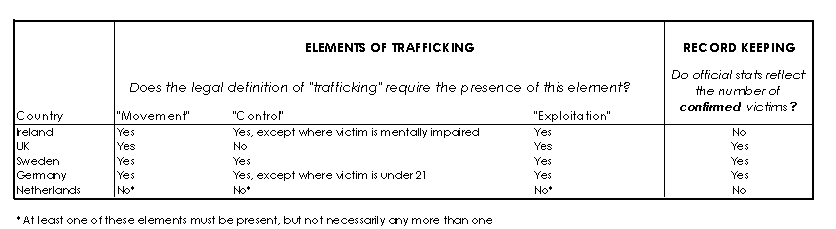
I thought it might be useful to make a simple chart to demonstrate why it’s meaningless to claim that one country has more trafficking than another, based on their official statistics. Seeing as this comes up all the time.

You can click on it to enlarge:

Trafficking definitions

There are a few explanations and disclaimers I need to get in:

  1. The chart is based on my own interpretation of each country’s laws. There is undoubtedly scope for disagreement in some of the details – but not, I believe, on the overall picture.
  2. The big centre column refers to adult trafficking only. I included an age qualifier for Germany because its law treats 18 to 21 year old adults as children.
  3. For “Elements of Trafficking”, I’ve used the three-part schema derived from Article 3(a) of the UN Trafficking Protocol. The headers are a common shorthand and are not to be interpreted literally (“control” doesn’t only mean actual control but can include deception, for example).
  4. Even within a single element, definitions can vary widely; eg, in the UK the “movement” element strictly requires travel, while the Irish definition adheres more closely to the broader Protocol criteria.
  5. Finally and most importantly, the chart reflects what the law actually says – not necessarily how it’s interpreted in practice. It’s theoretically possible that the reporting bodies in each country actually apply a more uniform definition in the process of collecting statistics. But that’s for the people who put faith in the official stats to demonstrate – and to my knowledge, not one of them has done so.

All that said, I think this chart makes one thing crystal clear: when countries tally up their “trafficking” figures, they aren’t necessarily counting the same thing. And unless these distinctions are controlled for in comparative studies, which they haven’t been so far, the evidential value of those studies is pretty close to nil.


Sources:

Ireland – Criminal Law (Human Trafficking Act) 2008

UK – Sexual Offences Act 2003

Sweden – Chapter 4 § 1 a of the Penal Code (2010:371) as translated in this Swedish police report

Germany – §232 StGB Criminal Code (original German here; translations courtesy of Ralph in this comment, Sonja Dolinsek of Menschenhandel Heute and Google Translate)

Netherlands – Article 273f of the Criminal Code