RSS Feed

Category Archives: Politics

Leo Varadkar’s World; Where men are men and women are grateful

Fine Gael’s Leo Varadkar, in a shining example of how to make friends and influence people, excelled himself with his comments indicating that some women may have to give up their jobs in order to avail of the new personal insolvency service.  The TD’s comments were picked up in The Irish Examiner;

I know one or two women who probably don’t make very much money at all from working, but they do it to keep their position on the career ladder, if you like, and that is a legitimate thing to do.

“But if you can’t pay your mortgage as a result, or buy your groceries as a result, then that is something that needs to be taken into account in any insolvency arrangement.

“Nobody is asking anybody to give up their jobs. What is going to happen is that people are going to come forward, they are going to say ‘I can’t pay my debts, I can’t pay my mortgage’, and in that case, the insolvency practitioner will go through with them why they can’t pay their bills, and obviously a creditor is not going to agree to a writedown unless that has been gone through and they can work out what is the most they can pay.”

We all know two income families where there are women working, and realistically they might be just about breaking even due to the cost of childcare. The outrageous cost of childcare is due to the fact that the Government have failed utterly in ensuring a state childcare system that is affordable and accessible for women or dare I say it, state-funded through an equitable taxation system and free to avail of.

Parents do not enjoy paying out the price of a mortgage to have someone mind their children, but they do it because they have to. They think “My child will be in school when they’re 4 or 5, this is hard but it’s only for a few years.” Working mothers will often add on a bit to the end of that sentence, “…this is hard but it’s only for a few years, and at least I’ll still have my job at the end.”

The implication of Varadkar’s comments are clearly that women in those situations where it may be a short-term cost to work should give up their jobs in order to avail of the personal insolvency arrangements. There is no other way of interpreting it.

And make no mistake about it he means women and women only should give up their jobs. Women for the most part earn less than men and it is they who should sacrifice their careers in order to save the family home. If they don’t do this, they can’t partake in the system and if the bank succeeds in having the home repossessed, well it’s Mammy’s fault because that selfish bitch wouldn’t give up her job. Dear Women, Leo Varadkar wants you to pull your socks up and get on with the hoovering because you have no business in trying to make your way in the workplace. That’s man stuff.

The problem with the new personal insolvency arrangements is that they’re wholly inadequate to deal with the level of distressed mortgages and personal indebtedness across the state anyway, so the number of people who will enter them will be limited to say the least. Most women and working mothers who are in debt now, are going to carry on being in debt and no amount of Varadkar’s nauseatingly nonsensical comments will change that.

But in Deputy Leo Varadkar’s world, women after giving up their engagement ring and then sacrificing their jobs because of childcare costs will enter an arrangement with the bank in which they’ll rearrange their debts and mortgage payments. Their children will go to school eventually and they’ll be told to go back to work. Except now there are no jobs so they’ll be dependent on their partner (if they still have a job) or social welfare payments or the kindness of St. Vincent de Paul, because if there’s one thing that Varadkar obviously doesn’t understand, it’s the difficulty that exists for women in attempting to re-enter the workplace after a prolonged absence. The Government is too busy bailing out banks instead of setting about creating jobs, or heaven forbid, doing a fundamental overhaul of how society is structured.

What this demonstrates is how women and women-focused issues are deemed completely irrelevant to the discourse around indebtedness, employment, and even motherhood in Ireland. Who cares if the childcare cost is arguably temporary and leaving her job contains a risk that may result in not getting another job a few years down the road? Who cares that nobody wants to acknowledge that childrearing is a form of labour? Who cares that women are expected to be responsible for childrearing, housework and labour outside of the home? Who cares that it costs up to €2,000 a month to put two children in a crèche? Certainly not the good and the great of Fine Gael.

Nevertheless the focus on women becomes very important when it comes to laying the blame at someone’s door. Just like working class single Mams have been demonised for having children and blamed for their lot of poverty since time began, indebted Mams will now be demonised for not giving up their jobs and sacrificing the family home, or alternatively giving up their job and then being unemployed when their children go to school. Realistically, who is going to stay working when the roof over their head is at risk? One would suspect it’s very few.

For women it’s a lose-lose situation. This is part of a strategy designed to make women work within the home for free to enable men to work outside it for payment. For a State that supposedly extols motherhood and deplores the fact that the reason most Irish women have abortions is because they do not have the financial means to raise children, it’s a particularly peculiar way to act.

Leo Varadkar’s attitude is like something out of an episode of Mad Men, envisioning a world where men are men and women are grateful, but perhaps the women of Dublin West won’t be so grateful at the polling stations during the next general election and if the men had any sense they won’t be so grateful either.

Taking Ideology to the Streets: Sex Work and How to Make Bad Things Worse

Posted on

“If you drive it underground so no one can find it, it wouldn’t survive.” – Rhoda Grant, 2012

In many ways, Dana fits the profile. She’s a twentysomething woman with a drug addiction. She was abused in childhood and her partner is occasionally violent towards her. They’re in and out of homeless accommodation, and she works on the street to fund both their habits. You could hold her up as an example of someone who does not want to do sex work, and you’d be right. You could score points with her story. You could insinuate that anybody who rejects total eradication of the sex industry simply doesn’t care about her. And that’s pretty much what the campaigners were doing when they lobbied for the criminalisation of her clients.

It’s late 2007, and the Scottish Parliament recently passed the Prostitution (Public Places) (Scotland) Act, outlawing kerb-crawling. Dana’s clients are now breaking the law. If she worked indoors, this would not (yet) be the case, but she doesn’t; she wishes she could, she knows she’d be safer there, but most brothel managers don’t take too kindly to injecting drug users, plus it would be hard to hold down structured shifts given how each day and night is arranged around the search for heroin. The law change hasn’t caused her to pack up and go home (what home?); instead, it has complicated and compounded an already difficult situation.

As I make her a cup of hot chocolate and count out free condoms, Dana takes a seat, tells me about last night. She waited on the streets for hours, frequently changing location in order to avoid police attention. The boyracers were out as usual, yelling abuse and throwing eggs as they sped by. She was rattling – experiencing heroin withdrawal. Gradually, the few remaining clients wore her down, and she agreed to do business with them for less than the usual price. She was out so long that she missed her hostel’s curfew and had to stay out until five in the morning; tried to sleep in a bus shelter. It’s late 2007 in Scotland, and the streets are cold.

“I used to complain about having to come out here to work,” she says. “I had nothing to complain about compared to now.” And this is the statement that sticks with me, a statement so simple and yet so clear, a statement which demonstrates that, despite how Dana’s supposed advocates, her would-be protectors – anti-prostitution campaigners – characterise sex work and how she experiences it, Dana herself knows the difference between a bad situation and a worse one. She is now in the latter. The support organisation I work for is severely underfunded (just over a year from now, it will be forced to cease service provision altogether). Waiting lists for drug treatment are lengthy, and missing an appointment, no matter how valid the reason, can land someone back at the end of the queue. When women like Dana are stopped by the police, sometimes they receive sympathetic treatment, but really it’s a lottery. There’s a serial rapist going around, but even though the women know about it, some of them are taking their chances with him anyway because there are so few clients to choose from. Maybe he’ll just be a bit rough, they rationalise. His behaviour escalates.

Those whose primary goal is to ‘send a message’ are worlds away from these women on the street. Their prioritisation of ideology over safety speaks volumes about their own motivations. It’s one thing if they simply don’t understand the practical repercussions of passing laws such as this one, although it’s too important an issue to excuse a lack of research – these are people’s lives we’re talking about here. But it’s quite another thing if their ignorance is a conscious decision, if they reject concerns not because those concerns are found to be invalid but simply because those concerns are raised by people they don’t want to hear from, including sex workers themselves. Those concerns interfere with a simplistic agenda which, in allowing no room for the nuances of real life, is set to fail. Harmful legislation is steamrollered through by people who block out dissenting voices and allow their supporters to believe there are no dissenting voices, or that those voices are dissenting only because they would rather see women ‘bought and sold’. This sorry state of affairs does no favours for the people they talk about helping.

Read the rest of this entry

An Open Letter to Roseanne Barr, From a Feminist Sister

Dear Roseanne,

My name is Ariel Silvera, I’m a latina from Buenos Aires, Argentina who has lived around the UK and Ireland for the past 11 years. I am also a feminist trans woman. Now that the election is over, I hope you’ll have time to take a look at this letter.

I’m going to admit I’m not as familiar with your work as I should be. I never watched your famous show, although a good number of my friends of mine swear by it. I’ve occasionally seen you say some quite brilliant things in terms of politics, and my perception of you until now has been one of a rather kickass woman. So, I’m writing this out of disappointment regarding your recent comments about trans women. From a feminist to another feminist.

I want to start with a reality check. I like talking about material reality, about things that actually happen, rather than conjectures and assumptions. This reality check is about toilets. In a heated twitter outburst, you wrote ‘if she has a penis, she’s not allowed in’, continuing with ‘women do not want your penises forced in their faces or in our private bathrooms’.

Roseanne, I honestly wonder, just what do you think I do when I go to the bathroom? I’m going to tell you exactly what I do when I go to a public bathroom. Don’t worry! I won’t be sharing any scatological details or talk about any gross poo stuff. Ick! Okay, so. My public bathroom routine is, more or less, as follows:

1. Enter bathroom, head to nearest cubicle (I’m lazy, what can I say), or, if there is a queue, join it and wait for my turn.
2. Once in the cubicle, I lock the door behind me. If there is no lock, or it’s broken, I try to find a way to hold the door either with one arm, or a leg, or a bag if I have any.
3. I do my business, and I get out of the cubicle. I head towards the sinks.
4. I wash my hands carefully. At this point, maybe eye contact is made with another woman. Maybe we’ll say hi or comment on the weather. You know, small talk.
5. Leave the bathroom in the knowledge of a job well done.

So, there you have it. This is what I do when I, a trans woman, a woman who was assigned male at birth and has transitioned to female, do when I go to the bathroom. I can imagine that you, a cis woman, assigned female at birth, have a similar routine. Maybe you make witty remarks if someone strikes up a conversation, after all you’re a very intelligent person who can come up with a better topic than the goddamn weather.

What I’m trying to point out here is that at no point did I:

1. Talk to other women or girls in the bathroom about my genitals and the status thereof, or
2. Show my genitals to other women or girls in the bathroom or generally expose myself.

I imagine you don’t do this either. Congratulations. You go to the bathroom in exactly the same manner I do, as a trans woman. And before you ask? No, I have not had sexual reassignment surgery.

In your tweets, you say that people like me should not be able to access women’s bathrooms. I imagine you expect me to go into the men’s toilets. Roseanne, are you aware of the violence statistics for trans people in America alone? The fact that a majority of young trans people report verbal and physical harassment, and a third of trans youth have considered suicide? Given the violent misogyny prevalent in American society today, that if someone perceived as ‘a man dressed as a woman’, or someone simply perceived as female or feminine, entered a male-dominated space, do you honestly believe they would not face violence? Did you know that there were 17 recorded murders of trans people in America alone in 2011?

We are just going to the toilet, Roseanne. We’re not there to molest kids. You’ve brought up NAMBLA, and how you fought against their inclusion under the Gay/Lesbian banner back in the day. Good. I despise NAMBLA. I’m glad you did that work and I’m thankful for it! But, I ask, why do you bring it up? Are you implying allowing trans women into women’s restrooms is the same as opening the door to child molesters, rapists and paedophiles?

Now, I want to ask you to do something. Look up all reported cases of trans women raping minors in restrooms. Or of ‘men dressed as women’ doing this. Now, look up statistics of the violence faced by trans people in our society, and the way it maims and murders us for who we are (or, occasionally, when a black trans woman kills a white man, by accident, in self defense, she is sentenced as a mere murderer).

Ask any trans person, trans men, trans women, genderqueer & non-binary folk, and we will all tell you that bathrooms, for us, are TERRIFYING. Almost every trans person I’ve ever met (and being a long-time activist in the community, I’ve met a few from at least a dozen countries), has a horror story. That time they got beaten up for being in the ‘wrong’ toilet, whether it corresponded to their birth-assigned gender or not. The time they got shouted at. The time someone stabbed them. And this violence is mostly faced by those whom patriarchy, heteronormativity and a racist capitalism makes the most vulnerable: trans women of colour. 

You are asking us to face real violence because of the fact that a small percentage of us (just like a small percentage of ANY GROUP IN SOCIETY) may be rapists or paedophiles. There’s probably paedophiles or rapists in your own party, Roseanne, statistically speaking. By your own logic, we shouldn’t let members of the Peace and Freedom party into women’s bathrooms either.

You’ve brought the misogyny present in much of the LGBTQ movement into this conversation. I couldn’t agree more that this is a hugely important thing to address, and we need to continue to make LGBTQ groups understand that misogyny exists, that women are particularly oppressed in this patriarchal society. I think we can agree on this quite easily. I’m a long-time feminist activist, and have seen how misogyny tears movements apart, and how we must bring a feminist consciousness to bear on these problems.

Near the end of this blog post, you talk about vitriol aimed your way by members of the trans community. Threats and misogynist insults are unacceptable! But when you imply that an entire community is made up of rapists and paedophiles, many people are going to be angry and upset. And they may have very base reactions based on the fact that a massive percentage of us deal with massive self-hatred, and are made to feel alienated and suicidal by a society which, largely, promotes hatred towards us. A hatred we have to confront in the streets, every day, when we leave our front door.

Your reaction to the anger of members of a persecuted and marginalised community, which you ignorantly insulted, was this:

“The level of their misogyny is akin to racist fascism from the nazi’s in 1930′s pre war berlin-The GLBTQ community needs to confront this and challenge it.”

As a trans woman who is also jewish; as a trans woman who is also the daughter of parents who survived two military dictatorships (in Uruguay and Argentina, supported by America, might I add); as a queer feminist activist fighting for liberation, as a person who has seen her friends bleeding after being beaten up at protests, evicted from their homes, as someone who fights the good fight against oppression, just as you do… This is disgusting and offensive.

The anger and vitriol from a bunch of pissed off people with very, very little power is not comparable to the campaigns of terror perpetuated by the Nazis in the build-up to their ascension to power. And that’s just the key here: power. Do you think that trans people really have the institutional and societal power to oppress you? In the United States, trans people keep being murdered, keep surviving horrible violence and discrimination, particularly trans women of colour, as I said above. Do you really think that their communication of anger through twitter is the same as a bunch of german dudes beating up an elderly jewish shopkeeper? Is this it?  I eagerly await your compilation of tweets, which the blog post promises.

I don’t know how to end this, Roseanne. I was shocked to hear you treat trans people as if we are your enemies, as if we are part of the powers that be, which continue to keep people fighting against one another, in poverty and misery, fighting wars for profit and propagating patriarchal attitudes. I hope you read this letter, and that you consider my words in it.

I leave you with a link to a video of me giving a speech encouraging Irish LGBTQ people to become allies of the pro-choice movement, at the March For Choice, Ireland’s largest pro-choice demonstration in 20 years, only a few months ago. One of my main involvements in feminism for the past five years has been campaigning for free, safe and legal abortion in Ireland, something which I imagine you strongly support. We have a lot in common Roseanne. I hope you consider what I’ve written here today.

Regards,

Ariel Silvera

Marching for Choice in Dublin

Posted on

Man carrying a sign with a picture of a coathanger and the words "Warning: Not for internal use".

It’s rarely easy to be openly pro-choice in Ireland. This country has no shortage of people willing to tell you how you’re a murderer, selfish, disgusting, a baby-killer. How you’re heartless. How you should be ashamed of yourself.

Woman with a poster saying "It's my uterus, I shouldn't need your permission"

The last major pro-choice demo I was at, two years ago, was a counter-demonstration to the March for Life. A couple of hundred of us, thousands of anti-choice marchers led by Youth Defence who didn’t hesitate to get in our faces, shout abuse at us, call us things I’m not going to repeat here. Being openly pro-choice can feel like running a gauntlet where you’re never sure what’ll happen next. So it’s not surprising that I was more than a little bit nervous before yesterday’s March for Choice. That nervousness, that apprehension, made what happened next even more incredible than I could have imagined.

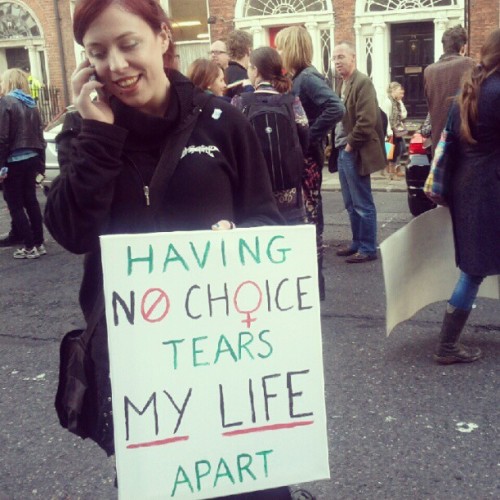
Woman on the phone, holding a sign saying "Having no choice tears MY life apart"

There were so many of us. Meeting at the Spire on Saturday afternoon, I couldn’t help but be amazed at how many people had showed up. I’d expected the usual suspects. There were, when I arrived early, hundreds and hundreds of us. And people just kept on arriving. And in these crowds of people was none of the usual tension of a pro-choice demonstration. As I walked through the crowd to check out what groups and banners were here and to say hello to friends I’d spotted, I heard so many people talking about the numbers. About how they couldn’t believe there were this many of us here. How they’d never seen so many people at something like this before. We were genuinely and collectively in awe at our numbers, here on O’Connell street. For the first time in my life, I felt that we might get somewhere with this. That we might really have some power to change things. Living in Ireland, it’s hard to truly explain what a truly big deal this is. How much of a revelation.

Woman with a sign saying "Against abortion? Don't have one!", pushing a pram with two children, with signs saying "I was a choice".

Walking through the streets, crossing O’Connell bridge, down Westmoreland Street and Kildare Street before turning up towards Merrion Square, it felt even more like a turning point. Here we were, chanting pro-choice slogans on the streets of Dublin, and the counter-demonstration was… where? I saw one man with a sign on O’Connell street. I saw no abuse from passers-by. And our numbers continued to swell.

Woman carrying sign saying "Woman, not Incubator"

In Merrion Square, the speakers were as varied and inspiring as the march itself. We weren’t on the defensive- we were on the offensive and proud of it. They spoke about how we won’t be shamed any longer. About how the majority of Irish people have consistently voted for women’s right to choose, and how we are fed up of being ignored. How if TDs want to follow God’s law and not the law of men (oh, how ironic), they should get out of Leinster house and join a seminary.

Woman carrying a sign saying "If I wanted the church in my *** I'd f*ck a priest!"

Feminist Ire’s Ariel Silvera spoke about the LGBTQ community and the pro-choice movement, arguing that we are natural allies. LGBTQ people need abortions too. Even if queer women don’t need abortions themselves, their sisters, daughters, mothers, and friends do. Ariel also highlighted the fact that it is not only women who need abortions. Many trans* men can get pregnant as well, and abortion providers and campaigners must be aware of their needs.

Man carrying a sign saying "My mother CHOSE to have me. I'm glad society didn't FORCE me on her!"

Mara Clarke from the Abortion Support Network spoke about her experiences raising funds for Irish women to access abortions they would otherwise never be able to afford. Banning abortion does not and never has prevented abortion. It just means that rich women can travel for abortions, and poor women are forced to give birth. The twelve women who travel to the UK every day for abortions are those who can afford it. The Abortion Support Network provides grants to Irish woman, and runs solely on private donations and fundraising. Needless to say, if you’re able to support them please do. Irish women should never be forced by lack of money to become mothers. Nobody should.

Woman carrying a sign saying "Fine Gael protects..." then with the words "Students, Pensioners, the Sick" crossed out, and then the word "Embryos"

But finances aren’t the only reason that people in Ireland could be forced to give birth against their will. The Irish Feminist Network‘s Osaro Azamosa reminded us that many immigrant women are simply not permitted to access visas to travel to the UK. These women’s reproductive rights are not only financially but legally denied by the current situation.

Woman holding a sign saying "Not just a white middle class issue: ethnic migrant women need access to abortion."

And so much more from Sinead Ahern, Ivana Bacik, Claire Daly- if I’ve left anyone out do tell me! And it wasn’t all about abortion. Pro-choice isn’t just about the right to choose abortion. It’s about full reproductive rights- and that means that right to reproduce free of coercion. For a real choice, women need to be supported to raise children without cutbacks to welfare. Without cutbacks to disability allowances for themselves and their children. Just as nobody should be forced to give birth because they can’t afford abortion, nobody should be forced to choose abortion because they can’t afford to raise a wanted child.

Man holding a sign saying "The Truth:In the UK, 78% of abortions are carried out under ten weeks. This is the result of an abortion at 10 weeks. Actual size. Truthfully. "

The Irish state needs to face up to its responsibility for the many thousands of women who have travelled overseas for abortions. It has a long-standing habit of brushing inconvenient women under the carpet- years ago to be incarcerated in Magdalene laundries, now on Ryanair flights to Britain. At yesterday’s march we came together to say that we are no longer going to accept this. We’re sick of being silenced and of our choices villified and shamed. We’re not going to accept being caricatured as heartless murderers anymore. We care deeply for the rights and well-being of all of us, for everyone in this country’s right to self-determination. And we’re not going to be quiet anymore.

Your post author holding a sign saying "Some of us can't leave this country! Whether illegal, trafficked, resident, refugee or asylum seeker- ALL ethnic migrant women deserve quality access to quality sexual health in Ireland. That includes ABORTION!"

Your intrepid blogstress weary and happy after the march.

New edition of Look Left out now

Posted on

Just a short announcement that the new Look Left is out now, featuring a piece by yours truly on the Swedish sex trade law (along with an opposing view). For a list of places to buy it, click here.

ETA: You can now read a PDF of my article here.

It’s also got the following articles:

* Another Europe is Possible
* Interview with Mandate General Secretary John Douglas
* Michael Taft on the possibilities for building a progressive future
* Conor McCabe on the myth of NAMA’s ghost estates
* Gavin Titley on the media’s reporting of the economic crisis
* The Price of Corruption
* Belfast: Divided by Walls, United by Poverty
* The politics of the Pogues
* Brian Hanley on Frank Ryan’s Street Fighting Years
* Lauren Arrington on Delia Larkin and the Irish Women Workers’ Union
* What Now for the ULA?
* Egypt’s Permanent Revolution?
* Stormont’s Policies a Recipe for Poverty

Well worth the €2. Please check it out. And thanks to the editors for inviting me to contribute.

On Labour Women’s Statement on the EU Fiscal Treaty

Posted on

Earlier this month, several female elected representatives of the Labour Party held a press conference and issued a statement calling for a Yes vote in Thursday’s EU Fiscal Treaty referendum. Their message was aimed at women, and Mairead Enright has a good piece here pointing out the tired essentialism in their appeal.

The first thing I thought of when I read this was a poster put up by the Yes side during one of the last referendum campaigns:

I never saw the “Ireland for Europe” group’s explanation of what they meant by this slogan – safer from what? – but the message was pretty clear. It was written in the first person singular, “I” rather than “We”, indicating personal and not collective safety. It featured a woman – can you imagine it featuring a man? – of an age where personal safety is likely to be a matter of significant concern; she is past the fearlessness of youth, but is neither so old that voters see her age before her gender, nor too young for senior women to identify with. In short, she is Everywoman, with the exception only of those women young enough to be targeted in the “young people” category. While the Yes campaign generally traded on fear, it was a peculiarly gendered, intimate type of fear that this poster aimed at instilling.

The Labour Women statement of the current campaign isn’t quite so brazen, but there is still a current of intimate fear running through it. Note, again, the reference to women’s safety in their support for the Treaty:

Joan Burton opened by reminding us that for women a YES vote is the safest option.

There is very little in the statement about what the Treaty will actually do to improve women’s lives – in fact, one of the speakers openly admits to the lack of direct positive consequences of a Yes – but a lot about what might happen if we don’t pass it, which Labour Women threaten could amount to no less than “devastation” for “you and your family”.

As Enright’s post shows, the statement makes a lot of suggestions as to why a Yes vote should appeal to our womanly nature. But it gives only one real concrete reason to vote for it: to get access to European Stability Mechanism funding. Without this funding, it is implied, social welfare will have to be cut, gender inequality will worsen, poverty will increase. Not mentioned is the fact that the Treaty also requires a commitment to the same austerity measures that have already led to social welfare being cut, gender inequality worsening and poverty increasing. Measures which Labour themselves have been implementing in government, through the very woman (Joan Burton, the Social Protection Minister) who opened this press conference.

Labour, of course, were firmly opposed to austerity while in opposition. In her response to the final budget of the previous government, Minister Burton said:

There is enough austerity in today’s announcement by the Minister, Deputy Lenihan, to make even the most ardent Tea Party fan grin in delight. There is pain for the poor, money for the rich, particularly for the bankers, and the rolling back of the State.

What has all the austerity and deflation done for us as a country so far? In more than two and quarter years of austerity, unemployment has risen from 4% to 14%, which is 435,000 people. Austerity has slashed growth, it has killed consumer confidence and turned us into a nation who are busy paying down debt or saving – anything but spending.

We all know about the famous three Rs that are the bedrock of early education. There is another set of three Rs that became the bedrock of economic recovery in the post-Depression era and formed the basis of the post-war politics in Europe, irrespective of the country or party in power. These three Rs are reflation, redistribution and reform. If the Labour Party is in Government after the next election, reflation, redistribution and reform will be what its participation in government will be about.

During the election campaign, plenty more promises like that were made by Labour, and all of them were broken. The three Rs we’ve got from this government have been recession, redundancies and repossessions. When asked to explain this about-face, Labour often responds by blaming the EU-ECB-IMF Troika. Burton again:

I am conscious that the reforms which are on the table may be painful for some in the short-term.

But we are constrained in what we can achieve by the fact that we are living on borrowed money, borrowed money which comes with many conditions attached.

In other words, having loaned Ireland the money it needs to run itself, the IMF and its Troika partners are also dictating how it is spent. The internal Labour line, or so I’ve been told by a party apparatchik, is that the Troika has people with veto power monitoring every government department. Now either that’s not actually true and the Labour/Fine Gael government are implementing these measures of their own accord, or Ireland is part of what can only be deemed an extremely unhealthy relationship of financial dependence, in which the other party controls all the purse strings.

The Labour Women statement, incredibly, implies that the solution to the problems created by this financial dependence is to sign up to more of it. The statement admits that the Treaty won’t bring us jobs, investment and growth, but since Ireland can’t access ESM funds without it, we

depend on this treaty to be passed to have a more secure future

At the end of the day, this is really what it’s all about: “security” is equated with “access to [someone else’s] money”. And to be entirely dependent on someone else’s money but have little control over what we can do with it, that’s not a bad thing. To be making huge sacrifices in a relationship that we’re not getting anything else out of – including things that we really need – that’s not a bad thing either. Forget things like autonomy, self-fulfilment and self-determination; as long as we have that security in our lives, that’s all that matters.

What kind of message does that send to women?

Children’s rights must not mean women’s wrongs

Posted on

Last month the Irish Minister for Children, Frances Fitzgerald, announced that the long-promised referendum on the rights of children would finally be held this year.

The background to this lies in the following provisions of the Irish Constitution:

Article 41
1. 1° The State recognises the Family as the natural primary and fundamental unit group of Society, and as a moral institution possessing inalienable and imprescriptible rights, antecedent and superior to all positive law.
2° The State, therefore, guarantees to protect the Family in its constitution and authority, as the necessary basis of social order and as indispensable to the welfare of the Nation and the State.

3. 1° The State pledges itself to guard with special care the institution of Marriage, on which the Family is founded, and to protect it against attack.

Article 42
1. The State acknowledges that the primary and natural educator of the child is the Family and guarantees to respect the inalienable right and duty of parents to provide, according to their means, for the religious and moral, intellectual, physical and social education of their children.

5. In exceptional cases, where the parents for physical or moral reasons fail in their duty towards their children, the State as guardian of the common good, by appropriate means shall endeavour to supply the place of the parents, but always with due regard for the natural and imprescriptible rights of the child.

The proposed referendum, as agreed by an all-party parliamentary committee, would leave Article 41 intact but remove those two subsections of Article 42. The replacement text is rather lengthy so I’ll just provide a link rather than post it all here.

The impetus for this change comes from a series of judicial and policy decisions, which have been seen as making it so difficult to interfere with the sacred institution of The Family (and more particularly the marital family) as to effectively tie the State’s hands when it comes to child protection and welfare. A few examples:

  • The 2001 case Northwestern Health Board v HW, where the Supreme Court upheld the right of parents to refuse to allow their child undergo the PKU test, a totally safe procedure to detect a disorder that leads to brain damage if untreated.
  • An unspeakably horrible case of familial abuse in County Roscommon, revealed a little over a year ago. You can Google it yourself, I don’t have the stomach for it. The mother had obtained an injunction preventing the children being removed from the family home; her affidavit cited the rights that she and her husband, as a married couple, had over their children. Social workers on the case confirmed that Article 42 had a sort of chilling effect on their efforts to protect the children, as it led them to believe they would need to prove a nearly impossible threshold of neglect.
  • The 2006 “Baby Ann” case (N v Health Service Executive), in which a two-year-old girl was ordered returned to her birth parents. They had consented to her adoption, but changed their minds and subsequently married – at which point, according to Justice McGuinness, the rights of the family took over from the best interests of the child as the “central issue”. (Actually, on the peculiar facts of this case the birth parents would have had a decent argument even without the constitutional imperative, but there are obvious reasons to be concerned about the court’s emphasis on the primacy of the marital family.)

So you can see why there’s widespread support for amending the Constitution to specifically enshrine the rights of children. What little opposition there is is mainly coming from two of the most repellent groups in Irish society: the xenophobes, who fear the amendment being used to prevent deportation of Africans with minor children; and the uber-Catholics for whom any interference with the marital family is anathema. (It hasn’t gone unnoticed that the list of amendment opponents reads like a Who’s Who of the Irish anti-abortion movement – whose concern for the rights of children clearly ends at birth.) Ironically, although the latter group is far more organised and politically powerful than the former, it is the deportation issue that is actually holding the referendum up. I was present at a private meeting a couple years ago where a then-Cabinet Minister, a current Cabinet Minister and a backbench member of the other current government party all agreed that the wording would have to be changed to assuage those fears.

Irish feminism, on the other hand, seems to be pretty much entirely behdind the amendment, and that’s fairly understandable. After all, the primacy of the marital (read: patriarchal nuclear) family hasn’t exactly done us many favours; and while the amendment won’t remove Article 41.1, it clearly will narrow its scope. But while I wouldn’t argue that we should vote “no”, I do think some important issues have been overlooked in the debate. Consider the following:

  • In 2006, the High Court ordered that a Jehovah’s Witness be given a blood transfusion (subscription required) contrary to her express wishes, the first time this was done to a competent adult. Counsel argued and the Judge accepted that her child’s need for a parent overrode her right to refuse medical treatment.
  • In the US, women have lost custody of their children for working outside the home, being lesbians and even reporting domestic abuse.
  • According to a representative of the fabulous Association for Improvements in the Maternity Services Ireland who I was speaking to recently, some Irish women have been threatened with prosecution – yes, prosecution – if they insisted on giving birth at home rather than under the full control of the professional (and strongly male-dominated, and extremely paternalistic) medical industry.

What these cases all have in common is that they’re examples of the “best interests of the child” being used to further a patriarchal agenda, in which motherhood automatically strips women of their autonomy. Make no mistake about it, this isn’t just the standard assumption of self-sacrifice that having children always entails; it’s the quite deliberate channeling of women with children – whose primary identity is now “mother” – into tightly prescribed roles, with the legal system there to act as enforcer.

I’m being a bit deliberately melodramatic here and I’m not suggesting that passage of this amendment will actually turn us all into Stepford wives. But I don’t think we should be complacent about the risk of “children’s rights” becoming another tool of state misogyny. Let’s not forget that this is a state where woman’s primary role as housewife and mother is actually enshrined in the Constitution (Article 41.2, for readers abroad). Do you trust all of our judges to read the new amendment in a way that protects children’s rights without trampling on women’s? I don’t.

I’m also uneasy about the way this amendment could be read in juxtaposition with Article 40.3.3, on the right to life of the “unborn”. Judging by some of the cases coming out of the US at the moment, it seems that pregnant women in some states might be only a few years away from being forcibly institutionalised to prevent them doing anything that might possibly lead to the birth of a less-than-perfectly-healthy baby, such as having the odd glass of wine or eating too much junk food. It’s a strange sort of logic that allows women to be penalised for “neglecting” foetuses that they have every right (at least on paper) to abort, which I suspect is why those laws aren’t more widespread throughout the US than they are. Here, of course, the constitutional position on abortion is no impediment to such laws – and with a mandate to protect both the rights of (actual) children and the rights of the “unborn”, there is, I think, a worrying possibility that this American trend could catch on here.

Again, and just to be perfectly clear, I’m not saying that feminists should oppose the amendment. In all likelihood I will vote for it myself, on a simple cost-benefit analysis (as in, I think overall it will probably do more good than harm). And I don’t have any suggestions as to how it could be worded to avoid these nightmare outcomes, especially while the odious Articles 40.3.3 and 41.1-2 remain. But we shouldn’t be leaving it to the racists and religious fanatics to highlight its possible unintended consequences. We should be putting the State on notice that although we want to see better protection for Irish children, we are not going to tolerate it becoming yet another tool to oppress Irish women.

Questioning quotas

The question of gender quotas in politics raised its head in Ireland again last week, as Labour TD Joanna Tuffy – who seems to fancy herself something of a maverick, at least when it doesn’t require her to actually defy the party whip – went all over the media arguing against the consensus that seemingly all parties have signed up to. We have a low rate of female representation in our legislature, despite all the main parties having some sort of internal strategy to promote women’s candidacy, so it’s not surprising that many believe it’s time to move beyond voluntary codes. The Programme for Government of the current coalition states that for future elections, funding for political parties will be tied to the percentage of female candidates they run.

Tuffy has made no secret of her opposition to this policy, and apparently it isn’t only quotas she objects to. Earlier this month an email went around to the female parliamentarians, proposing a meeting to discuss what steps they could take to promote women’s participation in politics. Tuffy replied, cc’ing not only the recipients of the original email but every male parliamentarian as well (as if she was exposing some naughty secret being hidden from them), saying that she would not take part in any meeting from which men were excluded. Predictably, she compared it to men holding a meeting and excluding women, and suggested that gender was irrelevant to their roles as public representatives. That the presence of men might hinder a full and frank discussion as to why women sometimes don’t feel comfortable in politics – possibly including, for example, the boorish and lecherous behaviour of certain male politicians (something I’ve experienced myself) – didn’t seem to occur to her or, if it did, she obviously didn’t think it was important.

Last week she addressed the quota issue directly in an opinion piece titled Gender quotas do women no favours – and undermine democracy. Her arguments are mostly pretty weak, but I’m sure they’ve been forensically picked apart elsewhere so I’ll just briefly highlight the glaring flaws:

Gender quotas bypass the voter’s right to decide, and impose a conclusion on him or her…The proposed quotas will mean that candidates will be ruled out on grounds of gender, and legislation will make such discrimination mandatory. This appears to conflict with Article 16.1.3 of the Constitution, which states that no law shall be enacted placing any citizen under disability or incapacity for membership of the Dáil on grounds of gender.

I would accept the validity of these arguments if there was a quota on the number of women that had to be elected. But that’s not what the government is proposing. Political parties will have to select more female candidates but the voter is under no obligation to elect them. Equally, a candidate is under no obligation to run for any particular party (or indeed, for any party at all): if a man can’t get selected for one party because of the gender quota he can still run for another party, or as an independent. If this was the US, where it’s the voters who select the party’s candidates and independents almost never have a hope, Tuffy would have a point here. But not under the Irish electoral system.

Which isn’t to say the Supreme Court might not ultimately agree with her – since their ruling that it’s ok for Portmarnock Golf Club to discriminate against women as long as it defines itself as not a golf club but rather a men’s club that happens to play golf, I’ve given up expecting logic from them in equality decisions – but it’s certainly not self-evident that they will, as Tuffy seems to think.

She next asserts that

gender quotas will give party leaders more control over candidate selection.

It’s a weak argument, made weaker by the lack of any explanation as to how or why they will do so. First of all, anyone who thinks Irish party leaders don’t already have all the control they need over candidate selection has, IMHO, a very naive view of how electoral politics actually works in this country. Secondly, this argument could work both ways: quotas could actually lessen party leaders’ control where too many of the favoured candidates were of a single gender. I suppose what she’s getting at is that under a quota system it isn’t simply a case of running the candidate who gets the most votes at the selection convention, but it isn’t as simple as that under our present system either. I doubt Tuffy is really unaware of all the manipulation that goes on behind the scenes at those “conventions”.

She continues with:

even if no woman had ever lost out because of gender quotas, that would not make them right. Positive discrimination is discrimination all the same.

Broken down, this argument goes like this: Discrimination is wrong; quotas are a type of discrimination; therefore quotas are wrong. It’s similar to one of the most annoyingly simplistic anti-choice arguments (the taking of human life is wrong; the foetus is a human life; therefore abortion is wrong). It reaches its conclusion by assuming that everyone agrees with its premises, unconditionally and without any need to justify them.

The problem of course is that there are plenty of circumstances in which discrimination is not necessarily wrong – or, at least, it isn’t seen as being necessarily wrong. These can range from the micro level (a woman who will only date men discriminates against other women in her choice of romantic/sexual partners) to the macro (a state that only allows its own nationals to enter without visas discriminates against foreign nationals). They already include the electoral level (the Labour Party is entitled to refuse to select Fine Gael members as candidates). If any of these examples are accepted as not being “wrong”, then the blanket assumption that discrimination is wrong is unsustainable – and therefore a statement like “positive discrimination is still discrimination” tells us absolutely nothing about why that is a problem.

She writes,

Those that argue for quotas claim that women don’t win selection conventions. Where is the evidence for this? Where the problem really lies is in the fact that not enough women choose to run for election.

I don’t have the facts and figures about women winning selection conventions, but I accept that the refusal to run at all is probably a bigger problem. It’s odd, though, that she doesn’t see the value in having spaces where women can openly discuss the reasons for that refusal. Does she think it will just sort itself out?

I nearly split a gut reading this part:

Quotas treat women as if they can’t hack it a party’s selection convention, like a man can. They decree that women must be selected on the basis of their gender, and this does them a disservice. Women, just like men, should be chosen on the basis of their qualities as individuals and their ability to persuade voters.

I honestly have to wonder what planet she is on to think that candidates are presently chosen for those reasons. Is that why Maurice “I’m sorry we legalised divorce” Ahern (Bertie’s brother) was selected to run in the Dublin Central by-election over the far more capable Mary Fitzpatrick? Is it just a coincidence that when a sitting politician gets a running mate, the candidate selected for that role is often the one who poses the least threat to the incumbent? The pretence that there is a meritocracy at work in the current system is possibly the weakest of all arguments.

The worst thing about Tuffy’s column is that it is so poorly argued it suggests that there aren’t any valid reasons to oppose quotas, or at least, to question their value. And there are some reasons. Tuffy hints at one when she says

A target is imposed from the top – but the reality on the ground stays the same because the issue is not tackled from the bottom up.

Unfortunately, since she fails to really think this argument through, the reader is left with the suggestion that this alone is a reason to oppose quotas. And it’s not. It’s an argument not to make quotas the sole “solution” to the issue, but not to exclude them as part of the solution. What she could have pointed out is the danger that quotas could mask the “reality on the ground”, could make it look as though there is no longer a problem and hence no need to also tackle the issue from the bottom up. This has in fact been my own experience of quotas: they are essentially a cosmetic solution, and too often they wind up being not a companion to, but instead a substitute for, more substantial measures.

Part of the reason for this, I think, is that quota supporters often have different notions of what the main problem is. Feminists want more women in politics so as to get more pro-woman policies. But in seeking quotas they are allying themselves with people who aren’t feminists, don’t necessarily support such policies and think that once you’ve sorted out the male-female imbalance in public life, that is the problem dealt with.

The case for quotas as a means of advancing women’s issues is often made by pointing to the Nordic countries, which have high proportions of women in their parliaments and also have very progressive policies around things like parental leave. But that country chart I linked to above shows that things aren’t quite as cut and dried as that. There are many countries whose ranking does not appear to coincide with any particular level of commitment to women’s rights. Andorra, at number two, still outlaws abortion under any circumstance except risk to life; only this month in Rwanda, the highest-ranked country, three teenage girls received one-year prison sentences for the same “crime”. It could well be that things would be even worse for women in those countries if they had less gender-balanced parliaments, but a female majority that won’t even remove laws that criminalise reproductive autonomy is hardly a thing worth aspiring to.

The problem with expecting more women in politics to lead to more feminist policies is, of course, that not all women are feminists. Some in fact are the exact opposite – but a quota policy won’t discriminate between the two (you see Joanna, that’s an example of “positive” discrimination!). Who is to say that the consequences of this policy wouldn’t be more Lucinda Creightons? What if men who have actively supported feminist causes were forced out in favour of more conservative female colleagues?

This is one place where my suspicion of quotas differs from Joanna Tuffy’s. She writes that

Gender quotas subvert democracy by making the ends more important than the means.

To my mind, equal representation of women in political life is a means and not an end. The “end” will be achieved when equality between men and women (and those outside the binary) is no more of an issue than equality between the blue-eyed and the green-eyed. Gender quotas could be a step towards getting us there, but they’re far from an end in themselves. And depending on how they operate in practice, in terms of the candidates who actually benefit from them, there is always the possibility that they could make things worse.

And though I don’t like the way quota opponents always resort to whataboutery in these debates, I also don’t think we can ignore the shockingly poor representation of ethnic minorities in Irish politics. As far as I can make out, our parliament has two members who are half-Irish and half-something else, one American of apparently Italian descent and everyone else is of an ethnic Irish and/or British background. There are no Travellers, either. The Houses of the Oireachtas must be one of the least diverse employers of its size in the entire country. And local government – where there isn’t even a citizenship requirement – is little better. Why isn’t this seen as at least as big a scandal as the under-representation of women? If gender quotas are introduced, is there really a good argument as to why ethnic minority quotas shouldn’t be next?

Let me be clear – I’m not against quotas, per se. I’m certainly not opposed to them on principle, as Tuffy is. What I question is the enthusiasm that so many Irish feminists have for them. It is especially galling seeing the energy being spent on this campaign by Labour Women, who could be doing much more for gender equality by stopping their party imposing budgetary measures which will have a particularly devastating impact on women. It is hard to take seriously their claims of supporting women’s interests by trying to get more women into the exclusive club at Leinster House (starting salary: €100K plus expenses) at a time when their (female) Social Welfare Minister is poised to slash the incomes of the women on the very lowest rungs of society.

Ultimately, what it comes down to is this. Women are oppressed because we live in a capitalist and patriarchal society. It will still be a capitalist and patriarchal society after the quota system is introduced (as appears inevitable). The main difference is that there will be more women administering capitalism and patriarchy. Is that better than fewer women? Sure, if they administer it in a way that does women less harm. But there’s no guarantee that they will, and anyway, my feminism is a lot more ambitious than that.

Of course, I don’t expect Joanna Tuffy to understand.