RSS Feed

Category Archives: Sex work

Just Don’t Call It Slut-Shaming: A Feminist Guide to Silencing Sex Workers

Posted on

The feminist movement really is in a pickle these days. It used to be a given that things like prostitution, pornography and stripping were bad, but nowadays there’s some resistance to these time-honoured notions. Women are increasingly coming out as sex workers and demanding rights. As feminists seek to shut down strip bars and criminalise clients, those women are complaining not just that they’ll lose their livelihood, but that they’ll be at increased risk of abuse and violence if their industries go underground! You can’t let such trivial concerns get in the way of your crusade, so below are some handy tips for discrediting these pesky meddlers. Remember: being an actual sex worker doesn’t entitle her to speak about sex work!

I don’t believe you; you don’t realise the harm you’re doing to yourself

This is generally your starting point. There you are, explaining that no woman really wants to work in the sex industry, and then some bint pops up claiming that her existence proves otherwise! Aim for the ‘false consciousness’ tactic here: citing statistics from research that the audience doesn’t need to know has been widely criticised by academics, you can imply that you know better than she does what’s good for her. Bonus points for using a strategy also employed by opponents of abortion rights!

a) You think the sex industry is the best thing ever!
b) What you said just proved that sex work is bad!

Keep her on her toes: if the sex worker claims any degree of autonomy or job satisfaction, paint her as a naïve fool who believes that the entire sex industry is a magical fairytale land of flowers, rainbows and sparkly dildos. Your own points about abuses in the industry should outweigh anything she has to say, rather than combining the two to give the audience a greater understanding of the diversity of human experience.

On the other hand, if the sex worker at any point mentions having a bad day at work, outlines the safety precautions she takes, or even jokes about clients with smelly feet, be sure to pounce on this straight away as evidence of the inherent harm of the sex industry. Don’t budge an inch if she tries to point out that none of these things are unique to sex work. It’s different, because it’s sex. Got that? Soon enough, she’ll stop publicly discussing any problems related to sex work, for fear that you’ll use them to call for complete eradication. And once she’s shut up about them, you can safely return to point a). Genius!

You’re only concerned about losing business

Goddammit, what is with these people? You’re only trying to send a message about equality between men and women, and they’re raising hell about disrupted support networks and a rise in violence! But that’s okay. As long as you make them out to be purely motivated by greed, you needn’t actually address the issues they’re highlighting, let alone the reasons why they might need money in the first place. Bonus points if you’re able to employ this one against, say, an escort who’s concerned about the increased vulnerability of street-based sex workers. Don’t for a moment entertain the idea that there might be solidarity across the sex industry.

You’re being paid off by pimps and traffickers

This is a great one. It’s a bit preposterous, but if your audience has already lapped up everything you have to say, you can possibly get away with the notion that the only reason people might disagree with you is that they’re the sockpuppets of shady criminal masterminds.

You’re letting all women down

If, despite your best efforts, the audience seems in danger of accepting that your opponent genuinely chose sex work, experiences it as a relatively worthwhile pastime and, furthermore, has some points that might be worth listening to, quickly play your trump card: it’s not about her, it’s about all women.

Although, once upon a time, feminism was concerned with questions such as “Does lesbianism discredit the movement?” or “If I like painting my nails, buying shoes and sucking cock (for free, of course) am I letting the side down?”, these issues have largely been cleared up in the name of freedom of choice. Luckily for you, though, feminism on the whole does not (yet) look so kindly upon women whose choices include sex work. Keep it black and white and don’t let any nuance get in there. Base your argument here on claiming that the sex industry promotes negative attitudes to women – for bonus points, use objectifying language to describe sex workers while explaining that objectification is bad. You’ve already established that consensual paid-for sex is wrong, so a woman who willingly provides it is clearly a traitor to your gender. Under the guise of ‘love the sinner, hate the sin’, you can proceed to being as nasty as you like to those uppity sex workers: they didn’t listen to you when you warned they were making the wrong choice, so they’ve already forfeited their right to sisterhood.

You’re not representative

Feminism has fought long and hard to dispel stereotypes and push for more rights for all women. Cast that legacy aside for now and focus on the task at hand! You may be advocating a course of action that will affect everybody in the sex industry, but you can still get away with claiming that anyone who doesn’t like it simply doesn’t count. Plus, if you play your cards right, manage to keep the dissenters in their place, and get the law-makers to agree that your ideology is more important than women’s safety, eventually the sex industry really will become a wholly unpleasant place to be. Those who have the means to find other work will at long last understand that it’s time for them to do so, and the only people left will be the ones who were already having a hard time of it and have no alternatives. Then all sex workers really will meet your standards of ‘representative’! It’s a bit of a circuitous route, grinding down a diverse industry until it encompasses nothing more than a homogeneous group of abused victims of pimping and trafficking, with no agency of their own and uniformly miserable experiences. But by then, at least, everybody will be exploited and unhappy, just like you were saying they were all along. You’ll have proved your point. Congratulations, and thanks for your contribution!

The Irish trade union movement throws sex workers under a bus

The Irish Congress of Trade Unions is an umbrella organisation representing nearly all the active trade unions in Ireland, north and south. A full list of its member unions can be found here (by industry sector) or here (alphabetically).

ICTU has made a submission to the Irish government’s public consultation on the prostitution laws. As you can see here, where their submission is reproduced is full, most of it is just a cut-and-paste job of text sent to them by the Turn Off The Red Light campaign, which seeks the introduction of the Swedish model. But there is one part of ICTU’s original contribution which I found remarkable. A few paragraphs down the submission cites – clearly for the purpose of endorsing – the view of the Technical, Electrical & Engineering Union‘s General Secretary that

prostitution could not be considered “work”

ICTU didn’t invent this view, of course. But it strikes me as taking on a much graver significance when held by trade unionists than by, say, radical feminists or religious puritans. Because the corollary of prostitution not being work is, of course, that the people engaged in it aren’t workers – and are therefore not entitled to the rights that trade unions (theoretically) exist to defend. Effectively, what they’re saying to sex workers who want those rights is: piss off, and call us when you’ve found a real job.

This position puts ICTU at odds with the International Labour Organization, to which it is of course affiliated. While the ILO takes an officially neutral stance on the legal status of sex work, it has made abundantly clear that it recognises the sex industry as a de facto economic sector, and people who sell sex as engaging in a form of labour. In its groundbreaking 1998 report The Sex Sector: The Economic and Social Bases of Prostitution in Southeast Asia, for example, editor Lin Lean Lim proposes that

For those adult individuals who freely choose sex work, the policy concerns should focus on improving their working conditions and social protection, and ensuring that they are entitled to the same labour rights and benefits as other workers.

The international standards developed by the ILO also reflect this position – albeit impliedly rather than explicitly, in their frequent reference to “all branches of economic activity” (my emphasis). The 1981 Occupational Safety and Health Convention is an example.

And what about the jurisdictions which have actually incorporated those standards into their own laws around sex work, such as New Zealand?

Abel, Fitzgerald and Brunton, “The Impact of the Prostitution Reform Act on the Health and Safety of Sex Workers” (2007)

The phenomenal figures in the last three rows of that table are the consequence of legislation which was expressly designed to treat sex work as work – legislation, in other words, designed to do exactly what ICTU says the law shouldn’t do. And thus ICTU, which is a trade union body hence theoretically a workers’ rights organisation, would reject a framework agreed to be rights-protective by over 90% of the workers operating within it, because they don’t consider them “workers” to begin with. ICTU policy would take those rights away from them.

I’ve been racking my brain trying to think of a parallel to this extraordinary situation, and I’m honestly stymied. Even considering the obvious context – disapproval of prostitution as a matter of principle – I can’t think of another sector in which the “solution” would involve the wholesale rejection of labour rights for those involved. I cut my political teeth in anti-war and anti-nuclear campaigning, and I don’t recall anything remotely comparable to this. We may have wanted to decommission the bases and power plants but we never said labour law shouldn’t apply to people working at them.

Nor can ICTU’s position be justified on the basis that sex work isn’t really a choice. The term “work” may be deemed inappropriate for actual forced labour, the labour of someone who is literally enslaved – but ICTU, like all but the most fanatical fringes of the anti-sex work movement, don’t seem to think that most in the sex trade fall into this category. Instead, their submission refers to the “poverty, past history of abuse or limited life choices” that push people into prostitution. But ICTU don’t see it as “not work” when poverty and limited options push people into unappealing jobs outside the sex sector – and they would never dream of opposing legislation to give those workers labour rights.

In some respects, this betrayal isn’t really a surprise: the Irish trade union movement has a long history of selling out Irish workers, especially those at the margins. (They also have a history of an undemocratic, top-down style of leadership which seems to be reflected here as well: nobody I know in any of the ICTU-affiliated unions was asked for their opinion of this submission before it went in.) But summarily excluding a whole sector of the economy from their remit, and refusing to defend the labour rights of the (particularly vulnerable) people dependent on it? That’s a new low for them, and it’s a shocking one.

The Oslo report on violence against sex workers

Posted on

[Hi, Feminist Current readers! Please see this response to the piece that brought you here.]

A couple years ago, as many readers will know, the Swedish government commissioned a report into the outworking of that country’s sex purchase ban. The so-called Skårhed report had numerous flaws which have been dissected elsewhere, such as terms of reference which explicitly precluded repeal of the law (“One starting point of our work has been that the purchase of sexual services is to remain criminalized”), and the fact that only seven active sex workers participated in the study and their views were dismissed anyway. Nonetheless, the law’s advocates repeatedly point to the report as if its official status rendered it ipso facto a definitive statement about the law’s impact – so I’m sure they’ll be the first to latch onto the new report commissioned by the City of Oslo, right?

Well, maybe not. For one thing, the Norwegians haven’t been as quick to have it translated as the Swedes were, although there’s a brief English-language article about it here. From that headline you’ll guess the other reason this report won’t be trumpeted by the same people who took the Swedish report as gospel: because its own findings, based on questionnaires completed by 123 active sex workers as well as interviews with police and social services, paint a decidedly more negative picture than Anna Skårhed’s.

I’m not going to get into the statistics in the Oslo report, first because (as I’ve often said) I think figures are inherently problematic in this field, and there are some methodological limitations which call for caution in interpreting the findings. It’s important to note that the authors themselves state, on page 54, that

This data does not explain whether the high incidence of violence and the vulnerability that women in prostitution experience are due to the criminalization of buying sex or other factors.

So it’s unsafe to conclude from these statistics that the law has led to more violence against sex workers. It is, however, entirely safe to state that the evidence undermines claims that the law somehow protects sex workers, either by putting manners on their clients or improving their relations with police. In fact, on page 51 the report says:

[A] 2008 report noted the possibility that the criminalization of clients can be something that protects women, they can threaten customers who behave badly, or want to break the contract, to report sex buyers to police (Tveit and Skilbrei 2008:113). Nothing in the surveys we have conducted among women and assistance services suggests that criminalization could protect women against customer violence

Since this is one of the major arguments put forward by the law’s supporters, it is extremely relevant to the debate if neither sex workers nor their support services have found it to actually have that effect.

Based on interviews with police and support services, the report identifies a number of grounds on which sex workers may now be more vulnerable to client violence. Many of these, we’ve heard before:

Another trend is that the customer base has changed in that there are fewer “good” customers than before. “Good” clients refers to men who seek out women to buy sexual services, you pay the agreed price and adhere to the agreement. These are customers who are often the typical “man in the street.” With criminalization many people believe that fewer of these types of men are buying sexual services, because this client group often consists of law-abiding citizens. They refrain from buying sex now because of the new law. These customers are known as the easiest to operate.

A reduction in the number of “bad” customers is not reported, however, from either the police or other assistance. The term “bad” customers is used about customers who do not adhere to the agreement, try to push the prices, will not have sex with a condom, show lack of respect for women by being derogatory, violent/ threatening, intoxicated, mentally unstable/ill or who attend the women with the motive to violate them – not just to buy sexual services.

The consequence of the reduction in the number of customers in total, and that there are fewer “good” customers while the number of “bad” customers remains constant, is that the “bad” customers make up a larger portion of our customer base to more women than ever before. This means that although the number of “bad” customers has not necessarily increased, sales of sexual services have become more dependent on this particular group because the earnings base from the “good” customers is reduced. (page 38)

Meanwhile, for the (mostly Thai) women selling sex out of massage parlours,

there are reports that several have stopped prostitution activities in the establishments, for fear that the business shall be identified by the police. They now include agreements in the selling of sex at massage establishments, to meet the customer at a later stage in his own apartment for the implementation of the sexual services. (page 40)

Clearly, this poses a risk to the sex worker sent off to the client’s apartment. The latter page refers also to the “individualisation” of prostitution, in which

the community of women who sell sex has been reduced… Prostitution is not something we do together in selling sex from the same street corner/flat/establishment, but which is an isolated and personal project.


And with that goes the safety-in-numbers effect. Page 41 cites one potential positive of this individualisation, namely

Police believe this has meant that women are less vulnerable to traffickers because it is harder for traffickers to organize prostitution.

However, it goes on immediately to say:

Nevertheless, the police believe that the women in many ways are more vulnerable to other actors, such as customers, because women are more often alone in contact with them.

It then continues on a familiar theme:

In street prostitution, services reported that the time pressure to conclude an agreement with the customer has increased considerably since criminalization. Customers are more stressed because they fear that the police will find them, making contact on the street need to be done quickly and to get away from the area quickly. For many women this poses major challenges in contact with the customer because it is difficult to achieve a clear agreement with the customer about the price, sexual favors, place of execution and condom use before they must be off with the customer. The agreements are made only when one has come to a place that is “safer” for the client, such as in a hotel room, in a vehicle or in one of the parties’ apartment.

So when buyers are criminalised, it seems, there’s an inverse relationship between their safety and the seller’s – and his is paramount in the transaction.

Unsurprisingly, the report finds that sex workers may now be more vulnerable to riskier sexual practices:

As the customer base has been somewhat reduced … several support services also report that women have had to lower the requirements they have for customers. Many women have previously had clear demands on the clients they take, nationality, substance abuse, mental health/client’s appearance are examples. The women also have other standards that were absolute, the sexual services they sell/don’t sell, how they conduct the sale, the number of customers they take the at same time, the price they take and the use of condoms. More services believe that women have been forced to lower their original demand to get clients and earn the money they need. Whether this has led to increased violence and increased rates of infection of sexually transmitted infections, it is difficult for aid services to consider, but it seems like there is a broad consensus among aid services that the women feel more vulnerable, more at risk and that they have less control of themselves in relation to the customer than before – just because they have had to lower their demands. (page 41)

This is what is known as a “buyer’s market”, where

customers to a greater extent than in the past may set the terms for the sexual services they want to buy, price, where the prostitution act shall be implemented and condom use. (page 38)

Another area in which sex workers are reported to have less control is in arranging their accommodation. This is because of an ongoing police operation, which carries the incredible name “Husløs” (homeless), aimed at enforcing the laws against indoor prostitution. Page 39 explains that this operation

means that the police notify owners of apartments / offices / hotels where prostitution is found that they will charged with pimping, if the tenancy is not terminated

As a consequence,

the rental market has become narrower for women in prostitution – both in terms of rental apartments to live in and in relation to operating a massage establishment. Prostitution support services report that according to the women, at times it has been difficult to find space for a massage establishment, because landlords will not rent apartments / rooms for people from ethnic groups associated with prostitution.

One wonders how many non-sex workers from those ethnic groups are also affected by this law. The result is that rather than being able to run their own establishment,

some women have had to get help from a Norwegian person to rent a room/studio in his name

… which means that rather than preventing dependency relationships, the law in this respect may actually encourage them. Page 39 reports a similar trend for drug-using street workers:

Among the addicts, women who still sell sex have many modified methods of how they come into contact with customers. Most aid services find that women are included in more long-term relationships with men who are referred to as “friends”, “boyfriends”, “uncles” or acquaintances. These are men they keep in touch with over the phone and that they are with for long periods, it can be about hours, days or weeks. They have sex with men in exchange for the men supplying them with drugs, money and other necessities. Many of the aid services say they feel women are very vulnerable in these relationships. The women are very dependent on the few customers they have.

Operation “Homeless” (I’m still utterly gobsmacked they call it that) also helps to explain why sex workers are reluctant to report violence to police. As page 42 notes:

Few women in the indoor sector contact the police when there is violence in the establishment or the apartment they work in because they fear that they will affected by operation “Homeless”, report aid services.

And then there’s my usual bugbear, the use of “anti-prostitution” laws as an immigration control measure. Page 37 states,

In relation to the foreign people who sell sexual services, police checks for valid identity and residence papers have soared.

On the next page,

The increase in immigration control has led to a strong presence of police in parts of the foreign prostitution environment and more are taken from Norway, while the use of various provisions of the order has resulted in more fines and being expelled for a period from various downtown areas.

The increased control of the market has meant that many of those who sell sex feel they have been criminalized. This is despite the fact that legislation has not changed in relation to those who sell sexual services. Both the police and aid services report on this trend.

Many of the aid services also report that police are no longer perceived by women as an ally they can turn to when they have been the victim of a crime because they fear that they will be checked for other conditions while in contact with the police.

This is an entirely predictable consequence of a crackdown on a market with many undocumented immigrants – and yet pro-criminalisation advocates still claim that their law will make sex workers more comfortable with police. Why in the world is this so hard for them to understand?

Notwithstanding my suspicion of figures, there is one in this report I think is worth highlighting (the usual caveats apply). On page 37 there is a reference to a study published in 2008, just before the law against buying sex took effect, in which sex workers were asked whether they thought the law would have an impact on their vulnerability to violence. 74% said yes, and of these, 90% said they would be more exposed – citing many of the same reasons already discussed here. Even accounting for any methodological weaknesses in that study, there were clearly significant concerns among sex workers as to what the law might mean for them. Why were those concerns ignored?

Page 41 gives a possible answer to that question: namely, that sex workers themselves were conceptualised as the problem that the law would address. Never mind that feminist stuff in Sweden, here it was seen as a public order issue and a highly racialised one at that:

Several support services, particularly prostitution services, report that in recent years there has been a shift in how the outside world reviews and relates to women in prostitution. This tendency can be traced back to 2006/2007 when the Nigerian women took the street prostitution market in Norway and started to sell sex in new and visible public areas. The debate often revolved around that these women acted inappropriately and immorally. Women in prostitution became more and more often referred to as disruptive and unwelcome, than as people in difficult circumstances. This focus was very clear in the debate prior to the criminalization of buying sex.

Unsurprisingly, the push for criminalisation has increased the stigma faced by sex workers:

The services reported that the direction the prostitution debate took in advance of and in connection with the ban has had a major impact on how “the man in the street” looks at women who sell sex, and they hear more women share experiences where they are harassed by strangers in public places than before.

In recent years, prostitution initiatives regularly received reports of people who attend the prostitution district of Oslo and harass women. The episodes that have been described, for example, are that individuals seek out prostitutes to shout abuse, throw things at women and behave rudely to them.

The Oslo report doesn’t address the key question in the Skårhed report, namely, whether the ban has reduced the amount of prostitution. This article cites a separate report which does; I’ll probably look at that at some future date. It’s pretty clear, though, that whatever about the statistics, the perception among those closest to the action – sex workers, their support services and the police – is that conditions are pretty rotten for those on the game in Norway’s capital and largest city. “The man in the street” in Oslo may not care about them, but for those who do or who claim to do so, there really can be no excuse for ignoring the very strong warning signals in this report and focusing immediately on how to improve these conditions – even if it means taking the foot off the End Demand train for a while.

New edition of Look Left out now

Posted on

Just a short announcement that the new Look Left is out now, featuring a piece by yours truly on the Swedish sex trade law (along with an opposing view). For a list of places to buy it, click here.

ETA: You can now read a PDF of my article here.

It’s also got the following articles:

* Another Europe is Possible
* Interview with Mandate General Secretary John Douglas
* Michael Taft on the possibilities for building a progressive future
* Conor McCabe on the myth of NAMA’s ghost estates
* Gavin Titley on the media’s reporting of the economic crisis
* The Price of Corruption
* Belfast: Divided by Walls, United by Poverty
* The politics of the Pogues
* Brian Hanley on Frank Ryan’s Street Fighting Years
* Lauren Arrington on Delia Larkin and the Irish Women Workers’ Union
* What Now for the ULA?
* Egypt’s Permanent Revolution?
* Stormont’s Policies a Recipe for Poverty

Well worth the €2. Please check it out. And thanks to the editors for inviting me to contribute.

Is the legality of buying sex in Ireland a “loophole”?

Posted on

More and more lately, I’ve been hearing advocates of a sex purchase ban in Ireland claim that it is a “loophole” in Irish law that makes it legal to buy sex. This letter in today’s Sunday Independent is an example.

The law governing prostitution in Ireland is the Criminal Law (Sexual Offences) Act 1993, which makes it an offence to solicit in public (whether as buyer or seller) for the purposes of prostitution. The Act does not, as that letter notes, make the purchase (or sale) of sex per se illegal.

But is that a loophole?

The word “loophole” implies that when the law was drafted, legislators unintentionally left an aspect of the subject matter uncovered, thereby leaving a particular action legal that was not meant to be left legal. Or as Wikipedia defines it:

A loophole is an ambiguity in a system, such as a law or security, which can be used to circumvent or otherwise avoid the intent, implied or explicitly stated, of the system.

Which means that the absence of a prohibition on buying sex can only be a loophole if the law was actually intended to outlaw the purchase of sex, but was drafted in such a way as to inadvertently fail to do so.

As it happens, Irish parliamentary debates are online and so it’s quite easy to see exactly what the intent of a law was. And here we see the then-Minister for Justice, Máire Geoghegan-Quinn, who introduced the bill, explaining its purpose to the Seanad (Senate):

I have explained in both Houses that prostitution is not illegal. What transpires in private between consenting adults is no business of the criminal law. The law must be concerned with the nuisance and annoyance caused by the public face of prostitution which is, in effect, soliciting, importuning or loitering for the purposes of prostitution.

This really couldn’t be any clearer. There was absolutely no intention in the bill to make the exchange of sex for money illegal, for either party, so long as it takes place between consenting adults behind closed doors. There was neither explicit nor implicit intention; there is no ambiguity. There is no “loophole”.

I suspect that pro-criminalisation advocates know this, and that their use of the word “loophole” is simply a discursive strategy aimed at portraying their proposal as a modest one. It seems to be a reaction to the plan of the current Minister for Justice for a consultation process on whether and how to reform our prostitution laws. By portraying their proposal as the tightening of a loophole rather than an actual policy change, they imply that there really isn’t a need for a consultation process at all, and if it has to go ahead, it should be merely a formality to get over and done with quickly.

It’s a clever enough strategy, but one fundamentally grounded in untruth.

Human trafficking in Ireland, part 2 (and about those brothel raids)

Posted on

In the comments to this post a few weeks ago, where I looked at the Irish government’s latest human trafficking report, a reader pointed me to the text of a presentation given recently by Detective Superintendent Noel Clarke of the Garda Síochána (Irish police)’s Human Trafficking Unit. I promised to give it a post of its own, which I meant to do last weekend, but something else intervened. Which turned out to be just as well, because in the meantime we’ve had the island-wide brothel raids which I referred to in this post – and what we’ve learned from those raids ties in very neatly with the contents of the presentation.

Much of Clarke’s statement is bland operational stuff but a couple points drew my attention. The first is his reference to the administrative status available to trafficked persons:

In the cases where the potential victim was not legally in the State and there were reasonable grounds to suspect that crime had occurred they were granted a Recovery and Reflection period and a subsequent Temporary Residence Permission… In 2011 only one of the 57 potential victims did not have a permission to be in the State and that individual was granted a Recovery & Reflection period and a subsequent Temporary Residence Permission.

This underscores what I said in the earlier post about the status serving as an anti-deportation measure, hence not being applied to persons who already have some kind of protection against deportation. But as you can see from the stats in that post, that status is “asylum seeker” for the majority of persons reported. And around 95% of asylum seekers in Ireland will lose their protection against deportation once their claims have been determined (that’s the approximate rejection rate). The Department of Justice gives the impression (paragraph 10) that the administrative arrangements will kick in automatically for identified trafficking victims should their other permission expire, but that’s not what actually happens: instead, failed asylum seekers who have been trafficked must ask for recognition under the arrangements, as a last-ditch effort to avoid deportation, at precisely the time when their immigration status is most precarious. Which is an awfully cruel procedural hoop to put vulnerable people through. It’s one of only several reasons why the arrangements are woefully inadequate for the people they are meant to assist, but that’s a subject for another post.

Another interesting thing in the presentation is that Clarke says:

The one significant trend emerging from the data is that in approximately two-thirds of the cases and after a detailed investigation no evidence of human trafficking has been disclosed.

Or to read it the other way around, only about one-third of the cases that are reported to the Gardaí as involving human trafficking actually do involve human trafficking. This is not too far from my interpretation of the 2011 data as showing only 14 confirmed cases out of 57 reported (that’s actually around one quarter, but the difference between a third of 57 and a quarter of 57 is only five people).

And that brings us neatly to last week’s brothel raids, which for all the hoopla seem to have been something of a damp squib as an anti-trafficking operation. To the best of my knowledge, there are no reports that any trafficking victims were found in this jurisdiction, though apparently three were found in the North (bearing in mind, however, the much broader offence of trafficking there). And according to this piece in today’s Sunday Independent,

Senior sources said that all the young women who were detained or questioned said they were working in the sex trade here voluntarily…Gardai disagree with claims by Catholic and feminist groups that there are high levels of human trafficking involved in Ireland’s sex trade.

Now, there should always be a health warning attached to statements attributed to anonymous “senior sources”. But in this case we have a named source saying pretty much the same thing. To return to that Noel Clarke presentation about the data in the Department of Justice report:

we are of the view that is it an accurate portrayal of the extent and nature of the problem in Ireland.

And if it is an accurate portrayal, then there aren’t high levels of human trafficking involved in Ireland’s sex trade because at most there were 14-19 victims last year while according to the pro-criminalisation lobby themselves there are over 1000 women in the Irish sex industry. Less than 2% is not a high level by any measure.

These kinds of figures are unreliable, of course; I’m always the first to say that. Undoubtedly there are cases that have gone undetected. But when even a police operation of last week’s scale fails to turn up evidence of a large number of victims, the burden of proof can’t keep being put on the side of the sceptics. It’s all well and good pointing out that absence of evidence isn’t evidence of absence but as justification for a potential legal change with significant consequences for people’s lives and livelihoods, it’s nowhere near good enough.

One final thing I want to address about the raids is the claim that police were not targetting the women selling sex. That is patently not true for the North, where three Polish sex workers have been prosecuted despite acknowledgement from all sides that there was no trafficking or pimping involved. There don’t seem to have been any arrests of sex workers in the South (despite the admission by Gardaí, in this piece again, that it is usually sex workers rather than pimps who face brothel-keeping charges), but look at what this article says:

An unknown number of prostitutes were spoken to by gardaí and their immigration details were checked. They will not face prosecution but may become witnesses.

All those congratulating the Gardaí for “not going after the women” seem to have missed that little detail emphasised above. If they were truly “not going after” them, why would they need to check their immigration status? What exactly do supporters of these raids think the Gardaí are going to do with the knowledge gleaned from those checks? In a country where even trafficking victims from outside the EU aren’t safe from eventual deportation, you can be damn sure that migrant sex workers won’t be; at best, they may be kept around long enough to serve as witnesses (if they don’t make themselves disappear before then). An undocumented person has more to fear from the police than prosecution alone. That’s something criminalisation advocates who think the Swedish model would turn sex workers and police into BFFs really need to get their heads around.

On RTÉ’s Prime Time last Thursday, Paul Maguire, the reporter whose February “exposé” of the online industry arguably set the stage for these raids, queried whether they’ve had any effect. He pointed out that the number of escort ads the day after the raids was actually higher than it was the day before. But why would the number go down? After all, there were as many women struggling to pay their bills the day after as the day before. There were as many migrants without employment permission the day after as the day before. And for those can truly be said to be in the business by choice – the so-called happy hookers – well, they weren’t the raids’ target anyway, were they?

None of the above means I don’t think there is exploitation in the Irish sex industry, or that it shouldn’t be investigated. But it is legitimate to query whether the outcome of this particular operation justified its considerable cost, and to ask whether more could have been achieved with less heavy-handed tactics. And if the professed concern for the women is genuine, then we need also ask about the impact of the raids on them. It simply cannot be assumed that they’d welcome such interventions with the same enthusiasm their would-be rescuers do. Particularly if, as the evidence we have suggests, such a small percentage of them actually need rescuing in the first place.

Quick note on last night’s Vincent Browne

Posted on

In the wake of a massive brothel raid police operation, the Vincent Browne show last night debated the issue of prostitution in Ireland. If you missed it a playback should be available soon here.

I don’t have too much to say about it but there are a couple points made by the anti-sex work speakers that I want to address. First, in response to a viewer’s claim that the rape rate in Sweden has skyrocketed since the sex purchase ban was introduced, Susan McKay of the National Women’s Council flatly denied that this was true and said that crime has generally gone down in Sweden.

The official statistics on reported offences in Sweden are here. I’ve taken a screenshot of the relevant time period (click on it to enlarge):

As you can see, the viewer was correct: the reported rape rate has gone up significantly since the sex purchase ban was introduced. Sarah Benson of Ruhama, another panelist, was correct to point out that Sweden broadened its definition during the period – in 2005, I believe, interestingly the same year that the Netherlands broadened their definition of trafficking– and in any event, these are only reported rapes so it’s impossible to know for sure whether the number of actual rapes has increased. And I’m sceptical of the claim of any link between legality of prostitution and rape in the first place, not least because there is no evidence that making it illegal to buy sex actually stops men from doing so. So I am not posting these statistics to make a claim that the rape rate has increased because of the law. My point is that Susan McKay responded to the allegation by not only flatly denying it but making a further claim about the general crime rate which, as you can see from those stats, is also wildly off the mark. With the exception of theft offences, it is absolutely, 100% untrue that crime rates have decreased since the law was introduced, and its advocates really need to be hauled over the coals for their willingness to make such breathtakingly false claims. (I’ll give McKay the benefit of the doubt that she may have been merely repeating something she was told since, as I’ve noted here and elsewhere, the Swedish authorities routinely fudge the truth around the law’s effects.)

The other thing I wanted to highlight was Sarah Benson’s assertion, in response to the point that Teresa Whitaker of the Sex Workers Alliance made about the UNAIDS Advisory Group on HIV and Sex Work report, that HIV is not an issue for Irish sex workers. Yes, you read that correctly, HIV is not an issue – because the HIV rate is so low, except among injecting drug users, who apparently don’t count.

I frankly find it astonishing that anyone who works with sex workers should dismiss the relevance of HIV – and it’s worth pointing to this document on the Ruhama website in which Benson says the opposite:

Women and children will contract sexually transmitted diseases, including HIV. This does not magically happen. Buyers are the source of infection and transmit it to women…

But the other point to be made here, and my tweet to this effect was read by Vincent Browne but ignored by the panel, is that the law they are advocating has the potential to make HIV much more of an issue. As I wrote about here and here, Norwegian health services are already seeing a rise in other STIs since the sex purchase ban was introduced, which they attribute to a greater reluctance to use condoms: where sex sellers are struggling to make a living because their clients have gone elsewhere, they are more vulnerable to demands for unprotected sex. It’s not rocket science. So even if Benson was correct that HIV isn’t an issue for Irish sex workers now, there’s a very good chance it will be if she gets her way on the law. Indeed, that’s pretty much the point the UNAIDS Advisory Group Report makes.

Finally, I look forward to a future Vincent Browne episode featuring the voices of actual sex workers. We need to remember that they are not, as Benson also (remarkably) put it, “burgers” but people with their own views on what they do and what the law should do about it. We need to create an environment where they can speak out and not only contribute to but actually shape the debate, which is, after all, about their lives and not ours. I’ll close here by linking to the Stories From Behind The Red Light blog, which is run by actual Irish-based sex workers. They are the people who should have been up on that panel last night.

“There was no lack of buyers” – Swedish sex trafficking trial concludes

Posted on

It may have escaped your notice if you rely on what the Swedes tell other countries about their sex trafficking problem, but last week several men were convicted for what Swedish prosecutors have called one of the largest trafficking rings of its kind ever uncovered in that country. It involved Romanian women who were brought to Sweden, some of them on the pretence of working in legal industries, and forced to sell sex in various Gothenburg arenas. You can read more about it here, here and here.

I won’t cite all the tragedy porn in those links (though I have no doubt supporters of the Swedish model would, if it had happened in a country where buying sex was legal), but there are a couple things I think are worth drawing attention to. The first is the quote in the title of this post, which comes from the third link. That article goes on to report one of the women’s testimony that she had seven or eight customers on her very first night. This doesn’t say much for the supposed deterrent effect of the sex purchase ban.

The second is the breakdown of ages (in the final link) of the men convicted of buying sex from these women: 36% were born in the 1960s, 21% in the 1970s and 30% in the 1980s. The other 13% aren’t accounted for except to say that the oldest was 76 and the youngest 17. So nearly a third, and perhaps slightly over that, were teenagers when the ban was introduced in 1999: further evidence (as I discussed here) that it hasn’t had the normative effect it was supposed to have on younger men.

The 17-year-old’s conviction is interesting for another reason. If Wikipedia (and all the other links I’ve found by Googling) is correct, Sweden’s age of majority is 18, which means that he is legally still a child. There’s nothing unusual about minors being convicted of crimes, of course, but the way that prostitution is conceptualised in Sweden does make this rather remarkable. The ideology underlying the sex purchase ban is that women cannot choose to sell sex; evidently, however, Swedish law considers that male children (at least of a certain age) can choose to buy it. In other words, when it comes to trading sex for money, adult women are less competent than male children. Could there be any clearer illustration of how this law infantilises women?

(It’s true that at least some of the women involved in this ring didn’t actually choose to sell sex, but the law doesn’t make a distinction between those who do and those who don’t. As far as I can tell from the various reports, the men were convicted for buying sex simpliciter, not for buying sex from trafficked persons, which does not appear to be a separate offence in Swedish law. Someone please correct me if I’m wrong.)

Nor is this an isolated incident. Last month, the same journal carried a story about another “large scale sex trafficking ring”, involving an even greater number of women, in Stockholm. In fact, the Swedish-language paper Sydsvenska, discussing the Gothenburg trial, says that “Många” (many) human trafficking cases have been reported since the law was brought in. The law’s advocates, funnily enough, seem to leave that detail out of their propaganda.

Some of the other Swedish language reports have equally interesting comments. I tracked down the source of that client age survey, this Dagens Nyheter (Daily News) article, in which I found the following information about the Gothenburg sex trade (Google Translate C&P job, but you get the gist):

The two worst pimps were convicted of trafficking and the other four for aggravated procuring. But in the street sex trade going back to normal. “Moreover, there prostitution in more arenas than we can access,” says social worker Ms Malmström…

We have also attempted to examine the major internet sites and SMS sent and email to over 300 who sell sex on the net, says Ms Malmström, so the market is actually much larger.

This article in the Gothenburg Post states that the men convicted included a municipal councillor, a Premier Division footballer, and several directors and sales managers. It also reports the County Police Commissioner as saying human trafficking is “a business with huge income and relatively low risks”. Not quite what we’ve been told about Sweden being an unattractive market for traffickers, is it?

I could go on but I think I’ve made my point. The picture that advocates of the Swedish model are painting outside of Sweden is clearly very different to the reality inside Sweden. Furthermore, the Swedes don’t seem unaware that they still have significant issues with prostitution and sex trafficking – they just don’t want the rest of the world to know about it. And so, they send their spokespersons out to lobby for the sex purchase ban in other countries, by making claims that are directly contradicted by their own officials in their own media. And credulous moralists and anti-sex work feminists swallow it wholesale, no questions asked.

What’s the Swedish for “con job”?

Exporting the problem – Irish abortion, Swedish prostitution

Posted on

During last week’s Irish parliamentary debate on a bill to allow life-saving abortions in Ireland (it failed), Clare Daly of the Socialist Party stated:

This debate is not about whether to allow abortion in Ireland. Irish abortion exists; it just does not take place in Ireland.

Daly was, of course, referring to the several thousands of Irish women each year who travel abroad to obtain a procedure that is illegal in their own country. As advocates of reform have regularly pointed out, the strict legal regime has not abolished the reality of abortion in Ireland; it has simply exported the problem. In the words of another supporter of the failed bill, Independent member John Halligan, it has simply led to “abortion tourism”.

I thought about this today as I was reading the Swedish government’s 2012 submission to UNAIDS, which among other things “addresses” what Sweden is doing in the way of HIV prevention and treatment for people who sell sex. I use the scare quotes because in truth, the report fails to address this issue in any but the most pathetically cursory fashion, as can be seen from the fact that the government didn’t even bother to collect data for it:

There is, however, a very interesting comment about the people who buy sex, on page 29:

Annual reports from Swedish social workers who meet buyers and sellers of sex indicate that the number of Swedish men who pay for or give other than a monetary form of compensation for sex is increasing. The increase seems to be due to purchase of sex when travelling to places where the sale of sexual services is common rather than purchase of sex within Sweden [21]. HIV and STIs are often endemic in these destinations.

A similar point is made on page 28, referring to “widespread sex tourism”, and on page 19, which says:

Among people born in Sweden, about 45 cases associated with heterosexual contact were reported per year in 2010-2011. A majority of these cases (65%) contracted the disease abroad, mainly in Thailand (60%).

I followed that footnote 21 from the first quote and found this report, a 2011 study by Niclas Olsson for Malmö City Social Resource Management, whose title Google-Translates as Mobility and commercial sex: A report on HIV/STI prevention by person and situation with a particular focus on Sweden, Denmark and Thailand. Here are a few of its more interesting findings:

There is a lot of Swedish sex tourism to Thailand, and it’s not just middle-aged men. A 2011 study is cited by Manieri and Svensson, Sex Tourist Risk Behaviour, An on-site survey among Swedish men buying sex in Thailand. I cannot find the original online. According to Olsson (page 19), the researchers collected questionnaires from 158 Swedish men who bought sex in Bangkok and Pattaya. They ranged in age from 20 to 70+ with a mean of 45; half of them had bought sex previously, and over a third planned to do so before their arrival in Thailand.

Olsson also interviewed a number of service providers, some of whom confirm that Swedish men of all ages are buying sex in Thailand. Jonny Harborg of the Triangle Youth Clinic in Malmö even describes it (page 31) as a father-son bonding experience for some:

Jonny also met with a small number of guys who travelled with their fathers, whose parents were divorced. They have bought various forms of sexual services together with their parent. Jonny says that the framing of sun, sand and holiday in Thailand, where father and son buy sex together is very special…

A significant minority fail to protect themselves and their sex partners.
In the Manieri and Svensson study, 70% said they always used a condom when buying sex, 6% never did – for a total of nearly one-third of Swedish punters whose condom use with Thai sex workers is inconsistent or nil (page 50). The Olsson report goes on to say that the 18-25 group in particular is increasingly travelling to Thailand and coming back with STIs. That’s, erm, not good.

There is a lot of Swedish sex tourism to Thailand, redux. Or at least a lot of wanna-be Swedish sex tourists. Page 46 refers to a Thai sex tourism web forum on which about 9600 people from Sweden are registered. Sweden’s population is just over double that of Ireland (south), so that would equate to around 4500-4600 people from the 26 Counties. I invite Irish readers to imagine the outraged NGO press releases, Seanad Independent Private Members’ Motions, and sensationalist TV3 “documentaries” if it was discovered there were 4500-4600 of us signed up to Thai sex tourism web forums.

Swedes are also buying sex in Denmark. On page 20, it is stated that men crossing the Öresund to punt account for “the largest mobility” within the regional sex trade. This is probably not surprising, however…

Swedes are also selling sex in Denmark, according to page 22. And there is repeated reference (pages 20, 38, 39 and 41) to Thai women resident in Sweden who “commute” to Denmark to work in brothels. There’s no indication that this movement is anything but voluntary, although one wonders why it hasn’t drawn the attention of those who equate any form of migrant sex work with trafficking. Finally,

The “traffic” isn’t all one way: clients come to Sweden, too. A sex worker interviewed for the report, identified as “Lovisa”, says on pages 45-46 that she has had clients “from, inter alia, Dubai, England, Germany, Italy and Denmark”. Page 23 cites the National Board of Health and Welfare as finding that in Sweden generally, and the Malmö region particularly, “there has been an increased internationalization and migration, as the sex trade traffic crosses national boundaries in several directions in a transnational market”. On page 36, Suzann Larsdotter and Jonas Johnsson of the RFSL say they have seen “an increase in international mobility for both buyers and sellers” in the LGBT community, and also refer to exchange students in Sweden who earn their income by selling sex. Clearly, not even the Swedish sex industry is immune to the forces of globalisation.

So what’s the point of all this, anyway? Well, first of all, it can’t be demonstrated that Swedish sex tourism has increased because of the sex purchase ban – if indeed it has increased at all, which we also don’t know (although Sweden’s UNAIDS submission appears to suggest that). Nor is that in itself a reason to reverse the ban. I certainly think there are troublesome aspects to a law that diverts sex buyers to the developing world, especially the objectionable distinction it makes between “our” women and “theirs”, but it’s futile to go down that road when we haven’t got the data to show the law does that in the first place.

The real significance of these reports, I think, is that they demonstrate the failure of the sex purchase ban in one of its primary aims – in fact, its most important aim, according to some of its supporters. It has not had the normative effect it was supposed to have, persuading Swedish men of the inherent wrongness of paying a woman for sex. Even the ones who grew up under the law don’t seem to have gotten that memo: the popularity of sex tourism among the younger age group seems to demonstrate this pretty conclusively.

I expect that the law’s supporters would react to this like supporters of Ireland’s abortion laws. “Just because we can’t stop people travelling to another country to do it doesn’t mean we should allow it in this country.” And perhaps it doesn’t. But it is time for supporters of the sex purchase ban to acknowledge that, as Clare Daly pointed out about Irish abortions, Swedish prostitution still exists. Even when it doesn’t take place in Sweden.

Sex trafficking in the Netherlands: should we believe the hype?

Posted on

At some point in any debate over the legal status of sex work, supporters of prohibitory laws will invariably claim that sex trafficking has skyrocketed in the Netherlands since prostitution was legalised there, that this is a known fact not even disputed by the Dutch authorities and that this proves that legalisation and decriminalisation lead to an increase in sex trafficking.

It’s an argument that has always annoyed me, first because of its obvious cause-and-effect fallacy and second because the Dutch model is not one that is supported by any sex workers’ right advocate that I know of. It’s not unlike invoking the USSR to argue against socialism – in fact, it’s just another logical fallacy, the straw man.

Nonetheless, it’s something that comes up so often I thought it really couldn’t be ignored, so I had a look at the most recent (2010) Report of the Dutch National Rapporteur on Trafficking in Human Beings. The Rapporteur’s role is described on this page:


The Rapporteur’s main task is to report on the nature and extent of human trafficking in the Netherlands, and on the effects of the anti-trafficking policy pursued…

The Dutch Rapporteur works independently and reports to the Dutch government…

The Bureau of the Dutch Rapporteur of Trafficking in Human Beings keeps in contact with and gathers information from individuals, organisations and authorities involved in the prevention and combating of human trafficking and in giving assistance to trafficking victims.

For their information, the Rapporteur and her staff have access to crimnial [sic] files held by police and judicial authorities. Because human trafficking often occurs across borders, the Bureau also has many contacts abroad and co-operates with international organisations.

This, I think, is as close to an “authoritative” source as we’re going to get. The usual caveats about measuring hidden/illegal economies obviously apply.

So let’s go straight to the statistics, which are maintained by a body called CoMensha. As sex work opponents claim, these do show a significant increase since the law reform of 2000. Here’s the chart on page 92:
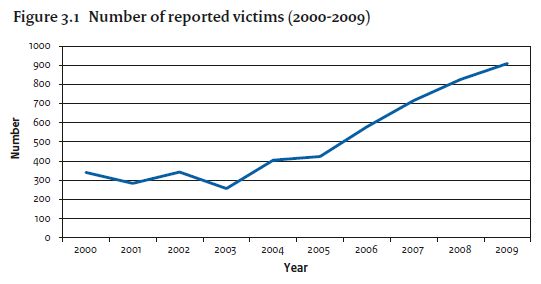
So, case closed? Well, hardly. The Rapporteur herself states that:

The likely explanation for the increase is the intensification of investigations by the police and the public prosecution service, as well as the growing attention to human trafficking. It is also possible that there is greater awareness (and in more agencies) of the need to report victims of human trafficking to CoMensha.

[internal references omitted]

In other words, the numbers aren’t actually increasing, we’re just finding more of them. The Rapporteur could of course be entirely wrong about this; perhaps the recorded increase does reflect a real increase as well. I quote her here only to point out that what sex work opponents portray as an undisputed fact actually isn’t.

But even if you take her words with a grain of salt (she may be independent of the government, but she’s still appointed by them), there are a number of problems with these figures. The first becomes apparent after a moment’s glance at the chart: the number of detected victims actually remained fairly steady for a few years after the law reform, and in fact was significantly lower in 2003 than it was in 2000. Bear in mind, these are only detected victims, and the actual number could have varied in either direction. But on the face of it the numbers don’t seem to support the claim that legalisation itself is behind the increase. You might expect there to be some lag in the law’s effects, but a sharp increase after an initial slump strongly suggests there’s something else going on there.

The real spike in the numbers occurred after 2005, and it should be apparent from the shape of the curve that something significant happened at that point. Sure enough: in 2005 the Dutch law on trafficking was amended, to cover non-sexual labour and the trade in organs as well (previously it had only applied to sex trafficking). So, a certain amount of that increase has nothing to do with the sex industry. How much of it? Well, on pages 174-175 the total number of victims specifically linked to the sex sector in the years 2007, 2008 and 2009 is given as 338, 473 and 419 respectively. So here is that chart again, with the number of reported sex trafficking victims for those years noted in red:

In fairness that probably understates the case a bit, since in each of those years there were upwards of 200 reported victims whose sector of exploitation was unknown. I’ll come back to this in a minute, but for the time being we can reasonably assume that some of these were in the sex sector. Even taking that into account, though, it must be clear that the expansion of the trafficking law beyond the sex industry has a lot to do with the impression of a recent trafficking explosion.

Another interesting point is made on page 91. While the usual reaction to statistics like this is to assume that they underrepresent the real numbers – because so many victims go undetected (something I certainly acknowledge) – there is also the possibility that they overstate the case as well. The Rapporteur explains:

it is possible that the persons reported to CoMensha are not all actually victims, so the number of registered victims could also be higher than the actual number of known victims in the Netherlands. This is because there is no formal assessment based on specific criteria by which the registered person’s status as a victim can be verified.

The broad categories of “notifiers” (persons and groups reporting victims to CoMensha) are charted on page 99:

This looks to me as though basically anyone can report a “trafficking victim” to CoMensha, and CoMensha will include that person in its data without ensuring they truly qualify. That must call into question whether the numbers have been inflated through misrepresentation of their actual victim status. A footnote on page 91 says that “very vague reports” will not be registered, but also that CoMensha “has no firm criteria for defining a ‘vague report’”. Also worth pointing out is this bit on page 111:

For almost a third of the victims reported to CoMensha since 2007, it is not known whether they had already been exploited or, if they had been exploited, in which sector.

There are two separate issues here. First, what exactly are the criteria for identifying someone as a trafficking victim if they have not “already been exploited”? I don’t think that identification would be unjustified if, say, they were intercepted en route to a brothel when they thought they were being taken to work in a restaurant, but it’s not at all clear whether that level of certainty is being applied. (I’m reminded of the often-cited statistic of 100,000-300,000 children trafficked in the US every year, which actually refers to children who are simply deemed to be “at risk” of sexual exploitation because of their personal circumstances, such as runaways, and may never actually face exploitation at all.) There’s clearly potential here for erroneous inflation of numbers – and certainly for the statistics to include people who might not be included in the statistics of other countries which only count the “already exploited”.

The second issue is the part about it not being known which sector the victims were exploited in. As mentioned above, these unknowns have accounted for more than 200 trafficking cases per year. What exactly does it mean for a sector to be unknown? That the notifier didn’t know the sector, or that they knew it but didn’t report it? I can certainly accept, given the nature of human trafficking and the trauma its victims can suffer, that it may be possible in some cases to recognise that a person has been trafficked without being able to ascertain the sector. But 200+ per year strikes me as an awfully high number of indeterminate-sector cases, and I would have to question whether some of these reports can really be taken as evidence that trafficking occurred at all. If on the other hand the notifier simply didn’t include the sector in their report to CoMensha, that question doesn’t arise – but you would wonder why CoMensha wouldn’t go back to the notifier and ask for clarification, since it’s a pretty important variable.

Another interesting thing I noticed was in the tables indicating the nationality of victims (pages 160-167). These also include the ranking of the top five nationalities – and the number one nationality of reported victims, since 2004, is Dutch. In fact, Dutch victims have accounted for at least a quarter of all reported victims since 2006, and for nearly two-fifths in 2007-2008. I found that extraordinary. It is true that trafficking can occur within state borders, but it’s fairly unusual for a state to recognise its own nationals as trafficking victims, at least on such a wide scale.

It’s difficult to explain this anomaly without more information, such as a breakdown of the sectors in which the Dutch victims were exploited. The only hint is in the fact that the proportion of these victims who were underage has averaged to 30% since 2006, suggesting that the “loverboy” phenomenon may be implicated. But that doesn’t account for the majority of cases. One possibility could lie in the Dutch definition of trafficking, which to my reading is extraordinarily broad. The UN definition is often said to boil down to “movement, control and exploitation”; however, the Dutch law allows for convictions without any “movement” element at all, within or across state borders. Note Article 1.1.6, which defines a trafficker as anyone who “wilfully profits from the exploitation of another person”. I would suggest that applies to more bosses than it excludes.

If the Dutch authorities are applying this broad a definition of trafficking, is it any wonder the numbers are as high as they are?

In fact, when you take all these qualifications into account it’s quite possible the Dutch figures aren’t excessively high at all (by “excessively high” I mean in comparison with other countries; even one case is too many, of course). Let’s go back to that 2009 figure of 419 sex trafficking victims. Seems a lot higher than Sweden’s 2009 number of 34 (see page 35), doesn’t it?

But first of all, they don’t seem to be comparing like with like. Pages 10-13 of that Swedish report discuss the nationality of the victims and from what I can tell they are all foreign; the report refers specifically to people being trafficked into Sweden. Now this could mean that Dutch people are being trafficked in the Netherlands while Swedish people are not being trafficked in Sweden, but more likely is that Sweden simply uses different terminology for its own nationals who experience “trafficking” within Sweden. So, what we need to compare the Swedish number to is not the total number of reported sex trafficking cases in the Netherlands, but the total number of sex trafficking cases of non-Dutch citizens in the Netherlands. We don’t have that exact number, but the Dutch report states that in 2009, 26% of all trafficking victims were Dutch nationals; if we apply that percentage to the sex trafficking victims we get a rounded figure of 109. Subtract that from 419 and we can estimate now that in 2009, 310 people were reported as sex trafficked into the Netherlands.

Next thing we have to look at is who is doing the reporting. The Dutch figures reflect reports from all sources; the Swedish figures reflect only police reports. In 2009 the Dutch police reported 61% of all Netherlands cases. Applying that figure to the 310, we can estimate that the Dutch police reported 189 cases of sex trafficking into the Netherlands. This is still significantly higher than the 34 cases of sex trafficking into Sweden reported by the Swedish police, but you see how the difference narrows when you take greater care to ensure you’re comparing the same things.

We’re left with figures that suggest a sex trafficking rate in the Netherlands around 5.5 times greater than the rate in Sweden. According to Googled World Bank statistics, the Netherlands’ population is around 1.75 times greater than Sweden’s, making the Dutch rate disproportionate by a factor of 3.75 – you’d expect the Dutch police to report 127.5 cases of sex trafficking rather than 189. So that’s 61.5 cases in 2009 that can’t be accounted for by the population difference alone. I can think of several possible reasons for this extra 61.5 that have nothing to do with the legal status of prostitution (other things that make the Netherlands a more attractive destination country, like its location and climate; or the much broader definition of “trafficker” in Dutch law; or operational differences in Dutch and Swedish police approaches to trafficking), but we really are in the realm of pure speculation at this point.

Of course, we’d need a more detailed set of statistics to really compare the two countries anyway. It’s quite possible that there is actually a wide disparity between sex and non-sex trafficking behind the percentages applying to overall trafficking which I used to arrive at that 189 figure. But that disparity could go either way, so it can’t be assumed that I’m underestimating the real difference between reported cases in Sweden and reported cases in the Netherlands. I could, in fact, be overestimating it and the actual figures could be much closer together. The point of this exercise is not to make any claims about the actual rate of sex trafficking in the Netherlands, but simply to show that there is a wide variety of factors behind the reported rates – and that you can’t simply compare sets of figures from two different countries without considering how all these factors could influence the results.

Another relevant question is how the Dutch numbers after law reform compare to the numbers before it. The most recent Rapporteur report doesn’t give figures from before legalisation, but I was able to find them (in somewhat different format) in the First Report, on page 49:
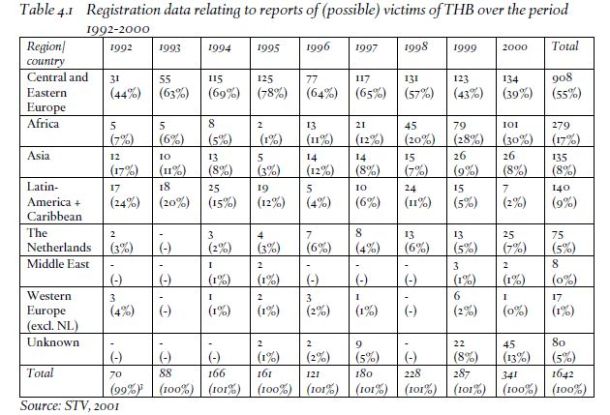
So clearly the problem was growing in the Netherlands even before legalisation, and perhaps the law change was entirely irrelevant to a trend that was developing anyway. However, even if the law itself had an effect, the report suggests this may be due (at least in part) to a reason that is very different to the one put forward by the anti-sex work movement – and it’s a reason that echoes a point I’ve made over and over again on this blog.

To put it in context: In the latest report, the Rapporteur states (page 26) that the purpose of the 2000 law reform was to

legalise a situation that was already tolerated.

The first report had gone into this in much greater detail, saying on page 11 that prior to 2000

in practice a distinction was made between voluntary and involuntary prostitution and the government in principle limited its concern for prostitution to regulating the exploitation of voluntary prostitution and combating involuntary prostitution. Because the ban on brothels…was still in the Penal Code, this policy in practice meant that the exploitation of voluntary prostitution in the Netherlands was in fact tolerated. This toleration developed in the course of time from a passive tolerance to an active tolerance (Venicz c.s., 2000). Passive tolerance meant permitting the establishment of prostitution businesses, as long as they did not cause any inadmissible nuisance or other articles of the law were not infringed. Active tolerance, on the other hand, meant the government taking controlling action so as to guide developments in a particular direction by various measures. A classic example of this is the system of tolerance orders or licences for brothels and other sex establishments used in many municipalities at the end of the 20th century, by which requirements and stipulations were laid down for their establishment and operation. And so in the 20th century the government did take virtually no action against brothels, except in those cases involving manifest abuses, exploitation of involuntary prostitution or disturbance of public order, peace and safety. In spite of an earlier attempt to amend article 250bis Penal Code in the Eighties, the ban on brothels was finally only abolished from the Penal Code on 1 October 2000.

Now, you might read this thinking that the 2000 law didn’t actually change a thing, and that what we should be talking about here is not what happens when prostitution is legalised but when it is tolerated. But there is an important difference between the two, and it’s one that has been noted in the context of Australian law reform as well:

Police, of course, under a legal system which officially legitimises certain forms of prostitution or certain places, are obliged by the government to enforce laws on other prostitution in order to justify the “legalisation”.

So what are the “other forms of prostitution” which were tolerated in the Netherlands until 2000 and are now enforced against? Well, one of them is prostitution by non-EU migrant workers (or those from EU countries excluded from the Dutch labour market). The legality of sex work notwithstanding, it usually isn’t an option for them unless they have residency on some other ground; it is impossible to get a work permit for the Dutch sex sector and very difficult to get recognition as a self-employed sex worker. And thus, as the sex workers’ rights group De Rode Draad told the Norwegian Ministry of Justice in 2004,

The situation for immigrant women has become much more difficult. Formerly these women’s work was tolerated in the same way as other sex workers’. With the legalisation of one group of women, the work of another group of women now becomes illegal. (page 34)

The Rapporteur’s current report doesn’t really go into this, but it does quote from an earlier report (the third) which addressed it in some detail, noting on page 22 that:

A number of NGOs have repeatedly argued that where aliens cannot work legally in the sex industry in the Netherlands but are still interested in doing so, a ban on or obstacle to doing this legally means a considerable risk of becoming dependent on third parties, with exploitation as a potential and harmful consequence. They therefore regard the ban on issuing work permits for prostitution work in salaried employment and the conditions that are or may be imposed on subjects of Association countries who want to come and work in the Netherlands as self-employed prostitutes as encouraging [trafficking].

So in other words, if it is the case that trafficking has increased as a result of legalisation, it’s because of changes in the government’s approach to migrant sex work, not to sex work generally. It’s an issue of immigration law rather than prostitution law. This, I think, is absolutely critical to a proper understanding of sex trafficking in the Netherlands – whether the actual rate is going up, down or sideways.

What about the claims of exploitation in the legal sector? I’ve seen all sorts of statistics thrown around about this, used to justify the argument that you can’t protect sex workers by legalising the industry. The Rapporteur doesn’t cite any data on this topic, but does accept the existence of these abuses and the failure of Dutch policy to adequately address them. On page 140 she states,

the view that entering the profession was an individual’s free choice that should be respected…may have obscured the sight of forced prostitution, especially since establishing a licensing system for the prostitution sector was expected to make licensed prostitution more manageable, and hence lead to eradication of abuses in the sector. Over the last decade, the emphasis in attitudes towards the prostitution sector seems to have shifted to the vulnerability of the sector to human trafficking. Several notorious cases that have shown that widespread exploitation can also take place in the licensed prostitution sector have undoubtedly been a factor in this.

Well, if Dutch lawmakers assumed that licensing on its own would sort out coercion in the sector then it’s hardly any wonder they’ve had problems. If that was all that was needed, there would be no abuse in any legal and regulated sector, and clearly that is not the case. Here, the report shows the risks not of legal prostitution per se, but of a poorly thought-out scheme which lazily equates “legal” with “non-exploitative”. I suspect that if Dutch lawmakers had taken more input from Dutch sex workers when drawing up their law, this might have been pointed out to them.

Since people frequently seem to have trouble grasping this point, I’ll close by reiterating that these reports cannot be assumed to reflect the actual amount of sex trafficking in the countries they relate to. No really accurate, reliable measure is possible – and the true numbers could be either higher or lower. But if one legal model is going to be advocated over another on the basis of the trafficking rates under those models, those doing the advocating have to find some basis to show that a model has the effect they ascribe to it. This requires showing that, as best as can be determined, not only is there more trafficking under one model than under another but also that there is a causal link between the model and the trafficking rate. The Dutch Rapporteur’s report could support the anti-sex work argument on the first count, but the statistics are not sufficiently disaggregated to say for sure: we don’t know enough about them to pull out all the things that the Swedish authorities aren’t counting and make a like-for-like comparison of the numbers.

The report actually does more to support the claim of a causal link, in the sense that it acknowledges risk factors connected directly or indirectly to legalisation (the laissez-faire approach to the licensed sector and the restrictions on some foreign workers). But the crucial thing here is that these are causal links to the Dutch model of legalisation, not to legal prostitution per se. They could just as easily be used to support arguments for the establishment of a proper inspection scheme, or for allowing non-EU migrants to work in the industry – two things that can only happen in the context of legalisation, decriminalisation or de facto tolerance.

So to answer the question in the title of this post: no, but we shouldn’t discount it entirely either. It may be impossible to say for sure whether the Netherlands actually has more trafficking than other countries, but it definitely has a legal regime which in some ways seems to facilitate it. The reasons it does so may not be the ones put forward by the anti-sex work movement – but that doesn’t make the need for change any less compelling.