RSS Feed

Labour’s proposed abortion referendum: Not good enough

Posted on

It’s being reported today that the Labour Party plan to fight the next election on the promise of a referendum to allow abortion in cases of rape, incest or fatal foetal abnormality. Bearing in mind that this is merely a Sunday newspaper report and (to my knowledge) Labour themselves have not confirmed it, here are all the reasons why I would strenuously oppose this move.

It would retain the constitutional anti-choice position as the default position. If this referendum passed, Irish residents would still have to get someone’s approval to have a right to abortion in their own country.  This is unacceptable, particularly coming from a party which paints itself as “pro-choice”.

It would enshrine into (constitutional) law the notion of pregnancy as punishment for sex. Feminists should absolutely reject any distinction in law between a pregnancy resulting from consensual sex and a pregnancy resulting from forced sex. To allow it is to acquiesce to the identification of women’s sexuality with reproduction, and the misogynist trope that choosing abortion is “avoiding responsibility for actions”. It reflects the odious idea that there are innocent Madonnas who can’t be blamed for having sex, and whores who deserve what they get.

It would be a nightmare in practice. You think it was difficult legislating for a “real and substantial risk to life”? Just wait until the troglodytes that write Irish legislation get to decide how to determine whether a rape happened.  As long as Article 40.3.3 remains in place – and by the looks of things, it will – you can be certain the “rape exception” will require a very high burden of proof, and that will inevitably involve a humiliating, (re-)traumatising inquisition. Who would go through that when they could just go to England – or the internet – instead?

It will still exclude the vast majority of crisis pregnancies. While accurate statistics will be impossible to come by as long as we have to go abroad or self-administer our abortions, it’s probably safe to say that relatively few take place because of any of the current or proposed “exceptions”. Most fall into the category that pollsters are now describing as “when the woman believes it’s in her best interest”: a broad category that can cover anything from financial woes, to interference with studies, to domestic problems, to simply not feeling ready to have a child, etc. These are normal reasons and they are valid ones, and they will still be excluded under this proposal – leaving the majority of those who have abortions to remain stigmatised and perhaps criminalised under the law.

It would eliminate the most persuasive argument for repealing Article 40.3.3. We don’t have a pro-choice majority in this country yet, and we may not for a while – but we do have a majority opposed to the strict parameters of Article 40.3.3 (at least, according to every single opinion poll in the past ten years not commissioned by the anti-choice movement). Those parameters could be a strong reason for people to support its repeal even if they aren’t fully on board with the right to choose. To widen the parameters through amendments that carve out exceptions would be to remove the incentive for people who aren’t pro-choice to support repeal. The end result would be a “compromise” that would effectively kill off any hope of actually getting rid of 40.3.3 and establishing a right to abortion in Ireland.

I am aware that a “repeal the 8th” campaign is unlikely to succeed without a guarantee by government that restrictive legislation would follow. And this legislation would have all the same problems I’ve outlined above – which might seem to undermine my whole argument. But restrictive legislation is much easier to deal with than a restrictive constitutional provision. It would be subject to constitutional challenge, and vulnerable to European pressure if the EU and ECtHR come to recognise abortion as a fundamental right (which I believe they eventually will). It could, of course, also be overturned by a progressive future government, though I may be overly optimistic about the possibility of us ever getting that.

I’ve mainly addressed the rape exception here, and I know not all these arguments apply to fatal foetal abnormalities. If the referendum proposal was limited to that I would find it more difficult to argue against (though some of my objections would still hold). I’m also aware that X legislation could equally be opposed on some of the grounds above, but X deals with life-and-death circumstances. I think it’s reasonable to put aside principled and tactical objections to incrementalism where the alternative is that a person actually dies.

And after the farce that the X legislation turned out to be, one thing should be obvious to everyone who supports abortion rights: we will never get anything meaningful as long as 40.3.3 remains. Our legislators will always feel the need to err on the side of protecting the foetus – so even if additional exceptions are carved out, the barriers to availing of them will be prohibitively high to many of those they’re intended to cover. And we’ll be left with a Constitution that further reinforces a value judgment as to who “deserves” an abortion, and less hope than ever of any real change.

The only tenable solution is repeal. We should not stand for anything less.

Does legal prostitution really increase human trafficking in Germany?

Posted on
Does legal prostitution really increase human trafficking in Germany?

Guest post by Matthias Lehmann and Sonja Dolinsek

[In the Irish campaign to criminalise sex workers’ clients, supporters of this proposal have regularly pointed to the German experience as “proof” of the failure of legalisation – despite the fact that Germany’s model is not actually advocated by anyone in the Irish debate. A recent article in the German newspaper Der Spiegel appeared to provide support for the view that legalisation has failed, and this has been picked up on and quoted by campaigners for criminalisation in Ireland. In this post, translated by the authors from the original German, two Berlin-based researchers explain what Der Spiegel got wrong.]

Last week, leading German news magazine DER SPIEGEL published a cover story – now published in English – on the alleged failure of the German prostitution law (ProstG) which rendered the State complicit in human trafficking. The deeply flawed report fails, however, to address numerous relevant aspects of human trafficking prevention and prosecution, including victim protection. It also fails to insert much needed factual evidence into the broader global debate on human trafficking, which is also about labor rights, migration, sustainable supply chains and human rights. DER SPIEGEL thus contributes to a very narrow debate on human trafficking and to the wrong debate around sex work.

Our blog post is based on a longer critique published in German on the blog “menschenhandel heute”. In this shorter version, we would like to critically engage with the international community on the difficult relationship between trafficking and sex work.

The myth of legalization

Prostitution, understood as the selling of sexual services, has been legal in Germany since 1927. In addition, Germany’s sex workers have been obliged to pay taxes since 1964. The new prostitution law of 2002 changed some aspects pertaining to the legal relationship between sex workers and clients and some criminal law provisions. It recognized the contract between sex workers and clients as legal and introduced the rights of sex workers to sue clients unwilling to pay for sexual services already provided. In addition, sex workers received the right to health insurance and social security. The law also forbids the right of direction (Weisungsrecht) by the employer in cases where a sex worker is employed at a brothel, for instance. In this way, a sex worker would always be able to determine to which sexual practices she or he would agree or not. What is misleadingly called the ”legalization“ of prostitution is actually the recognition of sex work as labor.

However, the law has encountered opposition in the implementation process. Rather than the law itself, as DER SPIEGEL claims, it is the unwillingness of some German states to correctly implement the law. Germany’s federal structure requires every state to issue its own implementation directives, which, as political science professor Rebecca Pates explains, did not happen in states like Bavaria or Saxony. Pates argues that some states actually never implemented the new law due to moral reservations with regard to prostitution. “The ProstG might in fact have the distinction of being the only federal law intentionally not implemented by Germany’s public administration”, she states in her paper “Liberal Laws juxtaposed with rigid control: an analysis of the logics of governing sex work in Germany” (2012). Other researchers presented similar findings. Her claims are supported by an official government report of 2007 (a shorter English version can be found here), which identifies the political unwillingness to implement the law as a reason for its failure. DER SPIEGEL’s analysis ignores this fact.

Technically speaking, prostitution is not legal everywhere in Germany. Most states prohibit prostitution in areas close to schools, churches, hospitals or residential areas, and most cities have defined restricted areas (Sperrbezirke) and times, where and when prostitution is not allowed. Some cities declare the whole city a restricted area, mostly with the exception of dark and dangerous outskirts, or allow prostitution only during the night. Furthermore, most states prohibit prostitution in cities with less than 30,000 inhabitants. This makes prostitution de facto illegal in most places and at most times, and sex workers receive fines or jail sentences if they violate the restrictions. In addition, sex work is not allowed for non-EU nationals (third country nationals), who would breach their residency requirements, if they engaged in prostitution. Non-EU nationals engaging in sex work are thus criminalized and made vulnerable not by the law, but because they are excluded from the law. Therefore, the incomplete legalization of prostitution may be the actual reason why the German prostitution law is failing its purpose to protect sex workers on the one hand, and why, on the other hand, most victims of human trafficking are from third countries.

“Pimping” in Germany and the war with numbers

New criminal law provisions were introduced with the reform. As DER SPIEGEL correctly points out, the criminal offence “promotion of prostitution” was replaced with “exploitation of prostitutes”. In his response to the Spiegel’s cover story, Thomas Stadler, attorney at law, explains:

‘The claim that procuration would only then be a criminal offence if it was “exploitative” or “organized in a dirigiste manner”, which is hardly verifiable, is tendentious, at the very least. According to prevailing legal norms, those activities are deemed as procuration (“pimping”) where someone exploits a person that works as a prostitute, controls this person’s work to gain pecuniary advantages, dictates the place, time, degree or other circumstances of this work or takes measures to prevent this person from exiting prostitution that go beyond an isolated incidence. Insofar, there might be individual cases, just as in other criminal proceedings, where evidence is hard to come by. One has to ask, however, what procuration actually is and how the legislator is supposed to define it. According to previous legal norms, cases could be built on the establishment of a pleasant atmosphere, which rendered virtually anyone a “pimp” that had some sort of function in a prostitute’s orbit. The decrease in convictions might therefore result from the removal of juridical measures that were questionable in the first place. And that surely wouldn’t be a step backwards.’

In addition, the new criminal offence of “human trafficking for sexual exploitation“ was introduced. As Stadler points out:

Human trafficking is certainly a criminal offence. In §232 StGB, the criminal code even contains its own article that deals with human trafficking for the purpose of sexual exploitation. The level of the penalty ranges between six months and 10 years. Introduced in 2005, this article is a considerable increase from the previous regulation, §180b StGB, both with regards to content and the penalty range. Since this article includes the so-called “forced prostitution”, the actual topic of the SPIEGEL article, the message of DER SPIEGEL’s cover is entirely incorrect. A sincere report should rather have pointed out that the legislator introduced considerably tougher laws to penalize “forced prostitution” in 2005. Therefore, to claim that the State promotes trafficking in women and prostitution is absurd. The opposite is true. The legislator increased penalties for “forced prostitution” and human trafficking.

Thus, with a strengthening of labor rights for sex workers came a stronger criminal law, making the exploitation of sex workers as well as human trafficking for sexual exploitation criminal offences.

DER SPIEGEL suggests that the case of 16-year old Sina, forced to work in a flat-rate brothel, is a typical example illustrating the failure of the German prostitution law, since the law would not protect her. However, employing a person less than 18 years of age at a brothel is a criminal offence under German law. Thus, Sina’s situation is not one that the prostitution law aims to address, and therefore, the law does not fail her in this regard. The failure of the legal system towards her situation and towards other victims of exploitation must lie somewhere else.

Contrary to DER SPIEGEL, the number of convictions for “pimping” did neither decrease nor increase in statistically significant ways with the new law. DER SPIEGEL claims 32 identified “pimps” were convicted in 2011, as opposed to 151 in 2000. An official government reply to a parliamentary enquiry from 1997, however, shows that low convictions for “pimping” were actually a trend: in 1994, there were only 39 convictions for “pimping”. Numbers from the federal statistics bureau suggest similar developments.

According to official statistics, the number of officially identified victims of human trafficking decreased significantly in the past fifteen to twenty years. The same government reply from 1997 mentioned 1,196 victims of human trafficking in 1995 and 1,473 victims in 1996, while the statistics of the past four years on record show steady figures of an annual 610 to 710 victims of human trafficking for sexual exploitation, i.e. 640 victims in 2011.

Human trafficking for labor exploitation is also a criminal offence, which so far has failed, however, to attract much interest by the German public. Recent research has shown that, until recently, even counseling centers for victims of human trafficking were mostly unaware of the possibility of labor trafficking and unprepared to provide adequate support. The general lack of interest towards labor trafficking is reflected in the low number of identified victims: only 32 individuals in 2011.

So, where is the real problem?

DER SPIEGEL’s greatest omissions are victim protection and victims’ rights when it comes to human trafficking. A narrow focus on the prostitution law and sex work prevents the authors from dwelling into the more complex web of legal regulations that make the prosecution of cases of human trafficking difficult in Germany.

First, human trafficking cases are dependent upon the testimony of victims. If they are for some reason unwilling to cooperate with the police and do not wish to testify, their cases will most likely fall apart. Furthermore, psychological support for victims of human trafficking is very limited. In many cases police officers and investigators expect linear and consistent narratives from victims from the very beginning, and utterly fail taking into account any traumas they may have endured just moments before. Victims are therefore not only forced to narrate their experiences over and over again, while their traumas are well and alive, but will also have their credibility judged and refuted as potential witnesses, if for some reason their stories show inconsistencies.

Before we talk about the prostitution law, let’s talk about how (potential) victims of human trafficking are treated once encountered by the police, and let’s talk about how those practices may in fact reduce to a minimum the willingness to testify.

Second, most victims of human trafficking who are third country nationals or from Romania or Bulgaria are repatriated to their home countries after their testimony. If they do not testify or cooperate with the authorities at all, they will be deported immediately after a reflection period of three months. Many decry the unwillingness of victims to testify as one central reason for the failure of trafficking prosecution. So far, however, little has been done to encourage testimony and cooperation by strengthening victims’ rights. What DER SPIEGEL fails to understand is that a reform of the prostitution law would have no impact on this aspect whatsoever. By focusing on the victims, the authors risk tapping into a dangerous rhetoric of victim blaming, and thus miss how not the prostitution law but the German immigration law actually contributes to much of the vulnerability of migrant women who are victimized. Germany should rather look towards Italy, where victims of human trafficking are unconditionally granted a residency permit and can begin re-building their lives.

Last but not least, Germany and the German media have so far missed the opportunity to broaden the public debate on human trafficking and modern slavery to include labor trafficking, organ trafficking as well as labor exploitation in supply chains of large corporations. Instead, the term human trafficking is often equated with prostitution by the media, politicians and even activists, thus perpetuating a selection bias towards women in the sex industry. Victims of other genders or in other sectors run not only a very high risk of never being detected but also of not even being believed. In this sense, we believe DER SPIEGEL has failed its declared commitment towards human trafficking victims – as the majority are conveniently left out, while others, like self-determined (migrant) sex workers, simply are not victims of trafficking.

The story and representation of Carmen, a sex worker from Berlin

The German print version of DER SPIEGEL’s cover story also featured an inset profile about Carmen, a sex worker from Berlin. Carmen works as an escort as well as a sex workers’ rights activist, a role she also fulfills as member of the German Pirate Party. She reacted to the profile by publishing a counterstatement, in which she quoted the email exchange with DER SPIEGEL’s journalist prior to the interview and publication. Contrary to the agreed terms, Carmen writes, the profile dealt only marginally with her “thoughts about prostitution policies, the sex workers’ rights movement, the discrimination of sex workers” or other relevant subjects. Whereas Carmen had agreed to the interview to introduce “arguments instead of prejudices into the public debate about prostitution and allow insights into an occupation that most people have no access to”, 80 per cent of the eventual profile contained stereotypical descriptions of Carmen’s appearance and her escort website

“I am not prepared to be made a projection screen of any clichés. I will not answer any personal questions that concern aspects outside my work in prostitution/politics”, Carmen had written prior to the interview.

In addition, DER SPIEGEL had altered the photo that Carmen had provided to be featured. While blackening her face without her consent anonymized her, the color corrections effectively highlighted her décolleté, further adding to the overall tone of the article.

After Carmen’s statement had gone viral, the journalist published his own counterstatement on DER SPIEGEL’s blog, only to draw more criticism. Under the headline “An Escort Lady makes Politics: Be truthful”, he admitted the non-consensual alteration of the image but claimed it was done to protect Carmen’s privacy, even though she had not explicitly asked for any such changes. Where the article’s focus and tone were concerned, he invoked the freedom of the press.

Interestingly, DER SPIEGEL also tried to do damage control by sending customized tweets to those who had twittered Carmen’s statement, and for its international online publication, DER SPIEGEL then chose to omit Carmen’s profile entirely, thus removing the one voice, if poorly presented, opposing the cover story’s narrative that legalizing prostitution in Germany had failed.

DER SPIEGEL also published a photo series to support the article’s narrative, which included voyeuristic images, a photo of Christine Bergmann, Federal Minister of Family Affairs when the German prostitution law was passed (of whom no other picture seemed available as that in front of a sign about child abuse), an angelic picture of Swedish anti-prostitution activist Kajsa Ekis Ekman, and to counter that, an unflattering photo of Volker Beck, human rights spokesperson of the German Greens and a staunch supporter of sex workers’ rights.

About the authors:

Sonja Dolinsek is a graduate student in Contemporary History and Philosophy at Humboldt-Universität zu Berlin. Her research project focuses on the history of prostitution in the German Federal Republic since 1949, with a particular interest in the gendered construction of sex workers. She is also the founder and editor of the German news blog on human trafficking “menschenhandel heute”, where she critically engages with anti-trafficking discourses and practices. She also volunteers as a translator for PICUM (Platform for International Cooperation on Migrants). She lives in Berlin, Germany.

Matthias Lehmann is an independent German researcher currently based in Berlin after extensive stays in East Asia. A graduate of the School of Oriental and African Studies (SOAS) and Kyung Hee University, he has conducted research and fieldwork in Thailand and South Korea. In 2012, he participated in the Sex Workers’ Freedom Festival in Kolkata, official hub of the 2012 International AIDS Conference. His research focus lies on the collateral damage caused by anti-trafficking and anti-prostitution legislation, in particular where the rights of sex workers and migrants are concerned. With his on-going research project, he aims to add to the knowledge about the experiences of sex workers in South Korea.

On law and “Lose the Lads’ Mags”

Posted on

So last week UK Feminista and Object issued a joint press statement, announcing they’d received legal advice that women working in shops that sell “lads’ mags” may be able to sue their employers for sexual harassment or sex discrimination. A number of bloggers have already given incisive critical responses, and I’ll particularly point you in the direction of Stavvers from Another Angry Woman, Gemma Ahearne from plasticdollheads and Jem and Carter from It’s Just A Hobby.

I’m coming to it a bit late myself, but that’s because I was hoping to be able to base my response on the legal advice the two groups received. I should have been able to base it on that legal advice – or at least a summary of it – according to this snippet from the press statement:

UKFemail

So, last Monday evening I sent them this email:

UKFemail2

By Friday morning, I hadn’t heard anything so I followed up with this tweet:

to which I unfortunately have had no reply, though they’ve been active on Twitter since then and have responded to other people’s tweets. So either they aren’t really making the summary available, or they’re being very selective about who they make it available to – which raises its own questions.  The press release (and the corresponding Guardian letter, signed by a number of British lawyers) are fairly clear about what they believe to be the legal basis for action – the Equality Act 2010 – and how they think the shops may fall afoul of it by selling lads’ mags, so I have to wonder what exactly is in the summary that UK Feminista are holding back.

The Guardian letter makes reference to “examples of staff successfully suing employers in respect of exposure to pornographic material at work”, so perhaps the advice contains actual details of those examples, and maybe unsuccessful attempts as well – which would be useful in assessing what criteria are needed to make out an actual case of sexual harassment or sex discrimination. You’ll notice that the letter is carefully couched in equivocal terms – sale and display of the magazines “may” breach the Equality Act; “is capable of giving rise to breaches”; “in some cases”. I’m not sure those caveats come across as clearly in the press release, in which Kat Banyard announces:

The good news is that customers and employees don’t have to put up with it any more. Legally as well as ethically, lads’ mags are well past their sell by date.

As Carter and Stavvers pointed out, the effect of such an unqualified assertion could very well be to mislead some shop workers into thinking they have a case when they don’t – and that could have disastrous consequences for their job security if they were to act without benefit of proper legal advice. As an occasional campaigning-group-press-release-writer myself, I understand that bold statements make better copy, but I wish they’d given some consideration to the fact that there are actual jobs at stake here which most of these workers can probably ill afford to jeopardise. A certain amount of responsibility has to go along with imparting legal advice, whether it’s your own or somebody else’s. And I don’t think that’s a very responsible statement for Kat Banyard to make.

As to the legal advice from the lawyers – or at least, what I’m able to see of it – all I as a non-British-lawyer can do is look at the statute and the case law. The Equality Act 2010 prohibits direct and indirect discrimination, the latter applying where

A applies to B a provision, criterion or practice which is discriminatory in relation to a relevant protected characteristic of B’s

… “sex” being one such protected characteristic.

There’s another section about Sex Equality (Section 64) but it deals with pretty much what it says it deals with, i.e., equal terms and conditions of work. Which would certainly be breached if female employees were singled out for sexual harassment, and may be the reason the letter and press statement refer to discrimination and not just harassment alone. On the other hand, they may be applying the Catharine MacKinnon notion of pornography itself as a discriminatory act – what she described in Only Words as “subordinating women through sex”. The problem with this is that it rests on a series of assumptions which would all need to be accepted for this approach to succeed: that lads’ mags are pornography; that pornography does subordinate women; that the impact of this is sufficient to overcome the rights of the publishers to produce, the stores to sell and the buyers to purchase these materials. It’s not a terribly solid foundation to build a case on, which I imagine is why the letter mostly just highlights the harassment angle.

So let’s turn to that. Under Section 26 of the 2010 Act, harassment occurs where:

(1)(a)    A engages in unwanted conduct related to a relevant protected characteristic, and
(b)  the conduct has the purpose or effect of
(i)violating B’s dignity, or
(ii)creating an intimidating, hostile, degrading, humiliating or offensive environment for B.

(2)A also harasses B if—
(a)A engages in unwanted conduct of a sexual nature, and
(b)the conduct has the purpose or effect referred to in subsection (1)(b)

I don’t think you have to agree with UK Feminista and Object to understand, in theory, where they see the lads’ mags fitting in here. But it’s important to read the section in full, because it goes on to say:

(4)In deciding whether conduct has the effect referred to in subsection (1)(b), each of the following must be taken into account—
(a)the perception of B;
(b)the other circumstances of the case;
(c)whether it is reasonable for the conduct to have that effect.

What this basically tells us is that displaying and/or selling the lads’ mags cannot constitute harassment in and of itself – even if a shop assistant feels her dignity has been violated, even if, and I think it is rather a big if, the sale of the magazines is what has given rise to the hostile or offensive environment she experiences. All the circumstances have to be looked at in the round, and each case will be judged on its own merits.

Which is why I really wish I had precise details of the cases the legal advice is based on. Most of the case law I’ve found predates the Act, though I don’t see any pertinent change from the previous law. There certainly are examples of successful actions against employers for exposure to porn in the workplace, but not in a context where the porn was a product being sold by the employer. So I’m not sure how much use those cases would be in the type of case we’re discussing here. For one thing, there is more scope for a conflict of rights here, since compelling an end to these sales would impinge on the publishers’ freedom of expression (as well as free movement of goods and services, if there’s any cross-border element involved). Given the huge deference that the ECHR and the EU give to member states to regulate sexually explicit material, I don’t think this would necessarily be the biggest legal hurdle, but it would be an additional one that wasn’t present in the earlier cases.

There’s also a strong possibility that the Employment Tribunals would distinguish between the circulation of images that are in no way related to a person’s actual work, and the sale of magazines by a shop whose business it is to sell magazines. I realise this has the whiff of “what did you expect when you took that job” and that can be problematic for a lot of reasons, not least that the people who work in these shops often don’t have a lot of alternatives. It is, nonetheless, a point on which the tribunals could distinguish this case from the precedents, and I think they’d be likely to seize on it. Unless women on staff are somehow being targetted for abuse with these magazines – in which case the issue really is the abuse and not the magazines themselves – I would expect the Tribunal to fall back on the “other circumstances of the case” provision. If it didn’t – if it held that a worker was sexually harassed by the mere sale and/or display of these magazines – then it would cease to be just an employment tribunal, and overnight would become a national press censor. This is just the type of scenario in which judicial bodies tend to put their hands up and say it’s up to Parliament, not them, to make that call.

I don’t entirely accept the slippery slope argument made by some other critics of the campaign. And again, this is because of the judiciary’s ability to distinguish between what might seem like analogous cases before it. It’s entirely possible, and indeed it happens all the time, that a court or tribunal will refuse to apply its own previous reasoning – not because it doesn’t follow logically, but because it would have undesirable consequences. If an Employment Tribunal did rule that a woman was discriminated against by having to sell Nuts, it doesn’t mean they’d then have to find a religious fundamentalist was discriminated against by having to sell Gay Times. Where the slippery slope might apply, though, is in the decisions made by individual shop owners or chains: if a UK Feminista/Object victory had the effect of emboldening other groups, as it surely would, pulling anything that causes controversy may well be the more desirable option from a commercial/convenience standpoint.

“Lose the lads mags” campaigners can’t pretend this is unlikely, either, because this sort of self-censorship is exactly what they’re aiming for. I’m not sure if they believe they could actually win a case, but they might have an impact just by threatening to bring one. How much of an impact remains to be seen (though I’m inclined to predict “not much”). One thing’s for sure anyway: just as a successful No More Page 3 campaign would still leave us with a vile rag called “The Sun”, losing the lads mags would still leave the women who work in these shops with a myriad of other problems – and dare I say it, more pressing problems, or at least they were more pressing when I worked in a shop – such as low wages, long hours, little or no job security and, yes, sexual harassment, the kind you can’t get rid of just by pulling a magazine from the shelves. I’d like to think that if they win this campaign, UK Feminista and Object will stick around to help these women fight to overcome those problems too. But I suspect they’ll just move on to the next sexy press release.

The latest on Norway’s sex purchase ban

Posted on

I happened to notice today that the 2012 annual report by Pro-Sentret, Oslo’s official “help centre” for sex workers, is now online. This is the organisation whose Dangerous Liaisons report was so badly misrepresented by prohibitionists recently, so I thought it would be interesting to see what they’ve had to say in the wake of that report.

Unfortunately it’s only available in Norwegian, so I had to run it through Google Translate. I don’t really have the time to, or think I can, add much to what the report itself says so I’m just going to C&P below some of the report’s more notable findings. Anyone who thinks I’m cherry-picking is welcome to do the same exercise themselves, but one thing I’ll tell you now: in absolutely no way does it provide support for those prohibitionist claims. Not that I think that’ll stop them from trying to twist it to say that it does.

Excerpts below, still in pristine Google Translate state. I did fix a couple words that would have rendered the translation incomprehensible, but I’ve left the grammatical errors intact.

INTRODUCTION

…there is no reason to believe that there has been a reduction in the prostitution market in the past year. On the contrary. Much suggests that the Norwegian prostitution market remains fairly stable in terms of the number of people who sell sex, nationality and how prostitution is organized.

TRONDHEIM

More recently, it revealed new venues for prostitution in Trondheim by bars and restaurants are increasingly being used. Police have had an advisory role in relation to the establishments that have been most affected. In an extended period of supervised police downtown tanning salons. They found that these frequently used as a venue for prostitution. Police went out with warnings to holders and noted that it was put into action to impede prostitution on tanning salons (staffing, warnings monitoring and so on).

Police in Trondheim has marked a change in relation to the nationality of the the prostitute. They reported that several women from economically distressed countries Greece and Spain, and frequent prostitution market in Trondheim. There is also a large increase in terms of Romanian prostitute. Police believe that these activities can be organized.

Nigerian

The Nigerian women prostituting themselves mostly on the streets. In 2009 we had an expectation that the proportion of Nigerians on the streets would reduced when buying sex ban was a reality, as Nigerians basically have few rights in Norway and thus would make it harder. However, we have seen an increase in the Nigerian contingent in total during the last three years, while the number who have availed themselves of outpatient follow-up, decreased. This is still the largest group that uses the outpatient services.

In 2012 there were 80 people from Nigeria who received long-term social care support. We believe that the reason why women do not leave the country depends on the (lack of) opportunities they have elsewhere in Europe. There is rarely an option to return to poor Nigeria, and in Italy and Spain where they have resided for several years, is no other than prostitution due to the financial crisis. And prostitution pays enough more Norway than in the south of the continent.

Norwegian

Many women have found other ways to establish contact with customers after the ban on purchase of sex was introduced as well as due to increased competition from overseas on the street. Many have gained regular customers as they make arrangements with the phone or online instead of establishing contact with them in prostitution district. Some have found it necessary to finance its drug use through crime, such as theft and sale of illegal drugs.

Eastern Europe

Pro Centre still has contact with a large group of women from East European countries. In the early 2000’s, these were the largest foreign deployment Until the Nigerian women took the prostitution market a few years later. Many predicted that the Eastern European women would flood the market when the first EU eastward enlargement was a fact. This did not happen. EU enlargement created opportunities for regular employment for many. When the EU included Bulgaria and Romania we thought the same would happen to the women there. This has not been the same degree, and one of the reasons may be that many of women in prostitution from these two countries is Rom-women who are not in the same degree eligible for our regular labor market.

A large proportion of the Pro Centre users have come to Norway by a third party and pay a backer / pimp / agent to work here. Some of the women have been in Norway while working independently.

Unfortunately, we see great motivation and desire to work does not compensate for the lack of work experience, reading and writing skills and knowledge of Norwegian. It is therefore many become discouraged and end to continue in prostitution when job hunting is not results.

Sexual Health

We still get a lot of feedback from users that condom use declines. We hear that there are many women who perform oral sex on men without a condom, so that it difficult for those who want to use a condom to negotiate this with the customer. The customer is often willing to pay more for sex without, so that in a market that has greater supply than demand, so more and more of our users report that they take “trips” without a condom.

Violence and trauma

We started in 2010 to record separately the cases where violence was the reason for inquiry to the health by Pro Centre. In 2011 we had fourteen women who came to us for help after being exposed to violence and / or rape, compared with six in 2010. In 2012 we had 33 such incidents recorded. There is a strong increase.

The women who have been victims of violence come from nine different countries, but 22 of the 33’s Nigerian women. Four are ethnic Norwegian. Ten of the women have been raped. Some of these must be characterized as very serious as some involving serious violence and several perpetrators. Three of the women have been stabbed so severely that they have had to get immediate medical attention in hospital. Eight of the thirty-three have been hospital / emergency room before they came to us. In eleven of the cases police have been involved, but we have no idea of how many that ends with review and any judgment. Women in prostitution are afraid to report violence and abuse.

In six of the cases, the offender is a woman, whether a “madam” or Another woman in prostitution. Eleven of the women stated that the violence / rape is performed by a prostitution client. Some have been assaulted in prostitution district by a unknown man, some have found that the abuser has penetrated into the apartment they live.

Our message through the report Dangerous Liaisons is that women in prostitution is still very vulnerable to violence. They frequently exposed to crime in the form of violence, intimidation and harassment. The report shows that prostitution has become more individualized and fewer report that they seek relief services after they have been violence. In addition a number of women that they lack legal protection as part of legislation – which basically should cherish and protect women – also entails that they do not contact the police when exposed to criminal acts. They fear that they may lose their apartment (Operation homeless) and / or earnings base their if they call the police attention. Customers must now “protected” from being fined, and his role goes from being “business partner” to an ally parallel to the Police goes from being an ally that women can obtain protection from a party they must protect customers against.

Women in prostitution are reminded constantly of the environment that they act undesirable. Be it through police actions, media coverage of the field or Also passers. When exposed to violence takes in many cases even responsibility. Shame and guilt prevents them from asking for help. Our experience is that the more focus as we help measures on violence and violence against, the more women will share their experiences with us and we will better position to assist them. This recognition we take seriously. It is incumbent upon the support system a great responsibility in adding ensure that vulnerable people receive the care, support and any redress they have entitled. We must be present for women who sell sex on their terms: we must be “here and now”.

Pro Centre would like to focus on the protection of victims of violence rather than a political tug of war or a rematch of the law. The challenge for governments is to provide police guidelines are clear: how should the seller of sexual services position as the “weak” and the individual’s right to protection and protection proportionate to the pursuit of pimps and traffickers? Is the legislator’s intention that the individual prostitute rights should be subordinated to the large market reduction project? How to
police and judicial system could emerge as credible allies when individuals are exposed to violence, whenever any police activity suggests that their situation from day to day is not Important?

We Are Here To Win

Posted on

A really powerful statement from the Philippine Sex Workers Collective on the appropriation of their voices by prohibitionist groups and the challenge they face with the Anti-Prostitution Bill, based on the Swedish model.
“Society has made us invisible so to have women of power speak for us was a blessing or so we thought. It was not a blessing. It was exploitation. They were not speaking for us, they were speaking for themselves in our name.”

Philipine Sex Workers Collective's avatarAnd Deliver Us From All Our Saviors

Sex workers have always been treated with great disdain in Philippine society. To call a woman a prostitute (puta) or the daughter or son of a prostitute (anak ng puta) would perhaps be the gravest insult you can throw on any Filipino. Credit this to the Catholic Church and Christian fundamentalists (the Catholics make up 88 % of the country’s population while the Christian groups account for 8%. The rest are Muslims.) They have ingrained in the minds of the people that sex outside of marriage is dirty and immoral. To most Filipinos therefore, prostitution is a moral issue and those involved in it must be condemned. This has led us, sex workers, to be treated with stigma and discrimination.

As sex workers, we are forced to hide who we are and what we do for fear that if we are outed, we and our families would…

View original post 1,025 more words

Ten Things You Can Do to Stop Violence Against Women. By Jane Ruffino

Posted on

Jane Ruffino originally posted this on Facebook. Facebook took it down. Fuck you, Facebook.

Exactly a year ago, my then-boyfriend put me in a headlock and punched me until his hand shattered. The only reason I didn’t die on my bedroom floor on the night of May 3, 2012 is that he didn’t know where to put his thumb when he made a fist. It wasn’t the first time, nor, I’m sad to say, was it the last time, but it was the one he got caught for, and the one I can’t get sued for talking about.

He spent the night in a hospital, having his hand rebuilt with pins. I spent the night strapped to a trolley in a different hospital, having everything x-rayed. I left with stitches in my face and my blood-soaked clothes in a Dunnes Stores bag. He left the hospital five days later, in a cast, and with a diagnosis of “work and home stress”.

I still get concealer in my scar (and it is still sore), and I’m still not totally safe, but I’ve started to rebuild my life, and it’s getting pretty good. But while my life improves, dudes are still beating up women.

As much as I’d like to shut up about this and have people stop identifying me with something that happened to me, it’s not that common for an abuser to be convicted. I’m in a position to do something that many women are not, so I’ll keep talking until dudes stop beating up women.

We all know victims, so we all know perpetrators. It’s always someone you wish it weren’t. Believe me, I know this better than anyone.

Even though you can’t make a relationship with a violent dickhead safe for his girlfriend (or possibly for any woman), we can make the world safer for women by making it harder to get away with cracking our faces open.

Here’s some of what I think we need to do differently.

1. Swap your sympathy for empathy, and get angry: Nothing could get better for me until I got really angry, and empathy helped me get there. Empathising with me means you’ll stop asking me why I stayed, and assume that, like with any violent crime, it could happen to anyone. Empathising with him means you accept that it’s done by seemingly normal human beings, and not by easily identifiable monsters.

I do appreciate the “Sorry for your troubles”, but I’d rather you be angry with me than sad on my behalf. I know the sympathy comes from the right place, but it can feel a little like a pat on the head, and even a bit isolating. We live in a world where you can beat your girlfriend nearly to death and walk out of a criminal court straight into a pub for a burger and a pint. That should piss you right the fuck off, so if you don’t think it’s my fault, then don’t make it all my responsibility.

2. Trust us: Women like me lose the ability to trust ourselves, and we don’t often speak believably about what’s happening until it’s well in the past. Even I sometimes don’t believe me. And yes, we all take them back. It seems to have undermined my credibility with a lot of people, forever. Because hey, if I hadn’t been exaggerating all along, then why would I take someone back after he put me in the hospital?

I managed to gloss over the time I woke up with a pillow being pushed to my face. I didn’t want to believe he was capable of it any more than you did, so you should probably trust that I’m not going to make this shit up.

3. Start calling bullshit: Does your friend, your brother, your colleague insist that his girlfriend or wife is“batshit crazy”? Does she sound like a wild-eyed shrieking harpy who is totally ruining his life? I’ll tell you something: having the shit slapped out of you makes you a little crazy. Five weeks after I contacted his family to ask them to help him, I was in the hospital with a busted face. They hadn’t believed me because they’d been told I was crazy. I’m not, by the way, which I feel the need to say because trauma does all sorts of things to you, whether or not you ever get your face broken. But maybe if someone had started calling his bullshit years ago, he wouldn’t have ended up the way he is, and I would not have to rebuild my life and my sense of self.

Try it. Next time some guy says “She’s crazy”, assume what he really means is, “I’m an enormous dickhead with no respect for women.”

4. Stop looking for the truth: My account is true and real, and verified in a criminal court, but his account also represents a world he truly lived in. The fact is, we were both delusional. He believed I was a monstrous asshole, and I thought if I stopped being such a monstrous asshole, he would stop throwing things at my head and be the loving boyfriend he promised he’d be – if I only changed a few more things about myself.

It’s a Venn diagram, where the overlapping bit was “Jane is an irredeemable piece of shit”. It’s when I started insisting I was a worthy human being, when the punches and the slaps would start. You can rearrange the data points all you like, and get a hundred different versions, but there is no grey area between two overarching perspectives where you’ll find the truth you’re looking for. That crisscrossing of narratives applies to normal human relationships, but these were two competing and incompatible narratives, neither of which were rational.

This was a situation where I was trying to have a normal relationship with someone who once threw a pint of beer over me to prove he wasn’t an alcoholic. OK, so maybe that is a little crazy.

5. Let go of the checklist: You know the one. You Google “emotional abuse” because someone was a dick to you, and there it is. It’s a useful guide, perhaps, but you can’t identify abuse through a Cosmo quiz. Yes, abusers fit a profile, and in some ways, they’re all the damn same. They all try to smash your computer. They all put your phone through a wall. They all search your fucking email. And they all cry and beg for your love right after you’ve cleaned up the glass they smashed at your feet.

But there are times when we all fit the more minor things on those checklists. I’m talking about the name-calling, the voice-raising, the times we manipulate and goad and cajole our partners; it’s not OK, but it doesn’t make your relationship an abusive one. I’ve seen you cringe and turn all confessional when I tell you about things he did -– you’re like me, trying to make absolutely sure the same terrible tendencies aren’t in you. Every one of us probably has the capacity to turn into despots, or become complicit in terrible acts. Being mean doesn’t make us despots, but covering up domestic violence does make us complicit.

Working only from a checklist makes it easy to ignore the enormous difference between acting like a dick in an argument, and wanting absolute power over your partner. I’d hate to add up the amount of money I spent on therapy, desperately trying to understand if I was really the abuser all along. Until one day the penny dropped: sometimes I am a fucking asshole,but that doesn’t make me an abuser. Maybe this is obvious to you, but it was news to me. And yes, I still feel the need to prove it over and over, and I’ll never fully believe it myself.

Even I’m still looking for the truth, and I’m never going to find it.

6. Get over your need to diagnose: We live in a pathology-obsessed world. “He sounds like a psychopath.” “That’s sociopathic!” “How totally psychotic!” “Is he bipolar?” I don’t know, and frankly, unless you’re his doctor, it’s neither your place nor my place to slap a diagnosis on someone based on my description of him, especially given the bias I have since he cracked my face open like an egg.

Diagnosis is also what he used on me, as part of his pattern. I was Google-diagnosed with everything from premenstrual dysphoria to narcissistic sociopathy to -– wait for it -– Munchausen’s By Proxy (I told him I thought he drank too much). I think diagnoses are partly a form of excuse-making, but also, sometimes people are just assholes.

If you want to ask what diagnosis is most likely for him, try to be satisfied with “gigantic piece of shit”.

7. Focus on the perpetrator: Outside of gender-based violence, is there any other crime where the focus is so much on the victim that the criminal becomes practically invisible? Remember his name; forget mine: his name is Mark Patrick Kenneth Jordan and he broke his hand off my face. I get that it comes from a good place when you say I’m the last person you’d think it could happen to, but there’s an uncomfortable implication that it had more to do with me than it did with him.

In fact, he used my outward confidence to his advantage; it made me less believable, and it made people question me. Because rather than seeing me as the sort of person who sends work emails with my neck strapped to an emergency-room trolley, my ability to cope made me look suspicious. I don’t know what’s more humiliating: knowing people think I’m a domineering and irredeemable asshole, or people knowing how easily I caved on just about everything.

But until we shift the discussion from “Why do so many women get abused?” to “Why do so many men beat their partners?” it will continue to be a sympathy-driven discourse that puts the onus on the victim to stop getting her ass kicked.

8. Cut out the platitudes: It’s not that I don’t understand what you mean by “There’s nothing you could have done” or “Nobody deserves it” or “Even if you were batshit crazy” – I get it, but those phrases are meaningless. When I say that I want to find out why I am afraid of spiders but not the guy who smashed a door to splinters with his bare hands, I’m not blaming myself for staying. When I talk about the things I did wrong, I’m not blaming myself, I’m actually kind of revelling in the fact that I’m now safe to be a complicated and flawed human being without getting a smack for it. Just respect my intelligence and my agency, and accept that I am able to grasp the complex dynamics; I still want to understand why I had such terrible risk assessment.

I think that people are pretty good, generally, that most people try to do the right thing, but platitudes are part of an “I don’t want to get involved” attitude. You’re involved, like it or not. You think I wanted to be involved?

Stop spouting cliches and talk for real. As long as what you say isn’t worse than “you fisheyed c*nt”, you can be sure I’ve heard worse.

9. Stop raising awareness and start demanding consequences: The week of Mark’s sentencing, Women’s Aid did a balloon launch. Women’s Aid is an indispensible organization that does great work, but what does PR fluff achieve? How much more aware of violence against women do you need to be before you do something? And are we so afraid of women’s anger that our own organisations are resorting to nice-girl complacency?

Pretty much every one of my calls to the cops – even with a barring order in place – was met with dismissiveness and impatience. They won’t start taking women like me seriously until the community makes it impossible to get away with beating us up.

It’s a crime against the state, which means the victim is only a witness. Violence against women is a crime against you.

10. Don’t hit women: It’s statistically likely that some of you reading this hit your partners, or will eventually. If this is you, then, hey – go fuck yourself.

The EU report on trafficking in human beings

Posted on

Last month saw the publication of the EU’s first Trafficking in Human Beings report, which is billed as an attempt to “collect comparable data on trafficking in human beings at the EU level”. The report is (properly) littered with disclaimers, such as this one in screaming bold type on page 30:

More reported cases do not necessarily mean an increase in the actual number of victims. This may indicate an improvement in the reporting rate of the phenomenon or a change in the recording system

Unfortunately, however, when it came to the press release, the European Commission decided to go for the handy soundbite – and so we’ve been deluged with headlines like “Human trafficking increased by 18%” when of course, the report doesn’t show it did any such thing.

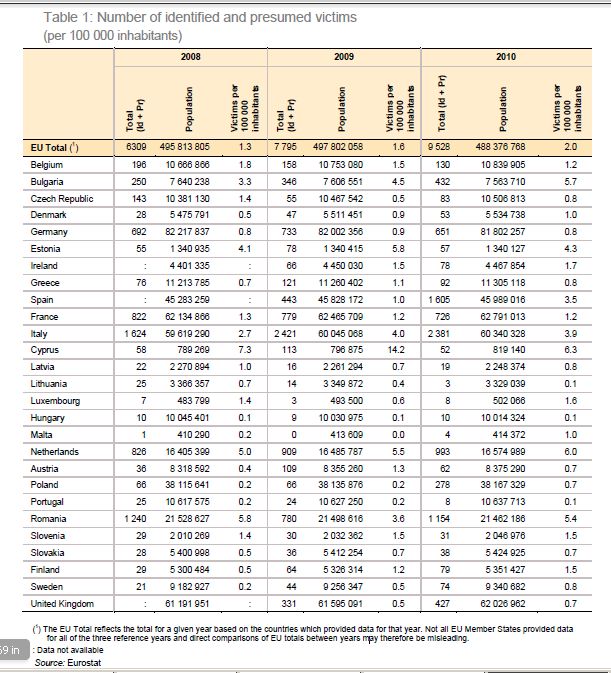
For all the faith put into that 18% figure, though, most of the newspaper and NGO reactions don’t evince much interest in the rest of the data. I’m going to put this down to simple laziness – it’s a whole 94 pages they’d have to wade through, poor dears – but it’s also the case that if all the statistics were accepted as readily as the “18% increase” has been, it would be a little bit inconvenient for some of those with an interest in this area. This table on page 31 shows why:

Trafficking01

Contrary to what we’re constantly told by the anti-trafficking movement, the most recent figures make it hard to discern any link between trafficking and the legal status of sex work. The Dutch rate is very high, but the Cyprus rate is higher – and Cyprus has much stricter laws than the Netherlands (brothels are illegal, for one thing). Romania, where sex work itself is illegal, is nearly as high. Hungary (legal), Portugal (legal) and Lithuania (illegal) are tied for last. Austria and Germany are also relatively low – in fact, Germany and Sweden are tied, at 0.8 per 100,000.  And the German rate has remained more or less constant over the three years surveyed, while Sweden’s has quadrupled.

Don’t think we’ll be reading that in the next Turn Off the Red Light press release.

I’m being mischievous, of course, because as I’ve already said, the data don’t – and can’t – show the actual number of trafficked persons in each country. So we can’t really say that Germany, Austria and Sweden have more or less the same trafficking rate. But let’s be honest here – had the table shown Germany and Austria to be right up there with the Netherlands, and Sweden way down on its own, is there any doubt we’d have heard all about it from the prohibitionist groups?

But sex workers’ rights advocates shouldn’t leap on those figures, either, because truthfully the whole report is pretty hopelessly undermined by its methodological weaknesses. These include the following:

Different countries provided different sets of data. On page 30 we are told:

Ten EU Member States provided data on identified and presumed victims, 15 EU Member States provided data on identified victims only and two EU Member States provided data on presumed victims only. The participating non-EU countries provided data only on identified victims.

This alone would make it impossible to get a cohesive account of trafficking, or even just of detected trafficking, across Europe. It certainly renders a comprehensive cross-country comparison untenable. (In case you were wondering, though, all the countries I’ve mentioned so far provided data only on “identified victims” – except for the Netherlands, which only gave “presumed victim” data. More about this later.)

Different countries use different definitions. The Commission seems to have attempted to get around this, by reminding countries of the international definition of “trafficking” when sending them the forms to complete, but the methodology problem is unavoidable. An “identified victim” is, according to page 22,

a person who has been formally identified as a victim of trafficking in human beings according to the relevant formal authority in Member States

and that inevitably introduces an element of subjectivity into the data, because not all member states strictly apply the international definition when deciding whom to identify as a victim of trafficking. In fact, I doubt whether any of them do – and they are inconsistent in the manner and degree by which they diverge from the international definition. So when we look at that table and see that Ireland has more than twice the rate of “identified victims” as Greece, for example, we have no way of knowing whether that’s because Irish police genuinely detected twice the rate of people who fit the international definition, or whether the Irish police identified people outside the international definition, or whether the Greek police declined to identify people inside it.

This problem is magnified for those countries that include data for “presumed victims”, that is:

a person who has met the criteria of EU regulations and international Conventions but has not been formally identified by the relevant authorities (police) as a trafficking victim or who has declined to be formally or legally identified as trafficked.

Here, member states are essentially being asked to submit data on people who were trafficked but were not identified as trafficked. To identify unidentified trafficking victims. There’s something a bit Schrödinger’s Cat-like about this category; it just doesn’t seem to lend itself to any real scientific measurement, at all.

If the data had been collected on a forward-looking basis, it might almost be workable. That is, if countries had been told that, for the future, they would be asked to record details of not only the people who they formally identified as victims of trafficking, but also of people who they would have identified as trafficked but for some insurmountable obstacle (such as that the person themselves told them where to stick their “trafficking victim” status). You’d still have the subjectivity problem, but at least you would know that the records were being kept on an ongoing basis, with the member states knowing exactly what they were to look out for.

But that’s not how this was done. Instead, as explained on page 17,

The questionnaire was sent via Eurostat to the National Statistical Offices of the EU Member States, EU Candidate and Potential Candidate countries and to the EFTA/EEA (European Free Trade Association/European Economic Association) countries in September 2011. It included the appropriate tables, a list of common indicators, definitions and guidelines for collecting the statistical data as well as the country codes to be used and a template for providing metadata.

So countries were asked to collate retrospectively their data on people who they had identified as unidentified trafficked persons. And then to pick out of that data only the people who fit the “common indicators, definitions and guidelines”. But who’s to say that the data were initially recorded in such a way as to make that possible? If the authorities weren’t already aware they were going to be asked to provide data on people who they’d declined to identify as “trafficked”, you have to wonder whether they’d be quite so diligent in their record keeping about those people.

Did I say “authorities”? Oh – here’s the next problem:

“Presumed victim” statistics were supplied by a wide variety of sources. According to page 23:

Data on ‘presumed’ victims on trafficking in human beings may be available from national rapporteurs (or equivalent mechanisms which tend to act as national coordinating bodies), victims assistance services, immigration services, labour inspections and border guards.

I don’t think I can really overstate this point: there is no possible way to get anything like a reliable, consistent overview when you throw out to your data collectors that they can get their information from pretty much anywhere they can find it. And as it happens, some of the key data sources are pretty questionable. For example, in the Netherlands the source is CoMensha, a national agency, which according to page 39:

does not have a formal assessment based on specific criteria by which the registered person’s status as a victim can be verified.

In other words – as I discussed in this post – CoMensha simply records the alleged cases that are referred to them, without actually investigating whether there’s any substance to the allegations. The Dutch figures in this report, therefore, are based on little more than rumour. No wonder they’re so high.

Also problematic is the Latvian information, which according to page 38 is

provided by the NGO Resource Centre for Women “Marta”, which provides assistance for presumed victims using alternative financing.

Marta is a prohibitionist organisation, and one that therefore has an interest in finding trafficking victims. In fairness to them, there’s nothing in the data to suggest they’re inflating the numbers; Latvia’s overall rate is the same as Germany’s and Sweden’s and only a minority of these fall into the “presumed victim” category. Nonetheless, their objectivity as a source has to be doubted.

To take a final example, page 39 states that Finland’s number of presumed victims

includes all cases who were directed to reception centers on the basis of suspicion of human trafficking.

Does that sound like a rigorous effort to make sure only the cases that fit the Commission’s specified criteria were reported? Not to me it doesn’t.

I could go on, but I think I’ve made the point. There’s just too much variation across countries, and too loose standards within countries, to consider this a reliable measure of the amount of trafficking in Europe. The report is of (limited) interest for what it reveals about the countries’ data collection processes, but overall you really get the sense of this being a box-ticking exercise for Brussels bureaucrats more than anything else.

I’ll just finish on a couple other matters I found worthy of comment. Firstly, on page 24 it states:

Data is to be collected on the total number of female and male victims

The binary (and I’m guessing cis-centric) approach is unfortunate, as even though the figures aren’t reliable it would still be interesting to see how many trans* persons were recorded. But the only reference I can find within any of the country data is in the British records, on page 39, where it says that one adult trans* woman was identified. Unfortunately, it manages to say this in a grossly offensive way.

There are also figures on “suspected traffickers” and “prosecuted traffickers”. It’s not clear exactly what threshold was required for the first category, but one thing I found interesting was that non-EU citizens accounted for 55% of the former but only 24% of the latter. The reasons for the discrepancy aren’t explained. It could be that non-EU citizens are more likely to go missing before they can be prosecuted, of course, but there could also be a greater tendency to suspect them without any real proof. This is something that merits further research.

And finally, a word about citizenship and labour market status. On page 52 there’s a table (Table 6) that breaks down all the identified and presumed victims, by year and by citizenship. So I did a little numbers exercise. First I counted all the identified victims by country (I didn’t count the presumed victims, because for all the reasons explained above, I think those numbers are too messy to be of any real use). Then I subtracted the internal trafficking victims (as listed on page 53, Table 7). And then I totalled up the remainder, put them into geographical categories and worked out the percentages of each.

The disclaimers first. The numbers don’t quite add up, because I came up with a grand total of 12,261 identified victims in Table 6, whereas the Table 2 combined figure for identified victims is 13,424. I’m not sure where that missing 1,163 went. There also seems to be a minor discrepancy in the Table 7 figures, since I end up with –2 cross-border EU-15 citizen victims in 2009. I couldn’t subtract the child victims, as there’s no breakdown by “identified” and “presumed” nor any indication of how many were working-age children. And of course, all the problems with the data I’ve already discussed still apply. But bearing all that in mind, I still think the results are stark enough to be worth pointing out. Of the identified victims of cross-border trafficking in the three year period:

  • 37% were Romanian or Bulgarian
  • 58% were from outside the EU/EEA
  • 5% were from the 2004 accession countries
  • <1% were from the EU-15

Thus, 95% were from countries barred from all or most of the EU labour market during the data collection period – and nearly everyone else was from a country barred from much of the EU labour market during the data collection period. This isn’t quite as dramatic as it seems, because it still only accounts for just over half the identified victims – the internal trafficking rate is surprisingly high, which is something else that merits investigation (though as the number is very high in some countries and negligible in others, I suspect it mainly comes down to definitions). Notwithstanding those limitations, though, I think it’s safe to conclude that cross-border migrants in the EU are far, far, far more likely to experience trafficking if they don’t have labour market access in the country they’re migrating to.

You’d think this would be a no-brainer, wouldn’t you? But EU states just don’t seem to get it. They consistently wring their hands about the trafficking problem, but stubbornly insist they just can’t relax their labour migration policies – without seeming to make the connection between the two. At some point they’re going to have to admit that if they really want to address the issue, they’ll have to stop making it all but impossible for accession state citizens and non-EU citizens to legally work in their countries. Or else admit that they aren’t really that bothered about trafficking after all.


Anti-choice spinning of California’s 1967 abortion law

Posted on

We’ve heard a lot lately from anti-choice campaigners about California’s 1967 Therapeutic Abortion Act. It’s being cited to support the argument that legislating for the X case – to allow abortion where a pregnant woman’s life is at risk, including by suicide – will inevitably open the floodgates and effectively allow abortion on demand.

One example is this Tweet from the Pro-Life Campaign’s Cora Sherlock:

Subsequently, an email circulated to Oireachtas members by a group of anti-choice politicians (parts of which were published in this Irish Independent article) claimed that the California law

was enacted in 1967 on the strict grounds of ‘where the mother was a danger to herself’

And then on the Vincent Browne show the other night, Dr Patricia Casey said that under the law, the woman had to be “certifiable”.

Three different claims about the California law. All wrong.

The actual text of the law was found in §25951 of the California Health and Safety Code. It allowed abortion where a committee, established by the hospital performing the abortion and consisting of at least two licensed physicians and surgeons (or at least three after the 13th week of pregnancy), found that there was

a substantial risk that continuance of the pregnancy would gravely impair the physical or mental health of the mother

“Mental health”, meanwhile, was defined in §25954 as

mental illness to the extent that the woman is dangerous to herself or to the person or property of others or is in need of supervision or restraint

Right away, we see that the text is logically problematic – how on earth can “mental health” be defined as “mental illness”? – but we don’t need to spend time on that. The more important thing is what the legislators intended in this requirement. Clearly Cora Sherlock got it wrong, because there’s no need that the woman actually be at risk of suicide, and the Oireachtas group also got it wrong, because the element of danger to herself is only one of the possible criteria under the law.

Dr Casey is closest to the truth, but even she is not quite correct. The text is based on an old standard under which a person could be deemed “certifiable” (a term I find a bit offensive, personally, but we’ll put that aside for now) but there is a crucially important difference. The old standard – which was found in §5550 of California’s Welfare and Institutions Code – allowed for involuntary commitment where a person was

dangerous to themselves or to the person or property of others, and are in need of supervision, treatment, care or restraint

What’s changed there is that the “and” was replaced by “or” for the abortion law. To be committed, a person had to be both dangerous and in need of supervision or restraint; to be allowed an abortion on mental health grounds, either was sufficient. So clearly, a lesser threat to mental health was required than that the woman would need to be institutionalised.

Still, it is a fairly high standard, and the anti-choicers are right when they say it was given a much broader interpretation in practice.  But it still doesn’t follow that the Irish law would do the same thing. For one thing, any way you look at it, “dangerous to herself or to the person or property of others or … in need of supervision or restraint” lends itself to a much looser interpretation than “at real or substantial risk of suicide”. (In fact, the California law was struck down as unconstitutionally vague in 1972 – two months before Roe v Wade – precisely because it had proven impossible for doctors to agree on what these criteria meant.)

For another thing, the California law operated in California. California isn’t Ireland, and it always took a more permissive attitude toward abortion. Even before the 1967 Act, it wasn’t actually difficult to get an abortion there – though the standard of care varied widely depending on the quality of provider the woman could afford. Women didn’t need to travel for abortion as they do in Ireland, where doctors are simply not willing to breach the law. It’s unlikely to the point of absurdity that the flexible interpretation applied by California doctors will be repeated here.

A comparable situation is the way that abortion laws are interpreted in Britain and Poland. On paper, the two countries have a pretty similar regime: both allow abortions in case of fatal foetal abnormality or risk to life or health. In practice, however, they couldn’t be more differently applied: Britain, as we all know, is more or less effectively abortion on demand, while Poland is regularly hauled before the European Court of Human Rights for denying even crystal-clearly legal abortions (and in the most appalling circumstances too; the latest example, P and S v Poland, reads like something Franz Kafka might have written with Margaret Atwood). Cultural views, and the constitutional context, have a huge impact on how liberally abortion laws are interpreted – and Ireland is far closer to Poland than Britain in this respect.

The increasing calls of the Irish pro-choice movement to repeal the 8th Amendment are a reflection of this. If legislating for X really would “open the floodgates” and allow abortion on demand, there’d be no need to amend the Constitution. When the legislation gets through eventually, and it will, we will see how little impact it really has on the abortion rate in Ireland. And then we can get on with campaigning for real change.

Free Clothes*

Free Clothes*

*By “free” I mean “you have to give Choice Ireland a fiver first.”

Click on the photo for more details.

On “pimps” and policy

Posted on

The Godwin’s Law of the sex work debate is that inevitably, someone on one side will call someone on the other side a pimp. Most of the time, the person making the accusation will be a supporter of criminalising the purchase of sex – and at least some of the time, the only ground for the accusation is that the other person disagrees. Sometimes, of course, there’s a bit more to it than that – the accused may have picked up a brothel-keeping charge, for example – but seeing as that’s happened to people on both sides of the debate, it’s a fairly unedifying accusation. Even when it’s true.

Of course, the point of the accusation isn’t to improve the debate from an intellectual standpoint; it’s to discredit the person it’s made against. And when it’s made against a person who wants sex work decriminalised, the point is to discredit their entire argument – by suggesting anyone who puts it forward is a “vested interest”, a person who (quoting RTÉ’s Prime Time) “profits from prostitution”, a person who pretends to have the interest of sex workers at heart but really just seeks to exploit them. In this way, supporters of the Swedish model can not only take the high moral ground themselves, but can also add impetus to their argument by portraying the law as an anti-pimp measure (as they did, for example, in this press release last month).

The irony is that there are plenty of reasons to think the law would actually have the opposite effect, and promote pimps and pimping. In 2003 the Norwegian Ministry of Justice and the Police went to Sweden to investigate the outworking of the law, and this is what they reported:

It has been claimed that prostitutes’ dependence on pimps has increased because street prostitutes cannot work as openly. The police informed us that it is more difficult to investigate cases of pimping and trafficking in human beings because prostitution does not take place so openly on the streets anymore….

Prostitutes’ dependence on pimps has probably increased. Someone is needed in the background to arrange transport and new flats so that the women’s activity is more difficult to discover and so that it will attract the attention of the police.

A few years later, this was echoed in a report by the Swedish National Board of Health and Welfare:

According to one informant in Göteborg, there are probably more pimps involved in prostitution nowadays. The informant says the law against purchasing sexual services has resulted in a larger role and market for pimps, since prostitution cannot take place as openly.

A woman engaged in indoor prostitution in Göteborg relates that when the law took effect in 1999, about ten women engaged in prostitution from various Eastern European countries approached her business because they wanted to hide indoors. Informants from the Stockholm Prostitution Centre also mention that the law has opened the door to middlemen (pimps), because it has become more difficult for sellers and buyers of sexual services to make direct contact with one another.

Norway, meanwhile, has seen the emergence of what you might call “pimp-like” relationships – relationships of extreme dependency, in which the most vulnerable (drug using street workers) become totally reliant on a particular man or men for survival. According to last year’s City of Oslo report,

Among the women with a drug addiction who still sell sex many have changed methods for finding customers. Most of the support services have experienced that the women enter into more long term relations with men who they refer to as “friends”, “boyfriends”, “uncles”, or acquaintances. These are men they stay in contact with through telephones and that they stay with for longer periods, this could be hours, days, or weeks. They have sex with the men in exchange for the men supplying them with drugs, money, and other necessities. Many of the support services say that they perceive the women as being very vulnerable in the relationships. The women become very dependent on the few customers they have.

So where does the idea come from that pimps would oppose criminalising clients? I think in part, it’s the failure of prohibitionists to understand the difference between legalisation and decriminalisation. Admittedly, there isn’t always a clear line between the two, but an essential element of legalisation is that sex work is only lawful under specified conditions. For indoor workers, this usually means that a premise has to meet strict criteria to be deemed a legal brothel – and that certainly can promote “pimping” as prohibitionists would define it. Few self-employed sex workers have the resources or even the desire to wade through that much red tape, so if they don’t want to work illegally and/or alone (depending on the laws of the jurisdiction), they often have little choice but to work for someone else.

But, and here’s the important thing that always seems to get missed, this is not the model advocated by most supporters of sex workers’ rights. Including many of those who are regularly accused of being pimps. A more favoured model would be something along the lines of New Zealand’s, where up to four sex workers can share a premise as a “small owner operated brothel” (SOOB) without the reams of bureaucracy that a managed brothel is subject to – and where sole operators can take the safety precautions they need without putting themselves at risk of arrest, as happens in many “legalisation” jurisdictions. Does this promote pimping? No, it doesn’t. In fact, according to the 2008 report of NZ’s Prostitution Law Review Committee,

Some brothels have closed down with operators citing the lack of staff and increasing competition for workers because of sole operators/SOOBs as reasons for the failure of their business.

You see? Make it easier for people to work without someone managing them, and they’ll have less need for managers. It isn’t really rocket science. In fact, none of this is counter-intuitive, at least for anyone who doesn’t consider the sex industry to be totally sui generis (which it isn’t). I mean, think about it: most people who call for drugs to be legalised are not actually drug dealers themselves. I don’t think I’ve ever even heard a drug dealer call for drugs to be legalised, for bleeding obvious reasons. Nor does anyone ever argue that criminalising drug dealers’ customers makes a dent in drug dealers’ profits – and fewer and fewer seem to think it really deters the customers, either. Why would criminalising the sex industry have an entirely different effect?

I am fully aware that this post is an exercise in futility. Criminalisation advocates are going to keep throwing the accusation around, keep raising the spectre of the Pimp-Monster lurking behind a multitude of Twitter accounts. It’s an emotive tactic, and thus perfect for what has been a heavily emotive campaign. It’s just ironic that its success will be measured by whether it achieves a policy that real pimps may be the first to benefit from.