RSS Feed

Abortion, X and the Eighth Amendment: why legislation isn’t enough.

Posted on

Abortion, X and the Eighth Amendment: why legislation isn’t enough.

It looks like Ireland is finally going to get legislation on abortion. Following the massive outcry over the fate of Savita Halappanavar, with the publication of the expert group report this week, there’ll be a debate in the Dail tonight on what- not if- to do about legislating for abortion to save pregnant people’s lives. With any luck, we’ll finally get that 20-years-overdue legislation on the X case, guidelines for doctors that spell out their responsibilities when faced with pregnant people whose lives are at risk, and Savita’s death, while unnecessary, will not have been utterly in vain.

But it won’t be enough. Why?

Continues at Consider the Tea Cosy

Taking Ideology to the Streets: Sex Work and How to Make Bad Things Worse

Posted on

“If you drive it underground so no one can find it, it wouldn’t survive.” – Rhoda Grant, 2012

In many ways, Dana fits the profile. She’s a twentysomething woman with a drug addiction. She was abused in childhood and her partner is occasionally violent towards her. They’re in and out of homeless accommodation, and she works on the street to fund both their habits. You could hold her up as an example of someone who does not want to do sex work, and you’d be right. You could score points with her story. You could insinuate that anybody who rejects total eradication of the sex industry simply doesn’t care about her. And that’s pretty much what the campaigners were doing when they lobbied for the criminalisation of her clients.

It’s late 2007, and the Scottish Parliament recently passed the Prostitution (Public Places) (Scotland) Act, outlawing kerb-crawling. Dana’s clients are now breaking the law. If she worked indoors, this would not (yet) be the case, but she doesn’t; she wishes she could, she knows she’d be safer there, but most brothel managers don’t take too kindly to injecting drug users, plus it would be hard to hold down structured shifts given how each day and night is arranged around the search for heroin. The law change hasn’t caused her to pack up and go home (what home?); instead, it has complicated and compounded an already difficult situation.

As I make her a cup of hot chocolate and count out free condoms, Dana takes a seat, tells me about last night. She waited on the streets for hours, frequently changing location in order to avoid police attention. The boyracers were out as usual, yelling abuse and throwing eggs as they sped by. She was rattling – experiencing heroin withdrawal. Gradually, the few remaining clients wore her down, and she agreed to do business with them for less than the usual price. She was out so long that she missed her hostel’s curfew and had to stay out until five in the morning; tried to sleep in a bus shelter. It’s late 2007 in Scotland, and the streets are cold.

“I used to complain about having to come out here to work,” she says. “I had nothing to complain about compared to now.” And this is the statement that sticks with me, a statement so simple and yet so clear, a statement which demonstrates that, despite how Dana’s supposed advocates, her would-be protectors – anti-prostitution campaigners – characterise sex work and how she experiences it, Dana herself knows the difference between a bad situation and a worse one. She is now in the latter. The support organisation I work for is severely underfunded (just over a year from now, it will be forced to cease service provision altogether). Waiting lists for drug treatment are lengthy, and missing an appointment, no matter how valid the reason, can land someone back at the end of the queue. When women like Dana are stopped by the police, sometimes they receive sympathetic treatment, but really it’s a lottery. There’s a serial rapist going around, but even though the women know about it, some of them are taking their chances with him anyway because there are so few clients to choose from. Maybe he’ll just be a bit rough, they rationalise. His behaviour escalates.

Those whose primary goal is to ‘send a message’ are worlds away from these women on the street. Their prioritisation of ideology over safety speaks volumes about their own motivations. It’s one thing if they simply don’t understand the practical repercussions of passing laws such as this one, although it’s too important an issue to excuse a lack of research – these are people’s lives we’re talking about here. But it’s quite another thing if their ignorance is a conscious decision, if they reject concerns not because those concerns are found to be invalid but simply because those concerns are raised by people they don’t want to hear from, including sex workers themselves. Those concerns interfere with a simplistic agenda which, in allowing no room for the nuances of real life, is set to fail. Harmful legislation is steamrollered through by people who block out dissenting voices and allow their supporters to believe there are no dissenting voices, or that those voices are dissenting only because they would rather see women ‘bought and sold’. This sorry state of affairs does no favours for the people they talk about helping.

Read the rest of this entry

“How many women have been told that their clothes, sexual partners, fantasies or use of contraception were responsible for their rape? So you think a rape crises center might FECKING NOT DO THE SAME!”

My country kills women.

Posted on

My country kills women..

 spent the last week of October visiting my family. Catching up with my cousin after her honeymoon. Calling over to friends from back home. Dinners with family and friends, full of that wonderful bustling laughter and warmth of sharing with the people you love.

While I was passing the potatoes and poking around the kitchen for a bottle of wine, a few hours drive away Savita Praveen Halappanavar was dying.

Savita did not need to die.

1992 – 2012 Legislating for X and Savita?

Savita Halappanavar was a 31 year old Indian dentist based in Galway, Ireland. She was married to Praveen Halappanavar who was a 34 year old engineer. Savita was pregnant. On the Sunday 21st October 2012, she presented to University Hospital Galway with back pains while in her 17th week of pregnancy.

Sadly, hospital staff told her she was miscarrying her pregnancy but there was still a foetal heartbeat present.

The doctors in the hospital told Savita and Praveen that her cervix was fully dilated and that amniotic fluid was leaking. They also told Savita that the foetus would not survive – but it would be over in a few hours.

For the following three days, Savita was upset and in “agony” but according to Praveen she had accepted that she was having a miscarriage and the doctors continued to check the foetal heartbeat. She asked the doctors on several occasions to terminate her pregnancy. They had said there was no prospect of the foetus surviving.

On Monday 22nd October, the consultant did ward rounds. Savita asked the consultant if there was no prospect of saving her pregnancy, could doctors induce to end the pregnancy instead. The consultant responded “As long as there is a foetal heatbeat, we can’t do anything.”

The same conversation took place with the consultant on the morning rounds of Tuesday 23rd October, and the consultant said that nothing could be done, as it was “against the law” and “this is a Catholic country.” Savita responded that she was a Hindu but the consultant said that there was nothing to be done. During that evening, Savita began to shake and shiver. The pregnant 31 year old began to vomit. She went to the toilet where she collapsed. Doctors took blood tests and gave her anti-biotics.

On Wednesday 24th October, Savita was still sick, and she and Praveen again pleaded with doctors to end her pregnancy and the response was unchanged from the previous days.

It is the law. It is a Catholic country. There will be no termination.

An open cervix has the same risk of infection as an open head wound.

Her cervix had been dilated since Sunday.

At around lunchtime, the foetal heart stopped and doctors brought Savita to theatre where they removed the womb contents. After the procedure she spoke to her husband Praveen, but she was very sick. This was the last time Praveen spoke to his young wife.

At 11pm that night Praveen received a call from the hospital to say she was being moved to an intensive care unit. Her heart was low. Her pulse was low too. Her temperature was high. The doctors said she was critical but stable.

By 7pm on Saturday her heart, kidneys, and liver were no longer functioning. She had contracted septicaemia and E.coli ESBL.

Savita Halappanavar, 31 year old Indian dentist, and wife of Praveen, died during the early hours of Sunday morning in this “Catholic country”. Praveen brought his wife home to be cremated in India. She was laid to rest on November 3rd.

Savita should have been celebrating Diwali this week with her husband.

Instead, the Health Service Executive have started an investigation in to her death and University College Hospital have extended their sympathy to her family and friends. External experts are being consulted and a ‘risk review’ is being carried out.

Under Irish law, the Supreme Court decision handed down in the 1992 X Case, Savita would have had a right to a legal termination of her pregnancy where there was a “real and substantial risk to her life.” There must not merely be a threat to a woman’s health. She must be at risk of death for an abortion to be performed legally in Ireland. But it is a Constitutional right in that case, according to the Supreme Court.

There is no legislation to give effect to this though.

Seven different governments have decided that women at risk of dying as a result of their pregnancies are not important enough to provide a law for. There are no legal rules to say to a doctor that yes, an open cervix for a number of days is a risk to a pregnant woman’s health, or that it may be such a risk to her health that it veers in to the category of being a risk to her life, and she is therefore constitutionally entitled to an abortion. Yes, the medical profession will know when a woman is at risk and when she isn’t, but there is no clarity as to whether there is legal cover for them to be able to act in a case such as Savita’s. They could be liable for severe penalties under the Offences Against the Person Act 1861 if they are found to not have the legal cover required.

Perhaps the doctors in this case genuinely felt that there was not such a high risk of infection and that this did not reach the very high standard of being a “real and substantial risk to her life”. However, the response the consultant gave Savita and Praveen while she was pleading in agony for a termination was that it was “against the law” in “this Catholic country” – rather than “you don’t actually need a termination.” Strange that.

The European Court of Human Rights said during the ABC v Ireland case that women should know under what circumstances they are entitled to a lawful termination in Ireland. It is a ruling based on the constitutional law of Ireland.

For many years, some prochoice activists have been of the clearly held view that, when it comes to the political establishment, someone would actually have to die before the Government would legislate for the Supreme Court decision in the X Case handed down twenty years ago. If the HSE inquiry finds that Savita died as a result of not receiving a termination, leaving her open to the massive risk of infection which eventually killed her, this Government, and the six Governments that have gone before them must realise her blood is on their hands. That is not to be melodramatic about things. A woman has died. If the HSE inquiry finds that Savita did not die from being prevented from having a termination and it was something else, her story will still send shivers down the spines of every woman in Ireland who has had a miscarriage who may well think “what if that had been me? What if the foetal heartbeat hadn’t stopped when it did?”  – because under those circumstances there is still a real and substantial risk of death. The fact remains, there are some conditions that will arise in pregnancy that will make the pregnancy itself life-threatening.

At this stage, it is either wilful ignorance or complete and utter misogyny that prevents the Government in Ireland from legislating for the X case to allow women in life-threatening situations have abortions legally and safely. The ABC case judgment was delivered in 2010. The Government responded by convening an Expert Group to examine “options” rather than actually produce legislation. The time is now over for the Expert Group.

While the Expert Group are examining, there is no way of knowing whether there is a woman in a hospital somewhere in Ireland with a dilated cervix miscarrying and pleading for a termination to take place. We have no way of knowing whether there is a woman contracting the e.coli that will kill her at this very moment because doctors have refused to terminate her pregnancy.

It is time to legislate for X. Savita Halappanavar should not be dead.

This must never happen again.


RIP.

Never again.

An Open Letter to Roseanne Barr, From a Feminist Sister

Dear Roseanne,

My name is Ariel Silvera, I’m a latina from Buenos Aires, Argentina who has lived around the UK and Ireland for the past 11 years. I am also a feminist trans woman. Now that the election is over, I hope you’ll have time to take a look at this letter.

I’m going to admit I’m not as familiar with your work as I should be. I never watched your famous show, although a good number of my friends of mine swear by it. I’ve occasionally seen you say some quite brilliant things in terms of politics, and my perception of you until now has been one of a rather kickass woman. So, I’m writing this out of disappointment regarding your recent comments about trans women. From a feminist to another feminist.

I want to start with a reality check. I like talking about material reality, about things that actually happen, rather than conjectures and assumptions. This reality check is about toilets. In a heated twitter outburst, you wrote ‘if she has a penis, she’s not allowed in’, continuing with ‘women do not want your penises forced in their faces or in our private bathrooms’.

Roseanne, I honestly wonder, just what do you think I do when I go to the bathroom? I’m going to tell you exactly what I do when I go to a public bathroom. Don’t worry! I won’t be sharing any scatological details or talk about any gross poo stuff. Ick! Okay, so. My public bathroom routine is, more or less, as follows:

1. Enter bathroom, head to nearest cubicle (I’m lazy, what can I say), or, if there is a queue, join it and wait for my turn.
2. Once in the cubicle, I lock the door behind me. If there is no lock, or it’s broken, I try to find a way to hold the door either with one arm, or a leg, or a bag if I have any.
3. I do my business, and I get out of the cubicle. I head towards the sinks.
4. I wash my hands carefully. At this point, maybe eye contact is made with another woman. Maybe we’ll say hi or comment on the weather. You know, small talk.
5. Leave the bathroom in the knowledge of a job well done.

So, there you have it. This is what I do when I, a trans woman, a woman who was assigned male at birth and has transitioned to female, do when I go to the bathroom. I can imagine that you, a cis woman, assigned female at birth, have a similar routine. Maybe you make witty remarks if someone strikes up a conversation, after all you’re a very intelligent person who can come up with a better topic than the goddamn weather.

What I’m trying to point out here is that at no point did I:

1. Talk to other women or girls in the bathroom about my genitals and the status thereof, or
2. Show my genitals to other women or girls in the bathroom or generally expose myself.

I imagine you don’t do this either. Congratulations. You go to the bathroom in exactly the same manner I do, as a trans woman. And before you ask? No, I have not had sexual reassignment surgery.

In your tweets, you say that people like me should not be able to access women’s bathrooms. I imagine you expect me to go into the men’s toilets. Roseanne, are you aware of the violence statistics for trans people in America alone? The fact that a majority of young trans people report verbal and physical harassment, and a third of trans youth have considered suicide? Given the violent misogyny prevalent in American society today, that if someone perceived as ‘a man dressed as a woman’, or someone simply perceived as female or feminine, entered a male-dominated space, do you honestly believe they would not face violence? Did you know that there were 17 recorded murders of trans people in America alone in 2011?

We are just going to the toilet, Roseanne. We’re not there to molest kids. You’ve brought up NAMBLA, and how you fought against their inclusion under the Gay/Lesbian banner back in the day. Good. I despise NAMBLA. I’m glad you did that work and I’m thankful for it! But, I ask, why do you bring it up? Are you implying allowing trans women into women’s restrooms is the same as opening the door to child molesters, rapists and paedophiles?

Now, I want to ask you to do something. Look up all reported cases of trans women raping minors in restrooms. Or of ‘men dressed as women’ doing this. Now, look up statistics of the violence faced by trans people in our society, and the way it maims and murders us for who we are (or, occasionally, when a black trans woman kills a white man, by accident, in self defense, she is sentenced as a mere murderer).

Ask any trans person, trans men, trans women, genderqueer & non-binary folk, and we will all tell you that bathrooms, for us, are TERRIFYING. Almost every trans person I’ve ever met (and being a long-time activist in the community, I’ve met a few from at least a dozen countries), has a horror story. That time they got beaten up for being in the ‘wrong’ toilet, whether it corresponded to their birth-assigned gender or not. The time they got shouted at. The time someone stabbed them. And this violence is mostly faced by those whom patriarchy, heteronormativity and a racist capitalism makes the most vulnerable: trans women of colour. 

You are asking us to face real violence because of the fact that a small percentage of us (just like a small percentage of ANY GROUP IN SOCIETY) may be rapists or paedophiles. There’s probably paedophiles or rapists in your own party, Roseanne, statistically speaking. By your own logic, we shouldn’t let members of the Peace and Freedom party into women’s bathrooms either.

You’ve brought the misogyny present in much of the LGBTQ movement into this conversation. I couldn’t agree more that this is a hugely important thing to address, and we need to continue to make LGBTQ groups understand that misogyny exists, that women are particularly oppressed in this patriarchal society. I think we can agree on this quite easily. I’m a long-time feminist activist, and have seen how misogyny tears movements apart, and how we must bring a feminist consciousness to bear on these problems.

Near the end of this blog post, you talk about vitriol aimed your way by members of the trans community. Threats and misogynist insults are unacceptable! But when you imply that an entire community is made up of rapists and paedophiles, many people are going to be angry and upset. And they may have very base reactions based on the fact that a massive percentage of us deal with massive self-hatred, and are made to feel alienated and suicidal by a society which, largely, promotes hatred towards us. A hatred we have to confront in the streets, every day, when we leave our front door.

Your reaction to the anger of members of a persecuted and marginalised community, which you ignorantly insulted, was this:

“The level of their misogyny is akin to racist fascism from the nazi’s in 1930′s pre war berlin-The GLBTQ community needs to confront this and challenge it.”

As a trans woman who is also jewish; as a trans woman who is also the daughter of parents who survived two military dictatorships (in Uruguay and Argentina, supported by America, might I add); as a queer feminist activist fighting for liberation, as a person who has seen her friends bleeding after being beaten up at protests, evicted from their homes, as someone who fights the good fight against oppression, just as you do… This is disgusting and offensive.

The anger and vitriol from a bunch of pissed off people with very, very little power is not comparable to the campaigns of terror perpetuated by the Nazis in the build-up to their ascension to power. And that’s just the key here: power. Do you think that trans people really have the institutional and societal power to oppress you? In the United States, trans people keep being murdered, keep surviving horrible violence and discrimination, particularly trans women of colour, as I said above. Do you really think that their communication of anger through twitter is the same as a bunch of german dudes beating up an elderly jewish shopkeeper? Is this it?  I eagerly await your compilation of tweets, which the blog post promises.

I don’t know how to end this, Roseanne. I was shocked to hear you treat trans people as if we are your enemies, as if we are part of the powers that be, which continue to keep people fighting against one another, in poverty and misery, fighting wars for profit and propagating patriarchal attitudes. I hope you read this letter, and that you consider my words in it.

I leave you with a link to a video of me giving a speech encouraging Irish LGBTQ people to become allies of the pro-choice movement, at the March For Choice, Ireland’s largest pro-choice demonstration in 20 years, only a few months ago. One of my main involvements in feminism for the past five years has been campaigning for free, safe and legal abortion in Ireland, something which I imagine you strongly support. We have a lot in common Roseanne. I hope you consider what I’ve written here today.

Regards,

Ariel Silvera

Recognition Not Pathologisation- how bad could it be?

Posted on

Originally posted at Consider the Tea Cosy

With tomorrow’s International Day of Action for Trans* Depathologisation, there’s a lot of talk going around about why and how we need to recognise trans* people’s legal rights. And I’m struck by how much of a big deal is being made over what is, in essence, the simplest thing.
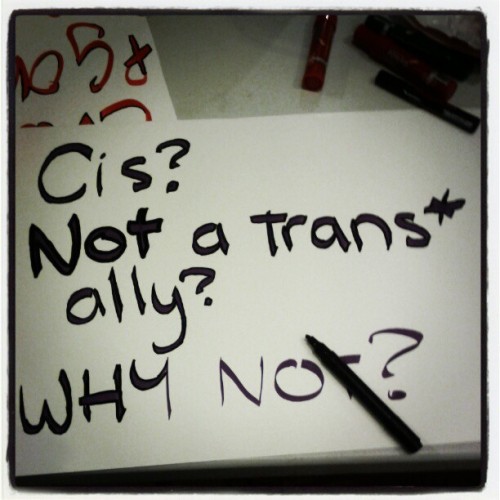
Ally?

What do we want?

It’s been five years today since Lydia Foy won her case for gender recognition. Five long years. In those five years, we’ve seen the publication of the GRAG report and, uh, very little else. By the sounds of it, gender recognition must be a complicated thing, right? Requiring all sorts of intricate legislative bits and bobs (the technical term) to sort out?

That depends. As with so many things, what it depends on is perspective. It turns out, the complexity of gender recognition legislation seems to depend mainly on whether you see being trans* as a tragic medical condition, or a normal part of human variation that should be recognised. On whether you’re determined to Other trans* people or to acknowledge that gender is a thing that lives between our ears that we get to define any which way we like. Turns out that if we go with the second definition, things get simple really, really quickly.

Legalise Trans*

Medical Tragedies or Self-Definitions

So what is being trans*? Is it a bizarre medical tragedy, an affliction that a small minority of people have to live with? Something a little bit scary that some people ust can’t help but that we should absolutely not be encouraging? Or is it a perfectly normal, if a bit less common than being cis, way to define yourself? And how does the answer to that question change what laws we put in place?

The recommendations of the GRAG report indicate that it tends toward the former definition. Here’s Maman Poulet:

The FF/Green Government formed the Gender Recognition Advisory Group in May 2010 to look at the issues which presented themselves following the Foy case. The group was entirely composed of Civil Servants and even though they received submissions and met with many groups from the rights and LGBT communities it is very evident that they really didn’t get it if an unnamed expert hadn’t told them.

Why was there no Trans rep on committee to at least provide an alternate view if even dissenting one? When the Government formed a group to look at the options for recognition of same sex relationships GLEN got a seat at the table….

The report recommends that Trans People applying for their gender to be recognised will have to have a formal diagnosis of Gender Identity Disorder with evidence of medical treatments or will have to have had Gender Reassignment Surgery. This means that one has to have had hormones and mental health treatment and assessment or gender surgery (and hormones and mental health assessment/treatment and everything else)… There is no understanding of the issues facing InterSex here at all..

…The report proposes that there is a panel which people will have to appear before made up of medical and legal representatives and one other where the applicant will will be told if they are a man or woman in the eyes of the state.

I know Trans people who are married and happily so, I know others who are divorced or separated. The report recommends that those applying for Gender Recognition be required to divorce or end their Civil Partnership before they can apply.

Let’s go over that again. In order to change their legal gender, a person would have to:

  • Present a formal diagnosis of GID (defined as a mental illness)
  • Have had medical treatments and/or surgical intervention
  • Appear before a panel of medical and legal representatives to make their case
  • If married, divorce.
  • Oh, and also, because of the definition of GID, you can’t be intersex.

That’s a lot of barriers. You have to be diagnosed as mentally ill. You have to chemically or surgically change your body- which means that gender recognition would be denied to those who, for financial or medical reasons, can’t do this. Never mind bodily integrity. You have to convince a panel of strangers. And if you are happily married, you need to split up your family. And, most bizarrely of all, you need to have a binary-sexed body.

Can I diagnose you too?

I could go into why this is ridiculous, but I’m going to trust that my lovely readers can work that out for yourselves. Instead, I want to show you a different model that is in place right now in Argentina. Let’s check out what TENI have to say about it:

The Argentinian Law is based on self-determination and provides full recognition of self-defined gender identity. Transgender people in Argentina will not need to prove they have had surgical procedures, hormonal therapy or other psychological treatment such as a diagnosis of a mental illness. This law clearly separates a legal right from medical interventions.
This law has been heralded as the most progressive in the world and signals a new era for transgender human rights. Justus Eisfeld, Co-director of Global Action for Trans Equality told press, “The fact that there are no medical requirements at all — no surgery, no hormone treatment and no diagnosis — is a real game changer and completely unique in the world. It is light years ahead of the vast majority of countries.”
However, while clearly separating medical interventions from the legal recognition process, the Argentinian law also provides a right to access any desired medical treatment which firmly enshrines the importance of transgender healthcare.

Huh. Well. Um. That was easy. So in order to get your gender legally recognised in Argentina you have to:

  • Fill out a form. Probably take it in to be stamped by someone because this is a bureaucracy we’re talking about. I’ll bet there’s some queueing involved, so you might want to bring a book.
  • Receive new documentation with correct gender.
  • Continue to be able to freely access whatever medical transition you need to. THIS BIT IS IMPORTANT. Gender diversity is awesome. Gender dysphoria is really, really not, and depathologisation without ensuring access to treatment for dysphoria for everyone who needs it is worse than useless.
  • Have a cup of tea, read the paper, give out about things on the internet, watch TV, go for a run, get on with your life, etcetc.

That last bit, by the way, is optional and can be adapted to your own preferences. As is the first bit. You might prefer a few podcasts to a book.

Note, by the way, how this involves vastly less hassle for everyone than the proposed Irish model. And how it also guarantees any trans* person the right to the transition-related healthcare that they want or need. So what, precisely, is getting in the way of Ireland doing the same? What are we so scared of? What’s the worst that could happen?

Time to do a poodle

If we make it easy to change your gender, everyone will want to do it!

Fearmongers envisage a society where you, me, your ma and your entire secondary school history class are changing our genders like we change our shoes. In my case, that would be as rarely as possible, when the old ones are worn out and full of holes, with an awful lot of grumbling. But I gather that I’m not representative of everyone.

So there we are, with everyone changing their genders whenever the mood strikes them. Down is up, left is right, nobody knows what to call anybody and everyone’s in such a panic that they can’t even remember how to make a nice cuppa anymore.

Shocked woman with a cup of tea
It’s okay, scared lady from the internet. It’ll be fine, I promise.

What nobody seems to have explained is why this would be such a bad thing in the first place. If gender is all about how we identify ourselves, then why shouldn’t we get to change it? Why shouldn’t you, me, your ma and your entire secondary school history class get to cheerfully toddle down to the relevant department, sign a couple of dozen forms, hand over the inevitable fee and then do it all again a few weeks later when they change their mind? Why on earth would that be so terrible?

In fact, it might be pretty great.

For one thing, we’re in a recession here, and changing documents always costs money. Wouldn’t the hordes of people changing their gender markers be a fantastic source of revenue?

For another thing, this scenario inevitably means that people are going to magically forget that they live in a world filled with cissexism and transphobia and instead cheerfully (and with legal recognition) explore all the gender possibilities that they can. Nobody would get to assume just by looking, or by having known what it was last week, that they knew a person’s gender! Asking “what’s your pronoun?” would become as ordinary a question as “Jaysus, will this rain ever stop?”.

Of course, this scenario- as delightful as it is- is ridiculous. I’m sure there are some people in the world who like filling out forms for the lulz. I’m equally sure that it’s a minority sport.

So with that scenario out of the way, what else is there to be scared of?

Dogs And Cats Living Together

Did you notice that in Argentina, there’s no requirement to divorce the person you love in order to get your gender markers changed? That’s because in Argentina, they’ve reinforced their buildings from falling skies and reinforced their umbrellas for downpours of (literal) cats and dogs. All necessary precautions in order to allow same-sex marriage.

Terrifying gays getting married
Under your very nose!

That’s right. If you let trans* people’s genders be recognised without forcing them to get divorced first, you’re going to have a situation where perfectly normal het couples, through a magical process probably involving radioactive spiders, start morphing into gay marrieds. Before your very eyes! WHO WILL BE SAFE? YOUR OWN NEIGHBOURS COULD TURN INTO THE GAYS AT ANY MOMENT.

So, uh, that’d be scary, right? Right? …….right?

What’ll we gain?

Oh, you know. Just little things. Dignity. Trans* people not being forced to out themselves whenever they have to present legal documents. Embracing people for who they are. Honouring bodily integrity and the sovereignty of each of us. Massive symbolic recognition throughout the country.

Little things like that.

Why’re you telling me all this now?

You can’t have forgotten, can you? Tomorrow is the International Day of Action for Trans* Depathologisation! If you’re in Dublin or can get here, and you’re even half as sick as I am of ridiculous, unnecessary barriers put in the way of trans* people’s legal rights, get that (remarkably attractive) ass of yours out to Kildare Street for 2.30pm.

Rally for Recognition Saturday 20th October 2012, 2.30pm


Edited to add a Very Important Thing:

In writing this, I’ve realised- almost instantly after hitting ‘post’- that something that I’ve left out here is anything about gender dysphoria. As I’m running out the door right now, I’m going to leave you with some quotes from the wonderful Quarries & Corridors. Listen up, because this bit’s important!

There’s an incredibly important distinction that needs to be made clearly, front and centre in any debate about depathologising trans people. Having a gender that differs from that assigned to you at birth isn’t illness, it’s the gender dysphoria resulting from this that is. That may seem like semantics, but there is nothing wrong with me for having a nonbinary gender, I used to have gender dysphoria, now treated. Similarly, no one is ill for being a trans man or a trans woman, but the gender dysphoria from not having that recognised and affirmed hurts. The DSM-5 is already removing ‘Gender Identity Disorder’ & replacing it with ‘Gender Dysphoria’, pathologising our dysphoria not our genders. I think this is the right approach. It lets me be transgender without that being seen as disordered, it maintains access to medical care. Anyone making a lot of noise about depathologising trans* without making these important distinctions up front’s likely to do serious damage.

So let’s not forget that, k?

Callout culture, tone trolling and being the Perfect Ally

Posted on

This morning, I was linked to a couple of interesting articles, Liberal bullying: Privilege-checking and semantics-scolding as internet sport at the Offbeat Empire, and Pyromaniac Harlot’s The Unicorn Ally. As social justice, communication and the idea of being an ally have been on my mind a lot lately, these provided food for thought. Both authors are people who, like me and like most people, intersect on both sides of the oppressed/ally fence. Both raise some important questions to which I don’t have any easy answers. I’d love a conversation.

Callout culture versus tone trolling- How important are semantics?

In Liberal Bullying, Ariel Meadow Stallings argues that callous culture has become a form of bullying. She sees callout culture as having become a

“new form of online performance art, where internet commenters make public sport of flagging potentially problematic language as insensitive, and gleefully flag authors as needing to check their privilege”

Stallings continues:

“It’s a kind of trolling, with all the politics I agree with, but motivations and execution that turns my stomach. It’s well-intended (SO well-intended), but when the motivations seem to be less about opening dialogue about the issues, and more about performance, righteousness, and intolerance for those who don’t agree with you… well, I’m not on-board.”

There’s so much to unpack here. For one thing, where do we draw the line between tone-trolling and legitimate expressions of anger? People in marginalised groups are often pissed about their marginalisation, and rightly so. Where do we create spaces for safe expression of that anger, and where do we create spaces that are safer for (potential) allies who might need a bit of 101? Whose comfort matters, and where?

I feel uncomfortable expecting perfect behaviour from marginalised people at all times. Holding people to a higher standard is, after all, itself a mechanism of marginalisation. Marginalised folks are expected to be exemplars at all times, to avoid ‘letting the side down’ and showing up the entire group. Additionally, marginalised people are generally subject to far more punitive sanctions for any misbehaviour than their more privileged counterparts.

This doesn’t mean that someone should be let off the hook if they turn out to be a member of a marginalised group. But it does mean that I’m a little uncomfortable with statements like this:

“This is where it starts to feel like the “GOD HATES FAGS!” sign-wavers. While the political sentiments are exactly opposite, the motivations are remarkably similar.”

You don’t get to compare people to a vile hate-group just because you don’t like how they’re acting in your comments section. Doing so feels like godwinning the entire thing.

But I can’t deny that we have a major problem with bullying online. And I can’t deny that internet-pile-ons can get incredibly ugly and disproportionate. If we want to grow our movements and welcome allies among the relatively-privileged, which every movement needs to do, we’ve got to make spaces where people can figure things out.

The ‘Perfect Ally’?

This is where Pyromaniac Harlot’s article comes in. Harlot writes about having a difficult time navigating allyhood and being under immense pressure to be perfect the entire time- something which she feels has been constructed as an impossible standard:

As an ally, my job is to not impose my own beliefs of what’s ‘right’, but instead amplify the voices of the oppressed people that I’m trying to be an ally for. Except that I shouldn’t bug them about educating me, because that’s not what they’re there for. And it’s my duty to talk about the issue of oppression in question, because it’s the job of all of us, rather than the oppressed people, to fix it. Except that when I talk, I shouldn’t be using my privilege to drown out the voices of the oppressed people. Also, I should get everything right, 100% of the time. Including the terminology that the oppressed people in question themselves disagree on.

Should we be really trying to be perfect allies? If there’s one thing that intersectionality teaches us, it’s that things are complicated. We don’t get a nice simple world with easy definitions of right and wrong, privileged and marginalised, ally and enemy. If someone wants me to be their perfect ally all the time, then I’m sorry. It’s not going to happen.

On the other hand, these are questions I ask myself all the time. When I’m working as an ally- which I try to devote a reasonable amount of time to- I’m incredibly conscious of all of the above. I don’t take it personally, though. I don’t choose to be privileged in some respects any more than I choose to be marginalised in others. Things like disagreeing while being an ally are always going to be complicated and difficult.

Privilege and allyhood

A thing I hear a lot is that even if dealing with being called out on privilege sucks, it sucks a hell of a lot less than oppression. A truer statement has rarely been said. But many of our allies also come from marginalised groups. How do we call out people who are relatively privileged but who might also be tired from dealing with their own oppressions, without either being assholes or censoring ourselves? Pyromaniac raises this question:

“I happen to be educated enough to understand varying levels of heavy jargon. I don’t have any conditions that prevent me from reading for hours. I happen to have the luxury of sufficient free time in which to do this. So telling me to go read up on something is kind of ok. But you know what? Most people don’t have that level of luxury. People are busy, you know, surviving themselves. They don’t necessarily have laptops, broadband, and ample time in which to make use of those things.”

This seems like one hell of a question to me, and possibly the most important that I’ve seen in these posts. If our allies are- like most people- oppressed/marginalised themselves in other ways, how do we deal with expectations of perfection or call-out culture? How do our obligations change? This isn’t something that I have any easy answers for.

How about you? What do you think about allyhood, about callout culture, about tone-trolling, about navigating intersections of privilege and oppression in our activism(s)?

Originally posted at Consider the Tea Cosy

March for TEA this Saturday!

Posted on

After #meteorshame, who’s feeling like it’s time that we all stood up to be counted in support of Irish trans people’s rights? I sure as hell am. So’s Aisling from Gaelick:

Hey, quick question, what are all you guys doing on the 20th of October? I know where I’m going to be. I will be outside the Dáil from 2.30, getting my protest on. That’s the day of the Rally for Recognition: Identity NOT Disorder.

The rally marks the International Day of Action for Trans* Depathologisation. If that seems like a paragraph full of made up words to you, don’t worry, sit down, I’ll explain it to you..

Rally for Recognition poster

Trans* Education and Advocacy, the organisers of the rally, have this to say:

Being gay used to be a mental illness… being trans* still is.

In 2012, trans* people are still not recognised by the Irish State.

Join TEA at the Rally for Recognition to mark International Day of Action for Trans* Depathologisation on Saturday 20 October 2012 at 2.30pm outside Dáil Éireann, Kildare Street, Dublin 2.

For those of you who can’t get enough of waving clever slogans around, TEA will be making placards from 6.30 tomorrow (Wednesday) evening at the Exchange. Come along! There’ll be tea and biscuits!


Originally posted at Consider the Tea Cosy