RSS Feed

“He’s sound on economic issues” – Hypocrisy around misogyny on the left

CN: for sexual violence

A Craiglist ad posted on a friend’s facebook account caught my attention the other day.

craigslist ad


I laughed and promptly posted it on my own page. In isolation, it’s funny, and given that I and other feminists regularly have men message us on twitter and facebook asking the most basic googleable questions of us, it wouldn’t be surprising this person exists. It also shouldn’t be surprising that there are a lot of broke feminists and gender studies experts who would happily take on the task of teaching some bloke they never met Women Are Equal 101.

Hell, most of us are doing it for free anyway.

However, it then came to light via a piece by Ruth Graham on Slate yesterday that this was not a mother looking to help her chump of a son out, but a man called Nader Kashani who is well known for harassing women online who concocted a fictional profile in order to make contact with feminists. The Slate read is disturbing. Kashani’s views on rape even more so.

The thing that made Kashani’s Craiglist ad and the Slate piece so remarkable is that Kashani got caught out, and the internet gasped as we all wondered what exactly the motivations were. It’s almost the two year anniversary of the Isla Vista shootings in which Elliot Rogers gunned down six people in retribution for his hatred of women. The conclusions that many came to about Kashani’s motivations and commentary that the whole incident was “terrifying” were certainly not unreasonable. There was too much effort put into it for it to be simply written off as a bad joke.

The thing that struck me about this was the amount of left activists of all genders, who shared the Slate piece commenting on how threatening it seemed. It’s heartening to see people acknowledge that these types of men *are* a threat to women. On the other hand, it was disappointing nobody (that I’m aware of) made the connection between a random dude on the internet posing as someone needing to learn about feminism (or at least representing themselves as not being actively hostile to it) and the men who walk among us posing as feminists or pro-feminist activists that eventually turn out to be abusive misogynists.

Suzanne Lee spoke at the Anarchist Bookfair over the weekend about her experiences in feminist struggle. If you haven’t seen her contribution, you should watch it (Suzanne begins around 23:24 in to the video). She makes the valid point that there were people who couldn’t attend a panel on feminism because they’ve made the decision that they can’t engage because the activist community still welcome certain known abusers in to their circles. I’m not pointing to any one particular group or organisation here, because as far as I have seen this action crosses political differences and factions but a lot of the time it’s common knowledge when someone is “dodgy” but it is women who are expected to be the ones to avoid places and disengage from the situation.

It is a sad reflection on Irish activism that there are women who can’t go to anti-domestic violence demonstrations because the last time they went to one they were faced with their own abuser standing shoulder to shoulder with the others attending – and it certainly wasn’t because they saw the error of their ways. There are men who tried to force their partners to have abortions against their will wandering freely at pro-choice demonstrations. There are men who have been violent towards their partners welcomed in or left in activist circles without comment. Women who are open about their illegal abortions are expected to get on with the work of fighting austerity alongside those who march against them in anti-choice demonstrations. I have literally lost count of the amount of times I’ve heard allegations of rape and sexual assault and domestic violence being made about male activists, and I’ve lost count of the number of times their victims have been branded as “mad” “liars” and “bitter” as a result.. Everyone knows these men are abusers and nobody says so. Meanwhile women quietly leave the room – and their activism as a result – and their abusers revel in the knowledge that these women will likely never engage with the architecture of the state system of courts and justice and they do the same thing all over again. I doubt there are many men on the left who text ahead to a friend or comrade to see if a certain person is at the meeting, demo or event they want to go to. It’s ok to criticise Nader Kashani because he’s very far away, but when a man who harasses or abuses women is in the meeting/ on our demo/ holding our mic everyone else is very quiet.

I don’t have any answers to this. I don’t know how this can be addressed. I do know that this post will be seen by many as an attack on the left, when the “real enemy” is elsewhere, but ultimately there isn’t much difference between a man like Kashani using feminism in order to abuse women and some pseudo-lefty who uses feminist activism in order to perpetuate their own brand of misogyny.

The result is still the same; women being abused.


@stephie08


On trigger warnings and double standards

Posted on

Content note: PTSD, anaphylaxis

I have an old friend who I’ll call Sarah. Sarah has a rare, fatal allergy to chicken. If she eats chicken she can literally go into anaphylactic shock and die in a matter of minutes. Her allergy is so severe it can even be triggered by the smell of chicken being cooked.  She’s never had a full-on anaphylactic episode from inhalation alone, but she does have a powerful and deeply unpleasant reaction to it, and she doesn’t want to take any chances.

When Sarah was in graduate school she lived in a student apartment on campus. Because of her allergy, she was given the one apartment in the building that had its own kitchen. The other students shared a kitchen on the floor. Unfortunately, the shared kitchen was between her apartment and the way out of the building, so she couldn’t help but walk by past it.  And if she was coming or going when someone was cooking chicken, she couldn’t avoid the smell. And the reaction.

Sarah knows her allergy is inconvenient for the people around her.  She feels bad about this, although she really shouldn’t. When she moved into the apartment, she went and spoke to every other student on her floor, individually. She explained her chicken allergy to them and asked that if they planned to cook chicken, could they please just let her know in advance so that she could make sure she did not have to walk past the kitchen until they were finished. She didn’t ask them not to cook it at all, just to give her a bit of notice when they were planning to.

Most of the students did. One refused to. She didn’t refuse to Sarah’s face; she simply went ahead and cooked her chicken when she wanted without giving Sarah any warning. At least once that Sarah knows of, one of the other students reminded her of Sarah’s request; her response was something along the lines of that she couldn’t be bothered, and Sarah would just have to deal with it.

Just have to deal with an extreme allergic reaction that may not actually kill her, but could trigger symptoms that make her feel like she is going to die. Just deal with it. Because this neighbour couldn’t be bothered to give Sarah a heads-up so she could do what she needed to protect herself. Too much trouble.

You can see where I’m going with this. Sarah’s neighbour was behaving very much like the people who simply refuse to use trigger warnings before sharing material that might adversely affect others. In fact, they are worse because in many cases they are actively trying to dissuade anyone from using them. As obnoxious as her behaviour was, Sarah’s neighbour wasn’t, as far as she knows, going around telling the other students they shouldn’t be letting her know about the danger their chicken cooking might pose to her.

And that’s exactly what we are talking about – danger. Not offence. Not discomfort. Real, genuine harm. The word “trigger” is in there for a reason. It reflects the language used by clinicians and researchers when talking about conditions that make the people who have them susceptible to sudden, acute reactions, set off by things that would be more or less benign to others. Anaphylaxis is one such condition. PTSD is another. In fact, the two conditions often share symptoms – hyperventilation, dizziness, a feeling of being suffocated. The suffocation may more readily lead to actual death in an anaphylactic, but when you’re suffering repeated spells of really feeling like you are going to die, I’m pretty confident in saying that’s going to have a negative effect on your health. And psychiatric conditions do kill people, sometimes, at least indirectly. It’s not the same risk as eating something you have a fatal allergy to, but it’s not incidental or negligible, either.

Anaphylaxis and PTSD have something else in common, too, and that’s that they’re both unpredictable: the triggers aren’t necessarily only where you expect to find them. Sarah once nearly died after eating a “vegetarian” pizza, probably due to cross-contamination in the restaurant kitchen. Other allergic people’s triggers may be even harder to avoid, like peanuts. And not every allergic reaction is an anaphylactic reaction, either, just as not every read of potentially triggering material will actually set off the symptoms in someone with PTSD. But just because you don’t know whether or how someone is going to react to something isn’t a reason not to warn them when you know it’s something they might react quite severely to.  Letting them know allows them to decide for themselves whether the risk is one they feel able to take. Not letting them know gives them no real choice in the matter – even if it’s a day when they’re feeling exceptionally vulnerable, or left their epi-pen at home.

Ultimately, where you stand on trigger warnings says a lot about where you stand on mental health. If you think Sarah’s request for a heads-up was reasonable, if “may contain nuts” doesn’t provoke you into writing awful New Statesmen columns about the threat to culinary freedom, but you think PTSD sufferers should just grow a thicker skin and certainly should not expect other people to have any regard to their condition, then what you’re basically saying is that mental health doesn’t matter in the way that physical health does. Not an uncommon view, of course, but one I suspect many of those in the “anti-trigger warning” camp would be loath to admit they hold.  Either they do hold it, or they’ve entirely missed the point of what trigger warnings are about. There really is no third option.


The political and personal landscape of choice in Ireland

This piece has been previously published in print by the Workers Solidarity Movement in the magazine Common Threads. Since its publication one of the pending prosecutions in the north referenced in the piece has resulted in a conviction for a young woman for having a safe though illegal abortion using the abortion pills.1383342_332492296896551_364124772_n.jpg


It is all but impossible, both in theory and in practice, to legally obtain an abortion on the island of Ireland, both north and south of the imaginary border that divides this island. It is completely impossible to safely and legally obtain an abortion anywhere in Ireland;  the legal framework in the south specifically requires that in order to obtain an abortion without being criminalised for so doing, the woman who needs it must be ill enough to die; thus it is rendered impossible for her to be safe in access to legal abortion.


In the north, the Offences Against the Person Act dating from 1861 – over a century and a half ago – is what renders women taking control of whether or not they give birth and remain pregnant illegal. It describes abortion as ‘procuring miscarriage’, a description which is very apt for what those who need abortions in the north of Ireland today are forced to do by this archaic piece of legislation; obtain the abortion pill illegally online via organisations like Women on Web, Women Help Women, or less reputable means. It states that anyone who does this “shall be guilty of felony, and being convicted thereof shall be liable [..] to be kept in penal servitude for life”. However there was an exception made to this under the Criminal Justices Act of 1945. This Act, while it created the offence of “child destruction”, defining it as “any wilful act [that] causes a child to die before it has an existence independent of its mother” allowed that such a “destruction” could be carried out without legal penalty if one is acting in good faith to preserve the life of the “mother”.


Unlike in the south, this has been interpreted by subsequent judgements to mean not only that the woman must be on the brink of death, but also that the woman’s health was important as well. (In the south, the Supreme Court ruling on X in 1992 specifically excludes the woman’s or girl’s health from being in any way relevant to whether she is permitted to access an abortion.) In 1994 a court in the north found that this “does not relate only to some life-threatening situation. Life in this context means that physical or mental health or well-being of the mother and the doctor’s act is lawful where the continuance of the pregnancy would adversely affect the mental or physical health of the mother. The adverse effect must however be a real and serious one and there will always be a question of fact and degree whether the perceived effect of non-termination is sufficiently grave to warrant terminating the unborn child.” However it is very difficult to establish clearly the criteria under which this is deemed to be the case; on the 26th of March of this year the Northern Ireland Executive finally agreed to publish guidelines for healthcare professionals on when it is legal for women to access abortion. This was following enormous pressure on the Executive owing to a ruling from Belfast High Court in November 2015 which found that to deny abortions to women carrying pregnancies that will not survive to term, or beyond birth, or pregnant as a result of “sexual crime” was a breach of their human rights. Again, as in the south, this legislative framework ensures that a woman cannot be safe if she is unwell and endangered enough to fit the criteria of being ‘permitted’ to access a legal abortion.

Despite the obvious outdatedness of the Offences Against the Person Act of 1861, there are nonetheless not one, but two pending prosecutions in Belfast at the moment under it. One is of a woman who procured the abortion pill for her teenage daughter; subsequent to its administration they presented at a hospital in search of medical treatment, worried for the daughter’s well-being. Though details of the case are as yet unclear, it seems that a (presumably anti-choice) medical professional they encountered there felt the need to report them to the police for something that would render them open to life imprisonment. The second pending prosecution is of a woman in her twenties who obtained the abortion pill for herself and apparently for others. Again, details of her situation are unclear, but given that there is no prosecution or pursuit of any of the over 200 women from the north who have openly and deliberately incriminated themselves under their full names in repeated open letters and publications in various media as people who have needed access to the abortion pill, it seems likely that this prosecution too came about under pressure from another party.


The legal structure in the south of Ireland is the 8th amendment to the Irish constitution. It states that “The State acknowledges the right to life of the unborn and, with due regard to the equal right to life of the mother, guarantees in its laws to respect, and, as far as practicable, by its laws to defend and vindicate that right.” The obvious afterthought of the right to life of the carrier of the foetus granted was only included in the wording after a vigorous campaign from feminist groups of the time. The referendum for its inclusion in the constitution of southern Ireland was passed in 1983 after a vitriolic debate in a referendum in which only 53% of the electorate voted. 67% of those who voted, voted for it. This means that a decision made by a mere 35% of the electorate of southern Ireland 32 years ago, none of whom are likely to be women of reproductive age today (the youngest a voter in that referendum would be now is 50), is deemed relevant and appropriate to force every person capable of becoming pregnant in the south of this island to remain that way regardless of that person’s own opinion on the matter.


The 8th amendment also strips from any pregnant woman or other person the right to consent or refuse any treatment a higher power than herself(!) may deem necessary for the foetus she carries in pregnancy. It also means that it is at the whim of a medical treating power to deny a pregnant woman potentially lifesaving medical treatment if they consider it may damage the foetus she carries, as was seen in the case of Michelle Harte. Michelle Harte was a cancer sufferer who was receiving treatment denied to her by Cork University Hospital’s “board of ethics” (what a misnomer) when she became accidentally pregnant. The same ethics board denied her, a dying woman, access to an abortion and forced her to travel to the UK while incredibly ill with cancer to obtain the healthcare she needed – an abortion. She subsequently died. A Catholic bishop sits on that ‘ethics’ board.


Since the context of choice and bodily autonomy in most public discussions, even most leftist public discussions, seems only to be understood as the choice to continue or to end a pregnancy, it is imperative to highlight that the 8th amendment is used also as a tool of coercion against women and others in continued pregnancy and during birth. The 8th amendment is regularly cited to pregnant women wishing to go against what their doctor deems to be the best for them; the phrase, “I could bring you to court if I have to, you know” is one used against pregnant and birthing women in Ireland far too often. This is explicitly stated in the HSE’s National Consent Policy, which cites the High Courts as the appropriate place to determine what can be perpetrated upon the body of a pregnant woman without her consent. Doctors, midwives and social workers are more often those doing the coercing in this scenario; it rarely goes as far as the courts, as most women when told by the social workers who arrive on their doorstep (as has happened in more than one instance) that their existing children will be taken from them into care if they continue to refuse to comply with their doctor’s vision of what is best for them, do not feel capable of struggling back when in all likelihood they will lose anyway. However there is one instance in which the High Court has been invoked, in Waterford in 2013 in the Mother A case.


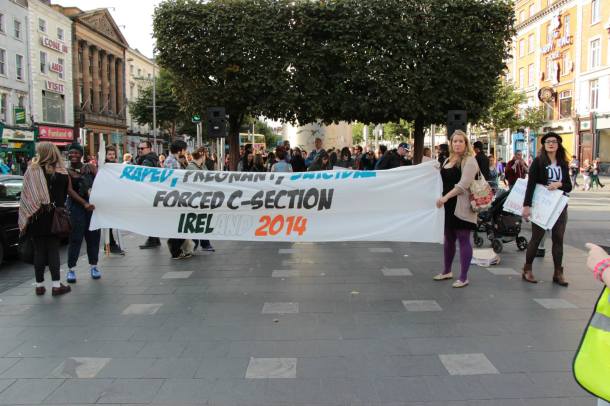
The Mother A case involved Waterford Regional Hospital taking a woman, known as ‘Mother A’ by the court, to the High Court in an attempt to secure an order coercing her into a caesarean section. They took this action despite the fact that Mother A was not utterly refusing to consent to a c section; she specifically said that despite her desire to have a vaginal birth, should an emergency arise, she would consent to a section. It was not an emergency situation; the spur for the coerced c section was a foetal trace which was categorised by the person interpreting it as “non-reassuring” rather than emergency. She also wanted to delay the birth by at least 24 hours, because her partner was out of the country until then and she wanted him to not only be present at the birth but also to be able to be there to care for their older child during the period she was in hospital. Further, while the hospital insisted she was 41 weeks and 6 days pregnant, she deeply disagreed with their assessment. (It is worth highlighting at this point a similar case in Our Lady of Lourdes Hospital in Drogheda in 2003 where a woman, Therese Darcy-Lampf, was coerced into a section at 34 weeks owing to the hospital having wrongly noted her gestation after a scan, despite the fact that she pointed this out to them repeatedly. Her baby, Jessica, died shortly after being born far too early.) All very reasonable things to want; yet all things that were utterly denied her at the apparently capricious behest of an obstetrician and a hospital that stripped her of her voice and her autonomy. No judgement was handed down in this case as the woman “consented” to the caesarean section before one became necessary.


The nightmarish reality of forced caesarean sections has now been publicly enshrined not only in Irish practice by the Mother A case, but also in law and in practice by the passing of the Protection of Life During Pregnancy Act of 2013. The first draft of this bill was called the Protection of Maternal Life During Pregnancy Bill; but clearly this concept, that women should not die because we are pregnant, was deemed far too radical by the Labour-Fine Gael coalition government to pass into law and thus it was renamed to ensure that nobody reading it should become confused and think perhaps that women’s lives matter. Such confusion is however highly unlikely given the content of the Act, which requires that a suicidal woman must prove that she is suicidal to up to 6 doctors before eventually being granted a lifesaving abortion. This despite the fact that suicide is a leading cause of death during pregnancy in Ireland, and despite the fact that we are constantly being reassured through ad campaigns telling us to ‘please talk’ (talk to whom is never made clear) that mental health is in fact real health. It is only real health until it comes to pregnant women, as was made obvious by the atrocities perpetrated on Ms. Y by the medical establishment and the state in the south in 2014.

10626302_700414156674328_50113362901245159_o.jpg

Ms. Y arrived in the south of Ireland on March 28th, 2014 as a refugee. At what is described as a “health screening”, six days later she found out she was pregnant; she made known to those performing the screening on behalf of the state that she had been raped and that she could not possibly under any circumstances have a child. She was very distressed. A nurse made an appointment for her two days later with the IFPA who informed Ms. Y that abortion is not accessible in Ireland and that travel for her “may” be difficult – as an asylum seeker travel documents and visas into and out of Ireland are time consuming, costly and difficult to obtain. The IFPA made an appointment for Ms. Y to have a dating scan and referred her to the Immigrant Council of Ireland for advice and support on travelling as a migrant. Four days later, Ms. Y had a dating scan performed and it was discovered she was 8 weeks pregnant.


At this point it would have been possible to hand her three pills and for her to have ended her own pregnancy as she wished, with minimal impact on her, minimal further violation of her bodily autonomy and integrity, and minimal pain and suffering. Three pills.


Instead, she was handed about from pillar to post, having contact with three separate NGOs as well as the HSE staff she initially encountered, and her situation appears to have slipped between the cracks of these, unnoticed by anyone except herself as with the continuation of her pregnancy her despair and hopelessness deepened. A doctor from Spirasi, one of the NGOs she had contact with, wrote to the GP of the direct provision centre she was consigned to, describing her as “having a death wish”. The GP of this centre says that the letter was not received. A co-ordinator at the ICI formed the opinion that Ms. Y might change her mind about needing an abortion based on apparently nothing whatsoever. A counsellor at the IFPA suggested adoption to her. For a further 16 weeks she was handed around and around until eventually, on the 23rd of July (almost four months after her pregnancy was first discovered and she initially declared herself utterly unable to contemplate going through with it) she had an assessment with a consultant psychiatrist who told her it was too late to have an abortion and then coerced her into being detained in a maternity hospital under constant surveillance, where she refused all food and fluids for several days.


By that time she had met a consultant obstetrician who was of the opinion, despite the fact that Ms. Y was so despairing and suicidal that she was even refusing water,  “that Ms Y could be maintained on the ward for as long as possible and hopefully to 30 weeks so that the baby could be delivered appropriately.” This would have meant another 6 weeks of detention against her will; another 6 weeks of sedation against her will in order to forcibly feed and hydrate her against her will in order that her body and autonomy undergo repeated violations in order to host a pregnancy she loathed so much she would rather have died than have it in her body any longer. Instead however, as Ms. Y continued in her determination to refuse fluids, a caesarean section was carried out on her several days later; enforced major abdominal surgery also against her will.


This horrifying and traumatic ordeal inflicted upon Ms. Y was torture; state-sanctioned, state-inflicted torture, state-legalised torture. And were another Ms. Y to arrive in the south tomorrow, in the same harrowing circumstances, the state would more than likely torture her in precisely the same manner.


It is important to note here the degree to which the maternity hospitals in the south are complicit in, and even the driving forces behind the denial of basic bodily autonomy to pregnant women; both in abortion and in continued pregnancy. It is for these reasons that those of us who are involved in the pro-choice movement should be deeply wary of embracing the “masters” (the word alone should be warning) of the Dublin maternity hospitals such as Rhona Mahoney and Peter Boylan when they declare themselves to be opposed to the 8th amendment. At least one of those ‘masters’ has been known to invoke the courts in order to coerce pregnant women into interventions during their pregnancies, labour and births, and both of them are opposed to women’s choice of type of care (midwife-led or obstetrician-led) and the choice even of birth position in the case of Peter Boylan. Furthermore Peter Boylan in 2015 testified in the High Court in defence of the barbaric practice of symphysiotomies. Tempting though it is to reach for a “higher authority” in defence of our stance, these are not our allies in the struggle for women’s bodily autonomy.


However those who are our allies in this struggle are, in fact, the majority of the voting public in the south. An exit poll carried out at the general election in February of this year found that 64% of people support the repeal of the 8th amendment. This number is all the more invigorating for those of us in the trenches of this fight given the increasing vehemence of the well-funded anti-choicers over the last number of years. It’s also all the more inspiring because there’s a general misunderstanding of what the pro-choice position is in the public discourse around abortion in the south; the case is constructed as “Would you agree with and support her decision in this case?” rather than “Would you personally stop her?”, a much truer reflection of what the pro-choice stance is and means.


As the fight continues, it becomes more and more important to avoid the slippery slope of only publicly advocating and arguing for abortion access in terms of the “hard cases”, such as where the pregnancy will not survive outside the womb or in the case of survivors of rape. The majority of those who seek abortions do not fall into these categories and would be left by the wayside. Only allowing abortion access for pregnancies conceived by rape and incest would not only be impossible to legislate safely for but also makes clear that the enforcement of continuation of unwanted pregnancy because the woman chose to have sex is outright misogyny; either one believes that an embryo or foetus has rights overriding that of the person carrying it or one does not.


We own our own bodies. We are not property of any state. We can and will birth where, how, and if we choose.


A pro-choice voter’s guide to the Stormont elections

We are happy to share this communication sent to us yesterday:

Just wanted to let you know that some NI pro-choicers have compiled a spreadsheet of MLA candidates and their stance on abortion in the run up to #AE16.

We’re keeping our names anonymous in the public sphere but there’s an email [in guidelines] if people want to get in touch.

Here’s the spreadsheet. And the spreadsheet guidelines are here.

Quick note on the Belfast abortion rats

Posted on

Just when you thought the story couldn’t get worse about the 21-year-old Belfast woman who was given a suspended jail sentence for inducing her abortion, along come the people who shopped her to the police – her own housemates – to show the world how truly abhorrent it’s possible for humans to be. Here are some choice quotes from them in today’s Belfast Telegraph:

“This isn’t anything to do with the rights and wrongs of abortion. I’m not anti-abortion. I believe there are circumstances, like rape, where it should be a woman’s choice.

“This is about her attitude. It was as if she was getting rid of a piece of clothing,” she stated.

“There was absolutely no remorse. Even the way she was up and away out and doing her own thing a day after the abortion, while me and our other house-mate just walked around in shock.”

“It is just insane the way we are being portrayed as being the bad ones in this.”


So they didn’t report her out of some sense of civic duty, because she’d committed an offence. Abortion is illegal throughout Ireland in the case of rape, too, but apparently this housemate would have had no problem with that (even though the embryo would presumably look exactly like it did in this case). They reported her because she wasn’t sorry about her abortion. Because she had the absolute temerity to be able to get on with her own life after it. Because she didn’t feel the regret they think a woman should be obliged to feel after terminating an unwanted pregnancy. Because she didn’t hurt. So, they were going to make sure she did.

The housemates are clearly taking note of the reaction on social media, so allow me to add this one: Yes, you are the bad ones in this. You are awful. You are the worst people I have read or heard anything about today. I am disgusted to breathe the same air as you. I hope you step on a Lego for every remaining day of your terrible life.

The social media response is the one positive thing to come out of your despicable deed. For once, the people being shamed because of an abortion actually deserve it.


Sex trafficking in Sweden, according to the Swedish police: part 3

Posted on

This is the third in a series (previous parts here and here) of my analyses of Swedish police reports which, as you’ll see, depict the law against paying for sex in a less flattering light than you’d expect from all the propaganda about it. I’m not going to go into much depth with this one, first because it largely repeats the findings of the previous two and second because I felt sick to my stomach before I reached the end of it, for reasons that will become clear. What follows, then, is only a few particularly notable excerpts from the latest report (published in November 2015). The link is here and, like last year, I’ve had to run this through Google translate; it seems the practice of publishing these reports in both Swedish and English ceased after my first post in this series. I’m sure that’s just a coincidence.

So here goes:

In cases where the women used in prostitution in Sweden had been found the police or NGOs offered opportunities for support and assistance. If they are not willing or able to cooperate with law enforcement authorities in an investigation into human trafficking or pimping, they could in some cases be rejected under the Aliens Act to the EU country where they have a residence permit. That women do not want or dare to cooperate in an investigation may be due to lack of confidence in the police, but also to the fear that they or their family will be punished. (p.16)

Supporters of the law often deny that this happens, but there it is in black and white from the Swedish police themselves. Non-EEA sex workers or women trafficked into prostitution (the report assumes they’re the latter) risk expulsion if they don’t help the police with their investigations – even though the police know that sometimes they refuse out of fear. What kind of “support and assistance” is that?

By the way, here’s the footnote to that paragraph:

According to Chapter 8, Section 2, first paragraph “an alien may be rejected if it can be assumed that during his or her stay in Sweden he or she will not earn a living in an honest way”.

Remember, these are women the law purportedly regards as “victims”.

Note also the procedural defect, which allows a person to be deported based on an assumption. In a country where discrimination against “Asian-looking” women is permitted as an anti-prostitution measure, without any actual evidence against the specific woman, you’d be forgiven for not putting much confidence in those “assumptions”.

Moving on to page 22:

In 2014, the police noted a change regarding the number of Internet sites with ads for the sale of sexual services where there was reason to suspect that the victims were under 18 years old. The ads were fewer and the police saw a change in the way to make contact from ads to the open pages of chat and social media applications such as Facebook.

It’s been pointed out time and time again that even where the sex industry is criminalised, it constantly adapts to new technologies and new methods of avoiding detection. Here’s a good example. Advertising on social media undoubtedly predates 2014, even if the cops weren’t aware of it. If police scrutiny begins to make that too inconvenient, something else will replace it – that’s an absolute certainty.

Oh and incidentally, if you’re imagining that it will only be people actually advertising sex whose social media accounts will be scrutinised, remember that the Swedish police have fairly strong surveillance powers. Anyone who spends time in, or talks to people in, Sweden can be pretty sure they’ll use this to justify even more snooping into your private communications.

Sex is still being sold by online advertisement, though, and on page 29 they give an example of it:

In the spring of 2014 the Stockholm police prostitution team came in contact with a 14-year-old girl sexually exploited by adult men for payment when she advertised sexual services via the Internet. The girl said that she was bought and sexually exploited by several men and the police managed to identify two of them.

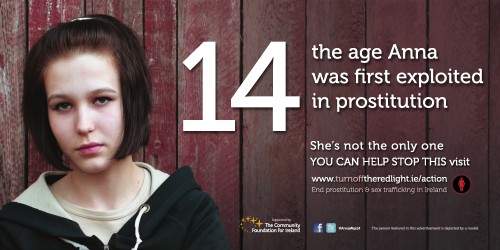
The 14-year-old girl is, of course, an iconic figure in anti-prostitution campaigning. This image was all over the place in Ireland a few years ago:

Anna

The organisations behind this ad want us to believe that Anna’s sad story wouldn’t have happened if only there was a law here criminalising men who pay for sex. Yet here are the Swedish police confirming that 15 years after this law was introduced – a law older than she is – they have their own Anna, who’s been paid for sex by “several” adult men. And I’m guessing “she’s not the only one”, either.

On page 43, we find what may be the single most heinous thing I’ve ever read about this law. Discussing penalties (and why the doubling of them doesn’t seem to have worked as well as expected, although of course that’s not stated in so many words) the report says:

several proposals have been made that the crime of purchase of sexual services should be divided into severity and a felony introduced. The [2010 official] evaluation of the effects of the ban on the purchase of sex noted in its analysis of this question that a classification of the offence by several severity levels could bring more disadvantages for the fight against this and related offences. Police Regions agree with the commission’s fear that graduation would lead to resources being exclusively devoted to crimes considered more reprehensible and that the investigation of the crime of purchase of sexual services would therefore not be prioritised.

Read that again, and let it sink in. Actually, let me repeat this bit:

graduation would lead to resources being exclusively devoted to crimes considered more reprehensible and that the investigation of the crime of purchase of sexual services would therefore not be prioritised

Once more. Just in case.

graduation would lead to resources being exclusively devoted to crimes considered more reprehensible and that the investigation of the crime of purchase of sexual services would therefore not be prioritised

I am nearly at a loss for words about this. One of the arguments that has been made against the introduction of this law in Ireland is that it would divert resources away from serious offences (like actual trafficking and exploitation) because the police would need to use those resources going after just any man who pays for sex. So, here the Swedish police are confirming that that’s exactly what they want it to do. As with the increase in stigma against sex workers, the reduced ability of the police to focus on “more reprehensible” crimes against them is a feature, not a bug of the law.

There are case study summaries at the end of the report, but I think I’ll leave it here. If there is anything more outrageous or despicable than the deliberate refusal to prioritise serious crimes against sex workers, I’m not sure I have the stomach to read them.

Now if you’ll excuse me, I’m off to donate to National Ugly Mugs. Please consider doing the same if you can.


Taking the Boat: A Short Film by Lisa Keogh

Guest post by Lisa Keogh

I don’t find it difficult making decisions, which is probably a good thing considering that a lot of writing and directing is about making decisions. How long should we linger on close-up? Is there really another world or is it all in her head? How the hell are we going to shoot this if it keeps raining?

Most of the time when we claim to agonise over a decision what we’re looking for is the permission to make the choice we feel is instinctively right.

For me, there is no drama in the decision of whether or not to abort an unplanned pregnancy, because drama suggests conflict between right and wrong. Instead, when it comes to abortion, each woman makes the choice that is best for her life – she just needs to give herself the permission to accept it. And society needs to support her to make that choice. Every child, whether planned or unplanned, should be a wanted child.

Too many women are imprisoned by the cloak of shame around abortion. The dramatic arts have played their part in adding to that cloak and in attempting to lift it. It all comes down to how writers handle the issue. Making films about “the dilemma” implies there are only certain circumstances where abortion is acceptable. It makes people believe they have the right to examine a woman’s choice about her own body and to make her justify why she does or doesn’t want to proceed with a pregnancy.

Instead, I believe we need to trust women. Instead of focusing on the dilemma of whether or not to have an abortion, exploiting the suspense of a “will she/won’t she” plot, what needs to be examined is that Ireland is exporting its abortions. 12 women a day are leaving our island to access services that should be free, safe, and legal on their doorsteps. How many other women are ordering pills over the Internet and facing prosecution? How many others are forced to continue with a pregnancy because they don’t have the means, knowledge, or support to make that trip?

That’s where the drama is for me – that’s where the story lies. So I made a short film.

25,000 women have left Ireland in the last five years to access abortions. That’s a lot of stories about taking the boat – about finding the cash, arranging childcare or time off work, booking flights or ferries, about lies told and secrets kept.

Taking the Boat is the story of just two of those women.

After #ge16, where to now for #Repealthe8th?

pro choice002

The results from count centres across the state are slowly trickling in as I write this, and Labour activists and supporters are shouting that #Repealthe8th is dead as quickly as their candidates are dropping out of the race. They need to stop.

I presume they genuinely believe what they’re saying, just as they believe that we wouldn’t have marriage equality were it not for the Labour Party, but peddling that view damages the pro-choice movement.

Labour might have been confident that they could deliver a referendum on the eighth amendment, but pro-choice activists of all political stripes and none haven’t forgotten that they delivered legislation on X to allow for abortion where a woman would be a risk of dying that contained a 14 year jail sentence penalty for inducing a miscarriage, and the horrifying case of teenage refugee pregnant as a result of rape enduring what was ostensibly a forced c-section at 25 weeks, despite medical professionals acknowledging that she was suicidal. The #Repealthe8th campaign exists in spite of Labour, not because of it. Perhaps Labour in government after #ge16 would have delivered a referendum, but what would that have looked like?

Besides, Labour aren’t in government now, and unless there’s some kind of divine intervention over the next twelve hours it doesn’t look like they will be. They had five years to work to hold a referendum and didn’t. We can acknowledge that Labour were in government when the Marriage Equality referendum happened but it was won because people mobilised and worked their rocks off to get it passed; People who were never involved in politics before came out alongside grassroots groups and got Ireland to a place where it said yes to valuing people as equals. So instead of throwing the toys out of the pram and acting all hard done by, Labour activists would do better to channel their energies into the pro-choice campaign and work for a repeal of these laws. There is nothing to be gained by trying to undermine the positivity of pro-choice campaigners by getting in a huff, throwing hands in the air and saying we should all just forget it now.

That said, it is difficult to ascertain just how much of a deciding factor abortion was in this general election given the number of Fianna Fail TDs that have been returned and their unwillingness to commit to a referendum – but there have been huge returns for independents and political parties who are very much in favour of holding a referendum. The people of Dublin Bay South waved goodbye to Lucinda Creighton, one of the most staunch anti-abortion voices in the Dáil and while this is to be welcomed, this is not a time for pro-choice activists to rest on our laurels. Clare Daly has championed reproductive justice and been returned to the Dáil alongside Joan Collins. Ruth Coppinger, Paul Murphy, Richard Boyd Barrett and Gino Kenny are all pro-choice. Sinn Féin have a policy in favour of repeal the eighth. There is a recognition, even amongst conservatives such as Leo Varadkar and Frances Fitzgerald that a referendum is inevitable. It is easier now to be pro-choice than it ever has been before and thanks to the work of pro-choice activists and an increase in public support, the stigma surrounding the subject is ebbing away. Now is the time to send a clear message to the returned members of the new Dáil that a commitment to repeal the eighth amendment must form a part of any new Programme for Government. Women must no longer be blocked from accessing appropriate healthcare. Public opinion on the need to repeal the law and provide legal abortion for women is far more progressive than what is represented in the Dáil now, even with the addition of the large range of socialist, republican and left of centre voices. This public opinion needs to be converted into action on the ground.

We must make no mistake, the anti-choice groups that are happy to see women die for want of medical care, will consolidate their efforts in order to keep the eighth amendment in place. They will continue with their bitter newspaper columns full of demonisation and blame, and their shaming billboards and they will continue their misrepresentation and campaigns of outright lies against people who provide women’s healthcare in Ireland. Their attacks on the IFPA and others are not about women’s healthcare, they are about muddying the waters so that they can portray themselves as being something other than religious fundamentalists who want to keep women in the dark ages. They have no intention of stopping so we have an onus to build our movement, to keep up the pressure no TDs and tell them in their clinics, in the streets, in the courts, and in their media streams that they must fight to repeal the eighth. We can’t only depend only on TDs to argue these points in the confines of the Dáil chamber; there is an onus on us to keep speaking to our families and friends to reduce the stigma, to help women accessing abortion care, to publicise information and to counter the outrageous propaganda and lies bandied about by anti-choice activists. We must organise and march in the streets and stand shoulder to shoulder with others campaigning for free, safe and legal abortion.

Pro-choice groups are ready for this fight. Are you?

#Repealthe8th

@stephie08

An Appeal to the Left from Sex Workers

Posted on

On Friday 15th February, a sex worker was found murdered by a client at her place of work in Aberdeen, Scotland. The media reported on this with the sole purpose to sensationalise, dehumanise and victim blame.  They set about doing this by using her full name; giving details of her hourly rate; giving detailed information from her bio on her escort site; reporting information from her personal social media site to support their depiction of an irresponsible mother living a double life rather than a working mother.  

In all of this reporting, the focus is completely on minimising the murder of a woman of colour rather than on the murder itself.  We know all of these largely irrelevant personal details about her, yet all we know about the alleged murderer is that he is 25.

If any other worker had been murdered on the job, we would be hearing about this from the left. Especially when laws exist that prevent those workers from taking measures to protect themselves from harm. Instead there has been a deafening silence, so challenging the sensational articles has been left to fellow sex workers who are grieving and scared.

Not only are we not hearing about this from people on the left, but we are currently being told to vote left. This will mean in some cases, voting not only for those who are silent on this, but also for those who are actively campaigning for the very laws that created the conditions for this murder in the first place.

Those who do not support sex workers struggle for bodily autonomy and worker rights on the left are the AAA/SP (Anti-Austerity Alliance/Socialist Party) and the Workers Party.

AAA/SP 

The AAA/ SP actively campaign on issues that affect sex workers negatively. When these activists say ‘my body, my choice’ they don’t mean that sex workers are capable of making an active choice over what they do with their bodies – they just mean reproductive choices.

They consistently patronise sex workers and question the choice they have made and the conditions under which they have made it under. Not only this, but they talk about the work sex workers do as something that is happening to them, rather than something they are actively participating in. When they say they will fight for workers rights, they don’t mean sex workers rights as can be seen here:

Ruth 3

Or here, where Ruth relies on an article from Anti-Choice site LifeSite News:
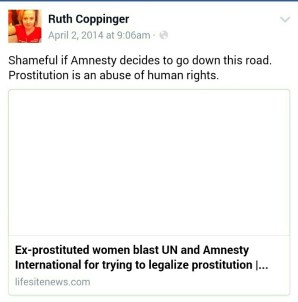
Ruth 1Ruth 2

When the AAA/SP hold a ROSA meeting on violence against women, you won’t hear them mention the abuse that the sex worker women face as part of that narrative. This all serves to further perpetuate the violence sex workers experience.

They continue to ignore the fact that many sex workers are mothers, many sex workers are students, many sex workers are working class, that sex workers are in fact workers. Their insistence on excluding sex workers struggle from their worldview is continuing to have a dangerous impact on women involved in the sex industry. As I said, they don’t just exclude sex workers, they actively campaign to ensure they are put in more danger and harm than they are already, and this is a problem.

Ruth Coppinger’s record of treating sex workers in a repulsive manner goes relatively unchallenged on the left. If it was any other type of worker, this kind of thinking would just be unheard of and completely condemned by everyone on the left.

During the time that the Sexual Offenses Bill was making its way through the Dail, it was difficult to tell the difference between Ruth Coppinger and any other Labour TD attempting to gain opportunistic support from the anti sex work lobby, or otherwise known as the conservative or religious right. When a socialist TD is as enthusiastic about a bill as Labour or the anti-choicers are, then it might be time to question what exactly they mean by socialist.

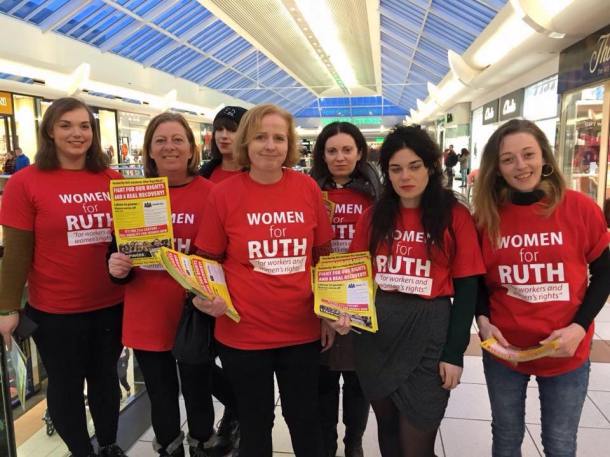
In fact, given Ruth’s record on the issue, it is quite incredible that she is running in the general election under ‘Women for Ruth’ banner – quoting that ‘Ruth will fight for your rights’ – but only if you aren’t repulsively selling sex or going off making immoral choices about your bodily autonomy that Ruth says you’re incapable of making.


ROSA (Reproductive rights against Oppression, Sexism and Austerity) is the feminist side-project of the AAA/SP. They held a talk on the sex industry at their last Bread and Roses Festival where Ruhama attended, spoke, and posed for a PR photoshoot with them. The second wave was spoken highly of by Laura Fitzgerald of the SP, and a conflation of sex work and trafficking occurred throughout.


The Workers Party

The Workers Party yesterday released the following statement in a message when requested to clarify their position on sex work:

“The Workers Party is firmly opposed to sex-slavery, sex trafficking and the commoditization of women’s bodies. We believe that the conceptualisation of sex work / prostitution as a “choice” undermines the very real material and cultural deprivation and exclusion which overwhelmingly drive women into prostitution under capitalism. People diving in sewerage or collecting cans for remuneration similarly engage in labour which is exploitative, and which as socialists we believe should be eliminated. Prostitution should be seen in this light. The Workers’ Party advocates eliminating the material conditions that drive workers into exploitative situations. Primarily this should involve providing comprehensive access to social housing, decent employment and social welfare, and the creation of respectful and dignified state bodies to support women in transitioning into less exploitative employment.

This strategy must necessarily be accompanied by harm reduction measures in the immediate term. In relation to how harm reduction for those involved in the sex trade can be ensured, the Workers’ Party does not support the Turn Off the Red Light campaign, recognises the evidence that it has not been successful in other countries. Neither have we taken a position to support full decriminalization. We continue to debate the issue within our party, within a frame which respects women, recognises the flawed model of “choice” often used to justify legalization of prostitution, but also recognising the difficulties which criminalisation of sex work poses to ensuring harm reduction.”

The minute you conflate sex trafficking with sex work, your position is completely flawed. The argument that sex work should ideally be abolished because of its ‘exploitative nature’ only stems from the influence of the religious right, whorephobia and moralism and neglects the fact that all work is exploitative.

The jobs that the Workers Party refer to above are valuable jobs, and include work that is and will be necessary even under parliamentary socialist reforms. However, to compare sex work and by extension, predominantly women sex workers, to diving in sewage really takes the anti sex worker rhetoric to a new vile low.

Let’s go with it though for a moment: Sewage diving is carried out by professional divers who are usually trades people first and it involves high-tech diving in places such as sewage farms, basements and drains of hospitals.  It takes careful planning and is a very serious job with stand-by divers ready in case something goes wrong. It is essential work especially in instances where bacteria is used to break down solids instead of chemicals or where repairs are required to the machines used to breakdown sewage.  It is difficult to imagine a situation where the Workers Party would not support requests by sewage workers to support measures that they deem would keep them safe while working, such as being able to work in teams for example.  However, where sex work is concerned, the Workers Party state that they have not taken the position requested by sex workers which will keep them safe, namely decriminalisation.  Their insistence on using the term ‘prostitution’ is indicative of the disregard they have for sex workers self-determination. But we shouldn’t have to be talking about sewage work when trying to win rights for sex workers that will keep them alive.

It is the experience of sex workers that no other work gets imagined as being redundant in the future as much as sex work.  The fixation on this can only be due to moralism.The questioning of choice is a familiar obsession of many on the left and it contains sexist undertones where predominantly women sex workers are deemed unable to make an active choice to engage in sex work. Regardless of the factors that drive women to engage in sex work, questioning the very notion of that choice clearly says that the Workers Party don’t trust women to make their own choices and think that they know better than the women themselves, thereby stripping women of autonomy.

There have been conflicting answers from various members of the Workers Party when questioned on their position, so sex workers say that they need to immediately retract this position, publicly apologise to sex workers and make a clear statement on the position they do have, if it differs from the one they released yesterday.

Appeal from sex workers 

Sex workers lives are at risk if the left continues to ignore their voices alongside conservatives, so sex workers are finding themselves in the unusual position of having to protest the left to change their position. Protest and pressure work.  We’ve seen many pledges in advance of this election yet none for sex workers who are some of the most margianalised in society.

The time to pressure those looking to be elected is now and it’s not fair to expect sex workers to remain silent on a matter that literally involves endangering their lives or to call those supporting them sectarian for doing so. In this respect, following the murder of Bianca in Scotland, a sex worker based in Ireland put out a call for people voting in the elections to not vote for AAA/SP candidates.  She asked that we extend our pro choice priority to sex workers. She said:

I would like to ask people not to vote Paul Murphy or any other AAA/SP candidate and stop singing praises for him/them. Him and his party supports the criminalisation of sex workers’ clients. It frustrates me to no end, that people turn around and say, well his policies on other issues important to lefties are good, but a shame about the sex work issue and but I will vote for him anyway. We wouldn’t accept this with abortion, so why do we allow it with sex work?

I got some sad news that a sex worker sister was murdered recently. Criminalisation of sex work and stigma was why she was targeted – and this will only get worse with client criminalisation. Please stop tooting the AAA’s horn, cause if it was up to them – they’d ignore evidence-based policy and sex workers’ voices, and would rather endanger their lives even more in the name of ideology.


…I want people to understand, that the next “dead hooker” story could possibly be a comrade.”

Not even 12 hours after this call was made however, leftists continued to promote AAA/SP election material and promote their politics as a chance for a ‘united left’. This completely ignored sex workers demands in favour of their own ideas of good politics.

This continued denial of the reality of sex workers lives and struggle is only further damaging sex workers lives. The longer we ignore this, the more likely that one of our own comrades is going to suffer the fate that Bianca did, along with so many others. We cannot, as feminists, leftists and activists, continue to throw our sex worker comrades under a bus. Voting for those who continue to abhorrently disregard sex worker rights will only serve to increase the violence that sex workers experience and worsen the stigma that sex workers face every day.

A vote for those who deny sex worker rights is not a pro choice vote and it is not a women’s rights vote, nor is it a workers vote. Women can’t wait, say the AAA/SP and they are right!

After the Russian Revolution, Innessa Armand didn’t seek to abolish, or ‘end demand’ of sex work, but she actually decriminalised it, therefore providing sex workers more safety and autonomy over where and with whom they work. In the words of Inessa Armand: “If women’s liberation is unthinkable without communism, then communism is unthinkable without women’s liberation.”

We see you, writing us out of history. Again.

The radio was on this weekend while I was in the kitchen. I was doing about seven different things at once at the time so I’m not sure what show it was or who was on it, but it was some male author or playwright or actor or some such being interviewed on it by a male presenter. The interviewee was being asked about his favourite authors and was predictably listing off Joyce and Beckett et al, and talking about taking part in a production of Waiting for Godot when younger with a listing of his male relatives and how lifechanging it all was and it suddenly occurred to me that what I was listening to was the ongoing act of removing all women writers and thinkers and playwrights and artists and dramatists and actors from the accepted list of ‘important’ work yet again.

We see it everywhere really; male bloggers and self-appointed, as well as actually appointed ‘political analysts’ only commenting and retweeting and talking to one another in their all-men’s social media echo chambers that may as well be the all-men’s exclusive social clubs of yesteryear and not even noticing that the voices of women and other not male people are missing from their conversations. It becomes particularly obvious when they start offering their (generally incredibly facile and poorly thought-out) opinions on women’s bodies, women’s health, and women’s rights as though they and their opinions were both revolutionary and also the final possible say on the matter. We see you.

We see you, men of the left who wouldn’t give up a platform to a woman even if you were paid to, suddenly proclaiming that the women of 1916 are revolutionary unsung heroes and listing all of their names and achievements; a list you have absolutely definitely lifted from the academic research of other women of today whose work you didn’t even credit in  your oh-so-feminist shout-out.

We see you, men who call yourselves feminists who absolutely Never Ever even think to include a single solitary work by a woman in any of your social media listings of your absolutely favourite, groundbreaking writers, artists, social commentators, thinkers, musicians, and creators. You claim you think we’re people too; just not people with anything of import to ever say about the world.

We see you, male curators of this year’s performances in the Abbey Theatre who decided that not a single solitary play by a single solitary woman was worth including in their year long celebration of Irish theatre. Teresa Deevy‘s entire body of work was utterly forgotten by an Abbey Theatre of 1937 onwards, who found her too uncomfortably revolutionary and feminist in Dev’s Ireland; the same is happening with the women writing and directing and performing plays in Ireland of 1990 onwards as their work, our work is being overlooked and ignored all over again by the men who continue interviewing each other and deciding that each other’s work and each other’s opinions are what is canon and important and Worth Reading.

We see you, Kate O’Brien, Edna O’Brien, Nell McCafferty, Teresa Deevy, Augusta Gregory, Eva Gore-Booth, Nuala O’Faolain, Éilis Ní Dhuibhne, Jennifer Johnson, and many many others and your works being written out of history, out of the context of 20th century Ireland, and left to gather dust. We see you Rosaleen McDonagh, Belinda McKeon, Sarah Clancy, Rita Ann Higgins, and the many other vivid, radical, angry women’s voices of 21st century Ireland who are only ever treated as the ‘other’ voice, writing from the edges; never as though their narratives were a genuine and driving one, on which entire stories and entire movements could be centred.

We see you.