RSS Feed

Tag Archives: Ireland

Those who can, teach. Those who can’t, complain about teachers.

Those who can, teach. Those who can’t, complain about teachers.

The Irish media has been clamouring to give voice to beleaguered parents and concerned citizens condemning today’s teachers’ strike. Some of those commenting on the ASTI and TUI decision to picket seem to be under the impression that teachers are just obstreperous babysitters who live a cosseted existence, overpaid and underworked, doing an easy job that a monkey could do in their sleep – except these monkeys are particularly greedy. The reality of this couldn’t be further from the truth and there is far more to teaching than standing in front of a classroom from one end of the day to the next.

Teaching is a profession that’s viewed with an almost unique level of disdain in some quarters. The phrase “those who can’t do, teach” might be used in a self-deprecating manner by some teachers but it’s something that genuinely appears be the core mind-set underpinning the criticisms of the strike. Texts are being read out on Newstalk from critics saying “these teachers are only afraid of doing more work with no extra pay,” as if teachers should be martyring themselves and teaching for free, for the pure love of imparting their knowledge to students, as if instilling a love of learning in pupils should be reward enough in itself. It’s probably only teachers and nurses that are consistently faced with the attitude that serving others should be compensation enough and it’s no coincidence that it’s a female-dominated professions that bring out comments such as that. The Minister herself isn’t immune from subtly making that same criticism, even though the strike isn’t actually about the rate of teachers pay. But even if it was, who could blame them? Why should teachers do more work for no extra pay?

Reform of the Junior Cert is badly needed. Students who are 15 years old shouldn’t be faced with exams of that intensity. The only thing I even remember about my own Junior Cert is that I bluffed my way through the English Paper 1 and wrote an essay that had something to do with Paul Weller and me on bikes in Drogheda, that a bottle of Sunny Delight leaked in my bag during the history exam, and that the horror of the whole exam experience provoked an episode of insomnia and sleeping difficulties that I’ve never fully shaken off.

Everyone agrees that the JC needs radical changes, and the elements of project work and continual assessment that are being incorporated should be welcomed. But when the people who are being expected to implement these reforms object on the basis that there is no best practice or evidence to support the claims being made by the Minister for Education Jan O’Sullivan, and further that there are issues around the resources being given to support them to implement the reforms, then they should be listened to. No matter how much a media and public given to teacher bashing would like to paint this as ultimately being a pay dispute, the crux of the strike is about who actually marks the Junior Cert papers. The Minister for Education allegedly believes teachers marking their own pupils is, educationally speaking, best practice for students. The Minister has moved from saying that internal marking 100% of the time is best, to saying that 40% internal marking will do, for the purposes of getting the reforms through. It’s unclear how much money will be saved in not paying other teachers to mark the junior cert papers but it’s a substantial amount given the sheer number of students involved, and the research or evidence that the Minister is basing her claims on hasn’t appeared thus far.

There are clearly difficulties in Ireland in making teachers mark the papers of their own pupils in a high stakes exam. That’s not to say that teachers are unable to mark the papers in the same way they would with other exams and tests they set for their classes, but to point out the difficulties that present in a state where schools are controlled by completely unaccountable boards of management and very often securing employment is based on who you know. There are teachers in Ireland who are as precariously employed as a person working in McDonalds on a temporary contract because they can’t get anything other than covering someone else’s maternity leave, and then four hours a week subbing when that teacher returns to their permanent post. Teachers may not cave to pressure in exam marking, but they will certainly come under it. In many cases, the students’ marks will be as high stakes for the teachers as the students themselves.

Teachers might not actively attempt to mark students unfairly (although I wouldn’t afford the benefit of that particular doubt to the teacher I had for Junior Cert geography) but there is evidence to suggest that teachers can be influenced by irrelevant factors in marking such as gender, socio-economic background, effort and behaviour of pupils. They are only human. Many teachers are now engaging in what could more accurately described as crowd control rather than education as a result of consistent severe cutbacks to school budgets and resources by this government. It is completely unreasonable to expect them to teach their class and mark their own students’ exams in an unbiased manner while not being offered adequate training to carry out what is envisaged in the marking scheme, or even enough training to actually deliver reforms to the curricula that they actually agree with; Not to mention that teachers will be expected to continue doing all of the extra-curricular work they do for free, like teaching the choir, or coaching the camogie team, or giving extra-lessons to struggling students in their own time while being continually demoralised by a government that doesn’t value what they do.

The Minister is quick to point out how other states assess students at that level fully through internally marked exams, but they are different school systems. The 26 Counties has one of the highest pupil-teacher ratios in the EU. Thousands of students spend the duration of their school life in cold, damp, mouldy prefab buildings. There are teachers who have never taught in anything else. Schools have had 1% cuts to capitation grants every year for the past three years while pupil numbers have increased. More students with special needs assistants are attending mainstream schools than ever before, so the Department of Education changed the rules to make it harder for them to get special needs assistants to support them in the classroom. Qualified special needs assistants were let go and some replaced with Jobbridge interns. The Department recognised that there are high levels of mental health issues among students in schools and introduced suicide prevention guidelines. However they took away guidance counsellors in schools with under 500 pupils who have ordinarily supported students with anxiety and mental health difficulties, leaving teachers to fill this role. Teachers who can’t secure permanent positions are told to apply for Jobbridge internships and do the same job as their peers for their unemployment benefit plus €50 extra a week. Schools make up the funding shortfall by increasing the so-called “voluntary” contribution that parents must pay. Teachers then have to deal with stressed parents who cannot afford to pay this because the Credit Union won’t lend them anymore money or because St. Vincent de Paul have already paid their electricity bill for them this month and they can’t ask for more.

This is what our teachers deal with on top of teaching. It would benefit us all to recognise the importance of their work and the pressure that they are under right now, and for the government to address the decimation they’ve inflicted on the education system before they go introducing a new system based on research that may or may not exist, that they in no way have the capacity to deliver. This is why we should support the teachers’ strike  – despite the media driven hysteria.
To them, we are nothing but vessels

A young non-Irish woman with limited English and precarious residency status, discovered she was eight weeks pregnant as a result of what the Sunday Times have reported as a “traumatic rape.” Due to her legal status in Ireland she could not freely travel abroad in order to access an abortion so immediately applied to have a termination in Ireland under the new legislation, stating that she was suicidal at the prospect of carrying the foetus to term. Like Savita Halappanavar and Bimbo Onanuga, she is another woman from outside of Ireland who has been completely failed by the Irish medical system.

Three doctors declared that the woman was suicidal under the panel formed under the Protection of Life During Pregnancy Act in January. The legislation states that medical practitioners may authorise an abortion where “there is a real and substantial risk of loss of the pregnant woman’s life from a physical illness or by way of suicide” but they must have “regard to the need to preserve unborn human life as far as practicable.” The Act does not set out timelines during which decisions should be made by these panels, or when abortions should be performed if granted under this law. To insert a timeline in that law, giving the applicant some clarity, would have been too generous a gift for the women of Ireland by the Irish government. The panel of three doctors said that despite the fact she was suicidal, it would be better to wait until the foetus was viable for delivery instead of performing an abortion. She went on hunger and liquid strike in response. People do not enter in to hunger strike lightly; It is a last resort attempt by people seeking redress when the politics of despair have left them with nothing else to fight with but their own bodies.

The HSE in turn, sought an emergency order at the High Court on the 2nd of August which would allow it to forcibly hydrate the woman on the grounds that they wanted to protect her life and the life of the foetus which she did not wish to carry. It further sought orders that would allow them to carry out other procedures related to her pregnancy. The woman was represented by her lawyers, and the foetus was also represented by its own legal team. The Irish courts have already stated that it is a medical practitioner who is entitled to make decisions concerning the pregnancy, and not the woman herself. The law goes far beyond preventing a pregnant woman from having an abortion in circumstances where her life is not at risk. The Irish law is designed so that a person who is pregnant no longer has any say over what happens their body whether it concerns continuing the pregnancy itself, the location in which you wish to give birth or whether you will hydrate yourself or not.

Last month in Geneva, the chair of the UN Human Rights Committee said that Irish law on abortion treats women as a “vessel and nothing more.” Once you are pregnant in Ireland, you become property of the state and your own wishes are irrelevant.

On the 3rd of August, this young, suicidal rape victim, having gone through two court hearings seeking an abortion and an unknown number of medical interrogations by a panel of three doctors, underwent a caesarean section in an Irish hospital at approximately 24-26 weeks gestation. Preserving human life as far as practicable in their eyes required performing a c-section on a woman while she was around six months pregnant, despite the fact that she had been raped, was suicidal, had gone on hunger and thirst strike and had asked for an abortion repeatedly from eight weeks on.

The implications of this are horrifying. It has sent a clear message to women in Ireland that if you are suicidal and seek an abortion which you are constitutionally entitled to, you run the risk of medical practitioners compelling you to wait until the foetus is viable and then having a c-section forcibly performed on you. This woman was in a very vulnerable position given the multiple traumas she had endured. It is the stuff of nightmares. There are other women who are suicidal as a result of pregnancy and access abortion services because they have the means and support to travel. Some contact Women on Web and some contract the Abortion Support Network. Some will borrow money from friends. Those who don’t have internet or phone access to make appointments or ability to leave the country, or money to pay, and will take other steps. Some will borrow from money-lenders, others might throw themselves down stairs. But those who are pregnant and suicidal will not go to these panels, the risk is too great.

We do not know the full facts of this particular case because the media are restricted from reporting in full. However, we do know that the Protection of Life During Pregnancy Act has not resolved the issue of not being able to access an abortion even if you are suicidal in Ireland. Three doctors said this woman was suicidal, but apparently this was not the right kind of suicidal for the purposes of the Act, and because a c-section was available then she could have that instead of a lawful termination.

It begs the question of what type of ‘suicidal’ will allow you to have a legal abortion in this jurisdiction and as long as the Eighth Amendment remains in the Constitution, there will be women travelling, dying and undergoing forced c-sections for want of an abortion within Ireland. There is no clarity as to what the scope of “practicable” actions are in order to prevent a woman from having an abortion under the cloak of “protecting the life of the unborn.”

Years ago, I had a conversation on facebook with someone who was anti-choice and was quite forthright in his views that women should be prevented from having abortions at all costs, even if they were suicidal and it required locking them up in specially designed pregnancy gulags under 24 hour suicide watch. It is a frightening vista but not totally unrealistic. Those on the anti-choice side will of course say the term “gulag” is hysterical, but if you were a pregnant suicidal rape victim, who wanted an abortion, and was in hospital on a court-ordered drip having an effectively forced c-section under threat of a court order, faced with the prospect of a 14 year jail sentence if you induce your own miscarriage, it just might feel pretty gulag-esque. You just might even etch “Nolite te bastardes carborundorum” on a wall.

To them, we are nothing but vessels.

Repeal the 8th.

The Moral Outrage of the Damned: Public reaction to the plight of Sabrina McMahon

Sabrina McMahon is 36 years old. She has three children, ages 5, 3, and 1. She and her three children currently live in her car. Sabrina has lived in her car for the past week after her “temporary” arrangements, which lasted a year, broke down. She formerly worked as a dental nurse and as a carer. She keeps her buggy, nappies and possessions in the boot of her car and her groceries in the front. She avails of the kindness of friends so she can wash and clean her clothes. Her children sleep in the back. When the baby wakes for a bottle she switches on the engine to keep her warm. A Sinn Féin Councillor Maire Devine, has been making representations to South Dublin County Council on her behalf for the past year while she went from relative to relative over the months since her relationship broke down. When SDCC were contacted by the Irish Times for comment, they said they were “aware” of the case but didn’t wish to say anything further which was unsurprising.

Unless they were going to say, “We are deeply ashamed that we have failed to show basic human decency to this woman and her family and find her a home” they were probably better off to say nothing. No landlord will accept rent allowance from her. She presented at the Dublin Central Placement Service and was told to go back to Kildare, where she had previously lived, but she wants to live near her family.

If was I was living in a car with three small children I would want to live near my family too.

Her story was on the front page of the Irish Times and it covered on all the major radio stations. On Newstalk this morning, texts flooded in saying that Sabrina was a bad mother; that she should have her children taken from her; that she shouldn’t have even had her children in the first place; that she was irresponsible and only “using” the media to get a free ride on the back of taxpayers. Social media users had a field day in condemning the parenting skills of a woman who is literally living on the margins of society. Very little was said about her former partner. However, the level of misogyny and hatred directed at her in those texts and comments was a slightly more ignorant representation of the structural misogyny directed at her from the state. The state shows its disdain for women like Sabrina by failing to provide for her needs. The tweets condemning her are this simply this same attitude refined to 140 characters.

There are 98,000 families waiting for social housing in this state and the comments levelled at Sabrina McMahon are not unusual. In fact, Sabrina’s situation is not unusual. People are fooling themselves if they think that Sabrina McMahon is the only person in Ireland living in her car right now. And the comments about her are the same type of comments made about poor and homeless women who become pregnant and have families because they generally pathologised as people who made bad decisions, lack male authority, and exist without morals or values. They are believed to be selfish and parasitic and rearing children in their own rough image. It is the stock depiction of the very poorest working class women.

While Sabrina has some bread rolls in the front seat of her car, her problem is that she isn’t a consumer. She just wants somewhere to live that’s safe. It’s one of the most basic things a person can ask for. She isn’t economically productive, and therefore doesn’t warrant the concern of the state. She is a mother and a carer so not considered to be engaging in “real work.”

Women do the lion‘s share of unpaid household and care work. But it isn’t considered “work” because there are no wages, it’s just what women do. It is a bizarre attitude from a state that has a Constitution that specifically assigns a woman’s role to the home. But the very structure of capitalism, depends on women doing the majority of this form of work without payment.  Neoliberal capitalism neglects to acknowledge that women working within the home (or from their car in the absence of having a home) are economically productive as it allows the State to not provide public childcare infrastructure or other supports for childrearing. It is just something that women are expected to do, but it isn’t good enough for the terms of capitalist patriarchy.

Unfortunately Sabrina lives in a place where the government department responsible for welfare, the Department of Social Protection, aim to restructure the lives of poor women like Sabrina, in both a physical and a moral sense. It was not by mistake that it was the Minister for Children and Youth Affairs Frances Fitzgerald was out commenting on this story today, to address the concerned masses’ cries of “won’t somebody please think of the children?” rather than the Minister for Social Protection or the Minister for Environment, who ultimately have the responsibility for Sabrina’s situation.

It is unlikely that those who had the luxury of sending a message from their smartphone to a radio station to condemn and blame Sabrina for her situation, stopped to contemplate the precarity of their own situations; how many of them are only two, three or four pay packets away from homelessness themselves.

Not only was Sabrina demonised as a bad parent – but through their commentary, the very value of her existence was questioned. Caring for three small children in the back of a car isn’t valued because it is unpaid labour, although it is probably fair to say that if those who condemned Sabrina were forced to do it, they would think it was pretty hard work indeed.

SPARK ran a campaign last year against a programme forcing lone mams to work when their children turned 7, which had been introduced by Minister Joan Burton. You couldn’t have people remaining economically unproductive now could you? The rationale is that the state cannot allow people to exist in a way that does not overtly benefit capitalism. The point of that programme was to redeem the women who do not have male authority in their lives by forcing them into a situation where they would live within a patriarchal system that would give them male authority in the form of employment. The likelihood is, if they even managed to get a job, their boss would be a man. It is the state’s antidote to these dreadful welfare recipients of getting something for nothing. This particular form of workfare is branded an “activation measure” but it is punitive. It punishes women for not conforming to a life that involves a man who is a breadwinner.

Women don’t become poor in a vacuum. Women like Sabrina don’t live in cars for the fun of it and as austerity continues to destroy Irish society, we will continue to see more Sabrinas living in more cars and cardboard boxes, and sadly, more people willing to condemn them for it.

What the “sex buyers” survey found. And what it didn’t.

Posted on

There’s been much in the Irish media this week about a new report on sex workers’ clients, based on research conducted in five European countries (Ireland, Finland, Bulgaria, Cyprus and Lithuania). Unfortunately, if unsurprisingly, the media coverage has ranged from bad to abysmal. For a prime example of the latter, see this piece in the Irish Examiner, which starts off with the claim that “Ireland’s sex trafficking trade is worth an estimated €250m a year, a new study shows” – despite the fact that no such claim is made anywhere in the report. The journalist appears to have mistaken a made-up stat cited by a speaker at the report’s launch for an actual research finding, which I suppose is an easy enough error to make when you just repeat things NGOs tell you without ever cracking open a report yourself.

As for most of the other coverage, in general its worst sin is making the report out to be somehow shocking or revealing or breaking new ground, when it actually tells us very little – at least where Irish clients are concerned. By the time I finished reading it, my reaction was such a big fat “meh” I actually wondered if I should write this piece at all, and risk drawing more attention to something deserving so little.

Having decided (with some reservations) to proceed, I’ll start at the beginning. The report is an effort by the Immigrant Council of Ireland, the NGO behind the Turn Off the Red Light campaign, in partnership with like-minded groups from the other countries mentioned above. There is no attempt to hide the report’s agenda; Chapter 1.1 openly identifies it as part of an overall project that aims to

Reduce demand for the purchase of sexual services

and while this clearly gives the authors an incentive to find data that presents clients in the worst possible light, I don’t think they’ve actually achieved this – at least not when it comes to the Irish clients (whose responses I will limit this post to). The main reason for this is that their sample is so small as to be virtually meaningless: only 58 Irish clients took part in the survey, which was conducted entirely by means of an online questionnaire. (They actually did attempt to do face-to-face interviews but, as this excerpt relates, failed in almost comical fashion.) You’d need a pretty small population size for 58 to be remotely adequate enough to tell us anything about clients as a class – and the authors can hardly claim simultaneously that the population size is small enough, and that it spends €250m a year. After all, if the respondents amounted to even 10% of the sex-buying population of Ireland, that would still require them to pay an average of €431,034 per year for sex – something clearly impossible at the income levels reported (nearly three-quarters earn less than €40,000 per annum, and only 13% earn above €60,000). Add this to the finding that nearly half of respondents had paid for sex either “just once” or only “a few times”, and clearly the Irish sex industry is either a hell of a lot less lucrative than TORL advocates make it out to be, or those profits are coming from far too many clients to make this sample size sufficient. They can’t have it both ways.

While there are some disclaimers about the inferences that safely can be drawn from the report, they are both too little and too late. The “Research methodology” section (Chapter 1.2) explains that non-probability sampling was used, but suggests the only weakness of this approach is that it cannot

determine the percentage of the respective populations who had purchased sex

Nowhere does it explain that non-probability sampling cannot, by its nature, ensure a representative sample, and in fact at several points the report uses language that seems to assume the respondents are representative of Irish clients as a whole. Near the end, in Appendix 3, it concedes the risk of self-selection bias – where the sample is skewed by certain shared characteristics of those who choose to participate it – but then suggests this concern is unwarranted on the basis of

similarities between those who participated in this research and those who engaged in previous similar studies

Which previous similar studies they mean is unclear; looking through the report’s bibliography, I can’t find any previous research on clients in Ireland. This is a strange omission, in a report that everywhere else carefully references all the research it refers to.

To be clear, the report isn’t devalued by the use of non-probability sampling. Sometimes there isn’t any other way to study a particular group, and the information you get may still be useful even if it can’t be extrapolated to the group as a whole. For example, five Irish respondents said “a bar” was the location where they found the last person they paid for sex with; this is notable for indicating the need to study the poorly-researched phenomenon of bar-based prostitution, even if it can’t tell us what percentage of the industry that sector comprises. But in a report aimed at a non-academic audience, it’s important to make these limitations clear, and I don’t think this report adequately does this. Public pronouncements by the NGOs behind this report have certainly not done this – like this article from the Immigrant Council, which repeatedly equates “clients who completed this survey” with “men who pay for sex”.

The report also examines the meaning of “demand” in the relevant international law instruments, which require member states to reduce the demand that fuels human trafficking. The purpose of this chapter is to argue that “demand” in this context should be interpreted as demand for paid sex rather than demand for paid sex from a trafficked person. Obviously I disagree with them on this point: the current interpretation is in line with the requirement to reduce demand in non-sex sectors, and this is how it should be. Nobody suggests we need to reduce demand for agricultural workers just because some of them meet the indicators of trafficking.

Beyond that, though, I think there is much to criticise in the way the “demand” argument is made. Exploring the understanding of that term in academic research, the report relies heavily on the work of Bridget Anderson and Julia O’Connell Davidson, which is absolutely essential reading. Unfortunately, it elides one of their central arguments: that sex work and trafficking are not purely demand-led, and that supply itself may create the demand. Here’s a direct quote from the Anderson and O’Connell Davidson article setting out this position, which is entirely contrary to the impression of it given by the report:

“There is certainly demand for cheap and vulnerable sex workers, but it is by no means clear that this kind of demand acts as a stimulus for trafficking. It could equally be that a supply of cheap workers stimulates demand.”

There are a number of other, similar sleights-of-hand in this study. It cites a 2013 report by a Council of Europe anti-trafficking body, GRETA, in a manner that would lead the reader to believe – wrongly – that GRETA endorsed the Oireachtas Justice Committee’s anti-sex work proposals. It mentions that the Finnish Ministry for Justice recommended criminalising payment for sex, but fails to mention that the Finnish Government rejected that recommendation (though in fairness, that was a very recent decision). And it acknowledges that the failure to recruit more Irish clients may have had something to do with the

ongoing, very public discussion on the future of prostitution legislation in Ireland

but conveniently omits the fact that there is an ongoing, very aggressive campaign to make the research subjects into criminals, which campaign is being led by the authors of the study themselves. It seems to me that the interests of full disclosure should have required some mention of this.

But the study’s biggest flaw is the way it deals with the question of potentially trafficked or exploited sex workers. The online survey, which is reproduced in full in an Appendix, asks the question:

16. Have you ever changed your mind and walked away because the person seemed:

and a list of options follows, including “scared”, “controlled”, “unwilling”, “unhappy” and “too young”. “Trafficked” is not one of the options, but we are told in the Appendix that the options were chosen because they are

physical manifestations of exploitation [and] indicators of trafficking

In other words, a client who admits to walking away from an appointment because the escort seemed “unhappy” is assumed to have walked away because he believed she was trafficked! Quite plainly, this is absurd.

But it gets worse, because in the main body of the report, the question itself is completely rephrased to reach the finding the authors want to reach. Instead of reporting Question 16 as it’s actually worded, it reports it as if a significantly different question had been asked:

Around one-quarter of Irish buyers said they had encountered sellers they believed were being exploited.

This leaves no room for doubt: a client who might have ticked the box for “unhappy” because he’d walked out of an appointment with an independent escort who was in a bad mood would now be recorded as having encountered a sex worker who he believed was exploited or trafficked. This is not a conclusion that follows logically from the research question. It is a gigantic leap that undermines whatever credibility this survey might otherwise have had.

Next, the survey asks:

17. Have you ever considered reporting your suspicions that someone was being trafficked or controlled?

The only options given are “No” or “Yes”. There is no “Not applicable”. This is a classic “Have you stopped beating your wife?” type of question: there is no way to answer without allowing an unpleasant conclusion to be drawn. Though it was possible to skip the question entirely, and about a third did, it’s not clear whether respondents were explicitly told they could do so; thus the possibility can’t be ignored that some who would have selected “n/a” picked the next best option instead.

If the survey was designed so that Question 17 only popped up once Question 16 was answered affirmatively, this wouldn’t be a problem. But there’s no indication that it was. The sequential numbering (rather than as, say, Q.16 and Q.16a) suggests that it wasn’t. The text of the report also suggests that it wasn’t, and that Q.17 was asked of all respondents:

Buyers were also asked whether they had ever reported suspicions that someone was being exploited or controlled.

This is where it becomes really important to distinguish the actual findings from the spin. In the Immigrant Council article linked to above, their spokesperson writes:

“As well as profiling buyers the Immigrant Council of Ireland examined if the men ever came across women they believed were being controlled by pimps, were frightened or were trafficked. The results are startling, with over one in four admitting they had come across women and girls they believed were in such situations. A significantly lesser number considered to report this to the authorities, dispelling the myth that buyers are helpful is [sic] tackling human trafficking.”

“A significantly lesser number”? The report found that around a quarter of respondents had ticked one of those so-called trafficking indicator boxes. In a sample size of 58, that’s 14.5. The article above says “over one in four”, so we’ll round up to 15. It also found that 21% of respondents had considered reporting such a situation to the authorities. In the same sample size, that’s 12. The difference between 15 and 12 in a sample size of 58 may or may not be statistically significant (I’ll let someone else do the math), but it is hardly significant in layperson’s terms. The Immigrant Council’s use of that word in that article seems to be designed to mislead. And of course, when you consider the rephrasing of Q.16 (so that some of those 15 who walked away may not have done so because they thought the sex worker was being exploited), the difference could actually be even lower.

It is shameful how readily the Irish media allow themselves to be used as a vehicle for what can only be described as propaganda masquerading as research.

Another part of the survey that has drawn attention is a question asking clients what would deter them from paying for sex. Interestingly (though again bearing in mind the non-representative nature of the sample), “a bad experience or a disease” ranks first. Criminal penalties and the publication of their photo are also ranked highly. Predictably, this is treated as “evidence” that these measures would be successful in ending demand.

The problem with questions like this is that the answers are necessarily speculative, and human beings do not always behave as they expect themselves to. How people say they would react to the abstract hypothetical possibility of something happening, and how they actually do react when that something finally occurs, may not line up as neatly as the authors want us to think they will. The report fails to consider the phenomenon that criminologists call “initial deterrence decay”, whereby the effectiveness of a measure drops significantly after first appearing successful, as those who were originally deterred by it learn not to fear the penalties or find ways to get around them.

There are also some issues of concern with how the study was conducted. We are assured:

At all times, the research teams were aware of the ethical sensitivity of the issues being looked at.

However, there is no indication that any institutional ethical approval was sought or given. We are told that “training” and “guidelines” were given for the face-to-face interviews in two of the countries and for the handling of research data, but it is not clear whether full disclosure was made to any of the respondents about the nature and purpose of the study – a key ethical consideration when working with human research subjects.

A few other things struck me while reading the report, but I’ll leave it at this for now. One final comment: as the report’s real purpose is to advocate for the Swedish law of criminalising sex workers’ clients, it would be interesting to see a similar study carried out in Sweden. Presumably if the authors are going to accept these findings as authentic, they would have to do the same for an equivalent study on Swedish clients. I suspect the answers might surprise them.

One week on from telling my story @Ireland.

Last week, Janet Ní Shuilleabháin became the first Irish woman to draw world attention to Ireland’s draconian abortion laws without having to die or go to the High Court to do it. While her story has been picked up by Al Jazeera, the BBC, and media in France and Sweden, the Irish media are still pretending it never happened. Here she reflects on her unpremeditated decision to go public with her abortion story – one of over 150,000 since Ireland passed a referendum outlawing abortion in nearly all circumstances. We are very grateful to Janet for helping to break the silence.

Comparing “trafficking” statistics: why it’s a waste of time

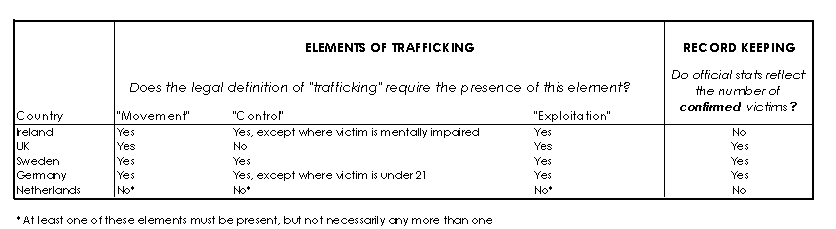
I thought it might be useful to make a simple chart to demonstrate why it’s meaningless to claim that one country has more trafficking than another, based on their official statistics. Seeing as this comes up all the time.

You can click on it to enlarge:

Trafficking definitions

There are a few explanations and disclaimers I need to get in:

  1. The chart is based on my own interpretation of each country’s laws. There is undoubtedly scope for disagreement in some of the details – but not, I believe, on the overall picture.
  2. The big centre column refers to adult trafficking only. I included an age qualifier for Germany because its law treats 18 to 21 year old adults as children.
  3. For “Elements of Trafficking”, I’ve used the three-part schema derived from Article 3(a) of the UN Trafficking Protocol. The headers are a common shorthand and are not to be interpreted literally (“control” doesn’t only mean actual control but can include deception, for example).
  4. Even within a single element, definitions can vary widely; eg, in the UK the “movement” element strictly requires travel, while the Irish definition adheres more closely to the broader Protocol criteria.
  5. Finally and most importantly, the chart reflects what the law actually says – not necessarily how it’s interpreted in practice. It’s theoretically possible that the reporting bodies in each country actually apply a more uniform definition in the process of collecting statistics. But that’s for the people who put faith in the official stats to demonstrate – and to my knowledge, not one of them has done so.

All that said, I think this chart makes one thing crystal clear: when countries tally up their “trafficking” figures, they aren’t necessarily counting the same thing. And unless these distinctions are controlled for in comparative studies, which they haven’t been so far, the evidential value of those studies is pretty close to nil.


Sources:

Ireland – Criminal Law (Human Trafficking Act) 2008

UK – Sexual Offences Act 2003

Sweden – Chapter 4 § 1 a of the Penal Code (2010:371) as translated in this Swedish police report

Germany – §232 StGB Criminal Code (original German here; translations courtesy of Ralph in this comment, Sonja Dolinsek of Menschenhandel Heute and Google Translate)

Netherlands – Article 273f of the Criminal Code

Labour’s proposed abortion referendum: Not good enough

Posted on

It’s being reported today that the Labour Party plan to fight the next election on the promise of a referendum to allow abortion in cases of rape, incest or fatal foetal abnormality. Bearing in mind that this is merely a Sunday newspaper report and (to my knowledge) Labour themselves have not confirmed it, here are all the reasons why I would strenuously oppose this move.

It would retain the constitutional anti-choice position as the default position. If this referendum passed, Irish residents would still have to get someone’s approval to have a right to abortion in their own country.  This is unacceptable, particularly coming from a party which paints itself as “pro-choice”.

It would enshrine into (constitutional) law the notion of pregnancy as punishment for sex. Feminists should absolutely reject any distinction in law between a pregnancy resulting from consensual sex and a pregnancy resulting from forced sex. To allow it is to acquiesce to the identification of women’s sexuality with reproduction, and the misogynist trope that choosing abortion is “avoiding responsibility for actions”. It reflects the odious idea that there are innocent Madonnas who can’t be blamed for having sex, and whores who deserve what they get.

It would be a nightmare in practice. You think it was difficult legislating for a “real and substantial risk to life”? Just wait until the troglodytes that write Irish legislation get to decide how to determine whether a rape happened.  As long as Article 40.3.3 remains in place – and by the looks of things, it will – you can be certain the “rape exception” will require a very high burden of proof, and that will inevitably involve a humiliating, (re-)traumatising inquisition. Who would go through that when they could just go to England – or the internet – instead?

It will still exclude the vast majority of crisis pregnancies. While accurate statistics will be impossible to come by as long as we have to go abroad or self-administer our abortions, it’s probably safe to say that relatively few take place because of any of the current or proposed “exceptions”. Most fall into the category that pollsters are now describing as “when the woman believes it’s in her best interest”: a broad category that can cover anything from financial woes, to interference with studies, to domestic problems, to simply not feeling ready to have a child, etc. These are normal reasons and they are valid ones, and they will still be excluded under this proposal – leaving the majority of those who have abortions to remain stigmatised and perhaps criminalised under the law.

It would eliminate the most persuasive argument for repealing Article 40.3.3. We don’t have a pro-choice majority in this country yet, and we may not for a while – but we do have a majority opposed to the strict parameters of Article 40.3.3 (at least, according to every single opinion poll in the past ten years not commissioned by the anti-choice movement). Those parameters could be a strong reason for people to support its repeal even if they aren’t fully on board with the right to choose. To widen the parameters through amendments that carve out exceptions would be to remove the incentive for people who aren’t pro-choice to support repeal. The end result would be a “compromise” that would effectively kill off any hope of actually getting rid of 40.3.3 and establishing a right to abortion in Ireland.

I am aware that a “repeal the 8th” campaign is unlikely to succeed without a guarantee by government that restrictive legislation would follow. And this legislation would have all the same problems I’ve outlined above – which might seem to undermine my whole argument. But restrictive legislation is much easier to deal with than a restrictive constitutional provision. It would be subject to constitutional challenge, and vulnerable to European pressure if the EU and ECtHR come to recognise abortion as a fundamental right (which I believe they eventually will). It could, of course, also be overturned by a progressive future government, though I may be overly optimistic about the possibility of us ever getting that.

I’ve mainly addressed the rape exception here, and I know not all these arguments apply to fatal foetal abnormalities. If the referendum proposal was limited to that I would find it more difficult to argue against (though some of my objections would still hold). I’m also aware that X legislation could equally be opposed on some of the grounds above, but X deals with life-and-death circumstances. I think it’s reasonable to put aside principled and tactical objections to incrementalism where the alternative is that a person actually dies.

And after the farce that the X legislation turned out to be, one thing should be obvious to everyone who supports abortion rights: we will never get anything meaningful as long as 40.3.3 remains. Our legislators will always feel the need to err on the side of protecting the foetus – so even if additional exceptions are carved out, the barriers to availing of them will be prohibitively high to many of those they’re intended to cover. And we’ll be left with a Constitution that further reinforces a value judgment as to who “deserves” an abortion, and less hope than ever of any real change.

The only tenable solution is repeal. We should not stand for anything less.

Anti-choice spinning of California’s 1967 abortion law

Posted on

We’ve heard a lot lately from anti-choice campaigners about California’s 1967 Therapeutic Abortion Act. It’s being cited to support the argument that legislating for the X case – to allow abortion where a pregnant woman’s life is at risk, including by suicide – will inevitably open the floodgates and effectively allow abortion on demand.

One example is this Tweet from the Pro-Life Campaign’s Cora Sherlock:

Subsequently, an email circulated to Oireachtas members by a group of anti-choice politicians (parts of which were published in this Irish Independent article) claimed that the California law

was enacted in 1967 on the strict grounds of ‘where the mother was a danger to herself’

And then on the Vincent Browne show the other night, Dr Patricia Casey said that under the law, the woman had to be “certifiable”.

Three different claims about the California law. All wrong.

The actual text of the law was found in §25951 of the California Health and Safety Code. It allowed abortion where a committee, established by the hospital performing the abortion and consisting of at least two licensed physicians and surgeons (or at least three after the 13th week of pregnancy), found that there was

a substantial risk that continuance of the pregnancy would gravely impair the physical or mental health of the mother

“Mental health”, meanwhile, was defined in §25954 as

mental illness to the extent that the woman is dangerous to herself or to the person or property of others or is in need of supervision or restraint

Right away, we see that the text is logically problematic – how on earth can “mental health” be defined as “mental illness”? – but we don’t need to spend time on that. The more important thing is what the legislators intended in this requirement. Clearly Cora Sherlock got it wrong, because there’s no need that the woman actually be at risk of suicide, and the Oireachtas group also got it wrong, because the element of danger to herself is only one of the possible criteria under the law.

Dr Casey is closest to the truth, but even she is not quite correct. The text is based on an old standard under which a person could be deemed “certifiable” (a term I find a bit offensive, personally, but we’ll put that aside for now) but there is a crucially important difference. The old standard – which was found in §5550 of California’s Welfare and Institutions Code – allowed for involuntary commitment where a person was

dangerous to themselves or to the person or property of others, and are in need of supervision, treatment, care or restraint

What’s changed there is that the “and” was replaced by “or” for the abortion law. To be committed, a person had to be both dangerous and in need of supervision or restraint; to be allowed an abortion on mental health grounds, either was sufficient. So clearly, a lesser threat to mental health was required than that the woman would need to be institutionalised.

Still, it is a fairly high standard, and the anti-choicers are right when they say it was given a much broader interpretation in practice.  But it still doesn’t follow that the Irish law would do the same thing. For one thing, any way you look at it, “dangerous to herself or to the person or property of others or … in need of supervision or restraint” lends itself to a much looser interpretation than “at real or substantial risk of suicide”. (In fact, the California law was struck down as unconstitutionally vague in 1972 – two months before Roe v Wade – precisely because it had proven impossible for doctors to agree on what these criteria meant.)

For another thing, the California law operated in California. California isn’t Ireland, and it always took a more permissive attitude toward abortion. Even before the 1967 Act, it wasn’t actually difficult to get an abortion there – though the standard of care varied widely depending on the quality of provider the woman could afford. Women didn’t need to travel for abortion as they do in Ireland, where doctors are simply not willing to breach the law. It’s unlikely to the point of absurdity that the flexible interpretation applied by California doctors will be repeated here.

A comparable situation is the way that abortion laws are interpreted in Britain and Poland. On paper, the two countries have a pretty similar regime: both allow abortions in case of fatal foetal abnormality or risk to life or health. In practice, however, they couldn’t be more differently applied: Britain, as we all know, is more or less effectively abortion on demand, while Poland is regularly hauled before the European Court of Human Rights for denying even crystal-clearly legal abortions (and in the most appalling circumstances too; the latest example, P and S v Poland, reads like something Franz Kafka might have written with Margaret Atwood). Cultural views, and the constitutional context, have a huge impact on how liberally abortion laws are interpreted – and Ireland is far closer to Poland than Britain in this respect.

The increasing calls of the Irish pro-choice movement to repeal the 8th Amendment are a reflection of this. If legislating for X really would “open the floodgates” and allow abortion on demand, there’d be no need to amend the Constitution. When the legislation gets through eventually, and it will, we will see how little impact it really has on the abortion rate in Ireland. And then we can get on with campaigning for real change.

On “pimps” and policy

Posted on

The Godwin’s Law of the sex work debate is that inevitably, someone on one side will call someone on the other side a pimp. Most of the time, the person making the accusation will be a supporter of criminalising the purchase of sex – and at least some of the time, the only ground for the accusation is that the other person disagrees. Sometimes, of course, there’s a bit more to it than that – the accused may have picked up a brothel-keeping charge, for example – but seeing as that’s happened to people on both sides of the debate, it’s a fairly unedifying accusation. Even when it’s true.

Of course, the point of the accusation isn’t to improve the debate from an intellectual standpoint; it’s to discredit the person it’s made against. And when it’s made against a person who wants sex work decriminalised, the point is to discredit their entire argument – by suggesting anyone who puts it forward is a “vested interest”, a person who (quoting RTÉ’s Prime Time) “profits from prostitution”, a person who pretends to have the interest of sex workers at heart but really just seeks to exploit them. In this way, supporters of the Swedish model can not only take the high moral ground themselves, but can also add impetus to their argument by portraying the law as an anti-pimp measure (as they did, for example, in this press release last month).

The irony is that there are plenty of reasons to think the law would actually have the opposite effect, and promote pimps and pimping. In 2003 the Norwegian Ministry of Justice and the Police went to Sweden to investigate the outworking of the law, and this is what they reported:

It has been claimed that prostitutes’ dependence on pimps has increased because street prostitutes cannot work as openly. The police informed us that it is more difficult to investigate cases of pimping and trafficking in human beings because prostitution does not take place so openly on the streets anymore….

Prostitutes’ dependence on pimps has probably increased. Someone is needed in the background to arrange transport and new flats so that the women’s activity is more difficult to discover and so that it will attract the attention of the police.

A few years later, this was echoed in a report by the Swedish National Board of Health and Welfare:

According to one informant in Göteborg, there are probably more pimps involved in prostitution nowadays. The informant says the law against purchasing sexual services has resulted in a larger role and market for pimps, since prostitution cannot take place as openly.

A woman engaged in indoor prostitution in Göteborg relates that when the law took effect in 1999, about ten women engaged in prostitution from various Eastern European countries approached her business because they wanted to hide indoors. Informants from the Stockholm Prostitution Centre also mention that the law has opened the door to middlemen (pimps), because it has become more difficult for sellers and buyers of sexual services to make direct contact with one another.

Norway, meanwhile, has seen the emergence of what you might call “pimp-like” relationships – relationships of extreme dependency, in which the most vulnerable (drug using street workers) become totally reliant on a particular man or men for survival. According to last year’s City of Oslo report,

Among the women with a drug addiction who still sell sex many have changed methods for finding customers. Most of the support services have experienced that the women enter into more long term relations with men who they refer to as “friends”, “boyfriends”, “uncles”, or acquaintances. These are men they stay in contact with through telephones and that they stay with for longer periods, this could be hours, days, or weeks. They have sex with the men in exchange for the men supplying them with drugs, money, and other necessities. Many of the support services say that they perceive the women as being very vulnerable in the relationships. The women become very dependent on the few customers they have.

So where does the idea come from that pimps would oppose criminalising clients? I think in part, it’s the failure of prohibitionists to understand the difference between legalisation and decriminalisation. Admittedly, there isn’t always a clear line between the two, but an essential element of legalisation is that sex work is only lawful under specified conditions. For indoor workers, this usually means that a premise has to meet strict criteria to be deemed a legal brothel – and that certainly can promote “pimping” as prohibitionists would define it. Few self-employed sex workers have the resources or even the desire to wade through that much red tape, so if they don’t want to work illegally and/or alone (depending on the laws of the jurisdiction), they often have little choice but to work for someone else.

But, and here’s the important thing that always seems to get missed, this is not the model advocated by most supporters of sex workers’ rights. Including many of those who are regularly accused of being pimps. A more favoured model would be something along the lines of New Zealand’s, where up to four sex workers can share a premise as a “small owner operated brothel” (SOOB) without the reams of bureaucracy that a managed brothel is subject to – and where sole operators can take the safety precautions they need without putting themselves at risk of arrest, as happens in many “legalisation” jurisdictions. Does this promote pimping? No, it doesn’t. In fact, according to the 2008 report of NZ’s Prostitution Law Review Committee,

Some brothels have closed down with operators citing the lack of staff and increasing competition for workers because of sole operators/SOOBs as reasons for the failure of their business.

You see? Make it easier for people to work without someone managing them, and they’ll have less need for managers. It isn’t really rocket science. In fact, none of this is counter-intuitive, at least for anyone who doesn’t consider the sex industry to be totally sui generis (which it isn’t). I mean, think about it: most people who call for drugs to be legalised are not actually drug dealers themselves. I don’t think I’ve ever even heard a drug dealer call for drugs to be legalised, for bleeding obvious reasons. Nor does anyone ever argue that criminalising drug dealers’ customers makes a dent in drug dealers’ profits – and fewer and fewer seem to think it really deters the customers, either. Why would criminalising the sex industry have an entirely different effect?

I am fully aware that this post is an exercise in futility. Criminalisation advocates are going to keep throwing the accusation around, keep raising the spectre of the Pimp-Monster lurking behind a multitude of Twitter accounts. It’s an emotive tactic, and thus perfect for what has been a heavily emotive campaign. It’s just ironic that its success will be measured by whether it achieves a policy that real pimps may be the first to benefit from.

Why childbirth should be on the feminist agenda in Ireland

Guest post by Sylda Dwyer

The day before Mother’s Day in an emergency Saturday sitting, a High Court judge was asked to compel a pregnant woman to undergo a Caesarean section. According to an affidavit presented in court, Waterford Regional Hospital believed that because the woman was 13 days overdue by their calculations, had a scar on her uterus from a previous C-section and the position of the baby’s head was high, a Caesarean was required. As the woman was refusing to consent to the procedure, the hospital sought an order to enforce the C-section immediately.

The judge heard evidence from the locum consultant obstetrician attending the woman and one other consultant obstetrician from the same hospital who gave his evidence over the phone. No independent or third party opinions were heard. The woman was represented in court by a solicitor paid for by the hospital. Her voice – undisputedly the most important in this potentially precedent-setting case – was absent. We do not know her reasoning for refusing the section except that it was not on religious grounds as the judge sought clarification on this.

We do know the following:

– she believed the hospital had miscalculated her due date and was in fact due on 18 March

– her husband was overseas and therefore unable to support her

– she has a son who was born in 2010 by Caesarean section

– she wanted to deliver this baby naturally

– she was prepared to undergo a C-section if an emergency arose or if the surgery took place on the Sunday or Monday when her husband would be back in the country.

Just minutes before the judge was due to make his ruling, word arrived from the hospital that the woman had consented and that a spinal anaesthetic had been administered. It is unlikely that we will ever know how the judge would have ruled. Either decision would have been a significant landmark in human rights in childbirth in Ireland.

A ruling in favour of the enforced C-section could have potentially opened up the floodgates to medical professionals turning to the courts when coming up against resistance from women who disagreed with hospital policies such as induction and active labour management. Such a ruling would essentially take the decision making power of a pregnant woman out of her hands and in the process remove her right to body autonomy in contravention of her human rights, a situation not unfamiliar to Irish women.

A ruling in favour of the mother would have been a boost to the recognition of a woman’s right to bodily integrity and to make informed decisions about her healthcare during pregnancy, something that is sorely needed in Ireland at the moment.

Either way, this emergency sitting had huge implications for maternity care and women’s human rights in this country.

It is also worth noting that the absence of a ruling meant that no woman in this country has yet been subjected to a court-enforced Caesarean birth against her will and this is cause for celebration. Although it is a dark day for pregnant women’s rights that the situation arose at all, we should be thankful that the horrors that might unfold in a forced C-section have not been realised. One can only imagination the long term negative implications such a birth would have on the baby and its traumatised mother.

So what happened next?

Outside of a couple of articles from the Irish Times, who initially broke the story on Saturday, an excellent opinion piece from Victoria White in the Examiner and some cursory pieces in a smattering of online and print outlets, the media has been deafeningly silent on this case. Apart from reporting the facts that presented themselves in court, no analysis or questioning of the case has been published. No one has asked why an independent expert opinion wasn’t sought, no one has asked why the woman was insistent on refusing consent, no one has queried the fact that one of the consultants claimed that Caesarean sections are “almost risk free”. It would appear that we’re all relieved that this messy business has been neatly swept under the carpet.

There has been no public outcry or a rallying of the troops to support this woman who played such a strong hand to defend her bodily integrity and human rights when most would have conceded to the pressures. In fact, rather than the sound of supporting voices, the loudest noise has been the feverish tapping on keyboards and smartphones as boards, forums and social media have lit up with other women condemning this new mother for daring to question her medical advice, calling her a reckless, selfish, stupid, dangerous, incense-burning hippy who deserves to have her child taken from her.

Rather than an outpouring of sympathy for a woman who felt she knew her own body and her baby best, many believe that the medical opinion was sacrosanct and beyond reproach and therefore the court should have ruled that she be subject to a forced Caesarean. By all accounts, the majority of the female online community have judged that the pregnant woman was fully entitled to bodily integrity and to make decisions about her body and her baby, just as long as they were the “correct’ decisions as deemed by her doctor.

Is seems that as a nation we are happy to accept that there is only one truth to birth and that is the medical system’s truth. Rather than question the policy practices of the Irish maternity system, which prioritises managing as many women through the system as it can, as fast as it can, over the health and wellbeing of mothers and their babies, we are happy to accept routine interventions which often directly lead to complications and traumatic birth experiences with long term health consequences, both physical and psychological.

We have a birth culture in Ireland where women accept that their birth process can be decided on by a medical practitioner. Hospitals dictate when a woman’s labour starts, how is starts, and whether its going fast enough according to a one-size-fits-all policy. Inductions convenient to hospital diaries, but not to a woman whose body simply isn’t quite ready to give birth yet, often fail leading to Caesarean sections that could have been completely avoided if the woman had been given a few extra days for her body to be ready to give birth.

Women already in labour who are deemed not to be progressing sufficiently fast enough to hospital policy, although their body is going at a pace that is working for both mother and baby, have their labour speeded up which can lead to both maternal and foetal distress. Episiotomies, surgically planned incisions of the perineum, are often performed without seeking a woman’s consent and in some cases in spite of her refusal. There is a time and a place for all of these interventions where they are positive and useful tools in successful birth outcomes. The issue is that they have become standard practice without medical indication.

In recent years a whole industry has developed around dealing with the fall out of women’s – and babies – negative birth experiences. Traumatic birth counsellors with expertise in post natal depression and post traumatic stress disorder, cranio-sacral osteopaths, women’s health physiotherapists and perineal specialists are part of mainstream healthcare. These practitioners provide a necessary and important service but surely there are questions to be asked about why so many women and their babies will require these services in the first instance?

Why is it that when the vast majority of pregnancies in Ireland are considered low risk, do we have such a high incidence of intervention and medicalised birth? Why do we accept that giving birth is something horrific that has to be endured as long as we end up with a healthy mother and baby? Who decides what the definition of healthy is? It would appear that we set that standard as simply still being alive, and to hell with the immediate and long term consequences of trauma caused by a medical interventionalist model. It is a low bar.

We unquestionably go along with hospital policies that are put in place to manage the number of women passing through maternity hospital doors and to protect medical professionals against litigation rather than for the best interest of mothers and babies. Rather than allowing labours to begin spontaneously and to progress at a natural pace for the comfort and safety of both mother and baby, hospitals hold full control over the birth process. This model of maternity care is the only example in the healthcare sector of maintaining such control. In any other medical situation, the patient has full control in the decision making process and can walk away without consequence if they don’t consent to medical recommendations. In this same context, it’s worth noting that pregnancy is not an illness, rather a natural physiological process, until medical complications arise.

Given that there are so many births in Ireland every year and child bearing is experienced by so many women, why is childbirth completely ignored by the feminist movement? . We rally to defend the rights of women in early pregnancy to choose how they want their pregnancy to proceed, as we should. Yet there is something about the birth process itself that we have marginalised and dismissed.

When uninterrupted, pregnancy and birth can be a life-affirming, empowering, peaceful and private experience that can result in positive outcomes for both mother and child, including in the post-partum bonding and healing process. So why do we allow it to be taken from us and controlled? The current system of maternity care, while populated with many excellent medical professionals, has administration, logistics and litigation management as its focus rather than mother-led care. Until freedom of choice in childbirth is put front and centre as a priority of the feminist movement in Ireland, alongside pro-choice and equality policies, cases like this High Court sitting will become de rigour and women’s rights in childbirth will continue to be eroded.

Related articles:

Woman agrees to Caesarean after hospital goes to court – Irish Times

Sadly, Ireland doesn’t know best in Ireland’s rigid childbirth regime – Victoria White, Irish Examiner

Caesarean Section Refusal in Ireland – Human Rights in Ireland

No country for pregnant women – AIMS Ireland

Giving birth is a feminist issue – Mind the Baby

Irish hospital prepared to forcibly perform C-section on non consenting woman – Allergic to Patriarchy

NHS NICE Caesarean Guidelines

Sylda Dwyer blogs at http://www.mindthebaby.ie