RSS Feed

Tag Archives: Ireland

This piece comes from Britain, but Irish feminists must not see it as irrelevant to feminism in Ireland. One example that jumped out at me immediately was this one: “To involve women of colour as entertainment or free catering service at feminist events whilst failing to involve women of colour in visible lead speaker or panel roles is racist.” I can think of a couple recent examples where events were organised to discuss migrant women’s experiences, and migrant women did not feature on the panel at all (at least initially, presumably until the exclusion was pointed out to the organisers). I also attended an event not too long ago where a migrant woman spoke powerfully about her negative experiences in Ireland, and when it came to Q&A time a white Irish woman in the audience stood up to express her sympathies…and then addressed a question about this woman’s experience to the white Irish NGO worker sitting beside her on the panel.

I’d note also the negative reaction among some Irish feminists to a woman of colour’s post on this blog, in which she objected to Islam being used as a bogeyman in the Irish abortion debate (as if Catholicism hasn’t been oppressive enough). Among other things, she was told that she should go to a Muslim country and see what things were like there. The assumption by the people who made those comments that they know more about life in her native country than she does – that’s also racist.

Any women of colour in Ireland who are reading this – what other examples of racism have you seen within Irish feminism? And what do white Irish feminists need to do better/differently/at all to address this?

Black Feminists Manchester's avatarBlack Feminists Manchester

By Mia

When we talk about ‘white feminist spaces’ what we mean is the default mainstream feminism of the UK, (Europe and USA). A feminism that considers itself superior to women’s movement’s throughout the world, using it’s white privilege to cherry pick which women (of colour) and oppressions are worthy of attention or rescue, viewed through a myopic authoritative white lens.

White feminism must evolve and integrate with multi cultural societies if it is genuinely concerned with the liberation of all women. Barr a few switched on individuals, many white feminists (WFs) I have encountered in the UK, view ‘woman hate’ as the only form of oppression requiring eradication, for women to be free. I wish that was true.

What many WFs still forget or fail to notice is that, women of colour making up the global majority of the women’s population, they face and challenge multiple oppressions i.e. racism, classism…

View original post 979 more words

Abortion, X and the Eighth Amendment: why legislation isn’t enough.

Posted on

Abortion, X and the Eighth Amendment: why legislation isn’t enough.

It looks like Ireland is finally going to get legislation on abortion. Following the massive outcry over the fate of Savita Halappanavar, with the publication of the expert group report this week, there’ll be a debate in the Dail tonight on what- not if- to do about legislating for abortion to save pregnant people’s lives. With any luck, we’ll finally get that 20-years-overdue legislation on the X case, guidelines for doctors that spell out their responsibilities when faced with pregnant people whose lives are at risk, and Savita’s death, while unnecessary, will not have been utterly in vain.

But it won’t be enough. Why?

Continues at Consider the Tea Cosy

March for TEA this Saturday!

Posted on

After #meteorshame, who’s feeling like it’s time that we all stood up to be counted in support of Irish trans people’s rights? I sure as hell am. So’s Aisling from Gaelick:

Hey, quick question, what are all you guys doing on the 20th of October? I know where I’m going to be. I will be outside the Dáil from 2.30, getting my protest on. That’s the day of the Rally for Recognition: Identity NOT Disorder.

The rally marks the International Day of Action for Trans* Depathologisation. If that seems like a paragraph full of made up words to you, don’t worry, sit down, I’ll explain it to you..

Rally for Recognition poster

Trans* Education and Advocacy, the organisers of the rally, have this to say:

Being gay used to be a mental illness… being trans* still is.

In 2012, trans* people are still not recognised by the Irish State.

Join TEA at the Rally for Recognition to mark International Day of Action for Trans* Depathologisation on Saturday 20 October 2012 at 2.30pm outside Dáil Éireann, Kildare Street, Dublin 2.

For those of you who can’t get enough of waving clever slogans around, TEA will be making placards from 6.30 tomorrow (Wednesday) evening at the Exchange. Come along! There’ll be tea and biscuits!


Originally posted at Consider the Tea Cosy

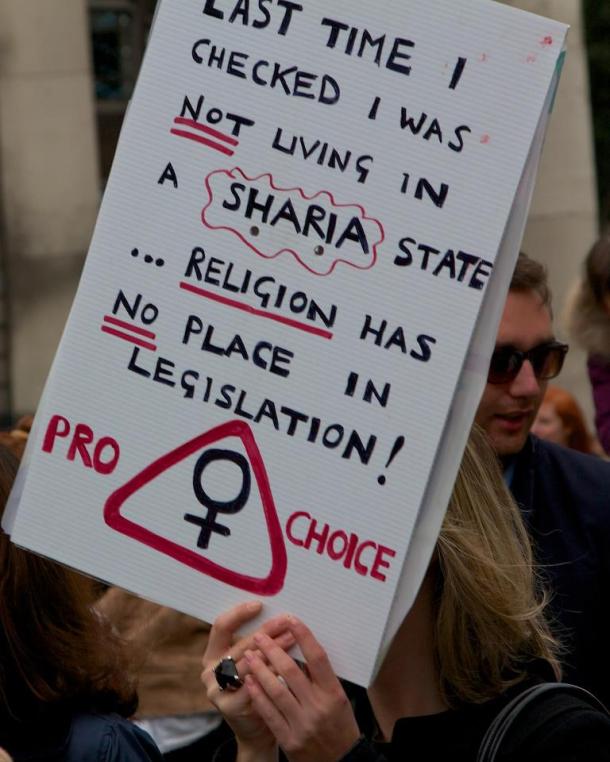
Islamophobia at Dublin’s ‘March For Choice’

Islamophobia at Dublin's 'March For Choice'

POSTER READS: ‘Last time I checked I was not living in a sharia state. Religion has no place in legislation! Pro choice”

I saw a picture of this poster in an album of Dublin’s prochoice march.

I don’t understand what the Sharia law has to do with Ireland, the main religion which is catholicism? Why couldn’t it say something about how Catholicism still dominates irish customs?

What does the Sharia law have to do with a catholic country? What’s it to do with Ireland not giving its people access to abortion and aftercare support?

Nothing at fucking all.

Just an excuse to criticize anything to do with islam and/or countries that practice islam. Just another excuse to remind people that there’s something apparently worse out there; sure shouldn’t Westerners be happy we aren’t like ‘those’ countries at least?

Fair enough if Ireland was an islam country whose laws are influenced by its religion which results in restriction to abortion, the poster would then make perfect sense. BUT the sharia law has nothing to do with Ireland so what on earth is the point of this poster exactly?

This sad belief that ‘The West’ is better and more civilized than those barbaric countries with their barbaric religions have got to stop. Dare I say that irritating phrase? ‘I can’t believe this still happens in 2012!’

Awful things happen in the west too; the West isn’t some magical land where all the good lovely stuff exists and all the terrible yucky, racist, sexist, restrictive-laws-influenced-by-religion-which-affects-women only exists in places outside the West.

Where did this idea come from that you should expect great things in a western country that doesn’t have sharia law and if a western country behaves like ‘those’ cultures with the crude religions, it’s something really REALLY bad? Get over this western imperialism, the west is no better in terms of treating it’s people with respect as anywhere else in the world.

I might as well make a sign that reads “Mitt Romney is a racist, legalize abortion now!” for all the sense it makes since some American dude in the US has nothing to do with Irish law and politics.

No one is saying there’s nothing problematic about Romney or the Sharia law but to derail a march to talk about something completely different is tacky and pathetic. I can write about some of the crude, uncivilized, tasteless, primitive things about Ireland- being a state that doesn’t have sharia law doesn’t exempt this country from the unfair ways it treats it’s citizens. Get it together.

Anti-Deportation Ireland launch

Posted on

(Note: In this post, I’ll be sharing things raised and spoken about at the ADI launch. Because of the risk this could pose to the people in question, however, I’m not going to give their names or any details about them unless I get explicit permission to do so.)

Anti-Deportation Ireland was officially launched on Wednesday morning. ADI is “a national, multi-ethnic grassroots network/alliance of activists, asylum seekers, refugees, community workers, trade unionists, and academics who have come together to campaign against forced deportation in Ireland, and for the abolition of the direct provision system.”. They have three demands:

  1. An immediate end to all deportations
  2. The immediate abolition of the direct provision system.
  3. The right to work for people seeking asylum.

So why these demands? How do direct provision and deportation work in Ireland, and why is it so important to end them?

Direct Provision

Direct provision is how asylum seekers’ basic needs- for food and shelter- are provided in Ireland. Asylum seekers are placed in hostels. Food is provided by these hostels. Because food and shelter are directly provided, the only money people are given is an allowance of €19.50 per week. Until people’s claims have been decided, they do not have the right to work or education in Ireland. The amount of time it can take for a claim to be decided varies hugely- people can spend years waiting for a decision.

Despite the name, direct provision isn’t, well, directly provided by the State. It’s outsourced privately, and because of this becomes a for-profit enterprise. Despite being outsourced, it’s unregulated. Can you see where this is going? People are accommodated three, four, five to a room, with different families sharing a room. The standard of food can be atrocious. Not only is it extremely bad, but in many cases utterly unlike what people are used to in their home countries. And because of direct provision, asylum seekers don’t have the facilities or the rights to even cook their own food.

Complaining about conditions is rarely an option. People who complain about overcrowding are told that they should be grateful that they are not homeless. That they’re taking up room that Irish homeless people don’t have- pitting two extremely vulnerable minorities in this country against each other.

Several people talked about raising their families in direct provision. One woman spoke of how one of her children is too young to remember anything else. How she doesn’t know the difference between a bedroom and a living room and a kitchen. How happy her child is whenever they leave the hostel, and how she hates having to go back ‘home’. Another speaker talked about the particularly Irish way in which cases of child abuse within hostels are dealt with. Perpetrators can be, in a cruel echo of so many other institutions in this country, simply moved from hostel to hostel. This is happening now. And those who complain are often moved themselves, without any right to protest, to other hostels around the country, disrupting any fragile sense of community they might have created where they are. People are denied the right to privacy, to cook their own food, to have a home where they feel safe and where they know how long they can stay.

Right to Work

As well as being forced to live in specific hostels, asylum seekers in Ireland are denied the right to work and education while their claims are being processed- which can take years. On the one hand, this is immensely wasteful. Ireland is in a recession! How many skilled, educated, qualified people are languishing in hostels unable to work, when they could be contributing to society? This also shows the lie of the idea that asylum seekers and migrants are ‘draining’ the system. These people are not permitted to work, even when they want to. On the other hand, years of enforced, stultifying idleness can be devastating for asylum seekers. Not being able to work means that people’s skills get rusty. Work and education are also two of the major ways that people integrate and find a place in communities. Direct provision and the denial of the right to work and study keep asylum seekers separate from Irish society. They mean that people can be here for years with no ability to put down roots and make a home. That Irish people don’t get to work and study beside asylum seekers. That we see asylum seekers as other.

Deportation

Asylum seekers, however, don’t just have to live with direct provision. They also face the constant threat of deportation. On World Refugee Day this year, the 20th of June, 18 people were deported from this country. Twelve of them were children. People are not deported during the day. They are taken from their beds in the middle of the night. When neighbours don’t notice. When people who could help them to appeal are out of work, are asleep. Without notice.

Several people spoke of the constant threat of deportation. About staying awake through the night, sacred this would be the night they’d be forced out. One speaker remarked that even criminals in prison in this country know what they have been sentenced to. They know how long they’ll be there. Asylum seekers don’t have even this security. Another speaker remarked that for asylum seekers, the normal rights accorded people by the legal system are turned upside-down. Asylum seekers are assumed guilty and lying until proven otherwise. The burden of proof is on them, and it is made incredibly difficult to prove themselves innocent. But, as several people asked, why would someone put themselves through this system without good reason? Why would they live like this, for years on end, if they didn’t absolutely need to?

Not okay.

Direct provision, night-time deportations, denial of basic human rights- these things are done by the state to asylum seekers. But as one speaker said, there is a thing line between a refugee and a citizen. Our government has shown that it is willing to trample basic human rights, to engage in a deliberate campaign to other and alienate a group of people. The ‘asylum seeker’ is constructed as scapegoat and a subject for deportation. As Irish people, we need to contest this construction. We need to reach out to people seeking asylum, to hear their stories, to share these stories every way we can. We need to bring the lives of asylum seekers into the light. As one speaker said, “No more secrets. No more lies. No more lying awake every night waiting to be taken away”.

More info on the launch at Cedar Lounge RevolutionPoliticoMillstreet.ie and Irish Left Review. Follow ADI on Facebook to find out more about what they are doing and how you can get involved.

Myself and Ariel Silvera also livetweeted this meeting. A summary of these is available here.

Originally posted on my personal blog, Consider The Tea Cosy.

On International Day to Decriminalise Abortion

This afternoon, for (I believe) the first time, the pro-choice movement in Ireland will mark the International Day for Decriminalisation of Abortion with a rally and march through Dublin city centre. It will begin at 2pm at the Spire on O’Connell Street and march to Merrion Square. I will be marching with the Choice Ireland contingent, and hope to see you Irish readers there.

I have reservations about the “Decriminalise Abortion” slogan. To decriminalise something means only the removal of criminal penalties for it; it does not mean that it becomes available, accessible or affordable. We can see this in the United States, where 40 years after Roe vs Wade decriminalised (most) abortions, access is still blocked for many women due to cost, burdensome conditions or simple lack of a provider in their area. If Ireland’s Offences Against the Person Act 1861 was repealed tomorrow, I doubt it would make much difference to the farmer’s daughter in County Leitrim, or to the asylum seeker in Waterford getting €19 a week.

That said, it would be remiss of me not to acknowledge that Decriminalisation Day was initiated by women in the Global South, not Ireland. I’m certainly not telling them how to campaign in their own part of the world. And there are tragic cases, like that of Rosa Hernandez in the Dominican Republic, where decriminalisation alone really might have made a difference. In no way do I wish to undermine the efforts of women fighting to prevent Rosa’s story repeating itself.

But abortion is a woman’s right, and we must be clear that it is a positive right to which we are entitled and not merely something that the law should not prohibit. Decriminalise it, of course. But let there be no mistaking that for our objective.

On a final note, I’d like to thank Youth Defence for their appalling recent billboard campaign, which has galvanised the Irish pro-choice movement like nothing in the past 20 years. Undoubtedly they’ll undercount our numbers this afternoon and proclaim our march much smaller than the last one they held. And it probably will be smaller than theirs. But the important thing is that ten years or even five years ago, there would have been half as many of us and twice as many of them. Those are the numbers that matter – and don’t think for a moment they don’t know it.

The Irish trade union movement throws sex workers under a bus

The Irish Congress of Trade Unions is an umbrella organisation representing nearly all the active trade unions in Ireland, north and south. A full list of its member unions can be found here (by industry sector) or here (alphabetically).

ICTU has made a submission to the Irish government’s public consultation on the prostitution laws. As you can see here, where their submission is reproduced is full, most of it is just a cut-and-paste job of text sent to them by the Turn Off The Red Light campaign, which seeks the introduction of the Swedish model. But there is one part of ICTU’s original contribution which I found remarkable. A few paragraphs down the submission cites – clearly for the purpose of endorsing – the view of the Technical, Electrical & Engineering Union‘s General Secretary that

prostitution could not be considered “work”

ICTU didn’t invent this view, of course. But it strikes me as taking on a much graver significance when held by trade unionists than by, say, radical feminists or religious puritans. Because the corollary of prostitution not being work is, of course, that the people engaged in it aren’t workers – and are therefore not entitled to the rights that trade unions (theoretically) exist to defend. Effectively, what they’re saying to sex workers who want those rights is: piss off, and call us when you’ve found a real job.

This position puts ICTU at odds with the International Labour Organization, to which it is of course affiliated. While the ILO takes an officially neutral stance on the legal status of sex work, it has made abundantly clear that it recognises the sex industry as a de facto economic sector, and people who sell sex as engaging in a form of labour. In its groundbreaking 1998 report The Sex Sector: The Economic and Social Bases of Prostitution in Southeast Asia, for example, editor Lin Lean Lim proposes that

For those adult individuals who freely choose sex work, the policy concerns should focus on improving their working conditions and social protection, and ensuring that they are entitled to the same labour rights and benefits as other workers.

The international standards developed by the ILO also reflect this position – albeit impliedly rather than explicitly, in their frequent reference to “all branches of economic activity” (my emphasis). The 1981 Occupational Safety and Health Convention is an example.

And what about the jurisdictions which have actually incorporated those standards into their own laws around sex work, such as New Zealand?

Abel, Fitzgerald and Brunton, “The Impact of the Prostitution Reform Act on the Health and Safety of Sex Workers” (2007)

The phenomenal figures in the last three rows of that table are the consequence of legislation which was expressly designed to treat sex work as work – legislation, in other words, designed to do exactly what ICTU says the law shouldn’t do. And thus ICTU, which is a trade union body hence theoretically a workers’ rights organisation, would reject a framework agreed to be rights-protective by over 90% of the workers operating within it, because they don’t consider them “workers” to begin with. ICTU policy would take those rights away from them.

I’ve been racking my brain trying to think of a parallel to this extraordinary situation, and I’m honestly stymied. Even considering the obvious context – disapproval of prostitution as a matter of principle – I can’t think of another sector in which the “solution” would involve the wholesale rejection of labour rights for those involved. I cut my political teeth in anti-war and anti-nuclear campaigning, and I don’t recall anything remotely comparable to this. We may have wanted to decommission the bases and power plants but we never said labour law shouldn’t apply to people working at them.

Nor can ICTU’s position be justified on the basis that sex work isn’t really a choice. The term “work” may be deemed inappropriate for actual forced labour, the labour of someone who is literally enslaved – but ICTU, like all but the most fanatical fringes of the anti-sex work movement, don’t seem to think that most in the sex trade fall into this category. Instead, their submission refers to the “poverty, past history of abuse or limited life choices” that push people into prostitution. But ICTU don’t see it as “not work” when poverty and limited options push people into unappealing jobs outside the sex sector – and they would never dream of opposing legislation to give those workers labour rights.

In some respects, this betrayal isn’t really a surprise: the Irish trade union movement has a long history of selling out Irish workers, especially those at the margins. (They also have a history of an undemocratic, top-down style of leadership which seems to be reflected here as well: nobody I know in any of the ICTU-affiliated unions was asked for their opinion of this submission before it went in.) But summarily excluding a whole sector of the economy from their remit, and refusing to defend the labour rights of the (particularly vulnerable) people dependent on it? That’s a new low for them, and it’s a shocking one.

New edition of Look Left out now

Posted on

Just a short announcement that the new Look Left is out now, featuring a piece by yours truly on the Swedish sex trade law (along with an opposing view). For a list of places to buy it, click here.

ETA: You can now read a PDF of my article here.

It’s also got the following articles:

* Another Europe is Possible
* Interview with Mandate General Secretary John Douglas
* Michael Taft on the possibilities for building a progressive future
* Conor McCabe on the myth of NAMA’s ghost estates
* Gavin Titley on the media’s reporting of the economic crisis
* The Price of Corruption
* Belfast: Divided by Walls, United by Poverty
* The politics of the Pogues
* Brian Hanley on Frank Ryan’s Street Fighting Years
* Lauren Arrington on Delia Larkin and the Irish Women Workers’ Union
* What Now for the ULA?
* Egypt’s Permanent Revolution?
* Stormont’s Policies a Recipe for Poverty

Well worth the €2. Please check it out. And thanks to the editors for inviting me to contribute.

Human trafficking in Ireland, part 2 (and about those brothel raids)

Posted on

In the comments to this post a few weeks ago, where I looked at the Irish government’s latest human trafficking report, a reader pointed me to the text of a presentation given recently by Detective Superintendent Noel Clarke of the Garda Síochána (Irish police)’s Human Trafficking Unit. I promised to give it a post of its own, which I meant to do last weekend, but something else intervened. Which turned out to be just as well, because in the meantime we’ve had the island-wide brothel raids which I referred to in this post – and what we’ve learned from those raids ties in very neatly with the contents of the presentation.

Much of Clarke’s statement is bland operational stuff but a couple points drew my attention. The first is his reference to the administrative status available to trafficked persons:

In the cases where the potential victim was not legally in the State and there were reasonable grounds to suspect that crime had occurred they were granted a Recovery and Reflection period and a subsequent Temporary Residence Permission… In 2011 only one of the 57 potential victims did not have a permission to be in the State and that individual was granted a Recovery & Reflection period and a subsequent Temporary Residence Permission.

This underscores what I said in the earlier post about the status serving as an anti-deportation measure, hence not being applied to persons who already have some kind of protection against deportation. But as you can see from the stats in that post, that status is “asylum seeker” for the majority of persons reported. And around 95% of asylum seekers in Ireland will lose their protection against deportation once their claims have been determined (that’s the approximate rejection rate). The Department of Justice gives the impression (paragraph 10) that the administrative arrangements will kick in automatically for identified trafficking victims should their other permission expire, but that’s not what actually happens: instead, failed asylum seekers who have been trafficked must ask for recognition under the arrangements, as a last-ditch effort to avoid deportation, at precisely the time when their immigration status is most precarious. Which is an awfully cruel procedural hoop to put vulnerable people through. It’s one of only several reasons why the arrangements are woefully inadequate for the people they are meant to assist, but that’s a subject for another post.

Another interesting thing in the presentation is that Clarke says:

The one significant trend emerging from the data is that in approximately two-thirds of the cases and after a detailed investigation no evidence of human trafficking has been disclosed.

Or to read it the other way around, only about one-third of the cases that are reported to the Gardaí as involving human trafficking actually do involve human trafficking. This is not too far from my interpretation of the 2011 data as showing only 14 confirmed cases out of 57 reported (that’s actually around one quarter, but the difference between a third of 57 and a quarter of 57 is only five people).

And that brings us neatly to last week’s brothel raids, which for all the hoopla seem to have been something of a damp squib as an anti-trafficking operation. To the best of my knowledge, there are no reports that any trafficking victims were found in this jurisdiction, though apparently three were found in the North (bearing in mind, however, the much broader offence of trafficking there). And according to this piece in today’s Sunday Independent,

Senior sources said that all the young women who were detained or questioned said they were working in the sex trade here voluntarily…Gardai disagree with claims by Catholic and feminist groups that there are high levels of human trafficking involved in Ireland’s sex trade.

Now, there should always be a health warning attached to statements attributed to anonymous “senior sources”. But in this case we have a named source saying pretty much the same thing. To return to that Noel Clarke presentation about the data in the Department of Justice report:

we are of the view that is it an accurate portrayal of the extent and nature of the problem in Ireland.

And if it is an accurate portrayal, then there aren’t high levels of human trafficking involved in Ireland’s sex trade because at most there were 14-19 victims last year while according to the pro-criminalisation lobby themselves there are over 1000 women in the Irish sex industry. Less than 2% is not a high level by any measure.

These kinds of figures are unreliable, of course; I’m always the first to say that. Undoubtedly there are cases that have gone undetected. But when even a police operation of last week’s scale fails to turn up evidence of a large number of victims, the burden of proof can’t keep being put on the side of the sceptics. It’s all well and good pointing out that absence of evidence isn’t evidence of absence but as justification for a potential legal change with significant consequences for people’s lives and livelihoods, it’s nowhere near good enough.

One final thing I want to address about the raids is the claim that police were not targetting the women selling sex. That is patently not true for the North, where three Polish sex workers have been prosecuted despite acknowledgement from all sides that there was no trafficking or pimping involved. There don’t seem to have been any arrests of sex workers in the South (despite the admission by Gardaí, in this piece again, that it is usually sex workers rather than pimps who face brothel-keeping charges), but look at what this article says:

An unknown number of prostitutes were spoken to by gardaí and their immigration details were checked. They will not face prosecution but may become witnesses.

All those congratulating the Gardaí for “not going after the women” seem to have missed that little detail emphasised above. If they were truly “not going after” them, why would they need to check their immigration status? What exactly do supporters of these raids think the Gardaí are going to do with the knowledge gleaned from those checks? In a country where even trafficking victims from outside the EU aren’t safe from eventual deportation, you can be damn sure that migrant sex workers won’t be; at best, they may be kept around long enough to serve as witnesses (if they don’t make themselves disappear before then). An undocumented person has more to fear from the police than prosecution alone. That’s something criminalisation advocates who think the Swedish model would turn sex workers and police into BFFs really need to get their heads around.

On RTÉ’s Prime Time last Thursday, Paul Maguire, the reporter whose February “exposé” of the online industry arguably set the stage for these raids, queried whether they’ve had any effect. He pointed out that the number of escort ads the day after the raids was actually higher than it was the day before. But why would the number go down? After all, there were as many women struggling to pay their bills the day after as the day before. There were as many migrants without employment permission the day after as the day before. And for those can truly be said to be in the business by choice – the so-called happy hookers – well, they weren’t the raids’ target anyway, were they?

None of the above means I don’t think there is exploitation in the Irish sex industry, or that it shouldn’t be investigated. But it is legitimate to query whether the outcome of this particular operation justified its considerable cost, and to ask whether more could have been achieved with less heavy-handed tactics. And if the professed concern for the women is genuine, then we need also ask about the impact of the raids on them. It simply cannot be assumed that they’d welcome such interventions with the same enthusiasm their would-be rescuers do. Particularly if, as the evidence we have suggests, such a small percentage of them actually need rescuing in the first place.

Quick note on last night’s Vincent Browne

Posted on

In the wake of a massive brothel raid police operation, the Vincent Browne show last night debated the issue of prostitution in Ireland. If you missed it a playback should be available soon here.

I don’t have too much to say about it but there are a couple points made by the anti-sex work speakers that I want to address. First, in response to a viewer’s claim that the rape rate in Sweden has skyrocketed since the sex purchase ban was introduced, Susan McKay of the National Women’s Council flatly denied that this was true and said that crime has generally gone down in Sweden.

The official statistics on reported offences in Sweden are here. I’ve taken a screenshot of the relevant time period (click on it to enlarge):

As you can see, the viewer was correct: the reported rape rate has gone up significantly since the sex purchase ban was introduced. Sarah Benson of Ruhama, another panelist, was correct to point out that Sweden broadened its definition during the period – in 2005, I believe, interestingly the same year that the Netherlands broadened their definition of trafficking– and in any event, these are only reported rapes so it’s impossible to know for sure whether the number of actual rapes has increased. And I’m sceptical of the claim of any link between legality of prostitution and rape in the first place, not least because there is no evidence that making it illegal to buy sex actually stops men from doing so. So I am not posting these statistics to make a claim that the rape rate has increased because of the law. My point is that Susan McKay responded to the allegation by not only flatly denying it but making a further claim about the general crime rate which, as you can see from those stats, is also wildly off the mark. With the exception of theft offences, it is absolutely, 100% untrue that crime rates have decreased since the law was introduced, and its advocates really need to be hauled over the coals for their willingness to make such breathtakingly false claims. (I’ll give McKay the benefit of the doubt that she may have been merely repeating something she was told since, as I’ve noted here and elsewhere, the Swedish authorities routinely fudge the truth around the law’s effects.)

The other thing I wanted to highlight was Sarah Benson’s assertion, in response to the point that Teresa Whitaker of the Sex Workers Alliance made about the UNAIDS Advisory Group on HIV and Sex Work report, that HIV is not an issue for Irish sex workers. Yes, you read that correctly, HIV is not an issue – because the HIV rate is so low, except among injecting drug users, who apparently don’t count.

I frankly find it astonishing that anyone who works with sex workers should dismiss the relevance of HIV – and it’s worth pointing to this document on the Ruhama website in which Benson says the opposite:

Women and children will contract sexually transmitted diseases, including HIV. This does not magically happen. Buyers are the source of infection and transmit it to women…

But the other point to be made here, and my tweet to this effect was read by Vincent Browne but ignored by the panel, is that the law they are advocating has the potential to make HIV much more of an issue. As I wrote about here and here, Norwegian health services are already seeing a rise in other STIs since the sex purchase ban was introduced, which they attribute to a greater reluctance to use condoms: where sex sellers are struggling to make a living because their clients have gone elsewhere, they are more vulnerable to demands for unprotected sex. It’s not rocket science. So even if Benson was correct that HIV isn’t an issue for Irish sex workers now, there’s a very good chance it will be if she gets her way on the law. Indeed, that’s pretty much the point the UNAIDS Advisory Group Report makes.

Finally, I look forward to a future Vincent Browne episode featuring the voices of actual sex workers. We need to remember that they are not, as Benson also (remarkably) put it, “burgers” but people with their own views on what they do and what the law should do about it. We need to create an environment where they can speak out and not only contribute to but actually shape the debate, which is, after all, about their lives and not ours. I’ll close here by linking to the Stories From Behind The Red Light blog, which is run by actual Irish-based sex workers. They are the people who should have been up on that panel last night.