RSS Feed

Category Archives: Equality

Savita, abortion and the right to health in international law

Posted on

Commentary around the Savita Halappanavar inquest has, understandably, focused on the Irish constitutional law context but I haven’t seen much discussion about the breach of her rights under international law.

This is perhaps unsurprising, as abortion itself has a nebulous standing in international human rights law. As its opponents never tire of pointing out, it isn’t protected per se in most of the world’s major human rights treaties. The only real exception is in the 2003 Maputo Protocol to the African Charter on Human and People’s Rights – that continent’s counterpart to the European Convention – which sets out in Article 14(2):

States Parties shall take all appropriate measures to:

(c) protect the reproductive rights of women by authorising medical abortion in cases of sexual assault, rape, incest, and where the continued pregnancy endangers the mental and physical health of the mother or the life of the mother or the foetus.

None of the human rights treaties to which Ireland is party even mention the word “abortion”, though that doesn’t mean they can’t protect the right in limited circumstances. The obvious example of this is the European Court of Human Rights decision in ABC v Ireland, which held the State in breach of an applicant’s right to her private life for failing to provide a clear mechanism by which she could establish and exercise her right to a legal abortion. This is similar to the way that other treaty monitoring bodies have approached the issue, such as the UN Human Rights Committee in KL v Peru and the CEDAW committee in LC v Peru. In both cases, the decision wasn’t that there was a right to abortion per se in the relevant treaty (respectively, the International Covenant on Civil and Political Rights and the Convention on the Elimination of All Forms of Discrimination Against Women), but that the particular abortion sought would have been legal under state law and thus various treaty provisions were breached by denying the petitioner access to it.

But what I want to talk about here is a more general right – namely, the right to health, and how it was breached in Savita’s case. The right to health is protected in a number of treaties that Ireland is party to, most importantly under Article 12 of the International Covenant on Economic, Social and Cultural Rights. Then there’s CEDAW, mentioned above, which has its own Article 12 protections for women’s health, while in the European Social Charter, “The right to protection of health” is set out in Article 11. It’s important to realise that these treaties are all fully binding on Ireland as a matter of international law. There’s often confusion on this point, because Ireland has a “dualist” system which means a treaty isn’t domestically enforceable unless it’s incorporated into national law by the Oireachtas (as with the European Convention on Human Rights Act 2003). You can’t go down to the High Court to sue the State for breaching your ICESCR rights – in fact, at the moment you can’t go anywhere. But it’s still legally obliged to protect them, even though there’s not much you can do if it doesn’t.

In and of itself, the fact that Savita died wholly avoidably in a public hospital proves the State’s failure to protect her right to health. If her death really had been due only to the “system failures” we keep hearing about, then perhaps we could chalk it down to a one-off, individual failure. But the more we hear from the inquest, the more apparent the truth becomes: the breach is in the law itself, not merely the way it was implemented or (mis)understood by her medical team. In fact, even if she had survived – and I know of a few women in similar circumstances who, thankfully, did – her right to health would still have been violated. Ireland’s ban on abortions in all but life-threatening cases will inevitably violate the right to health in those cases that fall short of the “real and substantial risk” threshold set by the Supreme Court. Here’s why.

The most widely-accepted definition of the right to health – the Article 12 ICESCR definition – is the “right to the highest attainable standard of physical and mental health”. The General Comment on this right by the treaty’s monitoring body, the Committee on Economic, Social and Cultural Rights, goes quite a bit further in defining that to include “the right to control one’s health and body, including sexual and reproductive freedom”. This is a fairly unambiguous, though legally non-binding, interpretation. But we don’t even have to go there, because on the plain terms of Article 12, you cannot enjoy the highest attainable standard of health if you’re denied an abortion that you need for the sake of your health. Simple as – and there’s no getting around it by hypothesising whether Physical or Mental Condition X would entitle someone to an abortion under this rule. Yes, there may be cases where it’s uncertain if abortion really is indicated for health reasons, but that’s completely beside the point: Irish law doesn’t allow for any of them if you aren’t considered likely to die otherwise. An absolute prohibition on “therapeutic” abortions for non-life threatening cases is not made compatible with the right to health just because it’s not always easy to determine who needs a therapeutic abortion.

“But rights aren’t absolute”, I hear you say. Well no, they aren’t, but when they’re guaranteed in a legally-binding treaty they can only be limited under the terms set out in that treaty. The ICESCR limitations clause, Article 4, states that the rights can be subjected

only to such limitations as are determined by law only in so far as this may be compatible with the nature of these rights and solely for the purpose of promoting the general welfare in a democratic society.

Now, admittedly, this is a bit woolly, and a casual reading might well lend itself to a utilitarian interpretation, or suggest that a society which considers abortion a generally bad thing could legitimately consider an abortion ban to promote society’s general welfare. It’s not an absurd argument, on its face.

But it’s also not supported by the aids we have to interpret the meaning of the text. The Convention’s travaux préparatoires – the official records of the negotiation process (not online, but detailed in this book) – don’t exactly explain what the drafters of Article 4 had in mind. They do, however, show the rejection of various proposals to include grounds of public order, public morality and the interests of the community – all things which might suggest a person’s rights could be trumped in the interests of some aspirational “greater good”. The CESCR, for its part, states that Article 4

is primarily intended to protect the rights of individuals rather than to permit the imposition of limitations by States

which would mean that the State has a heavy burden of proof in justifying any such limitations.

In Irish law, of course, this is met by Article 40.3.3’s protection of “the right to life of the unborn”. But that won’t cut it in international law, because there is no right to life of the unborn in international law.  (As with the “right to abortion”, there is one exception, but it’s in a treaty that Ireland isn’t party to – the American Convention on Human Rights). And again, in terms of the treaties we’ve ratified that protect the right to life – the International Covenant on Civil and Political Rights, the Convention on the Rights of the Child, the European Convention on Human Rights – there is either travaux or case law leaving the foetus out of this protection. (This nifty fact sheet from the Center for Reproductive Rights has lots more detail about this.) So the balancing exercise that would be required to make the denial of therapeutic abortion compatible with the ICESCR is, in international legal terms, simply a nonsense. There is no legal “individual” to balance the woman’s rights against.

There’s another way in which I think Savita’s right to health was infringed, and that’s in the discriminatory way her health needs were dealt with. Article 2 ICESCR requires that the Covenant’s rights be protected “without discrimination of any kind”. Patently, there was discrimination in her case: she was treated differently because she was pregnant. A non-pregnant person would not have had a medically-indicated course of action refused to them at a time of comparable need. There may also be an issue around the antibiotic she was given, which wasn’t strong enough but was “recommended for use in maternal cases”. I’ve found the newspaper reports on this a bit unclear, and I’m not sure whether she was purposely given a weaker antibiotic because she was pregnant, or whether the staff simply didn’t realise, when they gave her the one they always give the pregnant women, that her infection needed a stronger dose. If it’s the former, then she clearly received discriminatory treatment – especially given that it was already known her foetus wouldn’t survive and anyway, she’d already asked for an abortion. The use of less effective medication in the interests of foetal health may certainly be justified, with the woman’s consent, in a wanted and viable pregnancy. But this wasn’t one of those cases.

I said earlier that there’s no place we can go to complain about a breach of the Covenant on Economic, Social and Cultural Rights. Well, that could change in the near future. The Covenant’s Optional Protocol, which allows individuals to bring complaints to the treaty’s monitoring body, will come into force on the 5th of May. Ireland has yet to ratify the Protocol, but it did finally sign it last year and ratification is the next step. Again, since this is international law, the CESCR won’t have enforcement powers – but there’s plenty of potential to shine the world’s spotlight on Ireland, and how it fails to adhere to its international obligations. Abortion rights campaigners should call for the government to ratify the Protocol now.

Enduring (the) Myths: Sex Work, Decriminalisation and the Nordic Model

Posted on

“When prohibitionists do cite other researchers’ findings, they sometimes distort the results and assert the exact opposite of what the cited researchers found.”

– Ronald Weitzer, The Mythology of Prostitution: Advocacy Research and Public Policy (2010)

In early March 2013, the Huffington Post published an article with the title Debunking The Myths: Why Legalising Prostitution Is A Terrible Idea. I was not desperately keen to read it, but I proceeded to anyway because I am generally interested in what people are saying about sex work. And then I was angry. And then I went away and did something else, but I’ve had to come back to it again, a month later, because this one has specific features that make me particularly angry, and I need to share with you what they are.

It was written by Jacqui Hunt, London director of Equality Now. And despite its title, its scope is not limited to legalisation: she believes decriminalisation is an equally bad idea. At first glance, her article looks fairly reasonable and well researched, citing studies from various countries in which sex work has been legalised or decriminalised. It should be noted, however, that any legal model can be tweaked: whichever approach to sex work is selected by authorities, sex workers’ rights and well-being may or may not be prioritised in the accompanying legislation. Germany’s legalisation model is not identical to Austria’s (given the choice, I’d pick Germany). This means that negative outcomes might very well indicate the need for better legislation, rather than conclusive proof that legalisation or decriminalisation should never be entertained again. On the other hand, criminalising sex workers’ clients, as per the Nordic model, has specific, negative repercussions for sex workers’ safety, and there is no conceivable way to criminalise clients that won’t result in those negative repercussions.

I’m not going to address each and every claim Hunt makes about legalisation or decriminalisation: my intention in writing this post is, instead, to examine the ways in which some of her claims have been made, ways which I believe undermine her credibility. My main interest here is in references she makes to New Zealand, where I recently visited the New Zealand Prostitutes Collective (NZPC) to specifically discuss the effects of decriminalisation. And because the primary source for her observations on New Zealand reveals a markedly different picture from the one she has chosen to paint, I’m given to feel that all of her claims ought to be thoroughly investigated before anyone takes them as gospel.

Read the rest of this entry

This piece comes from Britain, but Irish feminists must not see it as irrelevant to feminism in Ireland. One example that jumped out at me immediately was this one: “To involve women of colour as entertainment or free catering service at feminist events whilst failing to involve women of colour in visible lead speaker or panel roles is racist.” I can think of a couple recent examples where events were organised to discuss migrant women’s experiences, and migrant women did not feature on the panel at all (at least initially, presumably until the exclusion was pointed out to the organisers). I also attended an event not too long ago where a migrant woman spoke powerfully about her negative experiences in Ireland, and when it came to Q&A time a white Irish woman in the audience stood up to express her sympathies…and then addressed a question about this woman’s experience to the white Irish NGO worker sitting beside her on the panel.

I’d note also the negative reaction among some Irish feminists to a woman of colour’s post on this blog, in which she objected to Islam being used as a bogeyman in the Irish abortion debate (as if Catholicism hasn’t been oppressive enough). Among other things, she was told that she should go to a Muslim country and see what things were like there. The assumption by the people who made those comments that they know more about life in her native country than she does – that’s also racist.

Any women of colour in Ireland who are reading this – what other examples of racism have you seen within Irish feminism? And what do white Irish feminists need to do better/differently/at all to address this?

Black Feminists Manchester's avatarBlack Feminists Manchester

By Mia

When we talk about ‘white feminist spaces’ what we mean is the default mainstream feminism of the UK, (Europe and USA). A feminism that considers itself superior to women’s movement’s throughout the world, using it’s white privilege to cherry pick which women (of colour) and oppressions are worthy of attention or rescue, viewed through a myopic authoritative white lens.

White feminism must evolve and integrate with multi cultural societies if it is genuinely concerned with the liberation of all women. Barr a few switched on individuals, many white feminists (WFs) I have encountered in the UK, view ‘woman hate’ as the only form of oppression requiring eradication, for women to be free. I wish that was true.

What many WFs still forget or fail to notice is that, women of colour making up the global majority of the women’s population, they face and challenge multiple oppressions i.e. racism, classism…

View original post 979 more words

March for TEA this Saturday!

Posted on

After #meteorshame, who’s feeling like it’s time that we all stood up to be counted in support of Irish trans people’s rights? I sure as hell am. So’s Aisling from Gaelick:

Hey, quick question, what are all you guys doing on the 20th of October? I know where I’m going to be. I will be outside the Dáil from 2.30, getting my protest on. That’s the day of the Rally for Recognition: Identity NOT Disorder.

The rally marks the International Day of Action for Trans* Depathologisation. If that seems like a paragraph full of made up words to you, don’t worry, sit down, I’ll explain it to you..

Rally for Recognition poster

Trans* Education and Advocacy, the organisers of the rally, have this to say:

Being gay used to be a mental illness… being trans* still is.

In 2012, trans* people are still not recognised by the Irish State.

Join TEA at the Rally for Recognition to mark International Day of Action for Trans* Depathologisation on Saturday 20 October 2012 at 2.30pm outside Dáil Éireann, Kildare Street, Dublin 2.

For those of you who can’t get enough of waving clever slogans around, TEA will be making placards from 6.30 tomorrow (Wednesday) evening at the Exchange. Come along! There’ll be tea and biscuits!


Originally posted at Consider the Tea Cosy

#MeteorShame

Posted on

You know Meteor? They’re a mobile phone company here. They have some.. interesting ideas about how it’s appropriate to advertise data plans.

There’s a lot of ways to advertise data plans, I’m sure. Advertising is plainly not my thing, but I’ve seen enough of it to be well aware that there are many creative ways to sell just about anything. Which is why I’m not certain why Meteor decided to do what they did. When you’ve a world of possibilities to choose from, why would it seem like a good idea to mock marginalised groups of people? I can’t say I get it.

And so begins my latest post at Gaelick, Meteoric Mistake. Turns out that, according to Meteor, making a mockery of trans people is absolutely a-okay as long as it reminds people to pick up their new all-you-can-eat data plans. Charming.

Many people who I love- dear friends, people I consider family, my gorgeous partner- are trans. People I love have been attacked, forced out of jobs, denied housing, and been driven to suicidal ideation and self-harm. While this ad is one little thing, it is a piece in a massive puzzle that combines to make a world where trans people are looked down on, villified, and victimised. The world is a more dangerous place for people I love because of things like this advertisement.

Let’s let Meteor know this isn’t okay. Tweet them at @Meteor_Mobile with the hashtag #meteorshame. Make this mistake into one they won’t forget.


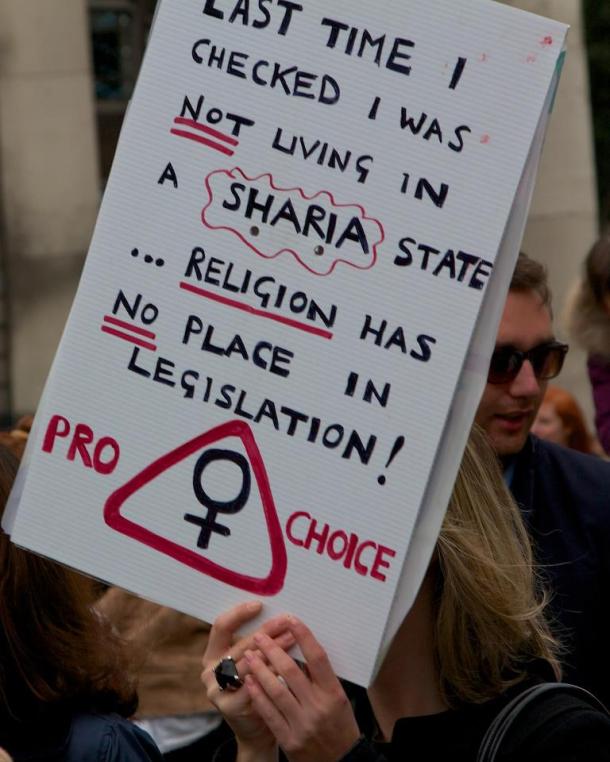
Islamophobia at Dublin’s ‘March For Choice’

Islamophobia at Dublin's 'March For Choice'

POSTER READS: ‘Last time I checked I was not living in a sharia state. Religion has no place in legislation! Pro choice”

I saw a picture of this poster in an album of Dublin’s prochoice march.

I don’t understand what the Sharia law has to do with Ireland, the main religion which is catholicism? Why couldn’t it say something about how Catholicism still dominates irish customs?

What does the Sharia law have to do with a catholic country? What’s it to do with Ireland not giving its people access to abortion and aftercare support?

Nothing at fucking all.

Just an excuse to criticize anything to do with islam and/or countries that practice islam. Just another excuse to remind people that there’s something apparently worse out there; sure shouldn’t Westerners be happy we aren’t like ‘those’ countries at least?

Fair enough if Ireland was an islam country whose laws are influenced by its religion which results in restriction to abortion, the poster would then make perfect sense. BUT the sharia law has nothing to do with Ireland so what on earth is the point of this poster exactly?

This sad belief that ‘The West’ is better and more civilized than those barbaric countries with their barbaric religions have got to stop. Dare I say that irritating phrase? ‘I can’t believe this still happens in 2012!’

Awful things happen in the west too; the West isn’t some magical land where all the good lovely stuff exists and all the terrible yucky, racist, sexist, restrictive-laws-influenced-by-religion-which-affects-women only exists in places outside the West.

Where did this idea come from that you should expect great things in a western country that doesn’t have sharia law and if a western country behaves like ‘those’ cultures with the crude religions, it’s something really REALLY bad? Get over this western imperialism, the west is no better in terms of treating it’s people with respect as anywhere else in the world.

I might as well make a sign that reads “Mitt Romney is a racist, legalize abortion now!” for all the sense it makes since some American dude in the US has nothing to do with Irish law and politics.

No one is saying there’s nothing problematic about Romney or the Sharia law but to derail a march to talk about something completely different is tacky and pathetic. I can write about some of the crude, uncivilized, tasteless, primitive things about Ireland- being a state that doesn’t have sharia law doesn’t exempt this country from the unfair ways it treats it’s citizens. Get it together.

Anti-Deportation Ireland launch

Posted on

(Note: In this post, I’ll be sharing things raised and spoken about at the ADI launch. Because of the risk this could pose to the people in question, however, I’m not going to give their names or any details about them unless I get explicit permission to do so.)

Anti-Deportation Ireland was officially launched on Wednesday morning. ADI is “a national, multi-ethnic grassroots network/alliance of activists, asylum seekers, refugees, community workers, trade unionists, and academics who have come together to campaign against forced deportation in Ireland, and for the abolition of the direct provision system.”. They have three demands:

  1. An immediate end to all deportations
  2. The immediate abolition of the direct provision system.
  3. The right to work for people seeking asylum.

So why these demands? How do direct provision and deportation work in Ireland, and why is it so important to end them?

Direct Provision

Direct provision is how asylum seekers’ basic needs- for food and shelter- are provided in Ireland. Asylum seekers are placed in hostels. Food is provided by these hostels. Because food and shelter are directly provided, the only money people are given is an allowance of €19.50 per week. Until people’s claims have been decided, they do not have the right to work or education in Ireland. The amount of time it can take for a claim to be decided varies hugely- people can spend years waiting for a decision.

Despite the name, direct provision isn’t, well, directly provided by the State. It’s outsourced privately, and because of this becomes a for-profit enterprise. Despite being outsourced, it’s unregulated. Can you see where this is going? People are accommodated three, four, five to a room, with different families sharing a room. The standard of food can be atrocious. Not only is it extremely bad, but in many cases utterly unlike what people are used to in their home countries. And because of direct provision, asylum seekers don’t have the facilities or the rights to even cook their own food.

Complaining about conditions is rarely an option. People who complain about overcrowding are told that they should be grateful that they are not homeless. That they’re taking up room that Irish homeless people don’t have- pitting two extremely vulnerable minorities in this country against each other.

Several people talked about raising their families in direct provision. One woman spoke of how one of her children is too young to remember anything else. How she doesn’t know the difference between a bedroom and a living room and a kitchen. How happy her child is whenever they leave the hostel, and how she hates having to go back ‘home’. Another speaker talked about the particularly Irish way in which cases of child abuse within hostels are dealt with. Perpetrators can be, in a cruel echo of so many other institutions in this country, simply moved from hostel to hostel. This is happening now. And those who complain are often moved themselves, without any right to protest, to other hostels around the country, disrupting any fragile sense of community they might have created where they are. People are denied the right to privacy, to cook their own food, to have a home where they feel safe and where they know how long they can stay.

Right to Work

As well as being forced to live in specific hostels, asylum seekers in Ireland are denied the right to work and education while their claims are being processed- which can take years. On the one hand, this is immensely wasteful. Ireland is in a recession! How many skilled, educated, qualified people are languishing in hostels unable to work, when they could be contributing to society? This also shows the lie of the idea that asylum seekers and migrants are ‘draining’ the system. These people are not permitted to work, even when they want to. On the other hand, years of enforced, stultifying idleness can be devastating for asylum seekers. Not being able to work means that people’s skills get rusty. Work and education are also two of the major ways that people integrate and find a place in communities. Direct provision and the denial of the right to work and study keep asylum seekers separate from Irish society. They mean that people can be here for years with no ability to put down roots and make a home. That Irish people don’t get to work and study beside asylum seekers. That we see asylum seekers as other.

Deportation

Asylum seekers, however, don’t just have to live with direct provision. They also face the constant threat of deportation. On World Refugee Day this year, the 20th of June, 18 people were deported from this country. Twelve of them were children. People are not deported during the day. They are taken from their beds in the middle of the night. When neighbours don’t notice. When people who could help them to appeal are out of work, are asleep. Without notice.

Several people spoke of the constant threat of deportation. About staying awake through the night, sacred this would be the night they’d be forced out. One speaker remarked that even criminals in prison in this country know what they have been sentenced to. They know how long they’ll be there. Asylum seekers don’t have even this security. Another speaker remarked that for asylum seekers, the normal rights accorded people by the legal system are turned upside-down. Asylum seekers are assumed guilty and lying until proven otherwise. The burden of proof is on them, and it is made incredibly difficult to prove themselves innocent. But, as several people asked, why would someone put themselves through this system without good reason? Why would they live like this, for years on end, if they didn’t absolutely need to?

Not okay.

Direct provision, night-time deportations, denial of basic human rights- these things are done by the state to asylum seekers. But as one speaker said, there is a thing line between a refugee and a citizen. Our government has shown that it is willing to trample basic human rights, to engage in a deliberate campaign to other and alienate a group of people. The ‘asylum seeker’ is constructed as scapegoat and a subject for deportation. As Irish people, we need to contest this construction. We need to reach out to people seeking asylum, to hear their stories, to share these stories every way we can. We need to bring the lives of asylum seekers into the light. As one speaker said, “No more secrets. No more lies. No more lying awake every night waiting to be taken away”.

More info on the launch at Cedar Lounge RevolutionPoliticoMillstreet.ie and Irish Left Review. Follow ADI on Facebook to find out more about what they are doing and how you can get involved.

Myself and Ariel Silvera also livetweeted this meeting. A summary of these is available here.

Originally posted on my personal blog, Consider The Tea Cosy.

Trans Health Forum

Posted on
TENI banner

On Monday, TENI, the Irish Transgender Equality Network,  hosted a trans health forum in the Civic Offices in Dublin. This forum’s purpose was to discuss the current context and situation of trans health in Ireland. It was divided into two parts. To start, TENI’s Vanessa Lacey presented some prelimiary results from the recent Trans Mental Health And Well-Being  Survey, which was carried out in July and August of this year, as well as a survey of HSE workers of their knowledge and opinions regarding trans health and working with trans people. After this, attendees were divided into groups to talk about different health issues facing trans people.

The results showed, above everything, the magnitude of issues that need to be dealt with, the impressive work being done largely by volunteers as well as paid staff, and the limits of what can be done without getting the wider community and health service providers on board.

The numbers here are stark. Preliminary results show that over three quarters of trans respondants have considered taking their own lives. Between a third and a half have attempted suicide, and most of these people have made more than one attempt.

And these, of course, are just the people who survive. Over 80% of respondants said that they had thought of ending their lives more before transition than during or after. Our society stereotypes and demonises trans people so much. How many more people would be here today if they had known that transition was a possibility? That meaningful, happy trans lives are possible here in Ireland? We don’t know. Researching suicide is notoriously difficult. But it’s certain that there are people whose lives would have been saved by transition, and that self-harm and suicide among trans people is a major health crisis right now. Something needs to be done. But what?

Discussions at the forum centred on three major areas- trans specific support groups and community, health service providers, and society as a whole. Each of these has its own part to play, as well as its own specific needs and issues.

Trans support groups and community has developed and expanded hugely in recent years, thanks in no small part to the work of TENI. There are now trans support groups, online communities, and social and lobbying groups working throughout the country. The trans community is more connected and visible than ever before. This kind of networking- going beyond simply support groups into forming real, deep community and connections, bringing in families, partners and other allies- was emphasised throughout the room yesterday. Because support and community groups are largely volunteer-driven, however, there are gaps in provision. For example, in many areas there is an age gap between youth groups and support groups mainly attended by older people. Consistent support is difficult to provide, since busy volunteers don’t always have the time and energy to keep up with running groups. Groups can hinge on the work of one or two people, and as people’s lives go on and they have other commitments, support groups can disappear. Keeping up long-term momentum is so difficult in what are often very small local groups. But these groups can be a lifeline.

Health services for trans people in Ireland are a mixed bag. While not everyone who identifies as trans goes through medical transition, for those who do it can be immensely important to their well-being. Unlike in the UK, there is no specific transition pathway in Ireland. We don’t have a gender clinic. There are very few medical professionals here who provide transition services. This means two things- firstly, many people have to travel long distances, taking time off of work or college to access services only available in Dublin. Secondly, a person’s ability to access these services, which may be urgently necessary, can depend on the whims of one or two professionals. There isn’t scope to get a second opinion, or to choose who you deal with. This means that regardless of the professionalism and ethics of the medical care providers involved, they have ended up in a gatekeeper position to transition in this country. This disempowers trans people, leaving them immensely vulnerable.

The lack of a dedicated clinic specialising in all aspects of transition in Ireland is also problematic. People not only often have to travel considerable distances to access medical care, but this is compounded by the different services being provided in different places. Some services, such as laser hair removal, are officially considered ‘cosmetic’. This means that people have to find trans-friendly providers  themselves, as well as paying out-of-pocket.

In addition to the lack of dedicated services and service providers outside Dublin, awareness of the transition needs of non-binary people was raised. Even professionals who deal with trans people can be stuck on a particular binary idea of gender as well as specific ideas of who trans people are and what medical pathways they will follow. Non-binary people often seek and need medical transition services too, though. Their needs- and their existence- need to be understood.

But trans people don’t only access medical care for transition-related treatment. They- of course- have to access general medical care as well, and these providers are often utterly unaware of how to deal with trans patients. Over 90% of HSE staff surveyed said that they’d received absolutely no training relating to trans people. They also reported that most of their contact with trans people was as rthe result of unprovoked attacks in public places. While a person might be normally capable of giving their doctors and nurses Trans 101, is it really okay that they would have to do this af ter being assaulted? That victims of assault then have to face even more stress, to have to worry about ignorance or transphobia in the A&E?

After trans communities and healthcare providers, the third group that needs to be educated on trans people is, of course, our society at large. Trans people don’t just show up from nowhere. We all live in local communities, go to schools and colleges, live in neighbourhoods, go to jobs. Trans kids growing up should know that there are other trans people out there, and so should the cis kids growing up with them. They need to know that they’re not the only one out there. The media have a huge role to play here in providing positive and varied non-stereotyped portrayals of trans people. Trans people are part of our society, and it’s time our society started acting like it.

To find out more, read Gaelick’s report on the forum. An overview of preliminary results of the Trans Mental Health and Well-being Survey is available at TENI.ie

Your girlie bits offend some people.

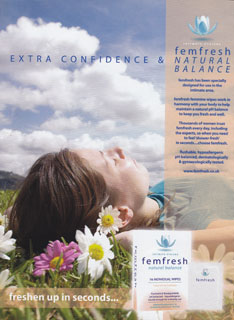
A PR disaster for feminine hygiene company Femfresh developed on the internet this week after their refusal to use the word “vagina” on their facebook page. Femfresh make feminine hygiene wipes – that is, wipes for vaginas, among a range of other products from gels to washes that serve the same purpose. One would expect that a company in the business of selling vagina-related products wouldn’t have any problem with saying the word vagina.

It was not to be. Instead of saying the v-word they took to using a number of words instead of it such as “va jay jay, kitty, nooni, lala, froo froo!” to describe women’s vaginas. It would be interesting to see transcipts of the discussions of their marketing meetings where that decision was made.

If you cared about your Lala at all you dirty girl, you’d buy our stuff.

Their Facebook page, which has now been deleted as a result of the uproar, was aghast with comments from rightfully disgruntled women who took umbrage with the fact that the Femfresh felt the need to give their vagina a new, rather infantilised, and for many insulting, name. The Facebook page showed an image of a woman at a festival under which someone added the most wonderful comment;

“I can’t go to any festivals! I’ll be too busy sitting at home crying about the embarrassing smell of my shame-shame.”


It generated a very interesting discussion on various blogs about why women took offence to the Femfresh idea that there was something offensive about the word ‘vagina’ and why it really didn’t need another name because the word ‘vagina’ was sufficient in itself.

The thing is though; nobody should be really surprised that Femfresh would consider that the word ‘vagina’ is too offensive to use on their facebook page and that a more sanitised word should be employed instead. Their whole business is based on the premise that vaginas are inherently offensive and in need of sanitising  -coincidentally, women have the opportunity to make their genitals less offensive if they buy Femfresh products to wash themselves with. It wouldn’t do to let women believe that their genitals are pretty much fine in their natural state.

This is about sending women a message that female bodies, where they are not aided by products that alter their natural state, be it their skin colour, hair levels, or ph balance for that matter, are unfeminine and unnatural and it is imperative that women engage in the alteration and self-regulation of their own bodies. To just wash normally, according to Femfresh, would not be hygienic enough, despite being contrary to all known medical evidence, so one must buy their product and do something extra. Where is Foucault when you need him?

There are rules within patriarchal capitalism and women who do not conform to the self-regulation of the body must be painted as being abnormal lest it threaten the sales of body-altering products. Although she wrote on the issue of weight, it’s rather similar to philosopher Elizabeth Grosz’s idea that women’s bodies in their natural state in Western societies are construed as being uncontained, uncontrolled and dangerous to a Western Patriarchal order. The woman’s body is positioned as being in need of control when in its natural state – almost as if it possesses a formlessness and disorder that threatens the order of patriarchy if left untamed. A body in no need of “untaming” would have no need for the purchase of commodities to tame it, and where would that leave capitalism?

Medical discourse decides what is healthy, and Femfresh (as well as other companies selling similar products) have attempted to appropriate the ability to control the “ph balance” of a vagina despite the fact that the vagina is self-regulating when it comes to its ph balance. But products sell much faster when you convince people that it’s for the good of their health.

There are many similarities to the marketing of these products and menstruation products.  Simone De Beauvoir wrote about the idea of shame attached to the female body as far back as 1949;

“It is not easy to play the idol, the fairy, the faraway princess when one feels a bloody cloth between one’s legs”.

And even today despite its normality (for the majority of cis-women at least) menstruation or even the natural and normal activity of what goes on between a woman’s legs is deemed to be a tainted aspect of femininity that she must keep hidden and secret at all times – because any other party’s knowledge of it would damage her femininity.

Advertisements for Femfresh style hygiene products as well as menstrual products depict the unattended woman’s genitals as a threat to the traditional image of femininity. Even the packaging for the products is specifically designed so as to be “discrete” and the secrecy of compliance with menstrual etiquette serves to reinforce to women their status as objects, and not as humans. This type of grooming is portrayed by these companies as a method for women to self-improve on the way to self-fulfilment; liberation will be found in the idealised body type – you must look a certain way, and you must smell a certain way. As they frame it, to not engage in this practice is to let yourself go and for a woman – according to the terms of patriarchal capitalism – to let yourself or your body go is to reject womanhood itself.

Thus self-improvement can be achieved, but it must be purchased by using more products and spending more money. For Femfresh the process is not an optional extra – it is about being healthy and maintaining a ph balance after all – it is about paying to bring the body to a state of normality as they have defined it and rescinding the body’s own control of itself.

Confidence problems? Femfresh will sort that. All you need to do it wipe your ladybits and make sure it smells like a meadow down there. Or else, no confidence for you!

Children’s rights must not mean women’s wrongs

Posted on

Last month the Irish Minister for Children, Frances Fitzgerald, announced that the long-promised referendum on the rights of children would finally be held this year.

The background to this lies in the following provisions of the Irish Constitution:

Article 41
1. 1° The State recognises the Family as the natural primary and fundamental unit group of Society, and as a moral institution possessing inalienable and imprescriptible rights, antecedent and superior to all positive law.
2° The State, therefore, guarantees to protect the Family in its constitution and authority, as the necessary basis of social order and as indispensable to the welfare of the Nation and the State.

3. 1° The State pledges itself to guard with special care the institution of Marriage, on which the Family is founded, and to protect it against attack.

Article 42
1. The State acknowledges that the primary and natural educator of the child is the Family and guarantees to respect the inalienable right and duty of parents to provide, according to their means, for the religious and moral, intellectual, physical and social education of their children.

5. In exceptional cases, where the parents for physical or moral reasons fail in their duty towards their children, the State as guardian of the common good, by appropriate means shall endeavour to supply the place of the parents, but always with due regard for the natural and imprescriptible rights of the child.

The proposed referendum, as agreed by an all-party parliamentary committee, would leave Article 41 intact but remove those two subsections of Article 42. The replacement text is rather lengthy so I’ll just provide a link rather than post it all here.

The impetus for this change comes from a series of judicial and policy decisions, which have been seen as making it so difficult to interfere with the sacred institution of The Family (and more particularly the marital family) as to effectively tie the State’s hands when it comes to child protection and welfare. A few examples:

  • The 2001 case Northwestern Health Board v HW, where the Supreme Court upheld the right of parents to refuse to allow their child undergo the PKU test, a totally safe procedure to detect a disorder that leads to brain damage if untreated.
  • An unspeakably horrible case of familial abuse in County Roscommon, revealed a little over a year ago. You can Google it yourself, I don’t have the stomach for it. The mother had obtained an injunction preventing the children being removed from the family home; her affidavit cited the rights that she and her husband, as a married couple, had over their children. Social workers on the case confirmed that Article 42 had a sort of chilling effect on their efforts to protect the children, as it led them to believe they would need to prove a nearly impossible threshold of neglect.
  • The 2006 “Baby Ann” case (N v Health Service Executive), in which a two-year-old girl was ordered returned to her birth parents. They had consented to her adoption, but changed their minds and subsequently married – at which point, according to Justice McGuinness, the rights of the family took over from the best interests of the child as the “central issue”. (Actually, on the peculiar facts of this case the birth parents would have had a decent argument even without the constitutional imperative, but there are obvious reasons to be concerned about the court’s emphasis on the primacy of the marital family.)

So you can see why there’s widespread support for amending the Constitution to specifically enshrine the rights of children. What little opposition there is is mainly coming from two of the most repellent groups in Irish society: the xenophobes, who fear the amendment being used to prevent deportation of Africans with minor children; and the uber-Catholics for whom any interference with the marital family is anathema. (It hasn’t gone unnoticed that the list of amendment opponents reads like a Who’s Who of the Irish anti-abortion movement – whose concern for the rights of children clearly ends at birth.) Ironically, although the latter group is far more organised and politically powerful than the former, it is the deportation issue that is actually holding the referendum up. I was present at a private meeting a couple years ago where a then-Cabinet Minister, a current Cabinet Minister and a backbench member of the other current government party all agreed that the wording would have to be changed to assuage those fears.

Irish feminism, on the other hand, seems to be pretty much entirely behdind the amendment, and that’s fairly understandable. After all, the primacy of the marital (read: patriarchal nuclear) family hasn’t exactly done us many favours; and while the amendment won’t remove Article 41.1, it clearly will narrow its scope. But while I wouldn’t argue that we should vote “no”, I do think some important issues have been overlooked in the debate. Consider the following:

  • In 2006, the High Court ordered that a Jehovah’s Witness be given a blood transfusion (subscription required) contrary to her express wishes, the first time this was done to a competent adult. Counsel argued and the Judge accepted that her child’s need for a parent overrode her right to refuse medical treatment.
  • In the US, women have lost custody of their children for working outside the home, being lesbians and even reporting domestic abuse.
  • According to a representative of the fabulous Association for Improvements in the Maternity Services Ireland who I was speaking to recently, some Irish women have been threatened with prosecution – yes, prosecution – if they insisted on giving birth at home rather than under the full control of the professional (and strongly male-dominated, and extremely paternalistic) medical industry.

What these cases all have in common is that they’re examples of the “best interests of the child” being used to further a patriarchal agenda, in which motherhood automatically strips women of their autonomy. Make no mistake about it, this isn’t just the standard assumption of self-sacrifice that having children always entails; it’s the quite deliberate channeling of women with children – whose primary identity is now “mother” – into tightly prescribed roles, with the legal system there to act as enforcer.

I’m being a bit deliberately melodramatic here and I’m not suggesting that passage of this amendment will actually turn us all into Stepford wives. But I don’t think we should be complacent about the risk of “children’s rights” becoming another tool of state misogyny. Let’s not forget that this is a state where woman’s primary role as housewife and mother is actually enshrined in the Constitution (Article 41.2, for readers abroad). Do you trust all of our judges to read the new amendment in a way that protects children’s rights without trampling on women’s? I don’t.

I’m also uneasy about the way this amendment could be read in juxtaposition with Article 40.3.3, on the right to life of the “unborn”. Judging by some of the cases coming out of the US at the moment, it seems that pregnant women in some states might be only a few years away from being forcibly institutionalised to prevent them doing anything that might possibly lead to the birth of a less-than-perfectly-healthy baby, such as having the odd glass of wine or eating too much junk food. It’s a strange sort of logic that allows women to be penalised for “neglecting” foetuses that they have every right (at least on paper) to abort, which I suspect is why those laws aren’t more widespread throughout the US than they are. Here, of course, the constitutional position on abortion is no impediment to such laws – and with a mandate to protect both the rights of (actual) children and the rights of the “unborn”, there is, I think, a worrying possibility that this American trend could catch on here.

Again, and just to be perfectly clear, I’m not saying that feminists should oppose the amendment. In all likelihood I will vote for it myself, on a simple cost-benefit analysis (as in, I think overall it will probably do more good than harm). And I don’t have any suggestions as to how it could be worded to avoid these nightmare outcomes, especially while the odious Articles 40.3.3 and 41.1-2 remain. But we shouldn’t be leaving it to the racists and religious fanatics to highlight its possible unintended consequences. We should be putting the State on notice that although we want to see better protection for Irish children, we are not going to tolerate it becoming yet another tool to oppress Irish women.