RSS Feed

Category Archives: Sex work

We Are Here To Win

Posted on

A really powerful statement from the Philippine Sex Workers Collective on the appropriation of their voices by prohibitionist groups and the challenge they face with the Anti-Prostitution Bill, based on the Swedish model.
“Society has made us invisible so to have women of power speak for us was a blessing or so we thought. It was not a blessing. It was exploitation. They were not speaking for us, they were speaking for themselves in our name.”

Philipine Sex Workers Collective's avatarAnd Deliver Us From All Our Saviors

Sex workers have always been treated with great disdain in Philippine society. To call a woman a prostitute (puta) or the daughter or son of a prostitute (anak ng puta) would perhaps be the gravest insult you can throw on any Filipino. Credit this to the Catholic Church and Christian fundamentalists (the Catholics make up 88 % of the country’s population while the Christian groups account for 8%. The rest are Muslims.) They have ingrained in the minds of the people that sex outside of marriage is dirty and immoral. To most Filipinos therefore, prostitution is a moral issue and those involved in it must be condemned. This has led us, sex workers, to be treated with stigma and discrimination.

As sex workers, we are forced to hide who we are and what we do for fear that if we are outed, we and our families would…

View original post 1,025 more words

The EU report on trafficking in human beings

Posted on

Last month saw the publication of the EU’s first Trafficking in Human Beings report, which is billed as an attempt to “collect comparable data on trafficking in human beings at the EU level”. The report is (properly) littered with disclaimers, such as this one in screaming bold type on page 30:

More reported cases do not necessarily mean an increase in the actual number of victims. This may indicate an improvement in the reporting rate of the phenomenon or a change in the recording system

Unfortunately, however, when it came to the press release, the European Commission decided to go for the handy soundbite – and so we’ve been deluged with headlines like “Human trafficking increased by 18%” when of course, the report doesn’t show it did any such thing.

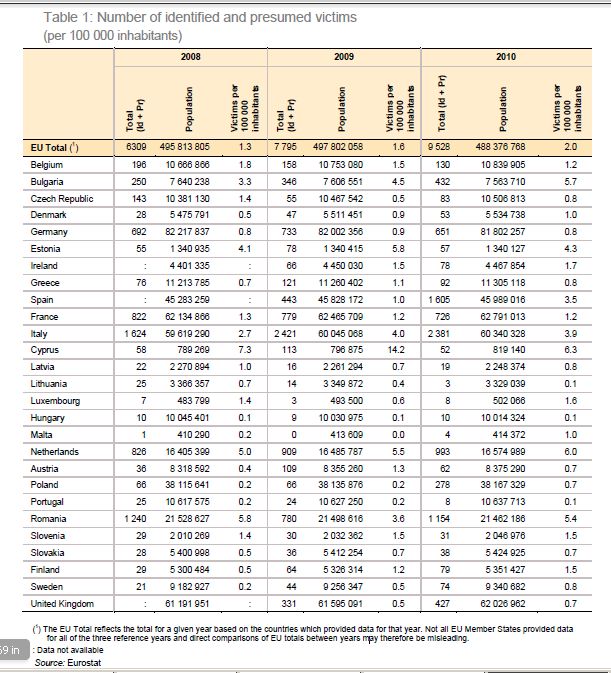
For all the faith put into that 18% figure, though, most of the newspaper and NGO reactions don’t evince much interest in the rest of the data. I’m going to put this down to simple laziness – it’s a whole 94 pages they’d have to wade through, poor dears – but it’s also the case that if all the statistics were accepted as readily as the “18% increase” has been, it would be a little bit inconvenient for some of those with an interest in this area. This table on page 31 shows why:

Trafficking01

Contrary to what we’re constantly told by the anti-trafficking movement, the most recent figures make it hard to discern any link between trafficking and the legal status of sex work. The Dutch rate is very high, but the Cyprus rate is higher – and Cyprus has much stricter laws than the Netherlands (brothels are illegal, for one thing). Romania, where sex work itself is illegal, is nearly as high. Hungary (legal), Portugal (legal) and Lithuania (illegal) are tied for last. Austria and Germany are also relatively low – in fact, Germany and Sweden are tied, at 0.8 per 100,000.  And the German rate has remained more or less constant over the three years surveyed, while Sweden’s has quadrupled.

Don’t think we’ll be reading that in the next Turn Off the Red Light press release.

I’m being mischievous, of course, because as I’ve already said, the data don’t – and can’t – show the actual number of trafficked persons in each country. So we can’t really say that Germany, Austria and Sweden have more or less the same trafficking rate. But let’s be honest here – had the table shown Germany and Austria to be right up there with the Netherlands, and Sweden way down on its own, is there any doubt we’d have heard all about it from the prohibitionist groups?

But sex workers’ rights advocates shouldn’t leap on those figures, either, because truthfully the whole report is pretty hopelessly undermined by its methodological weaknesses. These include the following:

Different countries provided different sets of data. On page 30 we are told:

Ten EU Member States provided data on identified and presumed victims, 15 EU Member States provided data on identified victims only and two EU Member States provided data on presumed victims only. The participating non-EU countries provided data only on identified victims.

This alone would make it impossible to get a cohesive account of trafficking, or even just of detected trafficking, across Europe. It certainly renders a comprehensive cross-country comparison untenable. (In case you were wondering, though, all the countries I’ve mentioned so far provided data only on “identified victims” – except for the Netherlands, which only gave “presumed victim” data. More about this later.)

Different countries use different definitions. The Commission seems to have attempted to get around this, by reminding countries of the international definition of “trafficking” when sending them the forms to complete, but the methodology problem is unavoidable. An “identified victim” is, according to page 22,

a person who has been formally identified as a victim of trafficking in human beings according to the relevant formal authority in Member States

and that inevitably introduces an element of subjectivity into the data, because not all member states strictly apply the international definition when deciding whom to identify as a victim of trafficking. In fact, I doubt whether any of them do – and they are inconsistent in the manner and degree by which they diverge from the international definition. So when we look at that table and see that Ireland has more than twice the rate of “identified victims” as Greece, for example, we have no way of knowing whether that’s because Irish police genuinely detected twice the rate of people who fit the international definition, or whether the Irish police identified people outside the international definition, or whether the Greek police declined to identify people inside it.

This problem is magnified for those countries that include data for “presumed victims”, that is:

a person who has met the criteria of EU regulations and international Conventions but has not been formally identified by the relevant authorities (police) as a trafficking victim or who has declined to be formally or legally identified as trafficked.

Here, member states are essentially being asked to submit data on people who were trafficked but were not identified as trafficked. To identify unidentified trafficking victims. There’s something a bit Schrödinger’s Cat-like about this category; it just doesn’t seem to lend itself to any real scientific measurement, at all.

If the data had been collected on a forward-looking basis, it might almost be workable. That is, if countries had been told that, for the future, they would be asked to record details of not only the people who they formally identified as victims of trafficking, but also of people who they would have identified as trafficked but for some insurmountable obstacle (such as that the person themselves told them where to stick their “trafficking victim” status). You’d still have the subjectivity problem, but at least you would know that the records were being kept on an ongoing basis, with the member states knowing exactly what they were to look out for.

But that’s not how this was done. Instead, as explained on page 17,

The questionnaire was sent via Eurostat to the National Statistical Offices of the EU Member States, EU Candidate and Potential Candidate countries and to the EFTA/EEA (European Free Trade Association/European Economic Association) countries in September 2011. It included the appropriate tables, a list of common indicators, definitions and guidelines for collecting the statistical data as well as the country codes to be used and a template for providing metadata.

So countries were asked to collate retrospectively their data on people who they had identified as unidentified trafficked persons. And then to pick out of that data only the people who fit the “common indicators, definitions and guidelines”. But who’s to say that the data were initially recorded in such a way as to make that possible? If the authorities weren’t already aware they were going to be asked to provide data on people who they’d declined to identify as “trafficked”, you have to wonder whether they’d be quite so diligent in their record keeping about those people.

Did I say “authorities”? Oh – here’s the next problem:

“Presumed victim” statistics were supplied by a wide variety of sources. According to page 23:

Data on ‘presumed’ victims on trafficking in human beings may be available from national rapporteurs (or equivalent mechanisms which tend to act as national coordinating bodies), victims assistance services, immigration services, labour inspections and border guards.

I don’t think I can really overstate this point: there is no possible way to get anything like a reliable, consistent overview when you throw out to your data collectors that they can get their information from pretty much anywhere they can find it. And as it happens, some of the key data sources are pretty questionable. For example, in the Netherlands the source is CoMensha, a national agency, which according to page 39:

does not have a formal assessment based on specific criteria by which the registered person’s status as a victim can be verified.

In other words – as I discussed in this post – CoMensha simply records the alleged cases that are referred to them, without actually investigating whether there’s any substance to the allegations. The Dutch figures in this report, therefore, are based on little more than rumour. No wonder they’re so high.

Also problematic is the Latvian information, which according to page 38 is

provided by the NGO Resource Centre for Women “Marta”, which provides assistance for presumed victims using alternative financing.

Marta is a prohibitionist organisation, and one that therefore has an interest in finding trafficking victims. In fairness to them, there’s nothing in the data to suggest they’re inflating the numbers; Latvia’s overall rate is the same as Germany’s and Sweden’s and only a minority of these fall into the “presumed victim” category. Nonetheless, their objectivity as a source has to be doubted.

To take a final example, page 39 states that Finland’s number of presumed victims

includes all cases who were directed to reception centers on the basis of suspicion of human trafficking.

Does that sound like a rigorous effort to make sure only the cases that fit the Commission’s specified criteria were reported? Not to me it doesn’t.

I could go on, but I think I’ve made the point. There’s just too much variation across countries, and too loose standards within countries, to consider this a reliable measure of the amount of trafficking in Europe. The report is of (limited) interest for what it reveals about the countries’ data collection processes, but overall you really get the sense of this being a box-ticking exercise for Brussels bureaucrats more than anything else.

I’ll just finish on a couple other matters I found worthy of comment. Firstly, on page 24 it states:

Data is to be collected on the total number of female and male victims

The binary (and I’m guessing cis-centric) approach is unfortunate, as even though the figures aren’t reliable it would still be interesting to see how many trans* persons were recorded. But the only reference I can find within any of the country data is in the British records, on page 39, where it says that one adult trans* woman was identified. Unfortunately, it manages to say this in a grossly offensive way.

There are also figures on “suspected traffickers” and “prosecuted traffickers”. It’s not clear exactly what threshold was required for the first category, but one thing I found interesting was that non-EU citizens accounted for 55% of the former but only 24% of the latter. The reasons for the discrepancy aren’t explained. It could be that non-EU citizens are more likely to go missing before they can be prosecuted, of course, but there could also be a greater tendency to suspect them without any real proof. This is something that merits further research.

And finally, a word about citizenship and labour market status. On page 52 there’s a table (Table 6) that breaks down all the identified and presumed victims, by year and by citizenship. So I did a little numbers exercise. First I counted all the identified victims by country (I didn’t count the presumed victims, because for all the reasons explained above, I think those numbers are too messy to be of any real use). Then I subtracted the internal trafficking victims (as listed on page 53, Table 7). And then I totalled up the remainder, put them into geographical categories and worked out the percentages of each.

The disclaimers first. The numbers don’t quite add up, because I came up with a grand total of 12,261 identified victims in Table 6, whereas the Table 2 combined figure for identified victims is 13,424. I’m not sure where that missing 1,163 went. There also seems to be a minor discrepancy in the Table 7 figures, since I end up with –2 cross-border EU-15 citizen victims in 2009. I couldn’t subtract the child victims, as there’s no breakdown by “identified” and “presumed” nor any indication of how many were working-age children. And of course, all the problems with the data I’ve already discussed still apply. But bearing all that in mind, I still think the results are stark enough to be worth pointing out. Of the identified victims of cross-border trafficking in the three year period:

  • 37% were Romanian or Bulgarian
  • 58% were from outside the EU/EEA
  • 5% were from the 2004 accession countries
  • <1% were from the EU-15

Thus, 95% were from countries barred from all or most of the EU labour market during the data collection period – and nearly everyone else was from a country barred from much of the EU labour market during the data collection period. This isn’t quite as dramatic as it seems, because it still only accounts for just over half the identified victims – the internal trafficking rate is surprisingly high, which is something else that merits investigation (though as the number is very high in some countries and negligible in others, I suspect it mainly comes down to definitions). Notwithstanding those limitations, though, I think it’s safe to conclude that cross-border migrants in the EU are far, far, far more likely to experience trafficking if they don’t have labour market access in the country they’re migrating to.

You’d think this would be a no-brainer, wouldn’t you? But EU states just don’t seem to get it. They consistently wring their hands about the trafficking problem, but stubbornly insist they just can’t relax their labour migration policies – without seeming to make the connection between the two. At some point they’re going to have to admit that if they really want to address the issue, they’ll have to stop making it all but impossible for accession state citizens and non-EU citizens to legally work in their countries. Or else admit that they aren’t really that bothered about trafficking after all.

On “pimps” and policy

Posted on

The Godwin’s Law of the sex work debate is that inevitably, someone on one side will call someone on the other side a pimp. Most of the time, the person making the accusation will be a supporter of criminalising the purchase of sex – and at least some of the time, the only ground for the accusation is that the other person disagrees. Sometimes, of course, there’s a bit more to it than that – the accused may have picked up a brothel-keeping charge, for example – but seeing as that’s happened to people on both sides of the debate, it’s a fairly unedifying accusation. Even when it’s true.

Of course, the point of the accusation isn’t to improve the debate from an intellectual standpoint; it’s to discredit the person it’s made against. And when it’s made against a person who wants sex work decriminalised, the point is to discredit their entire argument – by suggesting anyone who puts it forward is a “vested interest”, a person who (quoting RTÉ’s Prime Time) “profits from prostitution”, a person who pretends to have the interest of sex workers at heart but really just seeks to exploit them. In this way, supporters of the Swedish model can not only take the high moral ground themselves, but can also add impetus to their argument by portraying the law as an anti-pimp measure (as they did, for example, in this press release last month).

The irony is that there are plenty of reasons to think the law would actually have the opposite effect, and promote pimps and pimping. In 2003 the Norwegian Ministry of Justice and the Police went to Sweden to investigate the outworking of the law, and this is what they reported:

It has been claimed that prostitutes’ dependence on pimps has increased because street prostitutes cannot work as openly. The police informed us that it is more difficult to investigate cases of pimping and trafficking in human beings because prostitution does not take place so openly on the streets anymore….

Prostitutes’ dependence on pimps has probably increased. Someone is needed in the background to arrange transport and new flats so that the women’s activity is more difficult to discover and so that it will attract the attention of the police.

A few years later, this was echoed in a report by the Swedish National Board of Health and Welfare:

According to one informant in Göteborg, there are probably more pimps involved in prostitution nowadays. The informant says the law against purchasing sexual services has resulted in a larger role and market for pimps, since prostitution cannot take place as openly.

A woman engaged in indoor prostitution in Göteborg relates that when the law took effect in 1999, about ten women engaged in prostitution from various Eastern European countries approached her business because they wanted to hide indoors. Informants from the Stockholm Prostitution Centre also mention that the law has opened the door to middlemen (pimps), because it has become more difficult for sellers and buyers of sexual services to make direct contact with one another.

Norway, meanwhile, has seen the emergence of what you might call “pimp-like” relationships – relationships of extreme dependency, in which the most vulnerable (drug using street workers) become totally reliant on a particular man or men for survival. According to last year’s City of Oslo report,

Among the women with a drug addiction who still sell sex many have changed methods for finding customers. Most of the support services have experienced that the women enter into more long term relations with men who they refer to as “friends”, “boyfriends”, “uncles”, or acquaintances. These are men they stay in contact with through telephones and that they stay with for longer periods, this could be hours, days, or weeks. They have sex with the men in exchange for the men supplying them with drugs, money, and other necessities. Many of the support services say that they perceive the women as being very vulnerable in the relationships. The women become very dependent on the few customers they have.

So where does the idea come from that pimps would oppose criminalising clients? I think in part, it’s the failure of prohibitionists to understand the difference between legalisation and decriminalisation. Admittedly, there isn’t always a clear line between the two, but an essential element of legalisation is that sex work is only lawful under specified conditions. For indoor workers, this usually means that a premise has to meet strict criteria to be deemed a legal brothel – and that certainly can promote “pimping” as prohibitionists would define it. Few self-employed sex workers have the resources or even the desire to wade through that much red tape, so if they don’t want to work illegally and/or alone (depending on the laws of the jurisdiction), they often have little choice but to work for someone else.

But, and here’s the important thing that always seems to get missed, this is not the model advocated by most supporters of sex workers’ rights. Including many of those who are regularly accused of being pimps. A more favoured model would be something along the lines of New Zealand’s, where up to four sex workers can share a premise as a “small owner operated brothel” (SOOB) without the reams of bureaucracy that a managed brothel is subject to – and where sole operators can take the safety precautions they need without putting themselves at risk of arrest, as happens in many “legalisation” jurisdictions. Does this promote pimping? No, it doesn’t. In fact, according to the 2008 report of NZ’s Prostitution Law Review Committee,

Some brothels have closed down with operators citing the lack of staff and increasing competition for workers because of sole operators/SOOBs as reasons for the failure of their business.

You see? Make it easier for people to work without someone managing them, and they’ll have less need for managers. It isn’t really rocket science. In fact, none of this is counter-intuitive, at least for anyone who doesn’t consider the sex industry to be totally sui generis (which it isn’t). I mean, think about it: most people who call for drugs to be legalised are not actually drug dealers themselves. I don’t think I’ve ever even heard a drug dealer call for drugs to be legalised, for bleeding obvious reasons. Nor does anyone ever argue that criminalising drug dealers’ customers makes a dent in drug dealers’ profits – and fewer and fewer seem to think it really deters the customers, either. Why would criminalising the sex industry have an entirely different effect?

I am fully aware that this post is an exercise in futility. Criminalisation advocates are going to keep throwing the accusation around, keep raising the spectre of the Pimp-Monster lurking behind a multitude of Twitter accounts. It’s an emotive tactic, and thus perfect for what has been a heavily emotive campaign. It’s just ironic that its success will be measured by whether it achieves a policy that real pimps may be the first to benefit from.

Enduring (the) Myths: Sex Work, Decriminalisation and the Nordic Model

Posted on

“When prohibitionists do cite other researchers’ findings, they sometimes distort the results and assert the exact opposite of what the cited researchers found.”

– Ronald Weitzer, The Mythology of Prostitution: Advocacy Research and Public Policy (2010)

In early March 2013, the Huffington Post published an article with the title Debunking The Myths: Why Legalising Prostitution Is A Terrible Idea. I was not desperately keen to read it, but I proceeded to anyway because I am generally interested in what people are saying about sex work. And then I was angry. And then I went away and did something else, but I’ve had to come back to it again, a month later, because this one has specific features that make me particularly angry, and I need to share with you what they are.

It was written by Jacqui Hunt, London director of Equality Now. And despite its title, its scope is not limited to legalisation: she believes decriminalisation is an equally bad idea. At first glance, her article looks fairly reasonable and well researched, citing studies from various countries in which sex work has been legalised or decriminalised. It should be noted, however, that any legal model can be tweaked: whichever approach to sex work is selected by authorities, sex workers’ rights and well-being may or may not be prioritised in the accompanying legislation. Germany’s legalisation model is not identical to Austria’s (given the choice, I’d pick Germany). This means that negative outcomes might very well indicate the need for better legislation, rather than conclusive proof that legalisation or decriminalisation should never be entertained again. On the other hand, criminalising sex workers’ clients, as per the Nordic model, has specific, negative repercussions for sex workers’ safety, and there is no conceivable way to criminalise clients that won’t result in those negative repercussions.

I’m not going to address each and every claim Hunt makes about legalisation or decriminalisation: my intention in writing this post is, instead, to examine the ways in which some of her claims have been made, ways which I believe undermine her credibility. My main interest here is in references she makes to New Zealand, where I recently visited the New Zealand Prostitutes Collective (NZPC) to specifically discuss the effects of decriminalisation. And because the primary source for her observations on New Zealand reveals a markedly different picture from the one she has chosen to paint, I’m given to feel that all of her claims ought to be thoroughly investigated before anyone takes them as gospel.

Read the rest of this entry

Don’t ask, don’t tell, don’t listen – Joan Smith on the Swedish sex trade law

Posted on

Yesterday, the Independent ran this article by Joan Smith about Sweden’s sex trade law. Joan Smith is, in her own words, a “feminist author and columnist” and the essence of her article was that the law criminalising clients is an unqualified success.

This is despite the fact that she seemingly didn’t speak to a single member of the group most affected by the law, by which I mean Swedish sex workers. Her investigative method was to “jump in a squad car with local police” as they tailed working women around the streets of Stockholm, and then to uncritically report what those police told her.

Jem over at It’s Just A Hobby has already passionately conveyed her feelings about sex workers being ignored in this way. Please go and read her post and come back here when you’re done. If you only have time to read hers or mine, read hers. It’s more important.

For those of you who made it back here, I just want to add a couple things. The refusal to listen to sex workers’ voices isn’t only offensive, insulting and pretty much without parallel (would Smith “investigate” the results of a law on domestic violence without speaking to women who’d experienced it? Would she take police at face value that they had improved their handling of rape cases without asking rape victims if they agreed?), it’s also bad policy. It means she isn’t – can’t be – getting the full picture. She isn’t even asking all the relevant questions.

Just to give a few examples from that piece:

“The woman, who hasn’t broken any law, is offered help from social services if she wants to leave prostitution. Otherwise, she’s allowed to go.”

Did she accept the help? If not, why not? Has she accepted the help before? If so, why is she still on the streets? Now that she’s lost the income from that client, how will she compensate for it?

“[The national rapporteur on trafficking in human beings] talks about why women end up in prostitution, citing research that shows a history of childhood sexual abuse, compounded by problems with drugs and alcohol.”

Does that narrative accurately describe you?  Were there different or other factors that brought you where you are [and that Sweden will need to address if it wants to get you out of the sex industry and prevent others like you from entering]?

“Where 70 or 80 women used to sell sex outdoors, these days it’s between five and 10 in winter, 25 in summer.”

What happened to the missing women? Did they just go indoors? Did they leave Sweden (perhaps to work in a country where the clients aren’t as well-behaved as the cop claims the Swedish clients are)? Did they find “straight” jobs, or did they have to turn to other less desirable ways of earning income? Are they all even still alive?

“Before 1999, most women in street prostitution in Stockholm were Swedish. Now they’re from the Baltic states or Africa, and have sold sex in other countries as well.”

Why did they come to Sweden? Was the sex trade law itself the draw, or did they come for different reasons but find themselves unable to get any other work? Why aren’t they availing of that “help from social services”?

“They tell Haggstrom’s officers they’re much more likely to be subjected to violence in countries where prostitution has been legalised.”

Do they really?

“one of the criticisms of the law was that it would make prostitution more dangerous. All the Swedish police officers I spoke to insisted this was a myth”

Is it really a myth? Or are sex workers just less likely to report violence to police officers, now that they depend on income from a criminalised source?

“”If a sex buyer can find a prostituted woman in a hotel or apartment, the police can do it,” Haggstrom observes sardonically.”

Is this really true? Or do the police simply not know when they haven’t found a sex worker whom a buyer has found?

“40 women, mostly from Romania, had sufficient confidence in the Swedish criminal justice system to testify against the men exploiting them”

How many women in the sex trade didn’t have sufficient confidence in the criminal justice system to testify?

“In a brightly lit street, Haggstrom points out a couple of Romanian women who work as prostitutes.”

Once again, why are they selling sex in Sweden? Why haven’t they availed of the social services? Why isn’t the Swedish law “working” for them?

My last question there is a key one. Reading this article, I was struck by the number of references in it to women still in the sex trade. The Baltic and African women. The Romanians on the street. The 40 Romanians who testified in last year’s trafficking trials. The woman of undisclosed nationality whose income source was arrested at the start of the article. Even if you buy the Swedish claims that their numbers have dropped precipitously – and remember, those claims relate only to street prostitution, which was only a tiny part of the industry to begin with – there’s obviously still a Swedish sex trade. And the women (and men) working in it are actual human beings who presumably have views on the law and what its consequences have been for them. One would think that those consequences would be at least as important, to a feminist like Joan Smith, as the crude number count. Which in any case clearly excludes these women from the “success” narrative, a fact I’d expect her to also deem worthy of exploration.

But Smith didn’t just consider it irrelevant to ask these women what the law has meant (and hasn’t meant) to them. She also refused to engage with the many sex workers who tweeted her to point out this omission, the sole exception being her dismissive response to Jem. She allowed police officers – people who see it as their mission to drive sex workers out of business, people who have a long history of using sex workers for their own ends in all sorts of nefarious ways (yes, even in post-criminalisation Sweden) to define their experiences for them.

I have a few words for that type of reporting. “Feminist” isn’t one of them.

No, new research does NOT show that violence decreases under the Nordic model

[Update: in response to communication from Feminist Current’s Meghan Murphy, I am happy to clarify that the article critiqued below is not a “Feminist Current piece” but a Sam Berg piece which Feminist Current merely hosted.]

There’s been a bit of a social media buzz over this article on a radical feminist website, which claims that a recent Pro Sentret report from Norway – which you can read in English here – shows that “violence decreases under the Nordic model”. The author backs up her claims with an impressive array of graphs (and a fair smattering of ad hominems), and unsurprisingly receives glowing praise in her comments from people who were clearly predisposed to believe anything she said on the subject anyway.

I hate to burst their bubble. Well, actually I don’t.

The author kindly linked to one of my own posts on the report, though she seems not to have read it. If she had, she would have noticed that very near the start I referred to “methodological limitations” that made it unsafe to draw cause-and-effect conclusions from the study. At the time I didn’t feel it important to get into those limitations, but I will now. Apart from the health warning that always applies in studying a hidden population, there are two really massively important issues here:

1. Lifetime vs recent experience. The 2007-2008 study asked sex workers if they had ever experienced violence, throughout their “entire career in prostitution (which could be anything from one day to 50 years)”. The newer study asked about violence in the past three years alone. These are two very different questions, which can’t possibly give rise to comparable answers – at least without a detailed examination of the raw data, which we don’t have. We don’t know how long the respondents had been selling sex, in either survey; we don’t know how many in the first study had sold for more than three years nor how many in the second study had sold for less (though 16% of the latter group said they were not selling at the time the survey was carried out). You would expect, of course, that the more actual sex work-years covered by the survey, the more violence would be reported; and if we assume that the first study covered more actual sex work-years then we would expect to see higher rates of violence in it. I’m not even comfortable making that assumption on such flimsy data (which is why I didn’t make it in my initial post). But we certainly cannot make the implicit assumption that the Feminist Current post depends on, ie, that the two studies cover the same number of actual sex work-years.

2. Norwegian vs. foreign experience. Both surveys recorded sex workers’ experience of violence in prostitution wherever it occurred. For the 2012 study, we have a breakdown: 70% of respondents said it only happened in Norway; 12% said Norway and elsewhere; 10% said only elsewhere; 8% didn’t answer. There is also a breakdown of the venues within each country, but that is all. We don’t know, for example, which types of violence occurred in which country, or how many of the specific incidents occurred in which country. This makes it impossible to know how much of the reported violence even took place under the Nordic model. And we don’t have any of this data from the 2007-2008 study, so there’s really nothing for us to compare here at all.

Now, really, that ought to be enough to make it clear that Feminist Current’s claim is totally unsubstantiated. But just for the sake of argument, let’s say we really were comparing like with like. Would that justify their conclusions?

I’ll just address their headline statistic, namely, the claim that rape is down by half in the new study. That comes from here:

NorwayRape

And indeed, the drop from 29% to 15% looks impressive. But wait a minute – look over in the left-hand column, halfway down. See that category of “threatened/forced into sex that was not agreed to”? Last I checked, that’s rape. And the number who said it had happened to them in the past three years was not 15%, but 27%.

The Feminist Current author didn’t miss that category of violence – in fact, she commented on it, but totally missed its significance. She also missed what the report’s authors had to say about it, which is as follows:

We have looked at how many checked both answers which could mean that they define both these categories the same way. Only 6 people have done this, which confirms our suspicion that many of the women would not characterize actual rape as rape. This also means that the actual frequency of rape is considerably higher than what is shown in table 10. If we combine the amount that checked these options and then subtract those that checked both we see that as many as 34%(25 people) of those that have experienced violence in the last three years have been raped/threatened into sex that was not agreed to.

So how does the 34% de facto rape rate compare with its 2007-2008 counterpart? To find that out, we’d need the same accounting exercise to be carried out on the earlier data. It could be that in 2007-2008 there was zero overlap between the persons who said they’d experienced rape, and the persons who said they’d been threatened or forced into having sex; this would give us a de facto rape rate of 64%, from which 2012’s 34% would still be an impressive drop. On the other hand, it could be that every person who said in the first study that they’d experienced “rape” also ticked the box for “threatened/forced etc”, which would mean the de facto rate in 2007/2008 was only 35%. In that case, the subsequent drop to 34% would be considerably less impressive, and probably statistically insignificant. The fact is, we simply don’t know.

Finally, since the Feminist Current argument rests entirely on the claim that “serious” violence is down in the 2012 study, I think there’s one other stat in that image worth highlighting:

Norwayweapon

This of course is subject to the same flaws as everything else in this study, and I’m not pointing it out to suggest that the number of sex workers threatened with a weapon actually has increased under the Nordic model, by 50%, from less than a quarter to approximately a third. I just think it’s kind of…curious that someone who takes the stats at face value, and accuses others of ignoring inconvenient data, doesn’t see any room for this in her analysis of how “serious” violence has changed under the law. But maybe she doesn’t consider “threatened with a weapon” to be serious enough.

There’s a lot more to criticise in that piece if I had more time, not least its contradictions with the radical feminist conception of sex work as inherently violent, inherently rape – and the way it almost mockingly dismisses certain forms of reported violence as not serious enough to be counted as violence for the purpose of this study, while then going on to insist that “any violence inflicted on them matters”. But I’ll let someone else unpack that one. As I said in my first post, we can’t safely draw any conclusion from the stats. The study’s significance lies in its qualitative findings – which are totally inconsistent with the idea of the law as a “success” and which are, unsurprisingly, totally ignored by Feminist Current.

I didn’t have to dig particularly deep into the study to find why the Feminist Current piece is wrong. Pro Sentret are careful to emphasise the lifetime/three years difference. They also highlight the fact that the number of sex workers who report being raped is much higher than the number who call it rape. There’s no reason why anyone who actually read the study wouldn’t be aware of these issues. If they choose not to share them with their audience, that’s a matter for them to explain.

(ETA: More on this subject here.)

UN Special Rapporteur on the Right to Health visits Ireland

The UN Special Rapporteur on the right of everyone to the enjoyment of the highest attainable standard of physical and mental health – yes, that’s his full title – visited Ireland today to address a conference held by the National Women’s Council of Ireland. I couldn’t attend, which I was quite disappointed by as my Master’s research was in this area. However, I gather from Twitter that he spent a lot of time criticising Ireland’s abortion laws. And rightly so.

What conference attendees may not have been aware of (and I suspect the NWCI certainly weren’t) is that the Rapporteur, Mr Anand Grover, has also come down firmly on the side of decriminalising the sex industry. In fact, a 2010 report of his is one of the strongest statements I’ve ever seen in this regard by a UN official, and I’ve seen quite a few. I’ll just copy a few especially pertinent bits (omitting internal citations) and let them speak for themselves. Regular readers of this blog will notice a few familiar themes!

27. Sex workers remain subject to stigma and marginalization, and are at significant risk of experiencing violence in the course of their work, often as a result of criminalization. As with other criminalized practices, the sex-work sector invariably restructures itself so that those involved may evade punishment. In doing so, access to health services is impeded and occupational risk increases. Basic rights afforded to other workers are also denied to sex workers because of criminalization, as illegal work does not afford the protections that legal work requires, such as occupational health and safety standards.

30. Alongside the right to health, the International Covenant on Economic, Social and Cultural Rights protects the right to freely chosen, gainful work (art. 6), which the State must take steps to safeguard. Article 6 of the Convention on the Elimination of All Forms of Discrimination against Women does not require States to suppress consensual, adult sex work. Rather, it calls for the suppression of “all forms of traffic in women and exploitation of prostitution of women”. The term “exploitation of prostitution” has not been defined within the Convention, but is interpreted to refer to exploitation in the context of prostitution. Additionally, the International Convention on the Protection of the Rights of All Migrant Workers and Members of Their Families applies to a significant number of sex workers who travel between States to engage in sex work.

33. The trafficking and enforced sexual slavery of any person is abhorrent, and undoubtedly merits criminal prohibition. However, the conflation of consensual sex work and sex trafficking in such legislation leads to, at best, the implementation of inappropriate
responses that fail to assist either of these groups in realizing their rights, and, at worst, to violence and oppression.

35. For example, New Zealand decriminalized sex work in 2003, with the express aim of safeguarding the human rights of sex workers. Prior to decriminalization, sex workers were less willing to disclose their occupation to health workers or to carry condoms. Since decriminalization, sex workers have reported feeling that they have enforceable rights, including the rights to health and security of person, and are increasingly able to refuse particular clients and practices, and negotiate safer sex.

43. The criminalization of sex work infringes on the enjoyment of the right to health, by creating barriers to access by sex workers to health services and legal remedies. When sex workers are not recognized as engaging in legitimate work, they are not recognized by standard labour laws in many countries. Sex workers often cannot gain access to State benefits, and are not protected by occupational health and safety regulations that routinely protect employees in other industries. The criminalization of selling sex also renders any
agreement concluded for sex work illegal or unenforceable by law on the grounds of being contrary to public policy, resulting in no legal recourse for sex workers.

44. Moreover, the criminalization of practices related to sex work can create barriers to the realization of safe working conditions. For instance, where laws exist prohibiting the running of a brothel, those who invariably subvert the law and run such a business can
impose unsafe working conditions without difficulty, as sex workers themselves have no recourse to legal mechanisms through which they can demand safer working conditions. Where criminalization in any form exists, the protection offered by a brothel or a manager may become increasingly desirable or necessary, but this also comes at a price: fiscally, through the opportunities created for extortion, and in terms of health.

46. The decriminalization or legalization of sex work with appropriate regulation forms a necessary part of a right-to-health approach to sex work, and can lead to improved health outcomes for sex workers. Any regulation of the sex sector should be implemented in accordance with a right-to-health framework, and should satisfy the requirement of safe working conditions as incorporated into the right to health. Decriminalization, along with the institution of appropriate occupational health and safety regulations, safeguards the rights of sex workers. Where sex work is legally recognized, the incidence of violence may also be reduced, through the enforcement of laws against abuse and exploitation.

48. It is vital that those designing interventions to assist victims of trafficking differentiate between those persons working in the sex sector against their will and those who consensually participate in sex work. Brothel raids that are designed to assist victims of trafficking but fail to discriminate between these individuals can impede the realization of the right to health of both groups in some circumstances. Conversely, evidence from one study indicates that individuals consensually engaging in sex work are well placed to assist trafficked and underage persons engaging involuntarily in this industry. This demonstrates the benefits of participation as part of a right-to-health approach.

50. Decriminalization also assists in appropriately targeting these health promotion projects, as sex workers are more likely to self-identify and voluntarily take part in interventions if the risk of legal repercussion is eliminated. Effective interventions around
the health of sex workers and clients should also consider shared responsibility and client behaviour; this is increasingly possible in an environment where clients are not criminalized for using the services of sex workers.

Recommendations
76. The Special Rapporteur calls upon States:

(b) To repeal all laws criminalizing sex work and practices around it, and to establish appropriate regulatory frameworks within which sex workers can enjoy the safe working conditions to which they are entitled.

On International Day to End Violence Against Sex Workers

I thought this would be a good opportunity to revisit this post, in which I looked at a recent report commissioned by the City of Oslo, with support from the Norwegian Ministry of Justice, into violence against sex workers under the sex purchase ban. At the time I had to rely on Google Translate but since then a native Norwegian speaker, Thomas Larson, has given us an English version. You can read it in full here. And you should.

Many thanks to Thomas for the translation.

Taking Ideology to the Streets: Sex Work and How to Make Bad Things Worse

Posted on

“If you drive it underground so no one can find it, it wouldn’t survive.” – Rhoda Grant, 2012

In many ways, Dana fits the profile. She’s a twentysomething woman with a drug addiction. She was abused in childhood and her partner is occasionally violent towards her. They’re in and out of homeless accommodation, and she works on the street to fund both their habits. You could hold her up as an example of someone who does not want to do sex work, and you’d be right. You could score points with her story. You could insinuate that anybody who rejects total eradication of the sex industry simply doesn’t care about her. And that’s pretty much what the campaigners were doing when they lobbied for the criminalisation of her clients.

It’s late 2007, and the Scottish Parliament recently passed the Prostitution (Public Places) (Scotland) Act, outlawing kerb-crawling. Dana’s clients are now breaking the law. If she worked indoors, this would not (yet) be the case, but she doesn’t; she wishes she could, she knows she’d be safer there, but most brothel managers don’t take too kindly to injecting drug users, plus it would be hard to hold down structured shifts given how each day and night is arranged around the search for heroin. The law change hasn’t caused her to pack up and go home (what home?); instead, it has complicated and compounded an already difficult situation.

As I make her a cup of hot chocolate and count out free condoms, Dana takes a seat, tells me about last night. She waited on the streets for hours, frequently changing location in order to avoid police attention. The boyracers were out as usual, yelling abuse and throwing eggs as they sped by. She was rattling – experiencing heroin withdrawal. Gradually, the few remaining clients wore her down, and she agreed to do business with them for less than the usual price. She was out so long that she missed her hostel’s curfew and had to stay out until five in the morning; tried to sleep in a bus shelter. It’s late 2007 in Scotland, and the streets are cold.

“I used to complain about having to come out here to work,” she says. “I had nothing to complain about compared to now.” And this is the statement that sticks with me, a statement so simple and yet so clear, a statement which demonstrates that, despite how Dana’s supposed advocates, her would-be protectors – anti-prostitution campaigners – characterise sex work and how she experiences it, Dana herself knows the difference between a bad situation and a worse one. She is now in the latter. The support organisation I work for is severely underfunded (just over a year from now, it will be forced to cease service provision altogether). Waiting lists for drug treatment are lengthy, and missing an appointment, no matter how valid the reason, can land someone back at the end of the queue. When women like Dana are stopped by the police, sometimes they receive sympathetic treatment, but really it’s a lottery. There’s a serial rapist going around, but even though the women know about it, some of them are taking their chances with him anyway because there are so few clients to choose from. Maybe he’ll just be a bit rough, they rationalise. His behaviour escalates.

Those whose primary goal is to ‘send a message’ are worlds away from these women on the street. Their prioritisation of ideology over safety speaks volumes about their own motivations. It’s one thing if they simply don’t understand the practical repercussions of passing laws such as this one, although it’s too important an issue to excuse a lack of research – these are people’s lives we’re talking about here. But it’s quite another thing if their ignorance is a conscious decision, if they reject concerns not because those concerns are found to be invalid but simply because those concerns are raised by people they don’t want to hear from, including sex workers themselves. Those concerns interfere with a simplistic agenda which, in allowing no room for the nuances of real life, is set to fail. Harmful legislation is steamrollered through by people who block out dissenting voices and allow their supporters to believe there are no dissenting voices, or that those voices are dissenting only because they would rather see women ‘bought and sold’. This sorry state of affairs does no favours for the people they talk about helping.

Read the rest of this entry

Seriously, read this post. It’s spot-on in every single way.

hunternotthehunted's avatarHunter Not The Hunted

So: recently, a young woman, Lucy-Anne Holmes, started a petition on Change.org aimed at getting The Sun to stop featuring topless Page 3 girls*. The Internet seems to have done its work well, because it’s been all over Twitter for days, with endorsement from such stalwarts as Caitlin Moran** & Graham Linehan, and is now claiming over 27,000 signatures. Many of the proponents of #nomorepage3 have made reference to feminism and the general well-being of women as justifications for the quasi-campaign. Even more baffling was when I saw sex educators, sex radicals and other generally sex-positive (by which I include sex-critical) folks endorsing it.

Therefore, I think there is an even greater need for countervailing opinions from the perspectives of feminists. Which, in this case, is me. Nobody ever said life was fair. But there are 2 things I’m not going to touch on: whether or not P3…

View original post 3,526 more words