RSS Feed

#MeteorShame

Posted on

You know Meteor? They’re a mobile phone company here. They have some.. interesting ideas about how it’s appropriate to advertise data plans.

There’s a lot of ways to advertise data plans, I’m sure. Advertising is plainly not my thing, but I’ve seen enough of it to be well aware that there are many creative ways to sell just about anything. Which is why I’m not certain why Meteor decided to do what they did. When you’ve a world of possibilities to choose from, why would it seem like a good idea to mock marginalised groups of people? I can’t say I get it.

And so begins my latest post at Gaelick, Meteoric Mistake. Turns out that, according to Meteor, making a mockery of trans people is absolutely a-okay as long as it reminds people to pick up their new all-you-can-eat data plans. Charming.

Many people who I love- dear friends, people I consider family, my gorgeous partner- are trans. People I love have been attacked, forced out of jobs, denied housing, and been driven to suicidal ideation and self-harm. While this ad is one little thing, it is a piece in a massive puzzle that combines to make a world where trans people are looked down on, villified, and victimised. The world is a more dangerous place for people I love because of things like this advertisement.

Let’s let Meteor know this isn’t okay. Tweet them at @Meteor_Mobile with the hashtag #meteorshame. Make this mistake into one they won’t forget.


Posted on
Aoife's avatar

Just a note, before you read on: Writing this was easy. Posting it is not. This is the first time I’ve been open about this in a space as public as this. It’s a scary thing to do, especially when surveys suggest that almost 2/3 of people have trouble accepting people with mental illness as close friends, and over 40% think that getting treatment is a sign of personal failure. It’s difficult when it’s seen as making a fuss and drawing attention to yourself. So just for this one, please do go gentle on me. After all, it is my first time. Okay?

If you met me, you’d say I’m a pretty damn cheerful person. You’d be right. I’m incredibly lucky in so many ways. I get to spend my time doing things I enjoy. I get to see the benefits of lots of the things I do. I get to be creative and playful in my everyday life. And I get to share my life with some of the most inspiring, genuine and generous people I’ve ever met. I’ve got it good. And every night before I go to bed I take a tiny little pill. That little pill lets all of it happen.

The thing about having depression is that people expect you to be, well, depressed. Same for anxiety. It seems logical, doesn’t it? Depressed people are depressed. People with anxiety are anxious. And so on.

I have depression, and I’m happy.

Continued on my personal blog, Consider the Tea Cosy. Normally I’d just cross-post, but for this one I’d like to keep it in my own space. 

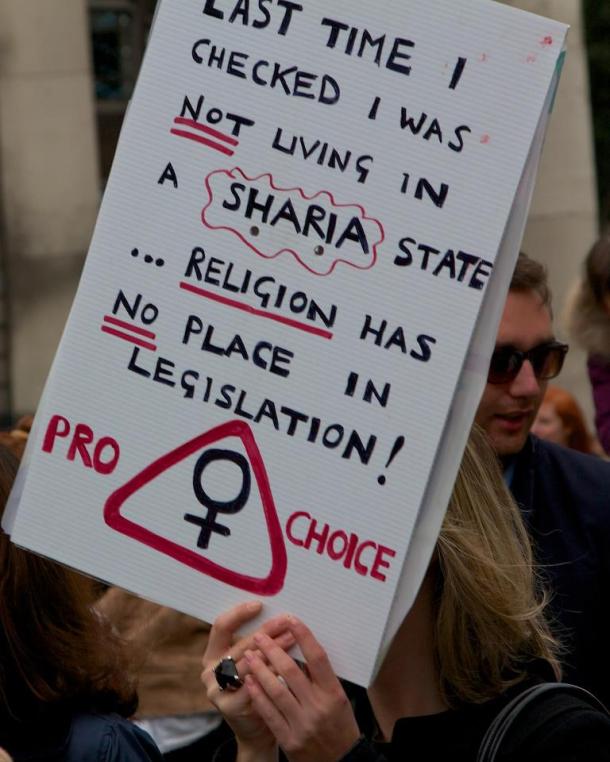
Islamophobia at Dublin’s ‘March For Choice’

Islamophobia at Dublin's 'March For Choice'

POSTER READS: ‘Last time I checked I was not living in a sharia state. Religion has no place in legislation! Pro choice”

I saw a picture of this poster in an album of Dublin’s prochoice march.

I don’t understand what the Sharia law has to do with Ireland, the main religion which is catholicism? Why couldn’t it say something about how Catholicism still dominates irish customs?

What does the Sharia law have to do with a catholic country? What’s it to do with Ireland not giving its people access to abortion and aftercare support?

Nothing at fucking all.

Just an excuse to criticize anything to do with islam and/or countries that practice islam. Just another excuse to remind people that there’s something apparently worse out there; sure shouldn’t Westerners be happy we aren’t like ‘those’ countries at least?

Fair enough if Ireland was an islam country whose laws are influenced by its religion which results in restriction to abortion, the poster would then make perfect sense. BUT the sharia law has nothing to do with Ireland so what on earth is the point of this poster exactly?

This sad belief that ‘The West’ is better and more civilized than those barbaric countries with their barbaric religions have got to stop. Dare I say that irritating phrase? ‘I can’t believe this still happens in 2012!’

Awful things happen in the west too; the West isn’t some magical land where all the good lovely stuff exists and all the terrible yucky, racist, sexist, restrictive-laws-influenced-by-religion-which-affects-women only exists in places outside the West.

Where did this idea come from that you should expect great things in a western country that doesn’t have sharia law and if a western country behaves like ‘those’ cultures with the crude religions, it’s something really REALLY bad? Get over this western imperialism, the west is no better in terms of treating it’s people with respect as anywhere else in the world.

I might as well make a sign that reads “Mitt Romney is a racist, legalize abortion now!” for all the sense it makes since some American dude in the US has nothing to do with Irish law and politics.

No one is saying there’s nothing problematic about Romney or the Sharia law but to derail a march to talk about something completely different is tacky and pathetic. I can write about some of the crude, uncivilized, tasteless, primitive things about Ireland- being a state that doesn’t have sharia law doesn’t exempt this country from the unfair ways it treats it’s citizens. Get it together.

Anti-Deportation Ireland launch

Posted on

(Note: In this post, I’ll be sharing things raised and spoken about at the ADI launch. Because of the risk this could pose to the people in question, however, I’m not going to give their names or any details about them unless I get explicit permission to do so.)

Anti-Deportation Ireland was officially launched on Wednesday morning. ADI is “a national, multi-ethnic grassroots network/alliance of activists, asylum seekers, refugees, community workers, trade unionists, and academics who have come together to campaign against forced deportation in Ireland, and for the abolition of the direct provision system.”. They have three demands:

  1. An immediate end to all deportations
  2. The immediate abolition of the direct provision system.
  3. The right to work for people seeking asylum.

So why these demands? How do direct provision and deportation work in Ireland, and why is it so important to end them?

Direct Provision

Direct provision is how asylum seekers’ basic needs- for food and shelter- are provided in Ireland. Asylum seekers are placed in hostels. Food is provided by these hostels. Because food and shelter are directly provided, the only money people are given is an allowance of €19.50 per week. Until people’s claims have been decided, they do not have the right to work or education in Ireland. The amount of time it can take for a claim to be decided varies hugely- people can spend years waiting for a decision.

Despite the name, direct provision isn’t, well, directly provided by the State. It’s outsourced privately, and because of this becomes a for-profit enterprise. Despite being outsourced, it’s unregulated. Can you see where this is going? People are accommodated three, four, five to a room, with different families sharing a room. The standard of food can be atrocious. Not only is it extremely bad, but in many cases utterly unlike what people are used to in their home countries. And because of direct provision, asylum seekers don’t have the facilities or the rights to even cook their own food.

Complaining about conditions is rarely an option. People who complain about overcrowding are told that they should be grateful that they are not homeless. That they’re taking up room that Irish homeless people don’t have- pitting two extremely vulnerable minorities in this country against each other.

Several people talked about raising their families in direct provision. One woman spoke of how one of her children is too young to remember anything else. How she doesn’t know the difference between a bedroom and a living room and a kitchen. How happy her child is whenever they leave the hostel, and how she hates having to go back ‘home’. Another speaker talked about the particularly Irish way in which cases of child abuse within hostels are dealt with. Perpetrators can be, in a cruel echo of so many other institutions in this country, simply moved from hostel to hostel. This is happening now. And those who complain are often moved themselves, without any right to protest, to other hostels around the country, disrupting any fragile sense of community they might have created where they are. People are denied the right to privacy, to cook their own food, to have a home where they feel safe and where they know how long they can stay.

Right to Work

As well as being forced to live in specific hostels, asylum seekers in Ireland are denied the right to work and education while their claims are being processed- which can take years. On the one hand, this is immensely wasteful. Ireland is in a recession! How many skilled, educated, qualified people are languishing in hostels unable to work, when they could be contributing to society? This also shows the lie of the idea that asylum seekers and migrants are ‘draining’ the system. These people are not permitted to work, even when they want to. On the other hand, years of enforced, stultifying idleness can be devastating for asylum seekers. Not being able to work means that people’s skills get rusty. Work and education are also two of the major ways that people integrate and find a place in communities. Direct provision and the denial of the right to work and study keep asylum seekers separate from Irish society. They mean that people can be here for years with no ability to put down roots and make a home. That Irish people don’t get to work and study beside asylum seekers. That we see asylum seekers as other.

Deportation

Asylum seekers, however, don’t just have to live with direct provision. They also face the constant threat of deportation. On World Refugee Day this year, the 20th of June, 18 people were deported from this country. Twelve of them were children. People are not deported during the day. They are taken from their beds in the middle of the night. When neighbours don’t notice. When people who could help them to appeal are out of work, are asleep. Without notice.

Several people spoke of the constant threat of deportation. About staying awake through the night, sacred this would be the night they’d be forced out. One speaker remarked that even criminals in prison in this country know what they have been sentenced to. They know how long they’ll be there. Asylum seekers don’t have even this security. Another speaker remarked that for asylum seekers, the normal rights accorded people by the legal system are turned upside-down. Asylum seekers are assumed guilty and lying until proven otherwise. The burden of proof is on them, and it is made incredibly difficult to prove themselves innocent. But, as several people asked, why would someone put themselves through this system without good reason? Why would they live like this, for years on end, if they didn’t absolutely need to?

Not okay.

Direct provision, night-time deportations, denial of basic human rights- these things are done by the state to asylum seekers. But as one speaker said, there is a thing line between a refugee and a citizen. Our government has shown that it is willing to trample basic human rights, to engage in a deliberate campaign to other and alienate a group of people. The ‘asylum seeker’ is constructed as scapegoat and a subject for deportation. As Irish people, we need to contest this construction. We need to reach out to people seeking asylum, to hear their stories, to share these stories every way we can. We need to bring the lives of asylum seekers into the light. As one speaker said, “No more secrets. No more lies. No more lying awake every night waiting to be taken away”.

More info on the launch at Cedar Lounge RevolutionPoliticoMillstreet.ie and Irish Left Review. Follow ADI on Facebook to find out more about what they are doing and how you can get involved.

Myself and Ariel Silvera also livetweeted this meeting. A summary of these is available here.

Originally posted on my personal blog, Consider The Tea Cosy.

Trans Health Forum

Posted on
TENI banner

On Monday, TENI, the Irish Transgender Equality Network,  hosted a trans health forum in the Civic Offices in Dublin. This forum’s purpose was to discuss the current context and situation of trans health in Ireland. It was divided into two parts. To start, TENI’s Vanessa Lacey presented some prelimiary results from the recent Trans Mental Health And Well-Being  Survey, which was carried out in July and August of this year, as well as a survey of HSE workers of their knowledge and opinions regarding trans health and working with trans people. After this, attendees were divided into groups to talk about different health issues facing trans people.

The results showed, above everything, the magnitude of issues that need to be dealt with, the impressive work being done largely by volunteers as well as paid staff, and the limits of what can be done without getting the wider community and health service providers on board.

The numbers here are stark. Preliminary results show that over three quarters of trans respondants have considered taking their own lives. Between a third and a half have attempted suicide, and most of these people have made more than one attempt.

And these, of course, are just the people who survive. Over 80% of respondants said that they had thought of ending their lives more before transition than during or after. Our society stereotypes and demonises trans people so much. How many more people would be here today if they had known that transition was a possibility? That meaningful, happy trans lives are possible here in Ireland? We don’t know. Researching suicide is notoriously difficult. But it’s certain that there are people whose lives would have been saved by transition, and that self-harm and suicide among trans people is a major health crisis right now. Something needs to be done. But what?

Discussions at the forum centred on three major areas- trans specific support groups and community, health service providers, and society as a whole. Each of these has its own part to play, as well as its own specific needs and issues.

Trans support groups and community has developed and expanded hugely in recent years, thanks in no small part to the work of TENI. There are now trans support groups, online communities, and social and lobbying groups working throughout the country. The trans community is more connected and visible than ever before. This kind of networking- going beyond simply support groups into forming real, deep community and connections, bringing in families, partners and other allies- was emphasised throughout the room yesterday. Because support and community groups are largely volunteer-driven, however, there are gaps in provision. For example, in many areas there is an age gap between youth groups and support groups mainly attended by older people. Consistent support is difficult to provide, since busy volunteers don’t always have the time and energy to keep up with running groups. Groups can hinge on the work of one or two people, and as people’s lives go on and they have other commitments, support groups can disappear. Keeping up long-term momentum is so difficult in what are often very small local groups. But these groups can be a lifeline.

Health services for trans people in Ireland are a mixed bag. While not everyone who identifies as trans goes through medical transition, for those who do it can be immensely important to their well-being. Unlike in the UK, there is no specific transition pathway in Ireland. We don’t have a gender clinic. There are very few medical professionals here who provide transition services. This means two things- firstly, many people have to travel long distances, taking time off of work or college to access services only available in Dublin. Secondly, a person’s ability to access these services, which may be urgently necessary, can depend on the whims of one or two professionals. There isn’t scope to get a second opinion, or to choose who you deal with. This means that regardless of the professionalism and ethics of the medical care providers involved, they have ended up in a gatekeeper position to transition in this country. This disempowers trans people, leaving them immensely vulnerable.

The lack of a dedicated clinic specialising in all aspects of transition in Ireland is also problematic. People not only often have to travel considerable distances to access medical care, but this is compounded by the different services being provided in different places. Some services, such as laser hair removal, are officially considered ‘cosmetic’. This means that people have to find trans-friendly providers  themselves, as well as paying out-of-pocket.

In addition to the lack of dedicated services and service providers outside Dublin, awareness of the transition needs of non-binary people was raised. Even professionals who deal with trans people can be stuck on a particular binary idea of gender as well as specific ideas of who trans people are and what medical pathways they will follow. Non-binary people often seek and need medical transition services too, though. Their needs- and their existence- need to be understood.

But trans people don’t only access medical care for transition-related treatment. They- of course- have to access general medical care as well, and these providers are often utterly unaware of how to deal with trans patients. Over 90% of HSE staff surveyed said that they’d received absolutely no training relating to trans people. They also reported that most of their contact with trans people was as rthe result of unprovoked attacks in public places. While a person might be normally capable of giving their doctors and nurses Trans 101, is it really okay that they would have to do this af ter being assaulted? That victims of assault then have to face even more stress, to have to worry about ignorance or transphobia in the A&E?

After trans communities and healthcare providers, the third group that needs to be educated on trans people is, of course, our society at large. Trans people don’t just show up from nowhere. We all live in local communities, go to schools and colleges, live in neighbourhoods, go to jobs. Trans kids growing up should know that there are other trans people out there, and so should the cis kids growing up with them. They need to know that they’re not the only one out there. The media have a huge role to play here in providing positive and varied non-stereotyped portrayals of trans people. Trans people are part of our society, and it’s time our society started acting like it.

To find out more, read Gaelick’s report on the forum. An overview of preliminary results of the Trans Mental Health and Well-being Survey is available at TENI.ie

Marching for Choice in Dublin

Posted on

Man carrying a sign with a picture of a coathanger and the words "Warning: Not for internal use".

It’s rarely easy to be openly pro-choice in Ireland. This country has no shortage of people willing to tell you how you’re a murderer, selfish, disgusting, a baby-killer. How you’re heartless. How you should be ashamed of yourself.

Woman with a poster saying "It's my uterus, I shouldn't need your permission"

The last major pro-choice demo I was at, two years ago, was a counter-demonstration to the March for Life. A couple of hundred of us, thousands of anti-choice marchers led by Youth Defence who didn’t hesitate to get in our faces, shout abuse at us, call us things I’m not going to repeat here. Being openly pro-choice can feel like running a gauntlet where you’re never sure what’ll happen next. So it’s not surprising that I was more than a little bit nervous before yesterday’s March for Choice. That nervousness, that apprehension, made what happened next even more incredible than I could have imagined.

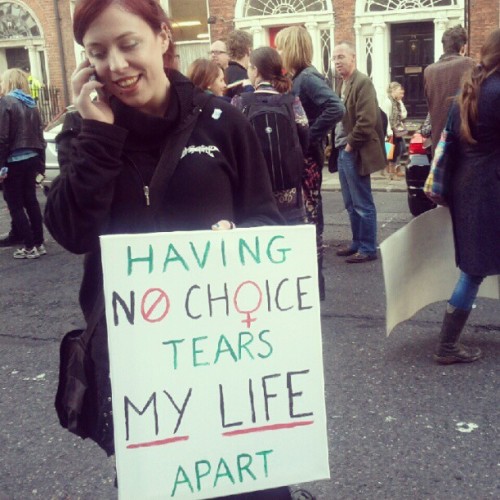
Woman on the phone, holding a sign saying "Having no choice tears MY life apart"

There were so many of us. Meeting at the Spire on Saturday afternoon, I couldn’t help but be amazed at how many people had showed up. I’d expected the usual suspects. There were, when I arrived early, hundreds and hundreds of us. And people just kept on arriving. And in these crowds of people was none of the usual tension of a pro-choice demonstration. As I walked through the crowd to check out what groups and banners were here and to say hello to friends I’d spotted, I heard so many people talking about the numbers. About how they couldn’t believe there were this many of us here. How they’d never seen so many people at something like this before. We were genuinely and collectively in awe at our numbers, here on O’Connell street. For the first time in my life, I felt that we might get somewhere with this. That we might really have some power to change things. Living in Ireland, it’s hard to truly explain what a truly big deal this is. How much of a revelation.

Woman with a sign saying "Against abortion? Don't have one!", pushing a pram with two children, with signs saying "I was a choice".

Walking through the streets, crossing O’Connell bridge, down Westmoreland Street and Kildare Street before turning up towards Merrion Square, it felt even more like a turning point. Here we were, chanting pro-choice slogans on the streets of Dublin, and the counter-demonstration was… where? I saw one man with a sign on O’Connell street. I saw no abuse from passers-by. And our numbers continued to swell.

Woman carrying sign saying "Woman, not Incubator"

In Merrion Square, the speakers were as varied and inspiring as the march itself. We weren’t on the defensive- we were on the offensive and proud of it. They spoke about how we won’t be shamed any longer. About how the majority of Irish people have consistently voted for women’s right to choose, and how we are fed up of being ignored. How if TDs want to follow God’s law and not the law of men (oh, how ironic), they should get out of Leinster house and join a seminary.

Woman carrying a sign saying "If I wanted the church in my *** I'd f*ck a priest!"

Feminist Ire’s Ariel Silvera spoke about the LGBTQ community and the pro-choice movement, arguing that we are natural allies. LGBTQ people need abortions too. Even if queer women don’t need abortions themselves, their sisters, daughters, mothers, and friends do. Ariel also highlighted the fact that it is not only women who need abortions. Many trans* men can get pregnant as well, and abortion providers and campaigners must be aware of their needs.

Man carrying a sign saying "My mother CHOSE to have me. I'm glad society didn't FORCE me on her!"

Mara Clarke from the Abortion Support Network spoke about her experiences raising funds for Irish women to access abortions they would otherwise never be able to afford. Banning abortion does not and never has prevented abortion. It just means that rich women can travel for abortions, and poor women are forced to give birth. The twelve women who travel to the UK every day for abortions are those who can afford it. The Abortion Support Network provides grants to Irish woman, and runs solely on private donations and fundraising. Needless to say, if you’re able to support them please do. Irish women should never be forced by lack of money to become mothers. Nobody should.

Woman carrying a sign saying "Fine Gael protects..." then with the words "Students, Pensioners, the Sick" crossed out, and then the word "Embryos"

But finances aren’t the only reason that people in Ireland could be forced to give birth against their will. The Irish Feminist Network‘s Osaro Azamosa reminded us that many immigrant women are simply not permitted to access visas to travel to the UK. These women’s reproductive rights are not only financially but legally denied by the current situation.

Woman holding a sign saying "Not just a white middle class issue: ethnic migrant women need access to abortion."

And so much more from Sinead Ahern, Ivana Bacik, Claire Daly- if I’ve left anyone out do tell me! And it wasn’t all about abortion. Pro-choice isn’t just about the right to choose abortion. It’s about full reproductive rights- and that means that right to reproduce free of coercion. For a real choice, women need to be supported to raise children without cutbacks to welfare. Without cutbacks to disability allowances for themselves and their children. Just as nobody should be forced to give birth because they can’t afford abortion, nobody should be forced to choose abortion because they can’t afford to raise a wanted child.

Man holding a sign saying "The Truth:In the UK, 78% of abortions are carried out under ten weeks. This is the result of an abortion at 10 weeks. Actual size. Truthfully. "

The Irish state needs to face up to its responsibility for the many thousands of women who have travelled overseas for abortions. It has a long-standing habit of brushing inconvenient women under the carpet- years ago to be incarcerated in Magdalene laundries, now on Ryanair flights to Britain. At yesterday’s march we came together to say that we are no longer going to accept this. We’re sick of being silenced and of our choices villified and shamed. We’re not going to accept being caricatured as heartless murderers anymore. We care deeply for the rights and well-being of all of us, for everyone in this country’s right to self-determination. And we’re not going to be quiet anymore.

Your post author holding a sign saying "Some of us can't leave this country! Whether illegal, trafficked, resident, refugee or asylum seeker- ALL ethnic migrant women deserve quality access to quality sexual health in Ireland. That includes ABORTION!"

Your intrepid blogstress weary and happy after the march.

On International Day to Decriminalise Abortion

This afternoon, for (I believe) the first time, the pro-choice movement in Ireland will mark the International Day for Decriminalisation of Abortion with a rally and march through Dublin city centre. It will begin at 2pm at the Spire on O’Connell Street and march to Merrion Square. I will be marching with the Choice Ireland contingent, and hope to see you Irish readers there.

I have reservations about the “Decriminalise Abortion” slogan. To decriminalise something means only the removal of criminal penalties for it; it does not mean that it becomes available, accessible or affordable. We can see this in the United States, where 40 years after Roe vs Wade decriminalised (most) abortions, access is still blocked for many women due to cost, burdensome conditions or simple lack of a provider in their area. If Ireland’s Offences Against the Person Act 1861 was repealed tomorrow, I doubt it would make much difference to the farmer’s daughter in County Leitrim, or to the asylum seeker in Waterford getting €19 a week.

That said, it would be remiss of me not to acknowledge that Decriminalisation Day was initiated by women in the Global South, not Ireland. I’m certainly not telling them how to campaign in their own part of the world. And there are tragic cases, like that of Rosa Hernandez in the Dominican Republic, where decriminalisation alone really might have made a difference. In no way do I wish to undermine the efforts of women fighting to prevent Rosa’s story repeating itself.

But abortion is a woman’s right, and we must be clear that it is a positive right to which we are entitled and not merely something that the law should not prohibit. Decriminalise it, of course. But let there be no mistaking that for our objective.

On a final note, I’d like to thank Youth Defence for their appalling recent billboard campaign, which has galvanised the Irish pro-choice movement like nothing in the past 20 years. Undoubtedly they’ll undercount our numbers this afternoon and proclaim our march much smaller than the last one they held. And it probably will be smaller than theirs. But the important thing is that ten years or even five years ago, there would have been half as many of us and twice as many of them. Those are the numbers that matter – and don’t think for a moment they don’t know it.

Seriously, read this post. It’s spot-on in every single way.

hunternotthehunted's avatarHunter Not The Hunted

So: recently, a young woman, Lucy-Anne Holmes, started a petition on Change.org aimed at getting The Sun to stop featuring topless Page 3 girls*. The Internet seems to have done its work well, because it’s been all over Twitter for days, with endorsement from such stalwarts as Caitlin Moran** & Graham Linehan, and is now claiming over 27,000 signatures. Many of the proponents of #nomorepage3 have made reference to feminism and the general well-being of women as justifications for the quasi-campaign. Even more baffling was when I saw sex educators, sex radicals and other generally sex-positive (by which I include sex-critical) folks endorsing it.

Therefore, I think there is an even greater need for countervailing opinions from the perspectives of feminists. Which, in this case, is me. Nobody ever said life was fair. But there are 2 things I’m not going to touch on: whether or not P3…

View original post 3,526 more words

Just Don’t Call It Slut-Shaming: A Feminist Guide to Silencing Sex Workers

Posted on

The feminist movement really is in a pickle these days. It used to be a given that things like prostitution, pornography and stripping were bad, but nowadays there’s some resistance to these time-honoured notions. Women are increasingly coming out as sex workers and demanding rights. As feminists seek to shut down strip bars and criminalise clients, those women are complaining not just that they’ll lose their livelihood, but that they’ll be at increased risk of abuse and violence if their industries go underground! You can’t let such trivial concerns get in the way of your crusade, so below are some handy tips for discrediting these pesky meddlers. Remember: being an actual sex worker doesn’t entitle her to speak about sex work!

I don’t believe you; you don’t realise the harm you’re doing to yourself

This is generally your starting point. There you are, explaining that no woman really wants to work in the sex industry, and then some bint pops up claiming that her existence proves otherwise! Aim for the ‘false consciousness’ tactic here: citing statistics from research that the audience doesn’t need to know has been widely criticised by academics, you can imply that you know better than she does what’s good for her. Bonus points for using a strategy also employed by opponents of abortion rights!

a) You think the sex industry is the best thing ever!
b) What you said just proved that sex work is bad!

Keep her on her toes: if the sex worker claims any degree of autonomy or job satisfaction, paint her as a naïve fool who believes that the entire sex industry is a magical fairytale land of flowers, rainbows and sparkly dildos. Your own points about abuses in the industry should outweigh anything she has to say, rather than combining the two to give the audience a greater understanding of the diversity of human experience.

On the other hand, if the sex worker at any point mentions having a bad day at work, outlines the safety precautions she takes, or even jokes about clients with smelly feet, be sure to pounce on this straight away as evidence of the inherent harm of the sex industry. Don’t budge an inch if she tries to point out that none of these things are unique to sex work. It’s different, because it’s sex. Got that? Soon enough, she’ll stop publicly discussing any problems related to sex work, for fear that you’ll use them to call for complete eradication. And once she’s shut up about them, you can safely return to point a). Genius!

You’re only concerned about losing business

Goddammit, what is with these people? You’re only trying to send a message about equality between men and women, and they’re raising hell about disrupted support networks and a rise in violence! But that’s okay. As long as you make them out to be purely motivated by greed, you needn’t actually address the issues they’re highlighting, let alone the reasons why they might need money in the first place. Bonus points if you’re able to employ this one against, say, an escort who’s concerned about the increased vulnerability of street-based sex workers. Don’t for a moment entertain the idea that there might be solidarity across the sex industry.

You’re being paid off by pimps and traffickers

This is a great one. It’s a bit preposterous, but if your audience has already lapped up everything you have to say, you can possibly get away with the notion that the only reason people might disagree with you is that they’re the sockpuppets of shady criminal masterminds.

You’re letting all women down

If, despite your best efforts, the audience seems in danger of accepting that your opponent genuinely chose sex work, experiences it as a relatively worthwhile pastime and, furthermore, has some points that might be worth listening to, quickly play your trump card: it’s not about her, it’s about all women.

Although, once upon a time, feminism was concerned with questions such as “Does lesbianism discredit the movement?” or “If I like painting my nails, buying shoes and sucking cock (for free, of course) am I letting the side down?”, these issues have largely been cleared up in the name of freedom of choice. Luckily for you, though, feminism on the whole does not (yet) look so kindly upon women whose choices include sex work. Keep it black and white and don’t let any nuance get in there. Base your argument here on claiming that the sex industry promotes negative attitudes to women – for bonus points, use objectifying language to describe sex workers while explaining that objectification is bad. You’ve already established that consensual paid-for sex is wrong, so a woman who willingly provides it is clearly a traitor to your gender. Under the guise of ‘love the sinner, hate the sin’, you can proceed to being as nasty as you like to those uppity sex workers: they didn’t listen to you when you warned they were making the wrong choice, so they’ve already forfeited their right to sisterhood.

You’re not representative

Feminism has fought long and hard to dispel stereotypes and push for more rights for all women. Cast that legacy aside for now and focus on the task at hand! You may be advocating a course of action that will affect everybody in the sex industry, but you can still get away with claiming that anyone who doesn’t like it simply doesn’t count. Plus, if you play your cards right, manage to keep the dissenters in their place, and get the law-makers to agree that your ideology is more important than women’s safety, eventually the sex industry really will become a wholly unpleasant place to be. Those who have the means to find other work will at long last understand that it’s time for them to do so, and the only people left will be the ones who were already having a hard time of it and have no alternatives. Then all sex workers really will meet your standards of ‘representative’! It’s a bit of a circuitous route, grinding down a diverse industry until it encompasses nothing more than a homogeneous group of abused victims of pimping and trafficking, with no agency of their own and uniformly miserable experiences. But by then, at least, everybody will be exploited and unhappy, just like you were saying they were all along. You’ll have proved your point. Congratulations, and thanks for your contribution!

The Irish trade union movement throws sex workers under a bus

The Irish Congress of Trade Unions is an umbrella organisation representing nearly all the active trade unions in Ireland, north and south. A full list of its member unions can be found here (by industry sector) or here (alphabetically).

ICTU has made a submission to the Irish government’s public consultation on the prostitution laws. As you can see here, where their submission is reproduced is full, most of it is just a cut-and-paste job of text sent to them by the Turn Off The Red Light campaign, which seeks the introduction of the Swedish model. But there is one part of ICTU’s original contribution which I found remarkable. A few paragraphs down the submission cites – clearly for the purpose of endorsing – the view of the Technical, Electrical & Engineering Union‘s General Secretary that

prostitution could not be considered “work”

ICTU didn’t invent this view, of course. But it strikes me as taking on a much graver significance when held by trade unionists than by, say, radical feminists or religious puritans. Because the corollary of prostitution not being work is, of course, that the people engaged in it aren’t workers – and are therefore not entitled to the rights that trade unions (theoretically) exist to defend. Effectively, what they’re saying to sex workers who want those rights is: piss off, and call us when you’ve found a real job.

This position puts ICTU at odds with the International Labour Organization, to which it is of course affiliated. While the ILO takes an officially neutral stance on the legal status of sex work, it has made abundantly clear that it recognises the sex industry as a de facto economic sector, and people who sell sex as engaging in a form of labour. In its groundbreaking 1998 report The Sex Sector: The Economic and Social Bases of Prostitution in Southeast Asia, for example, editor Lin Lean Lim proposes that

For those adult individuals who freely choose sex work, the policy concerns should focus on improving their working conditions and social protection, and ensuring that they are entitled to the same labour rights and benefits as other workers.

The international standards developed by the ILO also reflect this position – albeit impliedly rather than explicitly, in their frequent reference to “all branches of economic activity” (my emphasis). The 1981 Occupational Safety and Health Convention is an example.

And what about the jurisdictions which have actually incorporated those standards into their own laws around sex work, such as New Zealand?

Abel, Fitzgerald and Brunton, “The Impact of the Prostitution Reform Act on the Health and Safety of Sex Workers” (2007)

The phenomenal figures in the last three rows of that table are the consequence of legislation which was expressly designed to treat sex work as work – legislation, in other words, designed to do exactly what ICTU says the law shouldn’t do. And thus ICTU, which is a trade union body hence theoretically a workers’ rights organisation, would reject a framework agreed to be rights-protective by over 90% of the workers operating within it, because they don’t consider them “workers” to begin with. ICTU policy would take those rights away from them.

I’ve been racking my brain trying to think of a parallel to this extraordinary situation, and I’m honestly stymied. Even considering the obvious context – disapproval of prostitution as a matter of principle – I can’t think of another sector in which the “solution” would involve the wholesale rejection of labour rights for those involved. I cut my political teeth in anti-war and anti-nuclear campaigning, and I don’t recall anything remotely comparable to this. We may have wanted to decommission the bases and power plants but we never said labour law shouldn’t apply to people working at them.

Nor can ICTU’s position be justified on the basis that sex work isn’t really a choice. The term “work” may be deemed inappropriate for actual forced labour, the labour of someone who is literally enslaved – but ICTU, like all but the most fanatical fringes of the anti-sex work movement, don’t seem to think that most in the sex trade fall into this category. Instead, their submission refers to the “poverty, past history of abuse or limited life choices” that push people into prostitution. But ICTU don’t see it as “not work” when poverty and limited options push people into unappealing jobs outside the sex sector – and they would never dream of opposing legislation to give those workers labour rights.

In some respects, this betrayal isn’t really a surprise: the Irish trade union movement has a long history of selling out Irish workers, especially those at the margins. (They also have a history of an undemocratic, top-down style of leadership which seems to be reflected here as well: nobody I know in any of the ICTU-affiliated unions was asked for their opinion of this submission before it went in.) But summarily excluding a whole sector of the economy from their remit, and refusing to defend the labour rights of the (particularly vulnerable) people dependent on it? That’s a new low for them, and it’s a shocking one.