RSS Feed

Tag Archives: Ireland

Human trafficking in Ireland, 2011

Posted on

The Irish Department of Justice’s Annual Report of Trafficking in Human Beings in Ireland for 2011 was published recently and I’ve now had a chance to look it over. As you’d probably expect, the coverage of it has been pretty superficial, but that’s not entirely the journalists’ fault: it’s a pretty superficial document, which leaves a lot of really important questions unanswered. That said, no one’s exactly asking them, either.

So here are my thoughts about what this report tells us – and doesn’t tell us – about human trafficking in Ireland in 2011. First, a bit of context. Trafficking is prohibited under the Criminal Law (Human Trafficking) Act 2008, which you can read here. Sections 1-4 are the parts that set out the definition of the offence, and if you don’t mind a bit of legalese it’s interesting to compare them to the international definition set out in the Palermo Protocol on trafficking, which we finally got around to ratifying two years ago. The Irish statute is much wordier, which is entirely typical of domesticised versions of international law: the latter are typically aspirational, unenforceable and constructed through compromise, so detailed definitions are usually neither necessary nor (from a state’s perspective) desirable. The former, however, are the actual law in a country and so need to be drafted with precision.

Length aside, there are three differences I want to focus on between the Irish and international definitions. These are differences in how the two texts deal with what I’ll call the “what”, “why” and “how” of trafficking. The “what” difference is really just technical: in the Irish law (Section 1), “trafficking” itself is a neutral term and is not an offence per se. If you give someone a job, or a place to live, or put them on a bus to another county, you’ve trafficked them. It becomes an offence only if you do these things in a certain way (the “how”) and for a certain purpose (i.e. exploitation, the “why”), which I’ll get to shortly.

By contrast, under Palermo “trafficking” is defined by the simultaneous presence of the “what”, “why” and “how”, so trafficking must always be a crime. I’m not sure that this difference has any practical significance (the Irish statute’s broad definition has no relevancy outside this Act), but it’s one of those things that law nerds like me get excited about.

The second difference, which is much more important, is the restriction that Irish law places on the meaning of “exploitation” (the “why”). Palermo states that

Exploitation shall include, at a minimum, the exploitation of the prostitution of others or other forms of sexual exploitation, forced labour or services, slavery or practices similar to slavery, servitude or the removal of organs…

The Irish law, on the other hand, spells out what “other forms of sexual exploitation” are included, and draws out (without really adding anything) the non-sexual labour provisions, crucially omitting Palermo’s “at a minimum” phrase. So whereas in international law a highly abusive practice with all the other elements of trafficking could conceivably qualify as such without fitting into any of the specified types of exploitation, in Ireland at least one of the boxes has to be ticked before the exploitation can be deemed to amount to trafficking. This isn’t a criticism of the Irish law; if it did include an “at a minimum” phrase, it could probably never be used or a person convicted under it would have a constitutional challenge for vagueness. But it helps to explain why it can be so difficult to show exploitation amounting to human trafficking, even where exploitation in the everyday sense is obvious.

The final key difference is similar; it’s the way the two texts define the “how”. In the Protocol, it’s

by means of the threat or use of force or other forms of coercion, of abduction, of fraud, of deception, of the abuse of power or of a position of vulnerability or of the giving or receiving of payments or benefits to achieve the consent of a person having control over another person

Here, too, there’s a catch-all that can potentially encompass a very broad range of circumstances. It’s the clause about “abuse of power or of a position of vulnerability”. A person with limited migration and/or employment options is almost by definition in a position of vulnerability; a person with the ability to facilitate or deny them access to those options is by definition in a position of power. What constitutes “abuse” is not defined, and is therefore open to a wide degree of interpretation (and ideological spin).

The Irish law adds a significant qualifier to its version of this clause: under Section 4(1)(c) of the 2008 Act, abuse of this type is only sufficient to bring about a trafficking charge if it

cause[d] the trafficked person to have had no real and acceptable alternative but to submit to being trafficked

So, in Ireland the abuse has to pretty much reach the level of coercion before the law is breached. This is pretty clearly an intentional narrowing of the Protocol’s definition, and gives rise to what could be an important question in adjudicating trafficking cases: who decides what is a “real and acceptable alternative”, and how?

Where children are concerned, both the Protocol and the Irish law have a similar feature in that they both disapply the “how” provisions: as long as the “what” and “why” are present, the child has been trafficked. And the Irish law adds a few things to the “what” of child trafficking. I’ll come back to this later.

So after that rather lengthy introduction (I didn’t actually think it was going to be that long when I started it, apologies) let’s move on to the actual report. We’ll begin with the statistics since that, unfortunately, is what people are usually most interested in. Page 8 has a table summarising the data on victims reported to the Department by the Irish police, An Garda Síochána:

Then on page 17, there’s a table of the victims reported to the Department by NGOs:

A couple important things here. First, the report states that the figures in the first table should be assumed to largely include the figures in the second table, although the Department’s Anti-Human Trafficking Unit didn’t collect personal data on the victims so couldn’t be entirely sure.

The second important thing is that these are all reported – not confirmed – victims. In the first table, they are persons whom the police investigated as possible trafficking victims. In the second table, they are persons whom the NGOs (according to page 6)

believed exhibited indications of having been trafficked

In a similar vein, that strange “uncategorised exploitation” category in the first chart is explained on page 3 to mean that

while at the time of reporting there were general suspicions that these persons could be victims of human trafficking there were no firm indications that either labour or sex trafficking had occurred

.

So regard must be had to the possibility that in some of these cases there actually was no human trafficking. And the figures, of course, do not take into account those cases that were never detected or reported at all. As with every other human trafficking report in every other country, it is really a record of human trafficking (and alleged human trafficking) reporting, rather than being a record of human trafficking itself.

Page 10 gives a breakdown into age category, cross-referenced with exploitation category. Unfortunately all under-18s are lumped under the heading of “minor”; it would be useful to have more information on where the 7 reported child victims of sexual exploitation and 4 child victims of labour exploitation (plus one each of “both categories” and “uncategorised”) fell on the age scale. It’s all the same legally, of course, but I think there are few people who don’t recognise some kind of difference between a 17-year-old and a 7-year-old – at the very least they would call for rather different preventive approaches.

In terms of the child sexual exploitation, recall what I said above about the broad definition of “trafficking” where children are concerned. Just this week we had this case, in which a man was charged with attempted child trafficking after pulling a girl off her bicycle with the aim of abducting and raping her. A horrific crime, to be sure, but not exactly what most people think of when they see headlines like this. Those who are tempted to see those 13 reported victims as evidence of a growing problem of child trafficking (as it is commonly understood) should bear in mind that some of them may have actually been victims of a type of abuse we’re much more familiar with in Ireland.

Page 11 gives a breakdown of region of origin, and there’s no surprise here: around two-thirds were from outside the EU, which in most cases means they had very restricted, or no, access to the legal labour market. This, as I’ve discussed repeatedly, is a major risk factor for trafficking (both for sexual and non-sexual exploitation). Six of the reported victims were Irish, and the article linked to in the last paragraph says that they were all underage although I can’t find that in the report. Nine were EU citizens, but we don’t know from where – and this is very important, because it too would affect their access to the labour market (Romanians and Bulgarians, remember, are still generally excluded).

Page 14 gives their immigration status:
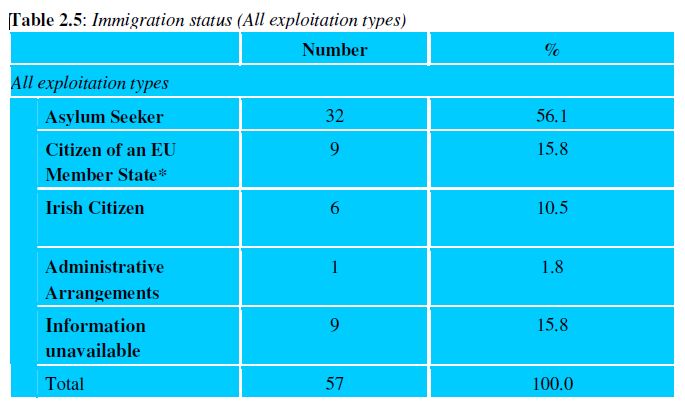
Under the table is this footnote:

Please note that the reported immigration status reflects the status of persons at the time the information was provided to the AHTU and not when persons were reported to An Garda Síochána.

So with the presumed exception of the EU/Irish citizens, we have absolutely no idea what status the victims entered the country with, or what their status was at the time they were being trafficked within Ireland. That’s a shame, because it would be useful to know whether they’re coming in as asylum seekers, on work permits or bypassing border controls completely (by, for example, crossing the land border with the North). It would also be useful to know how many of them entered the asylum system after being trafficked because the possibility of refugee status offers them their only hope for remaining in Ireland.

On that note I’ll turn to the figure for “Administrative Arrangements”: this is the status for people who have been recognised by the police as victims of trafficking, and allowed to remain for a “reflection and recovery” period. At first glance it seems striking that only one person out of 57 has been granted this status. But there are a couple things worth bearing in mind. First, the main effect of the AA status is to give (limited) protection against deportation – so it doesn’t in any case apply to Irish and EU citizens, who have their own protections already. Thus it’s really one person out of 42. More significant are the figures on page 26, on the “Criminal Justice response to human trafficking”. This states that trafficking investigations are still ongoing in 32 cases (out of a total of 53 – some of these cases account for more than one of the 57 victims); in one case the claim was withdrawn; and in 6 they couldn’t find enough evidence to show that any trafficking took place. In such circumstances, the grounds for recognition really aren’t there. So now we’re down to one person given AA status out of 14 confirmed trafficking cases (that’s assuming that those 14 actually are “confirmed”, which isn’t explicitly stated on page 26 but seems to be the implication). And we don’t know how many of these 14 victims were Irish or EU citizens and so not entitled to AA status anyway. There were 15 reported Irish/EU victims in 2011, so conceivably it could be all of them. On the other hand, it could be none of them. Without better data, we don’t know – but we shouldn’t jump to knee-jerk conclusions based on one quick glance at the overall numbers.

The final thing I want to look at is the breakdown of cases reported by NGOs, by exploitation category and gender. Page 17 states that 22 of the 27 NGO cases were sexual exploitation, and one was labour + sexual. Page 19 says that all of the 27 were female.

It would be easy to cynically assume from this that Irish NGOs just aren’t interested in labour exploitation or in male victims. And, in fact, two of the four reporting NGOs do only deal with sexual exploitation, and one of these only works with women. But the Migrant Rights Centre Ireland, for whom I have huge regard, focuses pretty much exclusively on labour exploitation and takes a gender-neutral approach. And in fact, only a day or two after this report appeared, the MRCI were quoted on the evening news as saying they’d found something like 167 cases of forced labour in the past few years (I can’t find a link to this news broadcast, so you’ll have to take my word for it). So why did they only report 4 cases of labour trafficking last year?

I don’t have a definitive answer to that question, but I can think of a possible explanation. Quite simply, the Migrant Rights Centre exists to promote migrant rights. And human trafficking is not a rights-based concept. It should be, ideally, but trafficking law as conceived at both national and international levels is fundamentally a criminal justice instrument, aimed more at punishing perpetrators than protecting victims.

From this perspective, the Administrative Arrangements would be problematic even if they were liberally applied. Their main purpose (as you can read here) is to facilitate trafficked persons in assisting police with their inquiries. If and only if the person agrees to do so, they will be given temporary residence permission, but it’s clearly envisaged that eventually (i.e., when the investigation is complete) they’ll be repatriated.

That’s great if you’re one of the (very small percentage of) trafficking victims who was forcibly removed from your home country, and you want to return. It’s great if you left home voluntarily but have since decided that you want to return. It’s great if you harbour such (justifiable) ill will toward your traffickers that your paramount concern is to see them punished for their crimes. But if you just want to get on with your life and achieve the goals that you came to Ireland for in the first place? Not so much.

Since the MRCI deals only with victims of labour exploitation, it’s likely that a lot of them would have arrived in Ireland on a work permit. Although a work permit is valid in respect of one employer only, the stated Department of Jobs, Innovation and Enterprise policy is to allow a change of employer in cases of exploitation. (It’s questionable how well this policy is actually adhered to, but at least it’s an option on paper.) Unlike the Administrative Arrangements, a work permit offers a path to long-term residency and citizenship. Why, then, would a person who was subjected to forced labour – at least one who had a work permit to start with – want to pursue it as a trafficking case? There seems to be very little in it for them.

I could be entirely off base here, but even if this isn’t MRCI’s reason for not reporting forced labour cases as trafficking, it’s still a valid concern. The trafficking laws have little or no benefit for trafficking victims who entered the country on work permits – and by the same token, the DJIE policies which do benefit those victims (when they’re actually applied) are not an option for most people trafficked for sexual exploitation. Some researchers lament that victims of forced labour are much less likely to be considered “trafficked”, but it seems in Ireland they might be better off that way.

I said earlier that this is a report about reporting, so perhaps it’s fitting that one of the only things it strongly suggests is that Irish law discourages certain reporting. It’s hard to draw many other conclusions from the report. Trafficking itself is unmeasurable, but the very limited data provision here really doesn’t help us much in understanding what’s going on. Researchers and activists in this field should demand better information, rather than simply seizing on largely meaningless numbers which make easy headlines while actually telling us nothing.

Children’s rights must not mean women’s wrongs

Posted on

Last month the Irish Minister for Children, Frances Fitzgerald, announced that the long-promised referendum on the rights of children would finally be held this year.

The background to this lies in the following provisions of the Irish Constitution:

Article 41
1. 1° The State recognises the Family as the natural primary and fundamental unit group of Society, and as a moral institution possessing inalienable and imprescriptible rights, antecedent and superior to all positive law.
2° The State, therefore, guarantees to protect the Family in its constitution and authority, as the necessary basis of social order and as indispensable to the welfare of the Nation and the State.

3. 1° The State pledges itself to guard with special care the institution of Marriage, on which the Family is founded, and to protect it against attack.

Article 42
1. The State acknowledges that the primary and natural educator of the child is the Family and guarantees to respect the inalienable right and duty of parents to provide, according to their means, for the religious and moral, intellectual, physical and social education of their children.

5. In exceptional cases, where the parents for physical or moral reasons fail in their duty towards their children, the State as guardian of the common good, by appropriate means shall endeavour to supply the place of the parents, but always with due regard for the natural and imprescriptible rights of the child.

The proposed referendum, as agreed by an all-party parliamentary committee, would leave Article 41 intact but remove those two subsections of Article 42. The replacement text is rather lengthy so I’ll just provide a link rather than post it all here.

The impetus for this change comes from a series of judicial and policy decisions, which have been seen as making it so difficult to interfere with the sacred institution of The Family (and more particularly the marital family) as to effectively tie the State’s hands when it comes to child protection and welfare. A few examples:

  • The 2001 case Northwestern Health Board v HW, where the Supreme Court upheld the right of parents to refuse to allow their child undergo the PKU test, a totally safe procedure to detect a disorder that leads to brain damage if untreated.
  • An unspeakably horrible case of familial abuse in County Roscommon, revealed a little over a year ago. You can Google it yourself, I don’t have the stomach for it. The mother had obtained an injunction preventing the children being removed from the family home; her affidavit cited the rights that she and her husband, as a married couple, had over their children. Social workers on the case confirmed that Article 42 had a sort of chilling effect on their efforts to protect the children, as it led them to believe they would need to prove a nearly impossible threshold of neglect.
  • The 2006 “Baby Ann” case (N v Health Service Executive), in which a two-year-old girl was ordered returned to her birth parents. They had consented to her adoption, but changed their minds and subsequently married – at which point, according to Justice McGuinness, the rights of the family took over from the best interests of the child as the “central issue”. (Actually, on the peculiar facts of this case the birth parents would have had a decent argument even without the constitutional imperative, but there are obvious reasons to be concerned about the court’s emphasis on the primacy of the marital family.)

So you can see why there’s widespread support for amending the Constitution to specifically enshrine the rights of children. What little opposition there is is mainly coming from two of the most repellent groups in Irish society: the xenophobes, who fear the amendment being used to prevent deportation of Africans with minor children; and the uber-Catholics for whom any interference with the marital family is anathema. (It hasn’t gone unnoticed that the list of amendment opponents reads like a Who’s Who of the Irish anti-abortion movement – whose concern for the rights of children clearly ends at birth.) Ironically, although the latter group is far more organised and politically powerful than the former, it is the deportation issue that is actually holding the referendum up. I was present at a private meeting a couple years ago where a then-Cabinet Minister, a current Cabinet Minister and a backbench member of the other current government party all agreed that the wording would have to be changed to assuage those fears.

Irish feminism, on the other hand, seems to be pretty much entirely behdind the amendment, and that’s fairly understandable. After all, the primacy of the marital (read: patriarchal nuclear) family hasn’t exactly done us many favours; and while the amendment won’t remove Article 41.1, it clearly will narrow its scope. But while I wouldn’t argue that we should vote “no”, I do think some important issues have been overlooked in the debate. Consider the following:

  • In 2006, the High Court ordered that a Jehovah’s Witness be given a blood transfusion (subscription required) contrary to her express wishes, the first time this was done to a competent adult. Counsel argued and the Judge accepted that her child’s need for a parent overrode her right to refuse medical treatment.
  • In the US, women have lost custody of their children for working outside the home, being lesbians and even reporting domestic abuse.
  • According to a representative of the fabulous Association for Improvements in the Maternity Services Ireland who I was speaking to recently, some Irish women have been threatened with prosecution – yes, prosecution – if they insisted on giving birth at home rather than under the full control of the professional (and strongly male-dominated, and extremely paternalistic) medical industry.

What these cases all have in common is that they’re examples of the “best interests of the child” being used to further a patriarchal agenda, in which motherhood automatically strips women of their autonomy. Make no mistake about it, this isn’t just the standard assumption of self-sacrifice that having children always entails; it’s the quite deliberate channeling of women with children – whose primary identity is now “mother” – into tightly prescribed roles, with the legal system there to act as enforcer.

I’m being a bit deliberately melodramatic here and I’m not suggesting that passage of this amendment will actually turn us all into Stepford wives. But I don’t think we should be complacent about the risk of “children’s rights” becoming another tool of state misogyny. Let’s not forget that this is a state where woman’s primary role as housewife and mother is actually enshrined in the Constitution (Article 41.2, for readers abroad). Do you trust all of our judges to read the new amendment in a way that protects children’s rights without trampling on women’s? I don’t.

I’m also uneasy about the way this amendment could be read in juxtaposition with Article 40.3.3, on the right to life of the “unborn”. Judging by some of the cases coming out of the US at the moment, it seems that pregnant women in some states might be only a few years away from being forcibly institutionalised to prevent them doing anything that might possibly lead to the birth of a less-than-perfectly-healthy baby, such as having the odd glass of wine or eating too much junk food. It’s a strange sort of logic that allows women to be penalised for “neglecting” foetuses that they have every right (at least on paper) to abort, which I suspect is why those laws aren’t more widespread throughout the US than they are. Here, of course, the constitutional position on abortion is no impediment to such laws – and with a mandate to protect both the rights of (actual) children and the rights of the “unborn”, there is, I think, a worrying possibility that this American trend could catch on here.

Again, and just to be perfectly clear, I’m not saying that feminists should oppose the amendment. In all likelihood I will vote for it myself, on a simple cost-benefit analysis (as in, I think overall it will probably do more good than harm). And I don’t have any suggestions as to how it could be worded to avoid these nightmare outcomes, especially while the odious Articles 40.3.3 and 41.1-2 remain. But we shouldn’t be leaving it to the racists and religious fanatics to highlight its possible unintended consequences. We should be putting the State on notice that although we want to see better protection for Irish children, we are not going to tolerate it becoming yet another tool to oppress Irish women.

On surrogacy, slavery and choice(s): My response to Breda O’Brien

Posted on

Breda O’Brien is a conservative Catholic and columnist with the Irish Times, notable for her resolute adherence to church doctrine in all matters reproductive. She has become notorious for crackpot columns like this one, a response to the horrific case of the 9-year-old Brazilian girl who was raped and impregnated with twins by her stepfather and whose mother and doctors were excommunicated after getting her an abortion. (Her rapist, quite tellingly, was not.) The column is behind a pay wall, but to summarise, O’Brien’s response was first to grab her own 10-year-old daughter and put her on a scale to compare her weight with that of the Brazilian girl, and ultimately to proclaim that if the same thing happened to her own daughter the pregnancy would be carried to term.

Last Saturday she wrote this piece, which I hope can still be read without subscription. It’s an attack on surrogate motherhood, which she condemns as “just another form of slavery” and wants to ban, although she does not clarify exactly what form this ban would take. The clear implication of her column is that surrogacy is something only done by desperately poor women in the developing world, which isn’t actually true; here, for example, is the website of a Canadian woman who seems to have become a professional surrogate and encourages others to do the same. I don’t think she’s aiming her “Information on how to become a surrogate mother” at Kolkata slum-dwellers – but even if she was, the possibility that they might rationally consider surrogacy a better option than their alternatives is one that O’Brien simply cannot fathom.

I sent a response to the Irish Times but, true to form, they didn’t print it. In fact, they haven’t printed any replies, which is unfortunate (I can’t believe mine was the only one). This is an increasingly important issue – not least because of the gap in Ireland’s laws which means that some children produced through surrogacy are ending up stateless – and as Ireland’s paper of record, the Times has a responsibility to facilitate debate on it and not to simply print one side of the argument and leave it at that.

Anyway, here’s the response that I wrote.

Breda O’Brien raises a valid point about the potential for exploitation of women as surrogate mothers, although her invocation of slavery to describe what is more likely to be a preference among limited options is unfortunate. Real slaves do not get to make even constrained choices.

It is not clear, however, why surrogacy should pose any greater legal dilemma than adoption, which O’Brien seems to believe should be not only legal but mandatory when a woman has an unwanted pregnancy which she would otherwise abort. Is it not also a form of surrogacy to compel a woman in this circumstance to bear the child for the benefit of another woman?

Furthermore, O’Brien is silent about exactly HOW Ireland should make surrogacy illegal. Would she criminalise a woman who becomes pregnant on behalf of another? Would she force such a woman to become the legal mother herself? Or would she simply deny Irish couples the right to recognition as parents of a child born through surrogacy, leaving the child and birth mother to whatever fate awaits them under the laws of their own country (in the hope this will never be Ireland)?

Finally, O’Brien fails utterly to address what will happen to the women who become surrogate mothers due to lack of other options. Those who use protection from exploitation as a reason to deny a source of income to persons in poverty have a responsibility to outline how they expect those persons to compensate – now, not in some future utopia where there are adequate alternatives available.

Why can’t a woman get a life-saving abortion in Ireland?

Ireland has produced many brave and influential women whose lives have helped change Irish society, but it’s a tragic irony that one of those who’s had the biggest impact – and sparked the longest-running controversy – is someone whose name we don’t know, who was only 14 when she came to our (and the world’s) attention and who you can bet would have given anything to have never been heard from in the first place.

She’s known as Miss X, and 20 years ago she was raped and impregnated by a much older family “friend”. Ireland is still governed by 1861 (!) legislation which makes abortion a crime punishable by life imprisonment, so her parents took her to England. When they contacted Irish police to ask if the embryonic remains might be useful as evidence, the police contacted the Attorney General, who promptly sought an injunction to compel her to return to Ireland and remain for the next nine months.

This astonishingly cruel and repressive act was “justified”, according to the Attorney General, by Article 40.3.3 of the Constitution. Passed by referendum in 1983, the Article reads:

The State acknowledges the right to life of the unborn and, with due regard to the equal right to life of the mother, guarantees in its laws to respect, and, as far as practicable, by its laws to defend and vindicate that right.

Miss X, however, was threatening suicide if she was forced to bear her rapist’s child and so her lawyers argued that her own right to life – also protected by Article 40.3.3 – was engaged. In the High Court, Justice Declan Costello (who was eulogised on his death last year for his commitment to social justice) applied a crude balancing test to reach his decision: if Miss X was forced to continue the pregnancy, she might die, but if she was allowed an abortion the foetus would die. He thus granted the injunction barring her from travel.

On appeal, the Supreme Court took a different approach: a majority deemed abortion permissible under Article 40.3.3 where it is established, as a matter of probability, that there is a real and substantial risk (not necessarily an immediate or inevitable one) to the woman’s life. The risk of suicide, it held, fell within these exceptional grounds.

The government responded to the decision – and the controversy engulfing Irish society – by putting three more referenda to the people (the Irish Constitution can only be changed by referendum). One would have overturned the X decision to the extent that it deemed suicide a risk entitling a woman to an abortion. The second would clarify that Article 40.3.3 did not impinge on the freedom to travel outside the state – a necessity since a majority of the Supreme Court had also felt that the rights of the “unborn” would supersede the right to travel where there was no risk to the pregnant woman’s life. The third aimed at resolving another ongoing controversy, allowing information to be made available about legal abortion services outside the State.

The Irish people voted sensibly, around two-thirds defeating the first referendum and slightly smaller majorities passing the other two. This still left the State with one of the most restrictive abortion laws in Europe, however – and the cowardice of successive governments, in refusing to legislate for the decision, means that 20 years on we still don’t know exactly what it means in real terms. How is it to be determined whether a pregnancy poses a real and substantial risk to life? Who gets to decide? And what remedies are available to a woman denied an abortion despite believing she falls within the criteria set out in X?

There are no answers to these questions – and the consequences for some women are dire. In 2010, a woman named Michelle Harte from County Wexford, a cancer patient, was advised by her doctors at Cork University Hospital that she should have an abortion because of the threat posed by her pregnancy. However, the hospital ethics committee – which apparently did not read the X judgment very carefully – overruled this advice, deeming the risk to her life insufficiently “immediate”. The identity of those on this “ethics committee” is unclear, but it is stated to include a number of non-medical people, including some with “theology and philosophy backgrounds”. What kind of bullshit policy allows theologians to overrule doctors’ decisions about the medical risk to someone’s life?

Another woman harmed by the lack of legislation in this area is known to us as “C”. She was one of three plaintiffs who challenged Ireland’s abortion laws before the European Court of Human Rights, which found in her favour (although not in the other two’s) in December 2010. In a ruling that was entirely predictable after the 2007 Tysiac v Poland case, the ECHR held that Ms C’s Article 8 (private and family life) rights had been breached by the State’s failure to make abortion actually available in the extremely limited circumstances where it is legal. (Ms C, like Michelle Harte, was a cancer patient; she testified that she could not even get medical advice on the risks posed by her pregnancy, such was the chilling effect of the anti-abortion criminal law.)

The State is obliged to abide by the rulings of the ECHR (although there is little in the way of enforcement mechanisms) and so, as a practical matter, it has one of two options. It can either amend the Constitution to remove the “due regard to the equal right to the life of the mother” clause – thereby making abortion illegal even to save a woman’s life – or it can set out a clear and transparent mechanism, with a proper appeals procedure, for women who believe they meet the X criteria.

To readers outside Ireland, the fact that this even poses a dilemma for the government must seem indescribably bizarre – something you might expect to find in the Taliban’s Afghanistan or Khomeini’s Iran, but not in an ostensibly modern, advanced OCSE country in northwestern Europe. And in fact, it’s pretty bizarre to us too. A referendum to remove the right to a life-saving abortion hasn’t a hope of getting past an Irish public that believes by almost nine-to-one that such abortions should be legal. It’s notable that in the two referenda that have attempted to roll back the X decision – the one immediately following the judgment in 1992, and a second one a decade later – it was only the eligibility of potential suicides that was at issue; the possibility of taking the right away from women facing other risks to their lives, women like Michelle Harte and Ms C, wasn’t even contemplated. Why on earth would it be contemplated now?

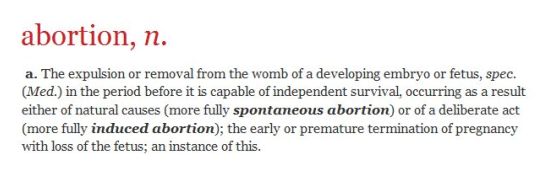
And so, as Choice Ireland noted several months before that predictable ECHR decision, the Irish anti-abortion movement have taken a different tack: they’re now picking a fight with the English language. In regular ludicrous press releases and columns like this one, they’re trying to convince a (not-buying-it) public that there is no need to protect the right to a life-saving abortion, because there is no such thing as a life-saving abortion, because – wait for it – it isn’t really an “abortion” if the purpose is to save the woman’s life. It’s a “necessary medical procedure”, or something to this effect. Which just happens to end in the death of the foetus or embryo. Got that?

Now you know, and I know, and anyone who’s ever opened a dictionary knows, that that’s a load of rubbish and there’s not a chance of the law being changed to reflect it. But what the hardcore anti-abortion movement lacks in logic and public support, they more than make up for in political power. Quite simply, the major political parties in this country are scared shitless of them – and I mean all the major political parties, not just the two right-wing ones (Fianna Fáil and Fine Gael) that have consistently pledged not to legislate for the X case. The two next-largest parties, Labour and Sinn Féin, both support the right to abortion in life-saving and a couple other scenarios, but neither trusts a woman to make up her own mind about the decision. In fact, prior to the last election (which returned five members of the United Left Alliance), there was not a single pro-choice party in the Irish parliament. And even the ULA declined to campaign on the issue during the election, although to their credit they’re starting to make up for that now.

A consequence of this hold that the foetalists have over politicians is that more than a year after the ECHR decision (and, of course, twenty after the X case) we’re still waiting for implementation. And we’ll be waiting a while more. The government “met” its obligation to tell the ECHR how it was going to implement the decision by stating that it would establish an “expert group” to consider how to implement it. Just telling that to the ECHR took six months. It took another seven to announce who was being appointed to the group and the group’s terms of reference. The group’s conclusions are to be reported back to the government in a further six months. What happens then is anyone’s guess.

There are a lot of aspects of this story that I find sickening, but perhaps none more so than this: we in Ireland are in the midst of several years of austerity budgets, which this and the last government have justified by saying they need to make “hard decisions”. So they have made the hard decision to cut income supports for working and unemployed people, lone parents and those in need of extra assistance to care for the children they have. They have the made the hard decision to impose new stealth taxes and increase VAT, all of which will have a disproportionate negative impact on those already struggling to cope. They have made the hard decision to cut funding for community and support services for low-income women and families, and to combine the Equality Authority and Human Rights Commission into a single (and even weaker) body at precisely the time when discrimination against pregnant women and new mothers is increasing. So, the Irish government has no problem making the hard decisions that hurt women and families, and the hard decisions that make it more likely that some pregnant women will seek abortions. But legislating to ensure that a woman who might die without an abortion can get one in Ireland?

It seems that’s a hard decision too far.

Please go here for information on the Action On X campaign, or email actiononx at gmail dot com

On labour law, human trafficking and the strange silence of advocates

Last week, a couple Tweeters I follow linked to a blog post from 2010 titled The anti-trafficking industry is the biggest threat to migrants. The post made a lot of the same points I’ve made on this blog, such as here, and it’s unfortunate that it was accompanied by such a ludicrously hyperbolic title (which I suspect was likely to lead many people to simply dismiss its contents entirely). The anti-trafficking industry doesn’t make policy, states do, and the biggest threat to migrants is the state policy of increasingly tightening borders to keep them out – irrespective of the consequences for their human rights and even their lives. This policy predates the growth of the anti-trafficking movement, and would undoubtedly continue if the movement disappeared tomorrow.

Of course, I agree that the movement’s advocacy often serves as an effective justification of border policies. It does this harm both by commission (encouraging crackdowns on migration in order to “rescue” people whom it assumes, not always correctly, to be unwilling victims) and by omission (failing to challenge these noxious policies where they occur). We saw another example of this recently in Ireland, where the government decision to maintain labour market access restrictions on Romanian and Bulgarian nationals was met with a resounding thud of silence by the big guns in Irish anti-trafficking.

A little bit of background first. Free movement of workers is, as we all know, supposed to be one of the principles underpinning the European Union’s existence. But as the EU has grown larger and larger – and, let’s face it, as its population has become more ethnically and culturally diverse – member states have developed colder and colder feet about opening up their labour markets. It is now a feature of accession treaties that states can opt to deny the right to work to new member state nationals for a specified period of time; Ireland as well as many other EU countries took that option when Bulgaria and Romania joined. As that last link reports, the Irish government has now also taken up the option to extend this exclusion until the end of 2013.

It’s important to understand that denial of labour market access is not the same thing as denial of entry. All EU citizens (well, apart from those with individual exclusion orders but that’s not really relevant here) have freedom to travel within the EU, and to enter other EU countries even if they cannot remain and work in them. The Irish government justified its original decision to ban Romanians and Bulgarians from the labour market on the basis that it might upset our Common Travel Area with Britain (which had already decided not to open its labour market to them), but that was a load of hooey – any Romanians/Bulgarians who want to enter Britain are perfectly free to fly directly into Heathrow, flash their passports at UKBA staff and walk on out onto the streets of London, labour market ban or no labour market ban. Allowing them to work in Ireland would not have made an iota of difference in that respect – that was simply an excuse that the Irish government used to avoid admitting that it wasn’t about to take on a “burden” that the Brits had already declined to share. The point of all this is that while Romanians and Bulgarians are still generally excluded from working in Ireland, their EU citizenship nonetheless entitles them to enter the country freely and without being subject to the border controls faced by citizens of countries outside the EU/EEA.

And that is a double-edged sword where the issue of trafficking is concerned. Because, although fortified borders are for the most part A Very Bad Thing Indeed, in that they force many migrants to turn to smugglers and traffickers just to get into their destination country, they have the (very small) potential to (occasionally) also prevent the worst abuses that occur in human trafficking. I don’t want to overstate this, because it is almost certainly the case that the number of migrants whose lives are worsened by their inability to get into countries where they can make a living far exceeds the number whose lives would be improved by intervention at the border (and for whom that needed intervention actually occurs). But it is theoretically possible, and I’m sure it does happen the (very) odd time, that an alert border agent susses out someone in genuine need of rescue from the fate that would await them if they were allowed to enter with no questions asked.

So in some respects, what we have here is a worst-of-both-worlds situation – Romanians and Bulgarians can get in (or be brought in) but once they are here, they can’t legally work (and under EU law, they have no right of residence without a means to support themselves). I am not arguing that they would be better off not to be allowed in at all, but I don’t think it’s difficult to see how a policy that eliminates the need to forge someone’s entry documents while simultaneously ensuring their financial (and hence residential) dependence on you is a trafficker’s wet dream. It’s a virtual invitation to those who want to exploit migrants from the two poorest EU countries.

And it’s clear, at least in the case of Romanians, that many are being exploited in Ireland – badly. The largest trafficking ring yet uncovered in Ireland, for forced agricultural labour in Wexford, involved Romanian migrants. I won’t link to any Romanian sex trafficking stories because I don’t trust the Irish media on the subject, but even my sex worker sources agree that it’s a real issue here. (It’s usually women working in the sex industry voluntarily but under deeply exploitative conditions, but that qualifies as “trafficking” too.) And, in all these cases, one of the most important factors that facilitates their exploitation is that they have no alternative source of income in Ireland – because they are excluded from the labour market. Even if they are physically capable of escaping their abusive employer, and many of them are, they have nowhere to go but back to Romania because Ireland does not allow them to work.

I was out of the country when the continuation of this shameful policy was announced, but I’ve gone back and looked over both the websites and the Twitter accounts of all the main anti-trafficking organisations in Ireland and I don’t see a single reference to it anywhere. If I managed to read about it while I was on holiday across the ocean, I can’t imagine it escaped their notice – yet apparently not one of them considered it important enough to issue a statement or even Tweet about. (Around the same time, though, several of them commented favourably on the arrests of men trying to buy sex in Limerick.) Has it actually not occurred to any of these groups that this policy decision will have negative consequences for people vulnerable to human trafficking? Have any of them even made the connection between trafficking and restrictive migrant labour laws? I really wonder.

Note that I am not holding this policy single-handedly responsible for that Wexford trafficking ring, or for the exploitation of Romanian women in Irish brothels. I do not believe that the things encompassed within the term “human trafficking” can be boiled down to any one simple explanation. But the trafficker-friendly environment it creates is so blindingly obvious as to be pretty much a no-brainer, and there is no legitimate excuse for anyone genuinely concerned about trafficking to ignore it.

Some thoughts on Department of Justice report on Sweden visit

I’ve been looking over the report published this week by the Irish Department of Justice, on the visit of its officials to Sweden last year to examine the sex purchase ban.

I was expecting the worst because, as Stephanie and I noted in this post, that visit involved meeting with a sum total of zero sex workers or representative organisations or allies. Every single person or group they met, at least in an official capacity, was in favour of the law.

Does the report reflect that omission? Well, yes and no. Sex workers’ views of the law are absent from the report, and consequently so is any mention of the law’s significant negative consequences. But that (rather large) complaint aside, it’s generally a measured, considered document with a healthy little dose of scepticism. This is mainly in terms of whether the law could be applied within the Irish legal and constitutional systems, but it also raises a few questions about the merits of the law itself.

The Irish Times has excerpted a lot of the Department’s key concerns here and I won’t repeat them. I did, however, want to single out a few of the report’s passages for attention:

Attempt is considered difficult to prove with the result that, in cases of street prostitution, the police deliberately wait until the sexual act has begun, and the offence has thus been committed in full, before intervening. (page 6)

This strikes me as a strange way to deal with an offence that is supposed to be as inherently damaging as the Swedes and their supporters portray commercial sex as. It’s not unusual, of course, for police to delay intervening in crimes-in-progress for just long enough to ensure the offender has done enough to make himself liable, but it’s hard to imagine that if they believed a man was about to assault a woman they would stand back and let it happen just to get their arrest in. If they did – and especially if they made a practice of doing so – I imagine there would be outrage from feminist groups. And in the ideology of those who support the Swedish law, a man who pays a woman for sex is assaulting her, so where is the outrage? Are advocates of the law simply not aware of this practice, or are they aware but accept the explanation for it, and if the latter then how do they square it with their view about the intrinsically harmful nature of paid sex?

It’s interesting also that the report specifies street prostitution. In the article I linked to yesterday, a man who bought sex indoors was arrested after leaving the brothel; the police listened through the letterbox to get the “proof” they needed for the arrest. This aural voyeurism has been reported before, in this case, which describes the police who listened in as being “treated to a symphony of grunts and moans”. So, no interruption at all there; they let the poor prostituted woman endure her paid rape (as the Melissa Farleys of this world describe it) for god only knows how long. Again, where is the outrage?

it might also be argued that policing operations to target the purchase of sex – which would be a minor offence – would divert law enforcement from operations targeting serious and organised crime, including human trafficking. (pages 9-10)

This is really a serious question. While there are shootings and burglaries and tiger kidnappings going on – and while our police are under a recruitment embargo and subject to the same swingeing cuts affecting all our public services – do we really want them spending their time hanging around outside people’s houses listening to them fuck?

While it was never an intended consequence of their legislation, Sweden’s 1999 ban on the purchase of sexual services was followed by complaints from Norway and its Baltic neighbours about displacement.

Ironically, this has also worked the other way around: in their most recent report on Trafficking in Human Beings for Sexual and Other Purposes, the Swedish police note “mainly in Gothenburg…a marked increase in the numbers of Nigerian women who are being exploited in prostitution, which is considered to be the effect of Norway’s new Purchase of Sexual Services Act which came into force”.

Think about that for a minute: Sweden’s sex purchase ban displaced sex workers to Norway, and then Norway adopted the ban and displaced them right back to Sweden. It is worth asking why, if Sweden is really so inhospitable to the sex industry, they weren’t displaced to a country where buying sex is legal – such as Denmark, which is only a few hours from Gothenburg on the ferry.

the Attorney General might be asked if the Law Reform Commission could be requested to examine the legal and constitutional implications of a ban on the purchase of sex. This could be done in the wider context of a review of our legislation on prostitution and include an international comparative analysis of different legal regimes to combat the phenomenon, not just in the Nordic region.

A visit to New Zealand, perhaps?

**

The report has two Appendices. The first, “Main Findings of Swedish Evaluation of the 1999 Ban on the Purchase of Sexual Services”, is drawn from the English-language summary of the 2010 Swedish government report. It’s a shame that the Irish officials didn’t read the entire Swedish report, because the English-language summary leaves some of the more revealing material out, such as the fact that the Swedish evaluators consider increased stigmatisation of sex workers to be a “positive effect” of the law.

Appendix 2 is a selection of criticisms of the Swedish government evaluation. These are said to be drawn from “the print media” but there is no further identification of the sources; I recognise some of the quotes from Laura Agustin’s critiques. Again, this is a shame, because the ordinary reader won’t be able to gauge the credibility of those doing the criticising. It would have been useful to point out, for example, that Sweden’s Discrimination Ombudsman, National Board of Health and Welfare, and Federation for LGBT Rights were among those who deemed the evaluation to be biased and methodologically unsound.

But the significance of the Irish report lies not in its power to persuade readers – after all, it wasn’t written for public consumption, at least as far as we know. What’s important is what it says about where the Justice Department’s head is on the issue. And it strikes me that the sheer number of the criticisms it includes – where it could have simply noted that such criticisms exist – suggests that the Department officials were trying to make a point. As I said, a healthy scepticism.

Of course, this doesn’t mean that sense will ultimately prevail. The government is, after all, run by politicians, and politicians are being subjected to an inordinate amount of pressure on this issue. (If the Attorney General decides the law would be unconstitutional in Ireland, how long do you suppose it will take before we start hearing calls for a referendum?) But suddenly the Irish debate doesn’t seem as completely one-sided as it has been up to now. The Irish Times, which has gained a reputation in recent years for refusing to publish the letters of sex worker allies, even ran an editorial opinion piece today opposing the law. That would have been unthinkable not so long ago.

No wonder so many of the law’s Seanad supporters opposed allowing time for a public debate on the issue. When you have a public debate – a real debate, that is – you have to let other voices in.

Dodgy Stat Diary, Day 2

The independent Senators have a motion for debate next week to criminalise the purchase of sex, and it’s a Dodgy Stat-lover’s dream. Let’s take it one (loaded) bullet point at a time:

That Seanad Éireann:
• Recognises that the trafficking of women and girls for sexual exploitation is a modern form of slavery and a form of human rights abuse.

Hard to argue with that – though it’s not really that modern, nor are only women and girls affected.

• Notes that the Irish sex industry – which is worth €250 million a year (CAB, January 2011) – is very damaging for the girls and women involved in prostitution.

I can’t trace the source of this statistic. The most recent CAB document available seems to be its 2009 annual report, which says nothing about the value of the Irish sex industry. I note, however, that €250 million seems to be a popular estimate:  Googling “Criminal Assets Bureau” “€250 million” I find that precise figure linked to the the private security industry, the Moriarty Tribunal, the IRA and even to CAB itself. Amazing, isn’t it, that such a wide diversity of matters can give rise to the exact same nine-figure estimate?

Just sayin’.

• Notes that internet audits consistently show that more than 1000 women are made available for paid sex on a daily basis all over Ireland and up to 97% of them are migrant women. (Kelleher 2009)

The cite here is to a report I have in front of me titled Globalisation, Sex Trafficking and Prostitution which was published by the Immigrant Council of Ireland and Ruhama, the two organisations leading the Turn Off the Red Light campaign (aimed at criminalising sex-purchase in Ireland). It’s a confusing mishmash of the actual statistics in that report, though those statistics are questionable enough anyway. The report alleges a “minimum of 800 women advertised on the internet in indoor prostitution in Ireland at any one time” (page 109), revealed by “internet searches of websites” (page 84) – but on the only website discussed in the report, Escort Ireland, they found between 387-468 women advertising at any one time (page 85). What other websites did they use? How do they know it wasn’t the same women advertising (for that matter, how do they know the same women weren’t placing multiple ads on Escort Ireland?). There is simply no explanation given for how “387-468” becomes “800” – and there is certainly no justification for the Seanad motion’s reference to consistent internet audits.

The 1,000 figure cited in the motion does appear in the report, on page 33, although it relates to “women in indoor prostitution” (not all women in the sex industry, and not only those who advertise online). Nothing in the report explains how they arrived at this figure. Page 15 cites its sources of information on indoor prostitution as the internet audit, “interviews with specialist frontline service providers” and “interviews with 12 women in prostitution”, so perhaps the extra 200 came out of these discussions, but without proper citing of that figure it’s impossible for the reader to know.

Finally, the claim that “up to 97% of them are migrant women” also comes from the chapter on indoor prostitution. It is not, as the Seanad motion claims, the figure for the sex industry generally. (Street-based sex workers are believed by both sides of this debate to be primarily Irish, as reflected on page 13 of the report.) And where did the 97% figure come from? According to page 86, that’s the percentage of women who advertised on Escort Ireland as non-Irish. On page 23 they allow that the percentage of Irish women over all forms of indoor prostitution could be up to 13%; presumably this is also derived from those non-EI internet searches and conversations with sex workers and service providers, but I can’t find any other explanation for that figure in the report.

Incidentally, I’m not disputing that there are at least 1,000 women selling sex in Ireland at any one time. In fact I wouldn’t be at all surprised if it was higher. But that’s just my own guesswork – I’m not trying to pass it off as research data. If I was going to do proper research into the numbers involved in the sex industry (all grant offers considered!), you can bet I would be a bit more careful about my evidence than the drafters of this motion were.

I also don’t take issue with the claim that most sex workers in Ireland are migrants. Turn Off the Blue Light accepts this to be the case, and they’re better placed to know than I am. But it is nonsense to cite specific figures, even within a ten-point range. The sex trade is simply far too complex and hidden to throw out numbers based on data from one internet site and conversations with a few people associated with the industry.

On a final point about this report, I note that page 86 urges caution with the fact that 41.9% of Escort Ireland advertisers are listed as “EU 15 states” (and therefore, presumably, very unlikely to have been trafficked). It notes the possibility that they may actually be from further afield but think “women from Europe have more appeal to men who buy sex”. Meanwhile, on page 23, it refers to the “growing demand for migrant women” in the industry. Nowhere does it put two and two together and consider the possibility that some of those advertising as foreign nationals on Escort Ireland may really be Irish women hoping to profit from a desire for the exotic.

• There is clear evidence of children who have been trafficked in Ireland specifically for the purpose of prostitution. (Kelleher 2009; AHTU annual report 2010)

The cites here are from police and NGO projects in which children have been specifically identified as victims of trafficking for prostitution. The criteria for identification may sometimes be questionable, but this statement is expressed in general enough terms that I don’t think there’s really any reason to dispute it. But buying sex from children is already illegal; I don’t know why it’s deemed relevant in a motion calling for criminalisation of those who buy sex from adults.

• Notes evidence from Sweden and Norway which shows that criminal sanctions for the purchase of sex are a proven a deterrent to prostitution and consequently to trafficking and also to organised crime. (Mc Leod et al. 2008) (Claude 2010).

The only thing I can find that looks like it might be “Mc Leod 2008” is this piece which is titled “Challenging Men’s Demand for Prostitution in Scotland”. Great referencing, there. That report cites from such reliable data as a police officer asserting that Sweden has less prostitution than its neighbouring countries (something that was claimed to be the case long before the sex-purchase ban was brought in), and another report which cites data from the first two years after the law was brought in. As I’ve pointed out elsewhere on this blog, however, more recent data make those claims impossible to substantiate.

“Claude 2010” is this document, and the sole statistic it cites (page 11) in support of the claims made in the motion is a decrease in the number of Swedish men who admit to buying sex, in polls taken in 1996 and 2008 – that is, before and after it was criminalised. Does anybody really believe this is a reliable way to measure it?

Interestingly, the same report also admits (page 14) that “the problems related to prostitution and human trafficking still remain significant” in Sweden, and quotes a policeman to the effect that street sex workers are regularly raped and do not report it (page 15). On the latter page another Swedish policeman states that “Sometimes the work seems hopeless, as there is a constant stream of new women ending up as prostitutes in deplorable situations…I also believe that, sooner or later, what we do for the girls on the street will produce results.” (emphasis added). Isn’t that a tacit admission that what they’re doing isn’t producing results now? I’m actually rather stunned that this report is cited as if it supports the motion.

Finally, contrary to the motion’s implication, neither the MacLeod nor the Clarke report say anything about how the law has worked – or not – in Norway.

• Further notes that International Conventions repeatedly call for efficient measures to deter demand for prostitution, which is recognised as an efficient approach to reduce sex trafficking (Article 6, Council of Europe’s Convention on Action against Trafficking in Human Beings 2005; Article 9(5), UN Protocol to Prevent, Suppress and Punish the Trafficking in Persons, especially Women and Children 2000)

The actual terminology used in these treaties is that states shall “discourage the demand that fosters all forms of exploitation of persons, especially women and children, that leads to trafficking”. On the face of it, that may indeed look like it’s requiring states to deter demand for prostitution.

But this is why it’s important to read laws in their full context. Neither the CoE convention nor the Palermo Protocol is about sex trafficking specifically – both refer to the full range of human trafficking, including labour trafficking and organ removal. Articles 6 and 9.5 respectively do not single out sex trafficking from the other types, and thus must also be interpreted as referring to the full range of human trafficking. To read them as requiring states to “deter demand for prostitution” is as logical as reading them to require states to “deter demand for domestic work” or “deter demand for transplantable kidneys”. Exploitation and abuse are the targets of international law, not the exchange of sex for money between two freely consenting adults.

• Proposes that the Government develops effective and appropriate responses to deal with prostitution and trafficking for sexual exploitation. Therefore we call on the Government to introduce legislation criminalising the purchase of sex in Ireland in order to curb prostitution and trafficking for sexual exploitation.

Sigh.

Senators Katherine Zappone, Fiach MacConghail, Jillian van Turnhout, Martin McAleese, Marie Louise O’Donnell, Eamonn Coghlan

In case anyone is curious what bright sparks came up with this text. On your dime.

Abortion laws and maternal mortality rates – deconstructing the anti-choice spin

(This is an edited and condensed version of a piece I originally wrote for the Choice Ireland website in early 2010. I thought it was worth dusting off in view of the hysterical response by the anti-choice movement to today’s Universal Periodic Review examination, in which Ireland’s abortion policies were sharply criticised by a number of UN member states. The anti-choice criticism has been almost entirely focused on the issue of maternal mortality rates.)

Listening to the Irish anti-abortion movement, you’ll notice certain mantras that slip into every public comment. All those recent surveys indicating a shift in attitudes toward abortion? They’re meaningless, you’ll hear, because they don’t distinguish between “medical interventions” necessary to save a woman’s life and, you know, real abortions. Their own polls, of course, also ignore some important distinctions, but it is rare to hear them challenged on this – frustratingly so, since it would be so easy to do.

The latest mantra that seems to pop up whenever they speak has to do with Ireland’s maternal mortality rate (MMR). It’s the lowest in the world, apparently, and they consider this crucially significant in the abortion debate. The first few times I heard them mention it, I dismissed it as being too obviously irrelevant to merit further discussion – after all, who ever suggested that our abortion ban was killing women? Pro-choicers have always pointed to the numbers of women travelling to Britain or further afield (statistics, incidentally, which the anti-choice movement prefers to ignore) as demonstrating our hypocrisy in using another country’s laws as our safety net so that Irish women don’t die from illegal abortions. We have never claimed that they are somehow dying anyway. So what exactly is their point?

As their use of this statistic increased, two themes began to emerge. The first was the claim that our low MMR was somehow indicative of a “culture of life” or “how Ireland values life”. This is, of course, utter nonsense, as is shown by our mortality figures in other categories. For example, we have a relatively high (for Europe) perinatal mortality rate;[1] the cervical cancer death rate has steadily increased here while declining elsewhere in Europe;[2] and our youth suicide rate is fifth highest in the EU.[3]Surely the fact that we don’t even have universal primary healthcare, unlike nearly every other developed country in the world, puts the final nail in the “culture of life” coffin.

The second theme took a little longer to deconstruct but ultimately turned out to be just as flawed. In this one, the anti-choicers try to use international statistics to show a correlation between legalised abortion and high MMRs, or inversely between abortion bans and low maternal mortality. In other words, they argue that the Irish statistic isn’t a fluke but part of a pattern of greater survival rates for pregnant women in countries that outlaw abortion. A typical example is an article titled “UN Health Data Show Liberal Abortion Laws Lead to Greater Maternal Death”[4], which compares the MMR in Mauritius to those in Ethiopia and South Africa; Chile to Guyana; and Sri Lanka to Nepal; and finds that in all these cases, the World Health Organisation death rate for pregnant women in the former (abortion-restrictive) country is far lower than in the latter (more liberal) country. Is there any truth in this?

The answer, unsurprisingly, is yes and no. The anti-choicers aren’t making these figures up – but they aren’t giving the full story behind them, either. For one thing, they’re assuming that “legal” equates to “widely accessible”, which is something we know isn’t always true. The United States, for example, has among the most liberal abortion laws in the world and yet there is no abortion provider in 87% of its counties[5] – not an insignificant obstacle in a large, sprawling country with poor public transport infrastructure, and where workers lack statutory rights to paid medical or personal leave. It certainly does not follow that less-developed countries have only to remove legislative barriers to abortion and suddenly any woman who wants a (legal) one can get it.

But we don’t need to rest on generalisations; let’s look at some of those countries where legal abortion is assumed to be widely available. Though Nepal relaxed its laws in 2002, it was only last summer that poor Nepalese women – thanks to a lawsuit by the Center for Reproductive Rights and the Forum for Women, Law and Development – obtained the right to state-funded abortions. And, in a country that ranks 144th out of 182 in the UN’s Human Development Index[6] – the fourth-lowest in all of Asia – there are a lot of really poor women. How exactly do the anti-choicers think these women were accessing legal abortions? Of course, there is also the matter of Nepal’s decade-long armed conflict, which led to the destruction of much of what that country had in the way of infrastructure – including healthcare facilities and how to get to them. The strong likelihood is that the change in abortion laws has had little impact for a large proportion of Nepalese women.

The situation is only somewhat better in South Africa. In 2004, the Durban Mercury newspaper reported[7] that healthcare workers were invoking moral grounds to refuse women abortions in spite of their legal rights – with the predictable consequence of dangerous backstreet abortions. A 2006 report[8] found that one-third of sexually active women attending public health clinics in one province did not even know that abortion was legal. A 2005 study[9]of forty-six women who had illegal abortions in another province found that 54% were unaware of their rights, while an additional 15% knew the law but didn’t know where to find a provider. Clearly, there are still a lot of backstreet abortions going on. The legal right to abortion is not yet an effective right – and thus it is simply disingenuous to claim that pregnant South African women are dying at a higher rate because abortion is legal.

Now if South Africa – one of that continent’s wealthier nations – can’t guarantee its women access to legal abortions, how could anyone imagine that a country like Ethiopia can? It is, after all, one of the most underdeveloped countries in the world, a place where women and children still have to walk many miles a day just to fetch water. It almost seems pointless to go looking for references on the actual availability of abortion since the law was relaxed in 2006. Fortunately, I don’t have to, because in this case the anti-choicers’ argument falls at the first hurdle: the WHO report they cite, although published last year, cites data from 2005. I’ll graciously assume they simply didn’t notice this.

I’m less inclined to be generous about their selectivity with the WHO statistics. As eager as they are to highlight those parts of the world where the MMR seems to back up their position, they’re curiously silent about those parts of the world where it doesn’t. They don’t tell you, for example, that the lowest rate in North America is in Canada, which abolished all abortion restrictions in 1988; or that in East Asia, the safest country for pregnant women is liberal Japan. And of course, while they point out that South Africa has a higher MMR than Mauritius, they conveniently ignore that both places are left for dust by countries like Niger and DRC, where abortion is pretty much totally illegal.

The anti-choicers could have a valid argument if they were using these facts and figures to show that the link between illegal abortion and maternal mortality is more complex than it may initially seem. That would be fair enough. But this is something the pro-choice side has always recognised. Even the Guttmacher Institute[10] implicates unsafe abortion in only 13% of the world’s annual maternal deaths – which means that 87% of them are caused by something else. (In real terms, of course, 13% is still a significant number, representing approximately 70,000 women per year, and a more telling statistic would be the proportion of these particular maternal deaths that occur in countries without an effective legal right to abortion. The anti-choice movement, however, doesn’t seem very interested in that. I wonder why.)

When it suits them, of course, they’re happy to acknowledge that maternal mortality is a function of a number of elements. Take the example of Chile. Family and Life recently cited a study that, in their words,[11] shows that “maternal mortality in Chile declined over the last century whether abortion was legal or illegal” [emphasis added]. In other words, factors particular to Chile other than the legal status of abortion had the most significant impact on the MMR – which is exactly the argument the pro-choice side would make. Apparently, Family and Life didn’t get the memo that they were supposed to credit the abortion ban for the decline. Neither did the Pro-Life Campaign, judging by its 23rd April 2010 newsletter: it approvingly cites a recent Lancet article[12] which attributes the worldwide decline in maternal mortality to a number of different factors, none of them relating to either the legalisation or criminalisation of abortion. Remember that the next time you hear it claimed that Ireland’s low rate is because of our restrictive laws.

But if Chile is a country whose historical MMR shows no discernible link to the status of abortion, there are plenty of others where the opposite is true – and some of the anti-choicers’ favourite examples feature prominently on that list. In South Africa, for example, a 2005 study[13] found that the MMR declined by anywhere from 51.3 to 94.8 per cent after abortion was legalised (the large range is due to the difficulty in ascertaining the number of abortion-related deaths in the pre-legalisation era). In Nepal, which legalised abortion in 2002, by 2006 the MMR had fallen by almost 48%.[14] There’s not much information available on Guyana, but one telling record is that hospital admissions for septic and incomplete abortion fell 41 percent after legalisation.[15] These statistics are not incontrovertible proof of a link between MMR and the law (especially given the already-discussed gap between what the law says and what’s actually available), but they’re a lot more persuasive than crude cross-country comparisons – and they certainly put the lie to any suggestion that legalisation increases maternal mortality.

So to summarise, the anti-choice movement is correct to point out that countries with legal abortion don’t necessarily have lower maternal mortality than countries without it, or the other way around. But they’re absolutely wrong in suggesting the existence of a pattern in their favour. If anything, the opposite is true – a big-picture evaluation of the data reinforces the pro-choice side, in that the majority of countries with high MMRs impose strict limits on abortion while the majority of countries with low MMRs do not. In picking out the exceptions and highlighting them as if they were actually the rule, the anti-choicers are a bit like the climate change deniers (not surprising, since they tend to spring from the same gene pool) who think the miserable summers we’ve had in Ireland for the past couple years prove that there isn’t a global warming trend. And they’re equally wrong.

But there’s something really offensive at the heart of this anti-choice argument, and it doesn’t actually depend on whether or not they’re right about the link between maternal mortality and the law. Even if they were, they would still be showing up their hypocrisy in pretending that their opposition to abortion rights was somehow motivated by concern for women’s well-being. These, after all, are the same people who believe that nothing short of the woman’s death (if that) should be sufficient to entitle her to an abortion. The same people who see nothing wrong with bogus crisis pregnancy agencies inflicting huge psychological damage on women in order to prevent them making that choice. We’re seeing this kind of hypocrisy being played out in the United States at the moment, where their latest tactic is to target the black abortion rate with cries of “genocide”. It wasn’t so long ago that many of the same people (i.e., white conservatives) were accusing black women of having too many babies (for the welfare cheque, of course) – and not so long before that that they were forcibly sterilising black women. They may feign concern for the women now, but it’s nothing more than a propaganda tool.

Just to emphasise the point, I did a trawl through the Family and Life and Irish Times archives, to try to find some comment from them about those 70,000 deaths per annum. Some reference to the fact that, rates and rankings aside, women are dying as a direct result of unsafe illegal abortions (and no doubt, many others die of complications from unwanted pregnancies that they would have aborted given the option). Some explanation as to how they propose to address this particular tragic consequence of the abortion laws in those countries, the laws that they support and want to see brought in everywhere else. I found nothing – which shows pretty conclusively that the life of a pregnant women isn’t really their concern. The woman in the abortion scenario has value to them only when they think they can advance their agenda by portraying it as being in her interest. And this is something the pro-choice side needs to point out in our own public statements, because at the end of the day, whatever about opinion polls and statistics, this is what distinguishes us from them: we care about women’s lives, and they don’t.

Let that be our mantra.

1. ESRI, Perinatal Statistics Report 2007, published September 2009
2. Comber H, Gavin A , “Recent trends in Cervical Cancer Mortality in Britain and Ireland: the Case for Population-Based Cervical Cancer Screening”;. British Journal of Cancer (2004) 91 (11):1902-4
3. National Office for Suicide Prevention Annual Report 2008.
4. http://www.lifesitenews.com/ldn/2009/aug/09081310.html
5. Henshaw SK, Finer LB. “The accessibility of abortion services in the United States, 2001”. Perspectives on Sexual and Reproductive Health. Jan-Feb 2003;35(1):16-24.
6. United Nations Human Development Report 2009
7. Akhona Cira and Latoya Newman, “Backstreet abortions take their toll”, 9th September 2004
8. Chelsea Morroni, Landon Myer and Kemilembe Tibazarwa, “Knowledge of the abortion legislation among South African women: a cross-sectional study”; Reproductive Health 2006, 3:7
9. Jewkes RK, Gumede T, Westaway MS, Dickson K, Brown H, Rees H: “Why are women still aborting outside designated facilities in Metropolitan South Africa?”, International Journal of Obstetrics and Gynaecology 2005, 112:1236-1242.
10. Singh S et al., Abortion Worldwide: A Decade of Uneven Process, New York: Guttmacher Institute, 2009.
11. “Chilean Maternal Mortality Study Refutes Pro-Abortion Assertions”, 1st March 10
12. “Maternal mortality for 181 countries, 1980-2008: a systematic analysis of progress towards Millennium Development Goal 5”, 12 April 2010
13. Jewkes R, Rees H: “Dramatic decline in abortion related mortality due to the Choice on Termination of Pregnancy Act”, South Africa Medical Journal 2005, 95(4):250
14. Nepal: Maternal Mortality and Morbidity Study 2008/09, Nepal Department of Health
15. Nunes F, Delph Y. “Making abortion law reform work: steps and slips in Guyana”, Reproductive Health Matters 9 (1997), pp. 66–76

Sweden’s sex trade laws: not the answer

(Article by Stephanie Lord and Wendy Lyon)

There has been much debate recently around the introduction of the Swedish model of legislation to criminalise the purchase of sex. Championed by a group of well-meaning NGOs, and some with questionable origins, considerable column inches have been devoted to discussion of the benefits of criminalising the purchasers of sex workers’ services. For those who believe in women’s equality and oppose trafficking, it appears to be a safe enough endeavour to support. We are told by the “Turn Off the Red Light” campaign that all prostitution, regardless of consent, is a form of violence against women; that if demand for paid sex is eradicated, prostitution will end; that this is the best thing for women; that it has decreased prostitution in Sweden; that it reduces the numbers of women and girls trafficked and so on. It is unsurprising that people support this. Everybody is against trafficking, right?

But does it actually work? In short – no. In this debate, where you stand on the morality of a person commodifying their sexual services is irrelevant. If the goal of the Swedish legislative model is to eradicate prostitution and end the exploitation of women – it doesn’t work. To date, no evidence has been produced that the Swedish model has reduced the amount of prostitution. Not a single independent review has found this to be the case. Yes, the Swedish are correct when they say that street prostitution has decreased – but street prostitution in Sweden, as in every other country, is only a tiny percentage of total prostitution. As the Swedish Government’s 2010 Submission to UNAIDS stated, “Estimates of the number of people involved in commercial sex in Sweden vary widely and are very hard to estimate since it is mostly hidden and initiated primarily through the Internet or telephone. Although street prostitution does occur it is assumed to be only a fraction of total prostitution.”[1]

This is really not surprising, as criminalisation has never been successful in deterring prostitution in any country. Further to this, it hasn’t reduced trafficking to Sweden either. Consistent Swedish annual police reports confirm that sex trafficking is there and is even increasing. The law is seen as hindering traffickers from establishing operations in Sweden – but they are still easily able to operate from outside Sweden’s borders, which the police say makes it more difficult to apprehend traffickers.[2] It has also been reported[3] that clients are now less likely to report suspected trafficking cases since it may result in them being charged.

Proponents of the law believe that this model will work because many of them have looked to the Swedish government’s own evaluation of the law[4] – a bizarre approach, considering that most would never take it for granted that an Irish government evaluation of one of its own initiatives painted an accurate picture of reality. The Swedish government’s evaluation of the law has been widely criticised by many commentators – including Sweden’s Discrimination Ombudsman,[5] the Swedish Federation for Lesbian, Gay, Bisexual and Transgender Rights,[6] and the Swedish National Board of Health and Welfare[7] – for its bias, lack of research, unsupported conclusions, unclear methodology and exclusion of sex workers’ own voices. The evaluation said that police had no evidence of increases in off-street prostitution. However, it acknowledged that police do not normally investigate off-street prostitution unless it is linked to trafficking – so how do they know the extent of it?

We do know that in 2010 the number of prostitution reports increased five-fold over the previous year, but Swedish police say this was not due to an increase in prostitution but merely to greater resources being applied to tackle the issue.[8] This is absolute proof that there is a significant amount of sex work going on below the police radar.

More importantly, Swedish sex workers have reported significant adverse consequences as a result of the law – including that it has deterred some of the “ordinary” clients who only want regular sex, but has not deterred the dangerous ones.[9] In short, criminalising the purchase of sex in Sweden has meant for Swedish sex workers that the odds of any particular client turning out to be dangerous are much higher. According to the sex workers – as opposed to their self-appointed spokespersons – since the clients are more nervous about being caught, the decision about whether to accept them has to be made much more quickly and without adequate time to assess whether they are dangerous.[10] For them, the loss of “ordinary” clients now means they have to accept clients they would not otherwise accept, including those who demand sex without a condom.[11] By making direct contact between buyer and seller more difficult, the law is also said to have increased the power of intermediaries (or in common language, pimps).[12]

It has been widely recognised in the HIV/AIDS sector that sex workers who are not able to control their working conditions, most importantly condom negotiation, are at a higher risk of infection.  This is the reason why virtually the entire global health sector supports the decriminalisation of sex work and granting sex workers occupational health and safety rights. The World Health Organization,[13] UNAIDS,[14] the Office of the High Commissioner on Human Rights,[15] the UN Secretary General,[16] the UN Special Rapporteur on the Right to Health[17] – all of these have called for the removal of laws criminalising commercial sex between consenting adults, primarily because criminalisation is a recognised risk factor for HIV/AIDS.

It is a mistake to assume that criminalising only the clients removes this risk factor. In Sweden’s UNAIDS Submission, only 18.5% of sex workers reported using a condom with their most recent client.[18] The health and safety complaints raised by Swedish sex workers since implementation of the law are virtually identical to those raised by sex workers in jurisdictions where sex-sellers can also be prosecuted.

The Swedish evaluation acknowledged that sex workers feel stigmatised, hunted and stripped of capacity under the new law – but said this was a good thing since the aim of the law is to combat prostitution. [19] To sell this to the Irish public as something that will stop exploitation of women is a lie. It is, in fact, comparable to saying that drug addicts should have to use dirty needles because it might stop them injecting! Although, while we’re on the subject, this is similar to the approach Sweden takes to drug addiction – it has largely rejected harm reduction[20] in favour of penalisation and abstinence-based treatment – which doesn’t work.

Sex workers have been consistently denied a voice in the Swedish debate. So far, they have also been denied a voice in the Irish debate. Last year, the Irish Department of Justice went to Sweden to learn about its policies and did not meet with a single sex worker or representative organisation.[21] It is a major violation of their human rights to adopt a law that affects their lives without giving them a primary role in shaping the debate.

It is important to understand that the alternative to the Swedish or Irish models is not “legalisation” as found in places like the Netherlands, Nevada, and parts of Australia. Those schemes are aimed at controlling the public order aspects of prostitution, rather than safeguarding sex workers’ rights. A truly rights-based approach would look more like the model in New Zealand, in which most sex work is not “legalised” but decriminalised. New Zealand sex workers made a significant contribution to the scheme’s design, and while the law that was ultimately passed is not perfect, it does give sex workers more rights than any other jurisdiction in the world – including an absolute right to refuse a client or service, protection under occupational health and safety legislation, and the important safety mechanism of being allowed to work together, in pairs or small groups.[22] It is hardly surprising that New Zealand sex workers overwhelmingly respond positively to questions about their rights under the law.[23] The same cannot be said about the Swedish law. Not even the Swedish government makes such a claim.

Everybody wants to see an end to forced prostitution and trafficking. Sex workers themselves are very well placed to assist in this campaign, and their contribution should be welcomed and encouraged. The Swedish law does the opposite: it encourages them to avoid police and social services rather than engage with them. Coercion and abuse can never be addressed by making an industry more hidden and denying labour rights to the people working in it. Just as they would in any other sector, it is the exploiters who benefit when we decide that the sex trade is “different” and so basic standards of labour law should not apply.


[1] Government of Sweden, ‘UNGASS Country Progress Report 2010’ p.63

[2] National Criminal Police of Sweden, ‘Trafficking of Human Beings for Sexual and Other Purposes: Situation Report 9’ (2006) p.18

[3] Ministry of Justice and the Police of Norway, ‘Purchasing Sexual Services in Sweden and the Netherlands: Legal Regulation and Experiences’ (2004) p.19

[6] Federation for Lesbian, Gay, Bisexual and Transgender Rights, ‘Prohibition of the Purchases of Sexual Services: An Evaluation 1999-2008

[8] The Local, ‘Big Increase in Prostitution Reports’ (2010)

[9] Ministry of Justice and the Police of Norway (n3), p.13

[10] Johannes Eriksson (Rose Alliance), ‘What’s Wrong with the Swedish Model’ (2006) p.4

[11] Ibid.

[12] National Board of Health and Welfare of Sweden, ‘Prostitution in Sweden 2007’ pp.47-48

[18] Government of Sweden (n1) p.25

[21] Freedom of Information request obtained from Department of Justice (2011).